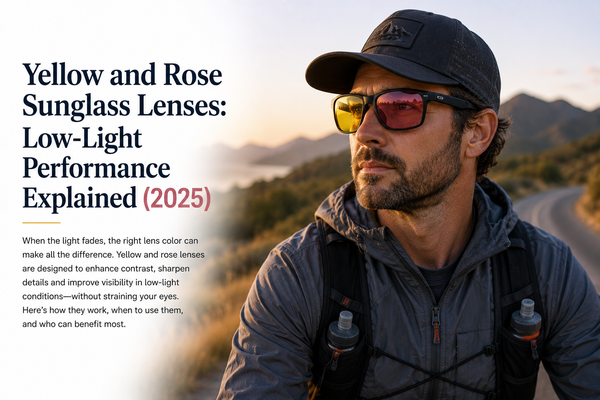

Yellow and Rose Sunglass Lenses: Low-Light Performance Explained
Yellow and rose are the most misused lens colors in the sunglass market. Yellow lenses are sold as night driving aids, as general sport enhancement, as fashion accessories, and as ski goggles — with wildly different claims about what they do. Rose lenses appear in fashion frames, in ski goggles, and in specialist clinical tints for migraine management. Neither is what most people think it is.
This guide covers the actual science: what yellow and rose lenses do to light, which activities they genuinely serve, what the research on yellow night driving glasses really says, and the FL-41 clinical rose tint that has documented evidence behind it. Yellow and rose are not everyday lenses. They are specialist tints with specific performance windows — and specific contexts where they are the wrong choice.
This is a C18 Lens Color Deep Dives supporting post. It links back to the cluster pillar atthe complete sunglass lens color guide. For the everyday lens color guide, seegray sunglass lenses: why neutral is the smartest everyday choice.
Quick Answer
Yellow lenses aggressively filter blue light, providing maximum contrast enhancement in flat, low-contrast, and overcast conditions. They are the correct choice for clay target shooting, flat-light skiing, and some indoor sport contexts. They are not an effective night driving aid — research consistently shows yellow night driving glasses do not improve nighttime driving performance. Rose and pink lenses filter green and blue-green wavelengths with a warmer aesthetic, providing moderate low-light contrast enhancement and serving as the base for FL-41, a clinically validated tint for migraine and photophobia management.

Table of Contents
Part 1: How Yellow Lenses Filter Light
Yellow lenses absorb blue wavelengths aggressively — more so than amber or brown. The blue absorption range extends from approximately 400nm to 500nm, with yellow lenses absorbing a higher proportion of this range than amber tints. The transmitted light is heavily weighted toward the longer wavelengths — green, yellow, orange, and red — producing the characteristic strong yellow-gold appearance of the transmitted image.
Because blue light is the component most responsible for atmospheric scatter, yellow’s aggressive blue filtering produces the maximum contrast enhancement of any common sunglass tint in conditions where scatter is the primary visual quality problem. In bright daylight, this blue scatter is a minor proportion of the overall light level and yellow’s filtering is less visually significant. In flat overcast, low light, or artificial indoor light where the proportion of blue-scattered light is higher relative to total light, yellow’s filtering effect is most pronounced.
Yellow lenses typically operate at Category 0 or Category 1 darkness (80–100% or 43–80% visible light transmission). This is the lightest end of the sunglass spectrum. Yellow is a contrast-enhancement tint, not a brightness-reduction tint. It maximizes the blue absorption effect while minimizing overall light reduction — keeping the visual scene as bright as possible while removing the specific wavelength component that reduces contrast.
Part 2: The Visual Experience Through Yellow
Through a yellow lens, the world appears with a strong warm, golden-yellow cast and a marked improvement in perceived contrast in flat or overcast conditions. Objects stand out more distinctly from their backgrounds. Edges appear sharper. The overall scene appears more vivid and defined than in unfiltered flat light.
In bright daylight, the yellow cast is strong enough to be disorienting. Colors are significantly altered. The sky appears greenish-yellow rather than blue. Green vegetation appears more saturated but differently colored. The visual scene, while high-contrast, does not look natural. This is why yellow is a specialist tint rather than an everyday one — its strong color alteration and light category (typically Cat 0–1) make it inappropriate for the general outdoor conditions that gray, amber, and green serve.
In its target conditions — flat overcast, low light, indoor sport — the yellow visual experience is genuinely useful. The contrast improvement in a flat-light clay shooting environment, where orange clay targets travel against an overcast gray sky, is dramatic and practically significant. The same effect in flat-light ski terrain provides terrain definition that gray and amber produce less effectively.
Part 3: Where Yellow Genuinely Performs
Clay Target Shooting
Yellow is the established, standard tint for clay target shooting. Orange clay pigeons against an overcast gray or pale sky provide a low-contrast target that is difficult to track without tint enhancement. Yellow’s aggressive blue filtering makes the orange clay appear vivid and distinct against the blue-filtered sky background. The contrast improvement in this specific scenario is dramatic and practically significant — many competitive clay shooters report meaningfully better target acquisition times with yellow lenses versus gray or amber.
Flat-Light Skiing and Snowboarding
Flat-light skiing — overcast conditions where the absence of strong shadows eliminates the natural depth cues of terrain — is one of the most challenging visual conditions in winter sport. Slope features become invisible. Moguls blend into flat terrain. Icy patches cannot be distinguished from snow. Yellow goggle lenses (and their milder variant, rose) address this by filtering the blue component of the diffuse flat light, creating the impression of depth and surface definition where the eye cannot find it in natural contrast.
Indoor Racquet Sports
Indoor racquet sports under artificial lighting — squash, indoor tennis, indoor padel — involve artificial light spectra that often have a high blue component. Yellow lenses filter this blue component, enhancing ball contrast against court and wall surfaces. Some indoor sport facilities use yellow as standard for player eye protection precisely for this reason.
Shooting Ranges and Target Sports
Beyond clay shooting, yellow is used across rifle and pistol target shooting, archery, and precision sports where target visibility against variable backgrounds is the primary visual challenge. The maximum contrast enhancement of yellow addresses the specific visual task of target acquisition against low-contrast backgrounds.
Part 4: The Night Driving Yellow Lens Myth — What the Research Actually Says
Yellow “night driving glasses” are one of the most widely sold sunglass products with the least scientific support for their primary claimed benefit. The marketing claim: yellow lenses improve visibility in low-light and nighttime driving conditions. The research finding: they do not.
The Physiology of Night Vision
Night and low-light vision operates primarily through rod photoreceptors, which are maximally sensitive to wavelengths around 498nm (blue-green). Yellow lenses absorb blue and blue-green wavelengths — the precise wavelengths that rod photoreceptors use most efficiently in low light. By reducing these wavelengths, yellow lenses reduce the efficiency of the primary low-light vision system.
What the Research Found
Multiple independent studies on yellow night driving glasses have found that they do not improve night driving performance and may impair it. A 2019 study by Hwang et al. in JAMA Ophthalmology found that yellow-tinted night driving glasses did not improve hazard detection in nighttime driving simulations compared to control conditions. The study concluded that these glasses provide no clinically meaningful benefit for nighttime driving. Earlier work by Wood and colleagues reached similar conclusions — yellow lenses reduce total light transmission in conditions where the visual system is already light-limited, which is the opposite of what night driving requires.
Why the Myth Persists
The subjective experience of wearing yellow glasses at night can feel like improved visibility because the warm color cast creates a sense of visual comfort and the contrast enhancement (relative to the blue-filtered dark scene) can feel like clarity improvement. This subjective impression does not correspond to objective hazard detection performance improvement. The feeling is not the function.
The Correct Advice
Do not wear any sunglasses for night driving. Do not use yellow “night driving glasses”. If glare from oncoming headlights is the specific concern, anti-reflective coating on prescription glasses addresses the optical source of glare. The complete guide to this topic is at
are yellow glasses for night driving actually safe? the truth.
Part 5: Yellow in Bright Outdoor Conditions
Yellow lenses are not appropriate for bright outdoor conditions. At Category 0–1, they provide insufficient brightness reduction for daylight sun, overexposing the eye to the high ambient light levels of sunny outdoor environments. The contrast enhancement yellow provides is most valuable in low-contrast conditions, not in bright conditions where natural contrast is already high from strong shadows.
Wearing Category 1 yellow lenses in full summer sun is equivalent to wearing a very light tint in conditions that require Category 2–3. The UV protection (if the lens is UV400 polycarbonate) remains intact, but the visual management of bright light is inadequate. Yellow is a specialty tint for specific low-contrast performance scenarios, not a general-purpose bright outdoor lens.
Part 6: How Rose and Pink Lenses Filter Light
Rose and pink lenses absorb green and blue-green wavelengths (approximately 500–570nm) more than blue or red, producing a warm pink-rose appearance of the transmitted image. The absorption profile is different from yellow — where yellow primarily filters short-wavelength blue, rose filters the mid-range green component while allowing both blue and warm wavelengths through.
The visual consequence: rose reduces the green-dominant component of daylight that is associated with the high-energy visible (HEV) blue-green light range, while maintaining a warmer and often more aesthetically pleasant visual quality than yellow. Rose is gentler than yellow — its contrast enhancement is moderate rather than maximum, and its color shift is warmer and less disorienting.
Rose lenses typically appear at Category 0–1, similar to yellow. They are light-transmission lenses for variable or low-light conditions, not brightness-reduction lenses for bright outdoor use. Rose in a darker Category 2–3 version would simply be a tinted lens with a pink aesthetic — the functional low-light benefit of rose is associated with its light transmission level, not its color shift alone.
Part 7: The Visual Experience Through Rose
Through a rose or pink lens, the world appears with a warm, pleasant color cast that most wearers find aesthetically agreeable. The scene has moderate contrast enhancement compared to a clear or gray lens in the same conditions — not as dramatic as yellow, but warmer and more naturally pleasing. Edges are slightly more defined. Objects have a slightly richer appearance. The overall visual quality has a lift from the flat, blue-dominated quality of overcast or indoor lighting.
Rose is also notably comfortable for extended wear in variable conditions. Its color cast is perceived as warmer and more natural than yellow’s strong golden quality, making transitions between outdoor and indoor environments perceptually smoother. Some wearers describe rose as making overcast conditions feel more like pleasant shade rather than dull flatness — a subjective improvement in the visual experience of low-contrast light that has a genuine optical basis.
Part 8: Where Rose Genuinely Performs
Moderate Overcast Outdoor Conditions
For overcast conditions where yellow’s maximum contrast enhancement is more than needed, rose provides a moderate contrast improvement with a more natural color rendering. Morning hiking in overcast conditions, variable autumn outdoor sport, and transitional conditions between cloudy and clearing benefit from rose’s lighter touch.
Flat-Light Skiing (Moderate Conditions)
Rose goggle lenses are the standard recommendation for moderate flat-light ski conditions where yellow would be too aggressive and gray insufficient. The moderate overcast ski day — not perfectly flat light but not bright sun either — is the specific rose performance window.
Indoor and Artificial Light Environments
Some indoor sport applications prefer rose over yellow for its more natural color rendering. Gym environments, indoor fitness classes, and indoor court sports where yellow’s strong cast is too disorienting for casual participants often use rose as the more moderate alternative.
Part 9: FL-41 — The Clinical Rose Tint
FL-41 is a specific rose-derived spectral filter developed for clinical use in photophobia — abnormal light sensitivity — particularly in migraine management. FL-41 is not simply a rose or pink tint. It is a precisely specified filter that absorbs wavelengths in the 480–520nm range (blue-green) that research has identified as most activating for the non-image-forming photoreceptors (intrinsically photosensitive retinal ganglion cells, or ipRGCs) involved in migraine light sensitivity.
The Research Behind FL-41
Research from the University of Utah by Katz and Digre, and subsequent work by Wilkins and colleagues, found that FL-41 tinted lenses reduced the frequency and intensity of light-triggered migraine attacks in clinical populations with photophobia-associated migraine. The specific wavelength range targeted by FL-41 corresponds to the peak sensitivity of melanopsin-containing ipRGCs, which are the primary mediators of light-induced pain in migraine.
FL-41 vs Standard Rose
FL-41 is not the same as a standard rose or pink tint. A rose-tinted fashion lens does not provide the specific spectral filtering that FL-41 provides. FL-41 has a precisely defined absorption curve optimized around the 480–520nm migraine wavelength window. Standard rose lenses filter a broader green range with less specificity to this window. For migraine management, FL-41 specifically is the clinically validated intervention, not generic rose.
How to Access FL-41
FL-41 lenses are available through optometrists and neuro-ophthalmologists who specialize in headache and photophobia management. They are available in prescription and some non-prescription forms. The clinical discussion with a neurologist or headache specialist is the appropriate starting point for anyone with significant migraine-associated photophobia considering FL-41.
The complete guide to hormonal light sensitivity and FL-41 is insunglasses and light sensitivity in women: the hormonal connection.
Part 10: Rose as a Fashion Tint
Apart from its clinical and sport applications, rose and pink are significant fashion tints with a long heritage in sunglasses aesthetics. Light rose tints at Category 0–1 provide a flattering, warm color quality to the visual scene and a distinctively attractive lens appearance that has cycled in and out of mainstream fashion since the 1960s.
For fashion-led sunglass buyers who want a light tint that is more interesting than clear but subtler than amber, rose provides an aesthetically pleasing option. The functional benefit — moderate contrast enhancement in overcast conditions — is a secondary consideration. The primary appeal is the warm, distinctive visual quality and the lens appearance.
Rose fashion lenses should still be UV400 polycarbonate to provide the UV protection that any sunglass lens should deliver regardless of tint. A light rose tint at Category 0–1 with UV400 certification provides the fashion aesthetic plus complete UV protection. Without UV400 certification, a light rose tint is a fashion accessory with no UV protection — and the very light tint means the pupil is not significantly contracted, allowing more UV to reach the retina.
Part 11: Comparison Table — Yellow vs Rose
|
Property |
Yellow |
Rose / Pink |
|
Primary wavelength absorbed |
Blue (400–500nm) — aggressive |
Green and blue-green (500–570nm) |
|
Color of transmitted light |
Strong warm yellow-gold |
Warm pink-rose |
|
Contrast enhancement |
Maximum — most aggressive |
Moderate |
|
Typical lens category |
Cat 0–1 (very light) |
Cat 0–1 (very light) |
|
Flat-light performance |
Excellent — the best flat-light tint |
Good — moderate flat-light improvement |
|
Color accuracy |
Strongly altered |
Altered — warm pink cast |
|
Extended wear comfort |
Variable — strong color shift |
Good — warm and often pleasing |
|
Night driving |
Not effective — research-refuted |
Not appropriate |
|
Best specific use |
Clay shooting; extreme flat-light ski |
Moderate overcast ski; FL-41 clinical; fashion |
|
Clinical application |
None established |
FL-41 for migraine photophobia (specific formulation) |
Part 12: Yellow and Rose vs the Everyday Tints
|
Tint |
Everyday Outdoor |
Bright Sun |
Overcast/Low Light |
Driving |
Night Use |
|
Gray |
Excellent |
Excellent |
Good |
Best |
Never |
|
Amber |
Very good |
Very good |
Excellent |
Acceptable (rural) |
Never |
|
Green |
Very good |
Good |
Good |
Acceptable |
Never |
|
Yellow |
Not appropriate |
Not appropriate |
Excellent (specialist) |
Not appropriate |
Not effective |
|
Rose |
Not appropriate |
Not appropriate |
Good (moderate) |
Not appropriate |
Not appropriate |
✨ NAVI EYEWEAR — UV400 POLARIZED FOR EVERY OUTDOOR CONDITION.Gray polarized for driving and everyday. Amber polarized for outdoor sport and beach. UV400 polycarbonate. Polarized. Oleophobic and anti-saltwater coating. TR90. Stainless hinges. Buy 1, Get Any 3 Pairs Free — $119 for four pairs (~$30 each). Free shipping. Free replacements. |
Part 13: Best For
Yellow Lenses — Best For:
Rose Lenses — Best For:
Part 14: Common Mistakes
Bottom Line
Yellow and rose are specialist lenses with well-defined performance windows. Yellow provides maximum contrast enhancement in flat, low-contrast, and overcast conditions — clay shooting, flat-light skiing, indoor sport. Rose provides moderate contrast enhancement with a warmer, more aesthetically pleasing quality — moderate overcast ski conditions, indoor fitness, FL-41 clinical use for migraine photophobia. Neither is an everyday outdoor lens. Neither is effective for night driving.
For everyday outdoor use, gray and amber cover the full range. Yellow and rose are additions to a rotation for users with specific low-light or clinical needs, not replacements for the everyday specification. If you are buying sunglasses for general outdoor use and are considering yellow or rose: choose gray for driving and everyday, amber for outdoor sport, and add yellow or rose only if a specific low-light or clinical application drives the need.
Browse UV400 polarized options atnavieyewear.com/collections/polarized. Add 4 pairs — Buy 1, Get Any 3 Free auto-applies. Free shipping. Free replacements.
Frequently Asked Questions
What do yellow sunglass lenses do?
Yellow lenses aggressively absorb blue wavelengths (400–500nm), filtering the scattered blue light that reduces contrast in flat and overcast outdoor conditions. The visual result is maximum contrast enhancement with a strong warm yellow-gold color cast. Yellow works best in low-contrast conditions — overcast outdoor sport, clay shooting, flat-light skiing — where the blue scatter is the primary visual quality problem. Yellow is not appropriate for bright outdoor conditions or night driving.
Do yellow glasses actually help at night?
No. Research consistently shows yellow night driving glasses do not improve nighttime driving performance and may reduce it. Night vision relies on rod photoreceptors sensitive to blue-green wavelengths — the precise wavelengths yellow lenses absorb. A 2019 JAMA Ophthalmology study found no meaningful benefit for hazard detection in nighttime driving simulations. Do not wear any tinted lenses for night driving.
What are rose or pink sunglass lenses for?
Rose lenses filter green and blue-green wavelengths to provide moderate contrast enhancement with a warm, pleasant color cast. They serve moderate overcast outdoor conditions, flat-light ski days, and indoor sport applications where yellow’s maximum contrast is too extreme. Rose is also the basis for FL-41, a clinically validated tint for migraine and photophobia management. And rose appears as a fashion tint in light-category lenses for its warm, attractive visual quality.
What is FL-41 and does it help with migraines?
FL-41 is a precisely specified rose-derived spectral filter that absorbs the 480–520nm blue-green wavelengths identified as most activating for migraine photoreceptors. Research from the University of Utah and other institutions found that FL-41 lenses reduced migraine frequency and intensity in clinical populations with photophobia-associated migraine. FL-41 is not the same as a standard rose fashion tint — it requires a precise spectral formulation. Available through optometrists and neuro-ophthalmologists specializing in headache management.
When should I use yellow lenses instead of amber?
When the lighting conditions are so flat and low-contrast that amber’s contrast enhancement is insufficient. Clay target shooting against an overcast sky and extreme flat-light skiing where terrain definition is completely lost are the primary use cases. For standard overcast outdoor sport — hiking, golf, running in variable weather — amber provides meaningful contrast enhancement without yellow’s strong color alteration and insufficient brightness for outdoor use.
Can yellow lenses be UV400?
Yes. UV400 protection is determined by the lens material, completely independently of tint color. A yellow UV400 polycarbonate lens provides complete UV protection. The category (Cat 0–1 for yellow) means it provides minimal brightness reduction, but the UV protection is complete. For clay shooting outdoors, even a very light yellow UV400 lens provides important UV protection during sustained outdoor exposure.
Are rose lenses good for driving?
Not recommended. Rose lenses typically appear at Category 0–1, providing minimal brightness reduction and altered color perception. They are not appropriate for driving in any conditions where brightness management or color accuracy is needed. Gray polarized UV400 at Category 2 is the correct driving specification.
What is the difference between yellow and amber sunglasses?
Both filter blue light for contrast enhancement, but yellow filters more aggressively. Amber operates in the Cat 2–3 range and is appropriate for everyday outdoor use in variable and bright conditions. Yellow operates in Cat 0–1 and is specifically for low-light, overcast, and specialist contrast scenarios. The color shift is stronger in yellow (more golden) than amber (warmer orange). Amber is the all-rounder outdoor sport tint; yellow is the specialist low-light maximum-contrast tint.
Supporting Articles
THE RIGHT LENS FOR THE RIGHT LIGHT.Gray and amber cover everyday outdoor and sport. Yellow and rose for specialist low-light applications. UV400 polycarbonate. Polarized. Oleophobic and anti-saltwater coating. TR90. Stainless hinges. Buy 1, Get Any 3 Pairs Free — $119 for four pairs. Free shipping. Free replacements. |
SOURCES & CITATIONS[1] Hwang Y, Kim J, Kim BJ, et al..“Effects of night-driving glasses on simulated nighttime driving performance.”JAMA Ophthalmology, 2019.View source [2] Wood JM, Tyrrell RA, Carberry TP.“Limitations in drivers’ ability to recognize pedestrians at night.”Human Factors, 2005.View source [3] Katz BJ, Digre KB.“Diagnosis, pathophysiology, and treatment of photophobia.”Survey of Ophthalmology, 2016.View source [4] Wilkins AJ, Sihra N, Myers A.“How precise do spectral filters for headache need to be?.”Ophthalmic and Physiological Optics, 2005.View source [5] Dain SJ.“Sunglasses and sunglass standards.”Clinical and Experimental Optometry, 2003.View source [6] American Academy of Ophthalmology.“Sunglasses: choosing the right pair for UV protection.”AAO EyeSmart, 2023.View source |