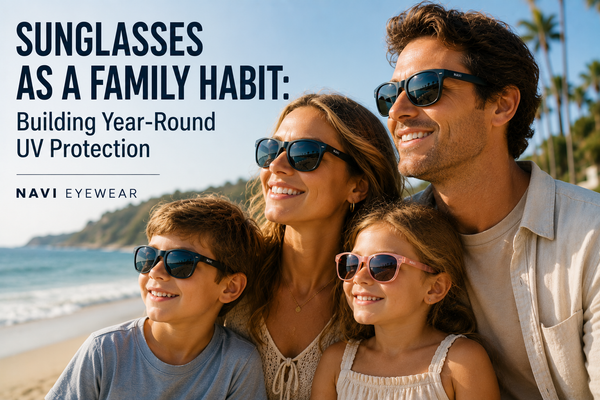

QUICK ANSWERThe most durable sun protection habits aren't built through repeated reminders — they're built through family culture, consistent adult modeling, and routine design that makes UV protection automatic rather than effortful. A family that wears sunglasses together, as a shared outdoor norm, produces children who wear them independently into adulthood. This guide covers the behavioral architecture of making that happen year-round, across all conditions and all ages. |

Sun protection advice tends to focus on what to buy and when to apply it. What it less often addresses is the harder question: how do you make UV protection a genuine, consistent, year-round family behavior rather than a summer reminder that fades by September? The gap between knowing UV protection matters and doing it reliably — across all seasons, all family members, all outdoor contexts — is a behavior design problem, not an information problem.
The families who do this well share a common structure: UV protection is woven into outdoor preparation as a non-negotiable routine, modeled consistently by adults, and adapted to the specific preferences and activities of each family member. This guide covers how to build that structure. For the UV science behind why it matters, see theUV Protection for Children: Complete Family Eye Health Guide. For age-specific compliance strategies, seeteaching kids to wear sunglasses.
1. Why Family Culture Is the Most Powerful UV Protection Tool
The Modeling Effect: What Children Observe vs What They're Told
Behavioral research on children's health habits consistently finds that parental modeling is a stronger driver of child behavior than verbal instruction. Children observe what adults around them actually do and calibrate their own behavior norms accordingly. When the adults in a household consistently reach for sunglasses when heading outdoors — without drama, without discussion, simply as a normal part of going outside — children absorb this as the behavioral norm.
The mechanism here is social norm formation. Children are not primarily reasoning about the health consequences of UV exposure when they decide whether to wear sunglasses. They are reading the social environment: what do the people around me do? When the answer is 'they all put sunglasses on when we go outside,' the compliance question becomes much simpler than when the answer is 'my parents tell me to wear them but don't always wear them themselves.'
→ Parental sun protection modeling and child behavior — PubMed
Family Culture vs Individual Compliance
The distinction between a family culture of sun protection and individual compliance enforcement matters practically. Compliance enforcement — reminding, insisting, monitoring — places the daily friction of UV protection into the relationship between parent and child, creates resistance patterns, and depends on parental attention and energy that is not always available. Family culture — shared norms, consistent modeling, routine integration — operates without that friction because it doesn't require a daily decision.
The goal is 'this is what our family does' rather than 'this is what I'm making you do.' The practical difference: the former is self-sustaining once established; the latter requires daily maintenance and creates adolescent resistance as children seek independence from parental enforcement.
The Long Game: Habits That Last Beyond Childhood
The UV protection habits formed in childhood are the strongest predictor of adult sun protection behavior. Adults who wore sunglasses consistently in childhood continue to do so as a default behavior. Adults who did not are more likely to treat sunglasses as a situational accessory rather than a consistent protective behavior. The investment in building a genuine family habit of UV protection pays out not just in reduced childhood UV accumulation but in the adult behaviors of the children who internalize it.
2. The Behavioral Architecture of a Durable Habit
Trigger-Based Habits: Removing the Decision
The most durable habits are those triggered by environmental cues rather than requiring conscious decision-making. 'Sunglasses go on when we go outside' is a trigger-based habit: the act of going outside automatically cues the sunglasses behavior. 'Sunglasses go on when it's sunny' is a judgment-based habit that requires weather assessment and a decision — two cognitive steps that introduce friction and inconsistency.
Trigger-based framing matters particularly in morning-routine contexts when cognitive load is high and any added decision is likely to be dropped. 'Shoes, sunglasses, out the door' as a fixed sequence removes the sunglasses decision entirely. This is how the most effective family sun protection routines work.
Physical Environment Design
Where sunglasses are stored determines how reliably they are used. Key environmental design principles:
Navi Eyewear's Buy 1, Get 3 Free offer —$119 for 4 pairs of UV400 polarized sunglasses — is specifically structured for this multi-location strategy. Four pairs means one for the car, one in the school/sport bag, one at home, and one spare — the environmental design that makes consistent wearing practically frictionless.
Reducing Barrier Points
Every point of friction in a routine reduces reliability. Common barrier points in family UV protection and how to address them:
|
Barrier |
Why It Reduces Compliance |
Solution |
|
Can't find sunglasses |
Disrupts flow, often results in leaving without them |
One fixed location per person, near exit |
|
Only one pair per person |
Lost or forgotten pair = no protection |
Multiple pairs in different locations |
|
Wrong frames for activity |
Discomfort or performance issues trigger removal |
Activity-matched frames: sport, everyday, driving |
|
Seasonal thinking ('summer only') |
UV is year-round; habit gaps in winter break the routine |
Year-round trigger: outdoors = sunglasses, regardless of season |
|
Parents not modeling |
Children adopt the observed norm, not the stated rule |
Adults wear consistently — this is the most effective investment |
|
Compliance battles with toddlers |
Creates negative association, increases resistance |
Elastic-strap frames + shade backup + avoid power struggles |
3. Year-Round UV Protection: The Seasonal Misconception
Why the 'Summer Sunglasses' Mindset Breaks the Habit
The most common structural failure in family sun protection is seasonal thinking — treating UV protection as a summer behavior and dropping it in fall and winter. This framing is incorrect scientifically and counterproductive behaviorally. Scientifically, UV radiation is present year-round — clouds transmit approximately 80% of UV, and winter UV index in most US locations is still meaningful. Behaviorally, seasonal habits are weaker habits: a behavior performed only in defined circumstances never reaches the automatic, contextual-trigger level that makes it truly routine.
The family that wears sunglasses only in summer needs to rebuild the habit each spring and loses several months of UV protection each year. The family that treats 'outdoors = sunglasses' as a year-round norm has a habit that never needs to be reestablished. For the complete seasonal UV guide, seeseasonal sunglasses and UV risk.
High-UV Seasons and Contexts to Build Around
While UV protection should be year-round, certain seasonal and situational UV peaks are the highest-stakes moments to prioritize:
The Weather Misconception: Overcast Days Still Have UV
Overcast and cloudy days account for a significant proportion of annual UV exposure simply because they're common. Clouds transmit approximately 80% of UV radiation — the bright overcast conditions of a gray day in spring or fall still carry meaningful UV risk. The 'it's cloudy, I don't need sunglasses' reasoning is responsible for a significant proportion of preventable UV accumulation across a lifetime. For the full guide on this, seeovercast and cloudy day UV protection.
NAVI EYEWEAR — UV400 POLARIZED SUNGLASSESBuy 1, Get Any 3 Pairs Free — $119.00 for 4 pairs. Discount auto-applies at cart. Free shipping. Free replacements. 30-day return on unworn pairs. Every lens: UV400 certified polycarbonate · FDA-cleared impact resistance · polarized PVA film · oleophobic coating · anti-saltwater coating · TR90 nylon frames · stainless 5-barrel hinges. |
4. Building the Routine by Family Context
Families With Young Children (0–7 Years)
The outdoor preparation sequence is the primary implementation vehicle for this age group. Physical environment design matters most — sunglasses stored with outdoor gear, at child-accessible height, in a fixed location. Elastic-strap frames for under-3 remove the compliance complexity that standard frames create. The adult models simultaneously; this is the most powerful single action available.
The expectation is 'we all put our sunglasses on when we go outside' — said and demonstrated, not just said. When a toddler refuses, shade strategies fill the gap without making the refusal into a confrontation. The routine attempt is what builds the habit, not 100% compliance on every outing.
Families With School-Age Children (8–12 Years)
School-age children are capable of understanding and embracing the UV protection rationale when it's explained simply and connected to things they care about. 'Protecting your eyes' is abstract; 'polarized lenses make it easier to see the ball in the sun during soccer' is concrete and immediately relevant. Sport contexts are the easiest habit-building entry point for this age group.
Out-of-home independence is the challenge — school, sport, and after-school activities where parents aren't present. The solution is a combination of habit established at home (so it generalizes) and physical access (frames in the school bag or sport bag so they're available when needed). Communicating with coaches about sun protection normalizes it within the team culture that school-age children respond to.
Families With Teenagers
Teenagers respond to autonomy and identity rather than parental instruction. The family culture approach works well here — a teenager who has grown up with sunglasses as a consistent family norm is significantly more likely to continue as an independent adult than one for whom it was always a parental enforcement issue. For teenagers who are new to the habit, the strategy is style autonomy within the UV400 requirement and performance framing for athletes. See the dedicated guide tosunglasses for teens for full implementation guidance.
Multi-Age Families
Families with children across a wide age range have an additional compliance resource: older siblings. Children who see older siblings or teenage family members wearing sunglasses consistently receive a peer-age modeling input that is, for many younger children, more influential than parental modeling alone. A family culture where sunglasses wearing is consistent across all ages — including teenagers and young adults — creates a layered modeling environment that is particularly effective for younger children.
5. Activity-Matching: The Habit That Generalizes
Why Activity-Specific Frames Improve Habit Strength
A common reason sun protection habits break down is the mismatch between a single pair of sunglasses and the full range of contexts a family navigates. A pair of fashion frames that is perfect for a casual weekend walk is uncomfortable for a soccer practice; a pair of sport wraparounds feels out of place on a casual errand. When the sunglasses don't fit the context, the habit of wearing them in that context breaks.
Activity-matched eyewear — having frames appropriate for everyday use, outdoor sport, driving, and beach/water contexts — builds habit generalization. When every outdoor context has an appropriate pair, the 'outdoors = sunglasses' norm extends naturally across contexts rather than being limited to the situations where one pair happens to be comfortable.
The Family Activity Audit
A practical approach to identifying activity-matching needs: audit the outdoor contexts your family regularly encounters across the year, then map the UV protection gaps:
6. The Adults-First Principle
Everything in family UV protection habit formation comes back to adult behavior first. The sequence is:
The first item on this list is the prerequisite for all the others. A parent who is genuinely committed to their own consistent UV protection wearing — not just enforcing children's compliance — is the most effective UV protection intervention available for a family.
For adults looking for quality UV400 polarized sunglasses they'll actually wear consistently — the foundation of family UV culture — Navi Eyewear'spolarized collection offers UV400 certified polycarbonate polarized lenses with the Buy 1, Get 3 Free offer ($119 for 4 pairs) that makes equipping multiple contexts and having backups practical.
✓ Family UV Protection Habit Checklist☐ Adults wear UV400 polarized sunglasses consistently outdoors — simultaneously with children ☐ Sunglasses stored near the exit point for all family members, at accessible heights ☐ Year-round habit established — 'outdoors = sunglasses' regardless of season or weather ☐ Toddler and infant frames: elastic strap retention, UV400 polycarbonate, correctly sized ☐ School-age children have frames in their school bag for independent wearing ☐ Activity-matched frames for sport, everyday, driving, and beach/water contexts ☐ Family language: 'we all wear sunglasses outside' — shared norm, not individual enforcement ☐ Teenagers have style-appropriate UV400 frames they choose themselves ☐ Replacement pairs available — multiple pairs per person removes the 'lost my only pair' gap ☐ Year-round: winter and overcast day wearing is part of the routine, not an exception |
Frequently Asked Questions
How do I get the whole family on board with year-round sunglasses?
Start with your own consistent wearing — the modeling effect is stronger than any conversation or rule. Make it a household norm ('we all put sunglasses on when we go outside') rather than a child compliance issue. Set up the physical environment so wearing is low-friction: sunglasses near the exit, at accessible heights, one per person per regular bag or location. Let each family member choose their own frames within the UV400 polycarbonate requirement. The habit builds faster when people wear frames they chose than frames they were handed.
What's the easiest way to make sunglasses part of the morning routine?
Add them to the existing outdoor preparation trigger sequence — the same moment you reach for keys, shoes, or a bag. 'Shoes, sunglasses, done' is a two-item trigger chain that becomes automatic faster than any separate reminder. Store sunglasses in the same location as whatever is already part of the leaving-the-house sequence. Physical proximity to an existing habit trigger is the most effective habit-stacking mechanism.
My kids only want to wear sunglasses at the beach. How do I extend the habit?
The beach habit is a strong foundation — the sensory experience of bright sun, reflected glare, and visual relief from polarized lenses creates a genuine preference that can generalize. The extension strategy is connecting other high-UV contexts to the same experience: 'same UV as the beach' for ski slopes, outdoor sport in peak summer, and sunny drives is a factual and concrete connection. Activity-matched frames for non-beach contexts also help — a pair that is comfortable and appropriate for everyday use makes wearing in that context feel as natural as at the beach.
Should we have dedicated sunglasses for each activity or can one pair do everything?
One well-chosen pair can serve multiple contexts adequately, but activity-matched pairs serve each context better. The practical tradeoff: a single pair of gray polarized UV400 in a comfortable everyday frame provides meaningful protection in all contexts. A pair each of gray (everyday/driving) and amber or brown (sport) serves most families' outdoor activity range well. Beach and water contexts benefit from copper polarized for sub-surface visibility; ski contexts warrant Cat 3 darker lenses. The minimum for a family with active outdoor sport is two categories: everyday/driving and sport-specific.
How do I handle different compliance levels between siblings?
Different children at different developmental stages will have different compliance levels, and this is normal. The goal is a family norm that operates regardless of individual compliance on any given day — 'we all wear sunglasses outside' remains the expectation even when a toddler refuses today. Older siblings who comply are doing the most effective compliance work for younger children: sibling peer modeling is powerful. Don't let the harder compliance case in one child lower the standard for the others — hold the norm consistently, use shade strategies when compliance fails, and don't make it a family conflict.
What if grandparents or other caregivers don't prioritize UV protection?
Communicate the priority clearly and practically: frame it as a safety requirement rather than a preference ('our kids need to wear UV400 sunglasses when they're outside — here are their frames'). Provide the frames so the barrier is removed. Brief, matter-of-fact explanation of the UV risk for children's eyes — specifically that their eyes transmit more UV than adults' — tends to land better than general sun safety messaging, which most adults have heard and partially tuned out. Most caregivers who understand the specific pediatric UV vulnerability take the requirement seriously once it's explained.
How does family UV protection extend to other sun safety behaviors?
Sunglasses habit, sunscreen habit, hat habit, and shade-seeking behavior tend to generalize together when they're established as a unified 'outdoor preparation' routine rather than separate individual behaviors. A family that has 'outdoor preparation' as a category of behavior — checking and applying UV protection before going out — tends to execute all components more consistently than one that manages each behavior separately. UV protection for the eyes throughquality UV400 polarized sunglasses is one element of that broader routine; it belongs in the same mental and physical space as sunscreen application and hat selection.
What UV protection do adults in the family need?
The same baseline as children: UV400 certified polycarbonate polarized lenses. Adults have more developed natural UV filtering in the crystalline lens but still accumulate UV damage over time — cataracts, macular degeneration, pterygium, and periocular skin damage are all significantly UV-linked and all accumulate across the adult lifespan. For adults, the primary recommendation is consistent wearing of UV400 polarized in all outdoor contexts year-round.Navi Eyewear's polarized collection — Buy 1, Get 3 Free for $119 — provides four pairs of UV400 certified polycarbonate polarized lenses for the adults in the family who need to model consistent wearing.
The Bottom Line
A family UV protection habit is built from the outside in — physical environment first, adult modeling second, child-facing strategies third. The habit that is most likely to last is one embedded in a shared family outdoor routine, modeled consistently by adults, and supported by correct frame design for each age and activity. It starts with adults committing to their own consistent UV400 wearing, and extends naturally from there. For quality UV400 polarized sunglasses for every member of the family:navieyewear.com/collections/polarized— Buy 1, Get Any 3 Free for $119.
Sources & Citations[1] Stöppler MC, et al.."Pediatric sun protection behaviors and parental modeling."Pediatric Dermatology, 2019.View source → [2] Coroneo MT, et al.."UV radiation and the crystalline lens in children."Archives of Ophthalmology, 2002.View source → [3] WHO."Global solar UV index: a practical guide."World Health Organization, 2002.View source → [4] Dain SJ."Sunglasses and sunglass standards."Clinical and Experimental Optometry, 2003.View source → [5] West SK, et al.."Exposure to sunlight and other risk factors for age-related macular degeneration."Archives of Ophthalmology, 1989.View source → [6] Taylor HR, et al.."Effect of ultraviolet radiation on cataract formation."New England Journal of Medicine, 1988.View source → |