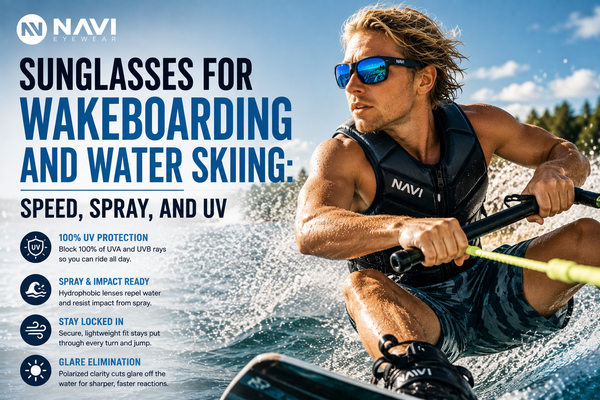

Sunglasses for Wakeboarding and Water Skiing: Speed, Spray, and UV
Wakeboarding and water skiing add a dimension that other paddle and sail sports don't: high speed. At typical tow speeds of 20–35 mph, the airstream across the face is strong enough to lift and remove frames that rely only on nose contact and temple friction. Water spray at tow speed hits the face with enough force to blur vision through non-hydrophobic lenses within seconds. The combination of speed-driven airstream, continuous water spray, saltwater or freshwater exposure, UV from above and water reflection below, and the physical dynamics of falls and boat wake crossings creates the most mechanically demanding frame retention scenario in recreational water sports. This guide covers what actually works. For the complete water sports context, see the complete water sports sunglasses guide.

1. The Tow Sport Environment
Speed as the Defining Factor
The defining environmental difference between tow sports (wakeboarding, water skiing, kneeboarding, wakesurfing) and other water activities is tow speed — typically 18–25 mph for wakeboarding and 26–36 mph for slalom water skiing. At these speeds:
- Airstream force: the wind force on a frame increases with the square of speed — at 25 mph, airstream force on the lens surface is approximately 4x higher than at 12 mph (running pace). Frames that stay on during running or cycling come off during tow sport at speed without grip contacts and strap retention.
- Water spray: spray generated by the boat wake and the rider's own board or ski at speed hits the lens surface continuously. Without hydrophobic coating, this spray sheets across the lens and severely impairs vision within seconds of getting on the water.
- Fall dynamics: falls in wakeboarding and water skiing involve water impact at the tow speed — essentially hitting the water at 20–35 mph. The impact force of a fall at speed dislodges any frame that isn't secured with a retention strap, and the subsequent underwater tumble produces hydrodynamic forces comparable to those in surfing wipeouts.
UV in the Tow Sport Environment
Wakeboarding and water skiing typically take place in lake and reservoir environments (freshwater) or occasionally ocean bays and coastal waterways (saltwater). The UV environment is comparable to other midday outdoor water activities: lake and reservoir surfaces reflect 15–30% of UV, amplifying effective UV above the ambient UV index. Afternoon tow sport sessions — the most common timing for recreational wakeboarding — occur during declining but still significant UV index hours (UV index 5–9 at 2–5pm in summer).
The rider is on the water in an upright or dynamic body position that exposes the face to both overhead UV and forward-angle reflected UV from the water surface in front of them. Consistent UV400 protection during tow sports is as important as during other water activities — the speed of the sport doesn't reduce UV accumulation.
2. Lens Specification for Tow Sports
Copper or Amber Cat 2–3 Polarized UV400 Polycarbonate
The tow sport lens specification:
- Copper polarized for saltwater and coastal lake environments where the reflection is blue-dominated — maximum glare elimination at the water surface ahead of the rider during approach to features and wakes. Amber polarized for inland freshwater lakes and reservoirs where the reflection is more green-brown toned — amber's contrast enhancement for water surface features and terrain is more appropriate than copper's blue-dominant absorption for freshwater environments.
- Cat 2 for variable afternoon light (partly cloudy, late afternoon declining UV) where Cat 3 would be too dark in shade and between-run intervals on the dock. Cat 3 for peak midday sun at open lake or reservoir venues with sustained high UV.
- Polarized: eliminates the water surface glare that impairs reading the water surface ahead for wake features, obstacles, and the boat's path.
- UV400 polycarbonate: complete UV protection, impact resistance for fall scenarios, and the hydrophobic coating performance that polycarbonate substrates support.
Hydrophobic Coating: Critical at Tow Speed
Hydrophobic coating is more critical for tow sports than for any other water activity — the spray velocity at tow speed means the lens surface is hit with water at 20–35 mph repeatedly throughout a run. Without hydrophobic coating, water forms a persistent film on the lens that severely impairs vision mid-run. With quality hydrophobic coating, spray hits the lens and immediately sheets off the edge of the moving lens, maintaining optical clarity throughout the run. This is not a comfort feature for tow sports — it is a functional requirement for maintaining vision during the active riding phase. Browse UV400 polarized options with full coating suite at navieyewear.com.
3. Frame Requirements: Speed-Rated Retention
The Speed Retention Problem
Frame retention at tow speed requires addressing three forces simultaneously: airstream lift (trying to push the frame upward off the nose), lateral airstream pressure (trying to push the frame sideways), and fall-impact forces (the hydrodynamic force of a water entry at speed). No single retention mechanism addresses all three — the solution is a combination of close-fitting frame geometry, aggressive rubber grip contacts, and a retention strap.
Close-Fitting Wraparound Geometry
Frames that sit close to the face and curve around the temporal area reduce the airstream surface area that the lens presents to the oncoming wind — a flat-lens design at 25 mph presents more drag surface and is more prone to airstream lift than a close-fitting curved design. Close-fitting wraparound geometry is the frame design standard for tow sports and other high-speed outdoor activities for this aerodynamic reason in addition to the UV coverage reason.
Rubber Grip Contacts and Temple Tips
Rubber nose contacts and rubber temple tips that grip the skin provide the primary retention mechanism during normal riding. At tow speed, rubber contacts compressed against the nasal bridge by the airstream actually increase their grip somewhat — the airstream presses the frame into the face, and the rubber contacts grip more tightly under this pressure. This is the mechanism that makes close-fitting rubber-contact frames adequate for some tow sport riders without a full retention strap for normal falls — though a strap adds the security for hard falls and tumbles.
Retention Strap for Falls and Tumbles
A retention strap is the recommended addition for wakeboarding and water skiing falls — particularly hard falls, edge catches, and tumbles in the wake where the frame experiences both the impact of water entry and the subsequent hydrodynamic force of tumbling through the water at speed. A neoprene retention strap adjusted to apply slight tension to the temples keeps the frame in position through most fall scenarios and ensures the frame floats near the head for recovery after underwater tumbles.
For competitive riders who find the strap distracting or who prefer to remove glasses before tricks: rubber grip contacts in a close-fitting frame without the strap is an acceptable compromise for lower-impact riding. The strap matters most for the harder falls of aggressive riding and learning new tricks where edge catches and unexpected falls are frequent.
4. Dock and Between-Run Use
UV on the Dock and in the Boat
Between runs — waiting on the dock, riding in the boat as a spotter or passenger, watching from shore — involves sustained UV exposure in the open lake or reservoir environment with full sky exposure and water reflection. The between-run UV accumulation during a full day of tow sport at a lake adds meaningfully to the total session UV dose, particularly during midday peak UV hours when wait times between runs can be 15–30 minutes per rider in a group session.
The same pair worn during riding covers between-run dock and boat time — copper or amber polarized UV400 is the appropriate specification for both. The dock pair doesn't need a retention strap; the riding pair does. Having a dedicated riding pair (with strap) and a dock/boat pair (without strap, more comfortable for sustained non-riding use) is the approach some dedicated tow sport athletes take for all-day sessions.
Boat Driver's Specification
The boat driver in a tow sport session has a specific use case: sustained forward-facing sun exposure on open water, typically for the full duration of the session as the driver stays in the boat while riders rotate. Gray Cat 2 polarized UV400 for the driver — color-neutral for obstacle and navigation scanning, polarized for water surface glare reduction in the boat's path, Cat 2 for the sustained duration of boat driving that may span the full UV arc from morning to late afternoon. The driver's UV accumulation over a full day of running sets is comparable to other open water occupational activities.
5. Wakesurfing: The Lower-Speed Variant
Different Speed, Same UV Environment
Wakesurfing — riding the boat's wake without a rope, surfing the wave generated behind the boat at lower speeds of 10–14 mph — has lower speed-driven retention demands than slalom skiing and aggressive wakeboarding. At wakesurfing speeds, airstream force is more comparable to running or cycling than to water skiing, and rubber grip contacts in a close-fitting frame without a retention strap are adequate for most riders. The UV environment is the same as other lake and reservoir water sports: copper or amber Cat 2–3 polarized UV400 with hydrophobic coating for the spray from the boat's wake.
6. Recommended Setup by Tow Sport Context
| Context | Tint | Category | Retention | Key Feature |
|---|---|---|---|---|
| Recreational wakeboarding (freshwater) | Amber polarized | Cat 2–3 | Strap recommended | Hydrophobic coating critical |
| Competition wakeboarding | Amber polarized | Cat 2–3 | Strap or max grip contacts | Close-fit wrap; hydrophobic |
| Slalom water skiing | Amber or copper polarized | Cat 2–3 | Strap recommended | Speed-rated grip; hydrophobic |
| Coastal/ocean tow sports | Copper polarized | Cat 3 | Strap required | Anti-saltwater coating; stainless hardware |
| Wakesurfing | Copper or amber polarized | Cat 2 | Grip contacts adequate | Lower speed; hydrophobic coating |
| Boat driver | Gray polarized | Cat 2 | Grip contacts | Color accuracy; sustained session UV |
Frequently Asked Questions
Will regular sunglasses stay on while wakeboarding?
Regular lifestyle sunglasses without rubber grip contacts and a retention strap will come off during falls and often during normal riding at tow speed from airstream lift. Close-fitting sport frames with rubber grip contacts stay on during normal riding at moderate speeds; a retention strap is needed for aggressive riding and falls. The first hard fall without a strap is typically what convinces tow sport riders to add one.
What tint is best for wakeboarding?
Amber polarized for freshwater lake and reservoir wakeboarding — amber's contrast enhancement for water surface features, terrain, and boat wake definition is more appropriate for the green-brown reflection character of freshwater environments than copper. Copper polarized for coastal and ocean tow sport environments where the blue-sky ocean reflection benefits from copper's strong blue absorption.
Do I need special glasses for water skiing or will sport sunglasses work?
UV400 polycarbonate polarized sport sunglasses with hydrophobic coating and rubber grip contacts work for water skiing. The hydrophobic coating is the most functionally critical specification specific to tow sports — spray at 30 mph on a non-hydrophobic lens impairs vision within seconds. A retention strap is added for falls rather than being built into the frame. Most TR90 sport frames accept standard retention straps without modification.
How do I keep spray off my lenses while water skiing?
Hydrophobic coating on the lens surface causes water droplets to bead and sheet off the moving lens at riding speed rather than forming a persistent film. Quality hydrophobic coating on a polycarbonate lens clears water spray effectively during active riding — the spray hits, beads, and is blown off by the airstream. Remaining water is cleared by the lens tilting and airstream between spray events. Without hydrophobic coating, the spray sheets across the lens surface and doesn't clear effectively.
Can I wear prescription glasses under goggles for water skiing?
Some water ski and wakeboard goggles are designed to fit over prescription glasses — OTG (over-the-glasses) goggle designs accommodate standard prescription frame widths within the goggle frame. This is a practical solution for prescription eyeglass wearers who need both vision correction and the full spray and retention protection of a goggle-style design. Non-prescription UV400 polarized sport sunglasses with a retention strap are the standard solution for non-prescription riders.
What about kneeboarding and other tow sports?
Kneeboarding and other tow sports (cable park riding, hydrofoil) have the same general requirements as wakeboarding — UV400 polarized polycarbonate with hydrophobic coating and a retention strap for fall protection. Cable park riding at slower cable speeds reduces the airstream retention demand somewhat but maintains the fall and spray requirements. Hydrofoil riding at speed has similar airstream demands to water skiing and warrants the same close-fit frame with strap approach.
The Bottom Line
Wakeboarding and water skiing add high-speed airstream and spray dynamics to the standard water sport UV challenge — frames without hydrophobic coating impair vision from spray within seconds, and frames without retention straps come off in falls. The specification that works: copper or amber Cat 2–3 polarized UV400 polycarbonate with hydrophobic, anti-saltwater, and oleophobic coatings in a close-fitting TR90 wraparound sport frame with rubber grip contacts and a neoprene retention strap. The same frame covers between-run dock and boat time, providing consistent UV400 coverage for the full session. navieyewear.com/collections/polarized — Buy 1, Get 3 Free for $119.
Related Reading
- The Complete Water Sports Sunglasses Guide | Navi Eyewear
- Sunglasses for Surfing | Navi Eyewear
- Sunglasses for Kayaking and Paddleboarding | Navi Eyewear
- Sunglasses for Sailing and Offshore Racing | Navi Eyewear
- Sunglass Lens Coatings Explained | Navi Eyewear
- How Polarized Sunglasses Work | Navi Eyewear
- Sunglasses for Beach Volleyball | Navi Eyewear
- Shop Polarized UV400 Sunglasses | Navi Eyewear
Sources & Citations
[1] Dain SJ. "Sunglasses and sunglass standards." Clinical and Experimental Optometry, 2003. View source →
[2] WHO. "Global solar UV index: a practical guide." World Health Organization, 2002. View source →
[3] Sliney DH. "Ocular exposure to environmental light and ultraviolet." Journal of AAPOS, 2014. View source →
[4] ISO 12312-1:2013. "Eye and face protection — Sunglasses and related eyewear." International Organization for Standardization. View source →
[5] Hecht E. "Optics." 4th edition. Addison Wesley, 2002. View source →
[6] Taylor HR, et al. "Effect of ultraviolet radiation on cataract formation." New England Journal of Medicine, 1988. View source →