
Sunglasses for Extreme Environments: The Complete Guide
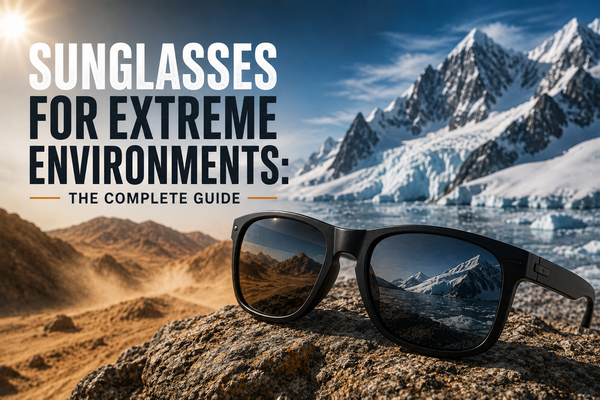
Everyday UV protection — a quality UV400 polarized lens in a durable frame — is adequate for the vast majority of outdoor activities. Extreme environments change the calculation. At high altitude, UV intensity doubles relative to sea level. In the desert, bare reflective terrain adds diffuse UV from below and laterally while temperature extremes stress frame materials beyond their standard operating range. In polar conditions, snow reflection amplifies UV while cold makes frame materials brittle and goggle fogging becomes a safety issue. Offshore at sea, saltwater corrosion systematically attacks every component not specifically engineered to resist it. In industrial outdoor settings, mechanical impact and debris risks add a protection dimension that UV alone doesn't address. Each extreme environment imposes a specific combination of stressors that the standard sunglass specification — UV400, polarized, polycarbonate, TR90 — either meets, partially meets, or falls short of depending on the specific demands. This guide maps each extreme environment to its specific demands and the lens, frame, coating, and hardware specification that meets them.
Contents
- 1. What Makes an Environment "Extreme" for Sunglasses
- 2. High-Altitude Mountaineering and Trekking
- 3. Desert and Arid Heat Environments
- 4. Arctic and Polar Conditions
- 5. Offshore and Deep-Sea Maritime
- 6. Construction and Industrial Outdoor Work
- 7. The Spec Matrix: Extreme Environment Requirements at a Glance
- 8. What Standard UV400 Polycarbonate Covers Across All Extreme Environments
- 9. Frequently Asked Questions
- 10. Supporting Articles in This Cluster

1. What Makes an Environment "Extreme" for Sunglasses
The Five Stressor Categories
Extreme environments impose one or more of five stressor categories that go beyond everyday outdoor UV exposure:
- UV intensity amplification: factors that multiply UV above the baseline established by latitude and time of day — altitude (10–12% per 1,000 feet), snow reflection (80%), desert terrain reflection (15–25%), and extended exposure duration in environments where activity is sustained for 8–12+ hours. The baseline UV that a UV400 lens blocks is the same regardless of intensity — what changes is the consequence of any gap in protection and the absolute UV dose accumulated per hour of exposure.
- Temperature extremes: both heat extremes (desert environments above 120°F / 49°C) and cold extremes (arctic environments below -40°F / -40°C) stress frame materials, lens coatings, and hardware beyond their standard operating range. Heat softens standard plastic frames; cold makes many plastic materials brittle; both extremes affect coating adhesion and mechanical properties.
- Mechanical stress: impact, vibration, pressure, and debris contact that go beyond the incidental mechanical stresses of everyday wear. Industrial environments add projectile and impact risks; mountaineering adds fall and rock-strike risks; desert riding adds wind-driven abrasion from sand particles at speed.
- Chemical and ionic attack: saltwater corrosion that systematically degrades hardware, coatings, and polarization film in maritime environments; industrial chemicals and particulate in outdoor work environments.
- Visual performance demands: environments where poor optical performance creates safety risk rather than mere inconvenience — glacial navigation where sun cups and crevasse edges must be seen clearly, maritime navigation where accurate horizon reading matters, high-altitude terrain where footing precision on exposed trails is a life safety issue.
The Standard Spec Baseline
The standard Navi Eyewear specification — UV400 certified polycarbonate lenses, polarized PVA film, oleophobic/hydrophobic/anti-saltwater coatings, TR90 nylon frames, stainless 5-barrel hinges — provides a strong baseline that covers most of these demands. The gaps that specific extreme environments expose: lens category (Cat 3 vs Cat 4 for extreme alpine UV), coating durability under sustained chemical attack, impact resistance beyond standard FDA clearance, and cold-weather frame brittleness at arctic temperatures. Understanding which gaps exist for which environment allows the correct specification upgrade without over-specifying for environments that the standard spec handles well.
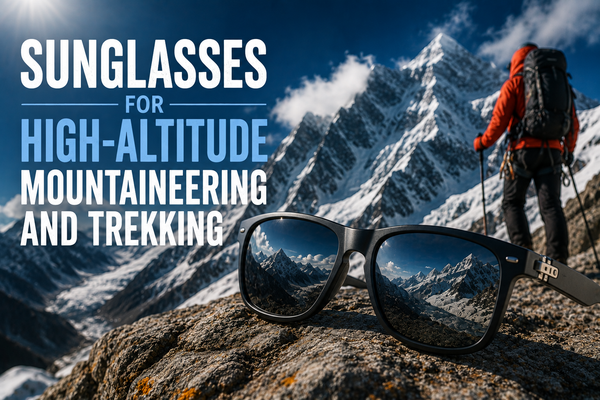
2. High-Altitude Mountaineering and Trekking
The UV Environment at Altitude
UV intensity increases approximately 10–12% per 1,000 feet of elevation. At 10,000 feet, UV is 90–120% higher than sea level at the same latitude and time of day. At 15,000 feet (approaching the altitude of high Himalayan trekking routes), UV is 140–180% higher than sea level. At 20,000+ feet (expedition mountaineering), UV exceeds 200% of sea level intensity. These aren't incremental differences — UV at 20,000 feet is three to four times the UV experienced at a tropical beach at sea level. Photokeratitis (snow blindness) at these altitudes can occur in as little as 30–60 minutes of unprotected exposure on a clear day with snow. Acute cataracts and permanent retinal damage have been documented in mountaineers with inadequate eye protection.
Snow Reflection: The Second Amplifier
Fresh snow reflects 80–90% of incident UV diffusely — unlike water reflection, which is primarily specular (directional), snow reflection sends UV upward from all below-eye angles simultaneously. This means that UV at altitude with snow cover reaches the eye from below, from the sides, and from above simultaneously — a 360-degree UV environment that wraparound frames with adequate top and side coverage address significantly better than standard flat-front frames. The effective UV reaching unprotected eyes in a high-altitude snowfield is the sum of direct overhead UV (2–4x sea level intensity) plus reflected UV from the snowfield (80% of that, from all below-eye directions).
The High-Altitude Sunglass Specification
- Lens category: Cat 3 (8–18% VLT) for trekking at 10,000–16,000 feet; Cat 4 (3–8% VLT) for glacial and expedition mountaineering above 16,000 feet with full snow coverage. Cat 4 is essential for glacier travel and must not be used for driving.
- UV400 polycarbonate: the UV400 spec is the minimum — at altitude UV intensity, lenses that claim UV400 but use inferior materials must be viewed with higher skepticism.
- Wraparound coverage: side shields or full-wraparound lens geometry that prevents lateral UV entry — critical at altitude where diffuse snow reflection enters from all below-eye angles.
- Frame coverage and side shields: many high-altitude mountaineering glasses add leather or fabric side shields to the frame to block lateral UV — the same protection principle as traditional Inuit bone snow goggles.
- Retention: retention strap mandatory — losing glasses on an exposed high-altitude ridge or in a snowfield is potentially life-threatening. Double retention (retention strap plus close-fitting frame geometry) for the most exposed conditions.
See the dedicated article: Sunglasses for High-Altitude Mountaineering and Trekking.
3. Desert and Arid Heat Environments
The Desert UV Environment
Desert UV involves three simultaneous factors not present in most everyday UV environments: low-latitude high sun angles (Sahara, Arabian Peninsula, and American Southwest desert zones at 20–35 degrees north), minimal cloud cover (Yuma, Arizona averages 91% sunny hours — effectively no natural UV moderation from cloud cover on most days), and highly reflective terrain. Bare limestone, caliche, sandstone, gypsum, and sand reflect 15–25% of UV diffusely — not the dramatic 80% of snow, but from a much larger surface area (the entire desert landscape rather than a specific snowfield) and at all horizontal angles.
Heat Stress on Frame Materials
Desert air temperatures regularly exceed 120°F (49°C) in the Sahara, Arabian Peninsula, and American Southwest in summer. Ground surface temperatures at the same time exceed 160–180°F (71–82°C). Outdoor workers, military personnel, and hikers in desert environments expose frames to ambient temperatures that standard polycarbonate and acetate frames begin to soften at. TR90 nylon's higher thermal stability (structural integrity to approximately 194°F / 90°C) is a functional frame material advantage in desert environments — not just a sport performance feature. Cars parked in desert sun reach interior temperatures of 160–180°F at dashboard level — TR90 frames in the car are safer from heat deformation than standard plastic alternatives.
Wind and Abrasion: The Mechanical Desert Factor
Desert wind — particularly in sandstorm-prone regions (North Africa, Middle East, American Southwest) — carries sand particles at velocities that produce abrasive impact on lens surfaces. Wind-driven sand at 30–50 mph creates surface abrasion on uncoated or lightly coated lenses that accumulates to visible lens damage over seasons of desert outdoor exposure. Hard coat is the protective layer for wind-driven abrasion — quality hard coat significantly extends lens surface life in abrasive desert wind environments compared to uncoated or thinly coated lenses.
See the dedicated article: Sunglasses for Desert and Arid Environments.
4. Arctic and Polar Conditions
The Polar UV Environment
The polar UV environment is counterintuitive: UV at polar latitudes (above 66 degrees north or south) is lower than tropical UV due to the extreme sun angles — but the 80% snow and ice reflection that is omnipresent in polar environments compensates substantially. In polar spring (March–May), the combination of rapidly increasing sun angle, low ozone layer (the polar ozone "hole" that still causes seasonal stratospheric ozone depletion over Antarctica), and universal snow and ice coverage produces UV conditions that can rival mid-latitude summer UV. Scott and Amundsen expedition members who survived to describe their experience uniformly cited eye protection as a critical survival need — snow blindness incapacitated members of multiple polar expeditions.
Cold-Weather Frame Brittleness
Standard polycarbonate and some acetate frame materials become significantly more brittle at temperatures below -20°F (-29°C). At arctic expedition temperatures (-40°F / -40°C and below), standard plastic frames can shatter on impact rather than flexing — a serious problem in an environment where falling glasses or a blow to the face is a plausible event. TR90 nylon maintains substantially better impact toughness at low temperatures than standard polycarbonate or acetate — it is among the cold-weather-appropriate frame materials available in consumer sunglasses. Military and polar expedition equipment specifications often include cold-temperature impact testing that TR90 frames pass where standard plastics fail.
Goggle vs Sunglass in Polar Conditions
Full goggle coverage — not sunglasses — is the standard for the most extreme polar conditions. Ski-type goggles with Cat 3–4 lenses and full foam face seal prevent the wind-driven eye exposure and fogging that open-frame sunglasses experience in extreme cold. For polar trekking and expedition conditions below -20°F (-29°C) with wind: goggles. For polar conditions above -20°F (-29°C) or in calm conditions: wraparound Cat 3 polarized sunglasses provide adequate protection. The sunglass-to-goggle transition point is wind and temperature, not UV intensity alone.
See the dedicated article: Sunglasses for Arctic and Polar Conditions.
5. Offshore and Deep-Sea Maritime
The Maritime UV Environment
Open ocean UV involves the combination of unobstructed tropical or subtropical sun (offshore maritime work and recreation occurs predominantly in lower latitudes where UV is highest), water surface reflection (the Fresnel reflection of the ocean surface at low to mid sun angles is the most efficient UV reflection in the natural environment — more directional and intense than snow or desert reflection at comparable angles), and extended duration exposure (a 10-hour offshore fishing or sailing day is 10 continuous hours of combined direct and reflected UV at sea). Maritime UV is the combination of high-intensity UV plus the most efficient natural reflector on Earth.
Saltwater Corrosion: The Maritime Hardware Killer
Offshore maritime environments expose all frame hardware to continuous saltwater — spray, immersion, and the salt-laden air that permeates everything on an offshore vessel. Standard alloy hardware (hinge screws, hinge barrels, nose contact frames) corrodes rapidly in this environment — the electrochemical attack of chloride ions on standard steel, brass, and zinc alloys proceeds continuously in saltwater spray conditions. Stainless steel 5-barrel hinges resist this attack substantially better — the passive oxide layer on stainless steel prevents the chloride ion penetration that corrodes standard alloys. In offshore conditions, stainless hardware is a functional requirement, not a premium feature.
See the dedicated article: Sunglasses for Offshore and Deep-Sea Maritime Work.
6. Construction and Industrial Outdoor Work
The Industrial UV Plus Impact Environment
Construction and industrial outdoor work imposes UV demands that overlap with other outdoor environments — outdoor construction workers in Sun Belt states accumulate occupational UV doses that approach those of professional outdoor athletes — plus mechanical impact and debris risks that go beyond any recreational outdoor activity. Nail guns, grinders, cutting tools, and power saws all produce high-velocity debris projectiles; concrete and masonry work produces fine particulate; demolition work produces unpredictable impact events. The eye protection specification for industrial outdoor work must address UV and impact simultaneously.
ANSI Z87.1 vs Recreational UV400
The ANSI Z87.1 industrial eye protection standard defines impact resistance requirements substantially more demanding than the FDA impact resistance standard that applies to recreational sunglasses. ANSI Z87.1 high-velocity impact testing (a steel ball projectile at 150 fps) and high-mass impact testing (a pointed weight dropped from specified height) establish impact resistance levels appropriate for industrial settings. Recreational UV400 sunglasses — including those meeting FDA impact resistance — do not meet ANSI Z87.1 requirements. For OSHA-regulated construction sites where eye protection is required, ANSI Z87.1-marked safety eyewear is the regulatory requirement regardless of the UV400 status of the lens.
The practical solution for many outdoor construction workers: ANSI Z87.1-marked safety glasses with UV400 polycarbonate lenses — which exist and are available — rather than choosing between UV protection and impact protection. See the dedicated article: Sunglasses for Construction and Industrial Outdoor Work.
7. The Spec Matrix: Extreme Environment Requirements at a Glance
| Environment | Lens Category | Key Lens Requirement | Frame Requirement | Hardware Requirement | Additional Requirement |
|---|---|---|---|---|---|
| High-altitude trekking (10,000–16,000 ft) | Cat 3 | UV400 polycarbonate polarized | TR90 wraparound | Stainless; retention strap | Side coverage; retention mandatory |
| Glacial mountaineering (16,000+ ft) | Cat 4 | UV400 polycarbonate; side shields | TR90; side shield capable | Stainless; retention strap | Cat 4; no driving; side shields |
| Desert hiking and work | Cat 3 | UV400 polycarbonate; hard coat | TR90 (heat stable to 90°C) | Stainless | Hard coat for sand abrasion |
| Arctic trekking (above -20°F) | Cat 3 | UV400 polycarbonate polarized | TR90 (cold-impact resistant) | Stainless | Wraparound; retention strap |
| Polar expedition (below -20°F) | Cat 4 | UV400 polycarbonate; goggle preferred | TR90 or goggle foam seal | Stainless | Goggle below -20°F; Cat 4 |
| Offshore maritime (recreational) | Cat 3 | UV400 polarized; anti-saltwater coating | TR90; retention strap | Stainless 5-barrel mandatory | Retention strap; anti-saltwater |
| Deep-sea commercial maritime | Cat 3 | UV400 polarized; anti-saltwater | TR90; full-wrap preferred | Stainless 5-barrel mandatory | Anti-saltwater; retention; rinse protocol |
| Outdoor construction (Sun Belt) | Cat 2–3 | UV400 polycarbonate; ANSI Z87.1 | TR90 or impact-rated | Stainless preferred | ANSI Z87.1 for regulated sites |
8. What Standard UV400 Polycarbonate Covers Across All Extreme Environments
Despite the environment-specific demands, the standard UV400 polycarbonate polarized specification covers the most fundamental protection requirement — UV400 blocking — across all extreme environments. UV400 in polycarbonate blocks 100% of UV-A and UV-B regardless of intensity — whether at sea level or at 20,000 feet, whether UV index is 4 or 16, UV400 polycarbonate blocks the complete UV spectrum. What changes at extreme UV intensity is the consequence of any gap in coverage (side entry, above-lens entry) and the absolute dose accumulated per unit time — but the UV that reaches the eye through the lens itself is blocked completely by UV400 polycarbonate in all environments.
The standard Navi Eyewear specification — UV400 polycarbonate polarized, TR90 frame, stainless 5-barrel hinges, oleophobic/hydrophobic/anti-saltwater coatings — covers the baseline demands of every extreme environment in this guide with the single exception of Cat 4 lens category for glacial mountaineering and polar expeditions. The environment-specific upgrades — side shields for high altitude, ANSI Z87.1 rating for industrial, goggle for polar extremes — address demands that go beyond any sunglass specification. The standard spec is not the limiting factor in most extreme environment sunglass performance; it is the environment-specific demands that require additional consideration. Browse UV400 polarized options at navieyewear.com.
9. Frequently Asked Questions
Do I need Cat 4 sunglasses for extreme environments?
Only for two specific conditions: glacial mountaineering above 16,000 feet with full snow coverage, and polar expedition conditions. For all other extreme environments — desert, high-altitude trekking below 16,000 feet, offshore maritime, arctic conditions above -20°F, and industrial outdoor work — Cat 3 is appropriate and Cat 4 is unnecessarily dark and creates safety issues for terrain navigation. Cat 4 must never be used for driving.
Are sunglasses enough for extreme alpine conditions or do I need goggles?
For conditions above -20°F with moderate wind: wraparound Cat 3–4 sunglasses with retention straps provide adequate protection. For conditions below -20°F or with sustained high wind: ski-type goggles with Cat 3–4 lenses and foam face seal are preferable — goggles prevent the fogging that open-frame sunglasses experience in extreme cold wind and provide the full-face coverage that arctic wind demands. Many mountaineers carry both and transition based on conditions during a single day.
What frame material is best for extreme environments?
TR90 nylon is the best-performing standard frame material for the widest range of extreme environments — higher heat tolerance than standard polycarbonate and acetate for desert conditions, better cold-impact resistance than standard polycarbonate for arctic conditions, shape memory for recovery from moderate deformation in all environments. For the most extreme cold expedition conditions, military-spec materials may be warranted; for consumer-accessible extreme environments, TR90 is the appropriate choice.
Can standard recreational sunglasses be used in industrial outdoor environments?
Only where OSHA regulations don't specify ANSI Z87.1 eye protection — for informal outdoor work not subject to workplace safety regulation, UV400 polycarbonate recreational sunglasses provide UV protection but not the impact protection of rated safety eyewear. For regulated construction sites and any work involving high-velocity debris, ANSI Z87.1-marked safety eyewear is required regardless of UV400 status.
How does saltwater affect sunglasses in maritime environments?
Saltwater attacks four sunglass components: hinge hardware (electrochemical corrosion of non-stainless alloys); lens coatings (ionic degradation of non-anti-saltwater coatings); polarization film (moisture penetration into PVA film at unsealed lens edges); and nose contact hardware (corrosion of metal contact arms and frames). The defense: anti-saltwater coating, stainless steel hardware, sealed lens construction, and immediate fresh water rinsing after every saltwater session before salt deposits dry and crystallize.
What is the highest UV environment a person can realistically encounter?
The highest UV environments accessible to non-expedition outdoor recreationalists: Haleakala summit in Maui (10,023 feet) at UV index 16–18 in summer; Colorado fourteener summits (14,000+ feet) at UV index 14–17; the Tibetan Plateau and high Andean routes accessible by road at 15,000–17,000 feet at UV index 18–22. For mountaineering expeditions: Everest base camp (17,600 feet) approaches UV index 20+; the summit at 29,032 feet would theoretically experience UV index 25–30, though the extreme cold and wind make goggle use mandatory and the UV measurement becomes largely academic.
10. Supporting Articles in This Cluster
- Sunglasses for High-Altitude Mountaineering and Trekking | Navi Eyewear
- Sunglasses for Desert and Arid Environments | Navi Eyewear
- Sunglasses for Arctic and Polar Conditions | Navi Eyewear
- Sunglasses for Offshore and Deep-Sea Maritime Work | Navi Eyewear
- Sunglasses for Construction and Industrial Outdoor Work | Navi Eyewear
The Bottom Line
Extreme environments amplify every UV and mechanical demand that everyday outdoor exposure imposes — altitude doubles UV, snow adds 80% reflected UV from all below-eye angles, desert heat stresses frames beyond standard plastic operating range, polar cold makes standard plastics brittle, offshore saltwater systematically attacks all non-stainless hardware, and industrial settings add impact demands that go beyond recreational sunglass specifications. The standard UV400 polycarbonate polarized TR90 stainless specification handles the baseline UV demand in every extreme environment; the environment-specific upgrades — Cat 4 for glacial mountaineering and polar expedition, ANSI Z87.1 for industrial, goggles for polar extremes below -20°F — address the demands that exceed what any sunglass specification can meet. Browse UV400 polarized options at navieyewear.com — Buy 1, Get 2 Free for $85.
Related Reading
- Best Sunglasses for Arizona | Navi Eyewear
- Best Sunglasses for Colorado and the Mountain States | Navi Eyewear
- The Complete Water Sports Sunglasses Guide | Navi Eyewear
- Photokeratitis and Snow Blindness | Navi Eyewear
- UV and Eye Disease: The Complete Guide | Navi Eyewear
- Sunglass Lens Categories Explained | Navi Eyewear
- TR90 Nylon Frames: Why the Material Matters | Navi Eyewear
- Shop Polarized UV400 Sunglasses | Navi Eyewear
Sources & Citations
[1] WHO. "Global solar UV index: a practical guide." World Health Organization, 2002. View source →
[2] Sliney DH. "Ocular exposure to environmental light and ultraviolet." Journal of AAPOS, 2014. View source →
[3] Diffey BL. "Sources and measurement of ultraviolet radiation." Methods, 2002. View source →
[4] Taylor HR, et al. "Effect of ultraviolet radiation on cataract formation." New England Journal of Medicine, 1988. View source →
[5] Dain SJ. "Sunglasses and sunglass standards." Clinical and Experimental Optometry, 2003. View source →
[6] ISO 12312-1:2013. "Eye and face protection — Sunglasses and related eyewear." International Organization for Standardization. View source →
[7] ANSI/ISEA Z87.1-2020. "American National Standard for Occupational and Educational Personal Eye and Face Protection Devices." American National Standards Institute. View source →