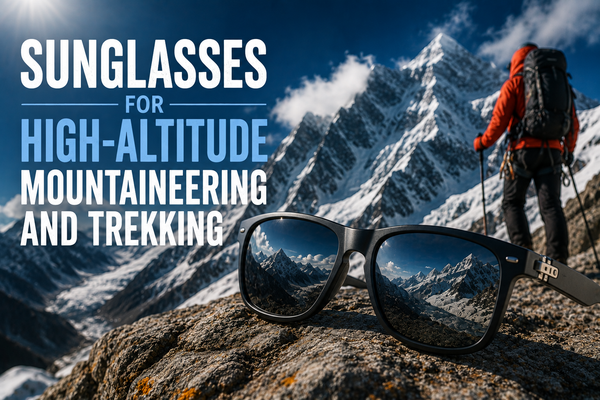

Sunglasses for High-Altitude Mountaineering and Trekking
UV intensity at altitude is not a minor increment above sea-level UV — it is a categorically different exposure environment. At 10,000 feet, UV is 90–120% higher than sea level at the same latitude and time of day. At 15,000 feet, it is 140–180% higher. At 20,000 feet, it approaches 200–250% of sea-level intensity. Combine this with snow reflection that amplifies UV by another 80% from all below-eye angles simultaneously, and the effective UV reaching unprotected eyes on a high-altitude snowfield is three to four times what a tropical beach at sea level delivers — and a tropical beach already produces UV index 12–14. Photokeratitis (snow blindness) at 15,000 feet with full snow coverage can occur in 30–60 minutes of unprotected exposure on a clear day. This guide covers the correct specification for every altitude tier of mountain outdoor activity, from accessible high-country trails to technical glacier routes and expedition peaks.

1. The Altitude UV Environment: A Tiered Analysis
How Altitude Amplifies UV
UV intensity increases because the atmospheric column between the sun and the observer shortens at higher elevation. At sea level, solar UV passes through the full depth of the atmosphere — approximately 100 km of ozone, water vapor, aerosols, and particulate that absorb and scatter UV before it reaches the surface. At 10,000 feet (3,048 m), roughly 10% of that atmospheric column is below the observer; at 20,000 feet (6,096 m), approximately 20% is below. Each 1,000 feet removes approximately 10–12% of the atmospheric UV filtering that sea level receives. The result is not linear — the UV amplification percentage compounds with altitude and is higher at the UV wavelengths (UV-B in particular) that the ozone layer most efficiently absorbs at sea level.
Altitude Tiers and UV Multipliers
| Altitude Tier | Example Locations | UV vs Sea Level | UV Index (Summer, Mid-Latitude) | Lens Category |
|---|---|---|---|---|
| 5,000–7,000 ft | Denver CO, Santa Fe NM, Flagstaff AZ base | +50–70% | 8–11 | Cat 2–3 |
| 7,000–10,000 ft | RMNP trailheads, Flagstaff AZ, Park City UT | +70–100% | 10–13 | Cat 3 |
| 10,000–13,000 ft | Colorado fourteener approaches, Haleakala Maui, Trail Ridge Road | +100–130% | 12–15 | Cat 3 |
| 13,000–16,000 ft | Colorado fourteener summits, Ecuador volcanos, Kilimanjaro crater | +130–160% | 14–18 | Cat 3–4 |
| 16,000–20,000 ft | Denali lower, Aconcagua, Himalayan trekking peaks | +160–200% | 16–22 | Cat 4 |
| 20,000+ ft | Denali summit, Himalayan 8,000 m peaks | +200–250% | 20–28+ | Cat 4 + goggle |
Snow Reflection: The Second UV Source
Fresh snow reflects 80–90% of incident UV. Unlike water or desert terrain, snow reflection is omnidirectional — it sends UV upward from the entire snowfield simultaneously, reaching the eye from below, from the sides, and from all angles below the horizon. This creates a UV environment that standard flat-front sunglasses are inadequately designed for: the frame prevents UV from entering from directly above, but lateral and below-eye-level UV enters freely through the unshielded sides and bottom of the frame opening.
The practical consequence: on a high-altitude snowfield, wearing sunglasses without side coverage is meaningfully less protective than the lens spec alone would suggest. A Cat 3 lens blocks overhead UV appropriately but allows significant reflected UV in from the sides and below. Side shields or full-wraparound lens geometry close this gap.
2. Photokeratitis: The Acute Risk of Inadequate High-Altitude Eye Protection
What Photokeratitis Is
Photokeratitis is UV-induced inflammation of the corneal epithelium — essentially a sunburn of the cornea. The condition is also called snow blindness in alpine contexts, though it can occur without snow in any high-UV environment where the eyes are unprotected for extended periods. Symptoms appear 6–12 hours after UV exposure (not immediately — the delay leads people to underestimate their exposure until it's too late): intense eye pain, foreign body sensation ("sand in the eyes"), excessive tearing, photophobia, and temporary vision loss ranging from blurring to complete temporary blindness.
Photokeratitis Onset Time at Altitude
At sea level on a clear day at peak UV, photokeratitis onset requires several hours of unprotected exposure in most individuals. At altitude with snow:
- 10,000 feet with full snow coverage: photokeratitis onset in 2–4 hours of unprotected exposure
- 15,000 feet with full snow coverage: onset in 60–90 minutes of unprotected exposure
- 20,000+ feet with full snow coverage: onset in 30–60 minutes of unprotected exposure on clear days
The 6–12 hour symptom delay means that a climber who loses glasses or removes them at 3pm on a glacier may not experience symptoms until 9pm–3am — typically after they've descended to camp but when treatment options are limited and the night ahead with painful photophobia is already unavoidable. Carrying a spare pair of glacier glasses as standard equipment is the practice of experienced mountaineers precisely because of this scenario.
Photokeratitis Treatment
Photokeratitis is self-limiting — the corneal epithelium regenerates completely within 24–72 hours in most cases. Treatment is supportive: darkness (no light entering the eyes), cool compresses, artificial tears for lubrication, and pain management. In remote mountain environments, "treatment" means lying in a darkened tent for 24–72 hours — a serious time and safety cost in an expedition context where weather windows are limited and the descent may need to happen during the recovery period. Prevention through adequate eye protection is categorically preferable to treatment.
3. The High-Altitude Sunglass Specification
Lens Category: Cat 3 vs Cat 4
The lens category decision for high-altitude use turns on altitude, snow coverage, and activity:
- Cat 3 (8–18% VLT): appropriate for trekking and hiking below 16,000 feet, for high-altitude environments with partial snow coverage, and for the approach and descent phases of glacier routes where terrain navigation requires adequate visual detail. Cat 3 is the standard for most high-altitude outdoor recreation accessible to the general public — Colorado fourteeners, Haleakala, Kilimanjaro, Himalayan trekking routes below 16,000 feet.
- Cat 4 (3–8% VLT): appropriate for sustained glacier travel above 16,000 feet, for direct sun exposure on high-altitude snowfields, and for expedition mountaineering on 8,000 m peaks. Cat 4 transmits very little light — it is appropriate only where UV intensity is at the extreme end of the scale and must never be used for driving or in low-light terrain where obstacle visibility matters.
Wraparound Coverage and Side Shields
For high-altitude snowfield use, the coverage geometry of the frame is as important as the lens category. Options in order of lateral UV protection:
- Full-wrap sport frames: the lens curves around toward the temple, reducing but not eliminating lateral UV entry. The standard for most high-altitude trekking.
- Glacier glasses with side shields: leather, fabric, or rigid plastic shields attached to the frame sides that block lateral UV completely. The traditional high-altitude mountaineering design — functional but warm in the face and less ventilated than open sport frames. Standard equipment for serious glacier and expedition use.
- Ski goggles: full face coverage, foam seal, no lateral UV entry path. The standard for the most extreme conditions — above -20°F wind or high-velocity snow that makes open-frame glasses impractical.
Frame Material at Altitude
TR90 nylon is the appropriate frame material for high-altitude use — it maintains dimensional integrity at the temperature ranges encountered from lower-elevation approach (potentially warm) to high-altitude cold (-20°F to -40°F at extreme altitude). Standard polycarbonate and acetate frames become significantly more brittle at the cold temperatures of high-altitude environments, particularly below 0°F (-18°C). At expedition altitudes, the cold-temperature impact resistance of TR90 is a functional safety consideration — a frame that shatters on a boulder impact at 20,000 feet is a serious problem with no remedy until descent.
Retention at Altitude
A retention strap is mandatory for high-altitude and glacier use — not optional. At altitude, losing glasses to wind, a fall, or a stumble is potentially a serious medical event (photokeratitis, immediate snow blindness) rather than a minor inconvenience. The retention strap should be adjusted to hold the frame snugly against the face when the head is inverted (as it would be in a fall) — loose enough to be comfortable but tight enough that the frame cannot fall from the face in any orientation. For expedition mountaineering, a double retention system (retention strap plus tight-fitting frame that grips the nose bridge firmly) provides redundancy against loss.
4. Altitude-Specific Activity Recommendations
Colorado Fourteeners (13,000–14,440 ft)
Colorado's 58 fourteener summits represent the highest-UV day hike accessible to the general public in the continental US. The pre-dawn starts that fourteener hiking requires mean that UV is low or absent at the trailhead — but by the time most hikers summit (8:30–11am), UV is at full altitude intensity with the sun well above the horizon and frequently above the cloud layer. Amber Cat 3 polarized UV400 in a TR90 sport frame with retention strap. The approach and lower trail sections may involve partially forested terrain where Cat 3's ambient light reduction is manageable; above treeline at 11,500+ feet, Cat 3 is the minimum appropriate category for the exposed granite tundra and any lingering snow fields on north-facing aspects.
Himalayan Trekking (8,000–17,600 ft)
The classic Himalayan trekking routes — Everest Base Camp (17,600 ft), Annapurna Circuit (highest point 17,769 ft at Thorong La), Langtang Valley, Manaslu Circuit — access altitudes where UV is 140–180% above sea level at Himalayan latitudes (27–30 degrees north, similar to Florida). The Khumbu glacier sections of the EBC route above Namche Bazaar (11,286 ft) involve glacier surface travel where Cat 3 is appropriate and the omnidirectional UV environment of the glacial ice and snowfields demands wraparound coverage. At the highest trekking elevations (Thorong La at 17,769 ft), Cat 4 becomes appropriate for the summit crossing conditions. Amber Cat 3 for the approach and descent; a Cat 4 glacier pair for the highest crossings and any glacier travel sections.
Kilimanjaro (19,341 ft)
Kilimanjaro at 3 degrees south latitude combines low tropical latitude (highest UV by sun angle) with extreme altitude (19,341 ft). The summit plateau — Uhuru Peak — receives among the most intense UV of any regularly climbed peak outside the Himalaya and Andes. The approach routes (Marangu, Machame, Lemosho) ascend through distinct vegetation zones before reaching the alpine desert and arctic summit zone — lens requirements change with altitude as the route progresses. Cat 3 through the lower zones; Cat 4 for the summit approach from crater rim to Uhuru Peak, which involves the highest tropical UV at significant altitude available to non-technical climbers.
Technical Alpine Routes
Technical alpine routes on glaciated peaks — North Cascades, Alaska Range, Alps, Andes — involve sustained glacier travel with crampons and rope work where vision clarity is a safety requirement for route-finding, crevasse detection, and ice feature navigation. The visual demands are higher than trekking routes — Cat 4's 3–8% VLT is appropriate for the UV environment but must be balanced against adequate light transmission for terrain navigation. Many alpinists use Cat 3 as the standard glacier lens and reserve Cat 4 for conditions of extreme reflective glare (midday sun on flat glaciers at high altitude) while using Cat 3 for the rest of the day when terrain navigation demands more light transmission.
5. What to Carry: The High-Altitude Eye Protection Kit
The Two-Pair High-Altitude System
Experienced mountaineers and high-altitude trekkers carry two pairs as standard practice:
- Primary pair: Cat 3 (trekking) or Cat 4 (glacier/expedition) UV400 polarized, wraparound, retention strap — the working pair for the primary conditions of the route
- Backup pair: Cat 3 UV400 polarized in a hard case in the pack — for loss, breakage, or lens damage of the primary pair, and for the approach and descent phases where the primary Cat 4 pair may be unnecessarily dark
The backup pair is not a luxury in high-altitude mountaineering — it is standard safety equipment. A primary pair lost in a fall or blown off by wind at 15,000 feet with 8 hours of descent remaining in full snow conditions is an emergency without a backup. At Navi Eyewear's Buy 1, Get 2 Free pricing of $85 for three pairs, the backup pair investment is $28 — the most cost-effective safety addition available for the high-altitude kit.
Frequently Asked Questions
What lens category do I need for Everest Base Camp trekking?
Cat 3 UV400 polarized for the majority of the EBC route — the approach through Namche Bazaar, the acclimatization rotations, and most of the Khumbu Valley sections. Cat 4 for any glacier travel sections and for the highest altitude sections above 15,000 feet where snow coverage is complete and UV is at expedition-level intensity. Many trekkers carry Cat 3 as primary and have a Cat 4 pair for the Khumbu glacier sections and any summit plateau crossing.
Can I use ski goggles instead of glacier sunglasses for mountaineering?
Yes — ski goggles with Cat 3–4 lenses are appropriate for glacier and high-altitude mountaineering, particularly in wind-driven conditions, blowing snow, or extreme cold where open-frame sunglasses are impractical. The limitations: goggles are less ventilated than sunglasses and fog more readily on physical exertion; they are bulkier to carry; and their field of view is slightly more restricted than open-frame glasses for technical route-finding. Many mountaineers use sunglasses in calm conditions and switch to goggles in adverse conditions during the same climb.
How do I prevent fogging at high altitude?
Anti-fog lens treatment (DeFog It and similar products), ventilated frame design that allows airflow across the lens, not wearing the glasses pushed up on the forehead where warm head air contacts the cold lens (the most common cause of fogging when the glasses are then lowered), and carrying a microfiber cloth to clear condensation. For goggle use: open vent covers slightly to increase airflow, and avoid covering the goggle with a balaclava or hat that blocks the vents. In cold, windy conditions where fogging risk is highest, single-layer Cat 3 lenses fog less than insulating double-layer lenses because they reach equilibrium temperature with the outside air faster.
Are cheap sunglasses adequate for high-altitude trekking?
No — unless they explicitly certify UV400 polycarbonate lenses with Cat 3 VLT. Budget sunglasses sold without explicit UV400 certification may transmit significant UV despite dark tinting. Dark-tinted lenses without UV400 certification are worse than no lenses at altitude — they cause pupil dilation (allowing more UV into the eye) while the dark tint creates the false impression of protection. At altitude, the consequence of inadequate UV protection is photokeratitis, not just inconvenience. Verified UV400 polycarbonate Cat 3 is the non-negotiable specification for any high-altitude snow environment.
Do I need different sunglasses for summer vs winter high-altitude use?
The lens category requirements are similar — Cat 3 for most conditions, Cat 4 for full-snow high-altitude — but winter use adds cold-temperature frame brittleness as a consideration. TR90 frames maintain impact toughness at winter high-altitude temperatures better than standard polycarbonate. Winter use also tends toward full goggle coverage more often due to wind and weather that summer alpine conditions don't impose as consistently. The UV specification (UV400 Cat 3–4) is the same year-round; the coverage and retention requirements become more critical in winter.
The Bottom Line
High-altitude UV is not an increment above everyday outdoor UV — it is a categorically different exposure environment where photokeratitis can occur in under an hour, where snow reflection reaches the eye from all below-eye angles simultaneously, and where losing eye protection is a medical emergency rather than an inconvenience. Cat 3 UV400 polarized in a TR90 wraparound frame with retention strap covers most high-altitude trekking and hiking up to 16,000 feet; Cat 4 is appropriate for sustained glacier travel and expedition peaks above that altitude; goggles for conditions below -20°F or in sustained high wind. Carry a backup pair — the $28 cost at Buy 1, Get 2 Free makes this standard practice rather than a considered expense. navieyewear.com/collections/polarized — Buy 1, Get 2 Free for $85.
Related Reading
- Sunglasses for Extreme Environments: The Complete Guide | Navi Eyewear
- Sunglasses for Arctic and Polar Conditions | Navi Eyewear
- Best Sunglasses for Colorado and the Mountain States | Navi Eyewear
- Best Sunglasses for Hawaii | Navi Eyewear
- Photokeratitis and Snow Blindness | Navi Eyewear
- Sunglass Lens Categories Explained | Navi Eyewear
- TR90 Nylon Frames: Why the Material Matters | Navi Eyewear
- Shop Polarized UV400 Sunglasses | Navi Eyewear
Sources & Citations
[1] WHO. "Global solar UV index: a practical guide." World Health Organization, 2002. View source →
[2] Diffey BL. "Sources and measurement of ultraviolet radiation." Methods, 2002. View source →
[3] Sliney DH. "Ocular exposure to environmental light and ultraviolet." Journal of AAPOS, 2014. View source →
[4] Rosenthal FS, et al. "The effect of sunglasses on ocular exposure to ultraviolet radiation." American Journal of Public Health, 1988. View source →
[5] Taylor HR, et al. "Effect of ultraviolet radiation on cataract formation." New England Journal of Medicine, 1988. View source →
[6] Dain SJ. "Sunglasses and sunglass standards." Clinical and Experimental Optometry, 2003. View source →