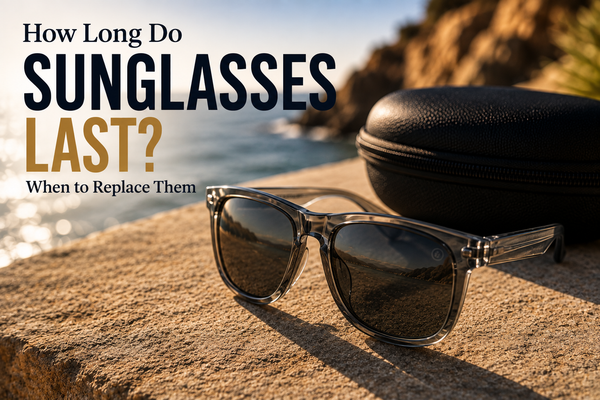

How Long Do Sunglasses Last? When to Replace Them
Sunglasses don't have a built-in expiration date — service life is determined by how hard they're used, how well they're cared for, and which component degrades first. The UV400 protection in polycarbonate lenses is permanent — it doesn't degrade with age, use, scratching, or sunlight exposure. What degrades: lens coatings (oleophobic, hydrophobic, anti-saltwater) lasting 1–5 years depending on use intensity and care; frame structural integrity varying by material and care; and hinge hardware varying by material quality and exposure to saltwater and sweat. Knowing which component limits service life — and what signs indicate it's time for replacement — prevents the two common errors: replacing functional sunglasses unnecessarily and continuing to use degraded sunglasses past their useful service life. For the full maintenance context, see the complete sunglass care and maintenance guide.

1. The Components That Determine Service Life
UV400 Protection: Permanent in Polycarbonate
The single most important fact about sunglass service life: UV400 protection in polycarbonate lenses does not degrade. Polycarbonate absorbs UV through structural chemistry — UV-absorbing compounds built into the polycarbonate matrix during manufacturing. This absorption is not a surface coating that wears away; it is a property of the bulk material itself. A polycarbonate lens provides identical UV400 protection when heavily scratched as when new. UV400 protection does not degrade with years of sun exposure, repeated cleaning, saltwater immersion, or any other normal use condition.
This matters because it reframes the replacement question: scratch damage and coating degradation affect optical quality, not UV protection. The correct question when evaluating whether to replace sunglasses is not "are these still protecting against UV?" (they are, if polycarbonate) but "is the optical quality still adequate for comfortable, safe use?"
Lens Coatings: The First Component to Degrade
Lens coatings are the primary service life limiter for most sunglasses:
- Oleophobic coating: 1–3 years with daily use and proper care; 6–12 months with daily use and improper care (alcohol-based cleaners, dry wiping, sunscreen contamination without proper cleaning). Signs of failure: fingerprints spread immediately after cleaning rather than beading; lens stays smeared after washing.
- Hydrophobic coating: 1–3 years with proper care; degrades faster with aggressive cleaning, chemical exposure, and UV-intense environments. Signs of failure: water sheets across the lens surface rather than beading into droplets; lens requires wiping in wet conditions where it previously cleared itself.
- Anti-saltwater coating: 1–3 years with proper post-use rinsing; significantly shorter with inadequate rinsing that allows salt to dry and crystallize on the coating surface. Signs of failure: lens cloudiness or haze that doesn't respond to cleaning; visible delamination at lens edges.
- Hard coat: 3–7 years with proper care; 1–2 years without proper care. Not visible as a discrete failure — accumulating micro-scratches from improper cleaning gradually degrade optical clarity until the overall scratch density impairs vision.
- Mirror coating (if present): 1–3 years — the most delicate coating layer, most sensitive to chemical and abrasion damage. Signs of failure: pitting, spots, or irregular mirror surface where the reflective layer has degraded.
Frame: Material-Dependent Service Life
- TR90 nylon: 5–10+ years with proper care — the most durable common frame material. Resists UV-driven embrittlement, thermal deformation, and chemical attack better than other plastics. Shape memory allows recovery from moderate deformation. TR90 frames outlast their coatings in most use cases.
- Standard polycarbonate frames: 3–7 years — UV exposure gradually embrittles polycarbonate frame material over years of outdoor use. The same UV that the lens absorbs is being absorbed by the frame material, and over years this produces oxidative degradation that increases brittleness.
- Acetate: 5–15 years — acetate is chemically stable and UV-resistant but can warp in high heat and becomes brittle at extremes of age. Acetate frames stored correctly can last decades; acetate frames exposed to repeated high heat (car dashboards) degrade in 2–3 years.
- Titanium: 10–20+ years — virtually indefinite service life for the frame itself. Titanium doesn't corrode, doesn't embrittle, doesn't warp. Titanium frames are limited by hinge wear and lens/coating degradation rather than frame material failure.
Hinge Hardware: Quality-Dependent
- Stainless steel 5-barrel hinges: 5–15 years with proper care — the highest-durability standard hinge hardware. Resists saltwater corrosion, maintains barrel bore integrity over years of use, and holds screw tension well.
- Standard alloy hinges: 1–3 years in coastal/active use — corrode in saltwater environments, lose barrel bore integrity faster than stainless, and strip screw threads more rapidly under normal use.
- Spring hinge cartridges: 3–7 years — spring cartridges wear and eventually lose spring return function, requiring cartridge replacement (professional repair) or frame replacement.
2. Realistic Service Life by Use Context
| Use Context | Coating Life | Frame Life (TR90) | Overall Service Life | Primary Limiter |
|---|---|---|---|---|
| Occasional use (weekends, vacations only) | 5–10 years | 10+ years | 5–10 years | Coating degradation (slow) |
| Daily everyday use, proper care | 3–5 years | 7–10 years | 3–5 years | Oleophobic/hydrophobic coating |
| Daily everyday use, poor care | 6–18 months | 5–7 years | 6–18 months | Hard coat (scratches); coating degradation |
| Daily outdoor sport (running, cycling) | 2–4 years | 5–8 years | 2–4 years | Sweat exposure; coating degradation |
| Regular coastal and ocean use, proper care | 1–3 years | 5–8 years | 1–3 years | Anti-saltwater coating; hardware |
| Regular surf/kayak/water sport | 1–2 years | 3–6 years | 1–2 years | Intense saltwater; coating delamination |
| Outdoor worker (construction, agriculture) | 1–2 years | 3–5 years | 1–2 years | Dust abrasion; UV degradation; sweat |
3. The Signs That Tell You It's Time to Replace
Vision-Impairing Signs (Replace Promptly)
- Significant scratch field: a dense pattern of fine scratches that noticeably reduces contrast, increases glare sensitivity, and creates a hazy or veiled visual experience through the lens. Individual scratches are cosmetic; a field of scratches that impairs the visual experience is a functional performance failure.
- Persistent cloudiness after cleaning: haze that remains after thorough soap-and-water cleaning indicates subsurface coating degradation — the haze is not surface contamination but coating breakdown that cleaning cannot address.
- Coating delamination: visible bubbling, rainbow iridescence, or flaking at the lens surface or edges — the coating has physically separated from the substrate. Delaminated lenses scatter light in ways that non-delaminated lenses don't and can produce visual distortion.
- Polarization film degradation: the rainbow or patchy appearance visible through the lens in polarized light (look at a blue sky through the lens and rotate) that indicates polarization film failure — typically delamination or moisture penetration into the PVA film layer.
Comfort and Performance Signs (Consider Replacing)
- Oleophobic coating failure: fingerprints spread immediately and persistently on the lens surface after cleaning — the coating that repelled them has worn through. Not vision-impairing but functionally annoying and indicates the lens surface has reached end of effective coating life.
- Hydrophobic coating failure: water no longer beads on the lens — sheets across instead. Not vision-impairing in dry conditions but reduces lens performance in rain, spray, or water sport conditions where water-clearing was previously automatic.
- Frame structural failure: cracked frame front, broken temple arm, seized hinge that cannot be freed. Structural failures are replacement triggers regardless of lens condition — a structurally compromised frame doesn't provide the consistent positioning that UV and optical performance require.
Signs That Are NOT Replacement Triggers
- Individual visible scratches: one or two scratches from an accidental contact event are cosmetic, not functional failures — they do not meaningfully impair optical performance or UV protection.
- Light surface contamination that cleaning addresses: sunscreen haze, water spots, and fingerprints that clean off completely are maintenance issues, not replacement triggers.
- Fading of frame color: UV-driven color fading of frame material is cosmetic — it doesn't affect lens performance, UV protection, or structural integrity.
- Age alone: a 7-year-old pair of UV400 polycarbonate sunglasses in good optical and structural condition provides identical UV400 protection to a new pair. Age is not a replacement trigger — condition is.
4. The UV400 Permanence Reassurance
The Sunscreen Analogy Doesn't Apply to Polycarbonate
Sunscreen has an expiration date because the UV-absorbing chemical compounds in sunscreen degrade over time with UV exposure and oxidation. This "sunscreen logic" is sometimes applied to sunglasses — the assumption that UV protection degrades with age and UV exposure. This assumption is incorrect for polycarbonate UV400 lenses. The UV-absorbing chemistry in polycarbonate is structural — covalently bonded into the polymer matrix — not a surface-applied compound subject to degradation. Polycarbonate's UV400 absorption is essentially permanent for the service life of the lens material itself.
The practical implication: there is no need to replace polycarbonate UV400 sunglasses "because the UV protection has worn out." The UV protection hasn't worn out. The reason to replace them is optical quality degradation — when scratches, coating failure, or delamination impairs the visual performance of the lens to a degree that affects comfortable daily use.
5. The Multi-Pair Strategy and Replacement Economics
The $85 Three-Pair Math
At Navi Eyewear's Buy 1, Get 2 Free — $85 for three pairs — the replacement economics are fundamentally different from premium single-pair ownership. A $28-per-pair replacement when coatings have degraded is a practical decision rather than a significant expense. The multi-pair strategy that places UV400 protection at all four departure points (car, bag, sport kit, home entry) means that any pair reaching end of coating life is replaced without disrupting coverage at the other locations.
This is the economic case for the multi-pair approach: not only does it provide better UV protection through consistent availability, it makes the replacement decision trivially easy — at $28 per pair, replacing a pair with degraded coatings is the same cost as a restaurant appetizer, not a considered purchase. The resistance to replacing degraded sunglasses that affects premium single-pair owners ("I paid $200 for these, I can't replace them yet") doesn't apply when replacement cost is $28.
6. Extending Service Life: The High-Return Practices
The Three Practices With the Highest Service Life Impact
- Rinse before wiping: the single practice that most extends lens coating service life. Dry wiping is responsible for the majority of accumulated hard coat damage. Every rinse-before-wipe cleaning prevents the equivalent of dozens of dry-wipe micro-scratches. See the complete cleaning guide.
- Center console storage (not dashboard): moving the car pair from dashboard to center console prevents the summer heat damage (150–170°F dashboard temperatures) that accelerates coating degradation by years in hot climates. One storage habit change extends car pair coating life by 2–3x in Sun Belt states.
- Immediate post-saltwater rinsing: rinsing within minutes of a saltwater session before salt deposits dry prevents the salt crystal abrasion and ionic corrosion that are the primary service life limiters for coastal and water sport use. See the complete care guide.
Frequently Asked Questions
Does UV protection in sunglasses wear out over time?
No — not in polycarbonate lenses. UV400 protection in polycarbonate is structural (built into the material) rather than a surface coating, and it does not degrade with age, use, scratching, or UV exposure. A 10-year-old polycarbonate lens in good structural condition provides identical UV400 protection to a new lens. The replacement trigger for polycarbonate UV400 lenses is optical quality degradation (coating failure, significant scratching) — not UV protection degradation.
How do I know when my sunglasses need replacing?
Replace when: a field of micro-scratches reduces contrast and creates visible haze through the lens; coating delamination or cloudiness doesn't respond to cleaning; polarization film shows degradation (rainbow patches visible through the lens); or the frame has structural failure (cracked, broken temple, seized hinge). Do not replace for: individual scratches that don't impair vision, age alone, frame color fading, or coating performance loss that only affects convenience (oleophobic failure) rather than optical quality.
How long do polarized lenses last?
The polarization film embedded in quality polycarbonate polarized lenses is stable for the typical service life of the lens — 3–7 years of daily use with proper care. Polarization failure is typically visible as rainbow iridescence or patches visible through the lens in polarized light (look through the lens at a blue sky and rotate slowly — a healthy polarized lens shows a uniform change in blue sky brightness; a failing polarized lens shows irregular patches or rainbow effects). Polarization degradation in quality lenses from delamination or moisture penetration is a replacement trigger.
Is it worth repairing old sunglasses or buying a new pair?
For premium frames ($150+) in good structural condition with only coating or lens issues: repair or lens replacement may be economical. For direct-to-consumer priced sunglasses at $28–$40 per pair: new complete pair replacement is typically more economical and delivers new coatings, new frame, and full warranty. The decision framework: if the frame itself is worth more than the replacement cost of a complete new pair, repair is worth pursuing. If not, replacement is the practical choice.
Do cheap sunglasses lose UV protection faster?
Budget sunglasses that use non-polycarbonate lens materials — where UV protection is provided by a surface coating rather than the inherent material properties — can lose UV protection as that coating degrades. In polycarbonate lenses, UV400 protection is permanent regardless of price. This is another reason to verify polycarbonate lens material explicitly: UV protection longevity depends on whether UV400 is inherent (polycarbonate) or applied (surface-coated non-polycarbonate).
Should I replace sunglasses every year?
Only if coating quality has degraded to the point of functional impairment — annual replacement is not a general recommendation. With proper care (rinse before wiping, case storage, center console rather than dashboard), quality UV400 polycarbonate sunglasses in everyday use maintain optical performance for 3–5 years. For heavy outdoor sport and water use with proper post-use care, 1–3 years. For occasional use with proper storage, 5–10 years. Replace based on condition, not on a calendar schedule.
The Bottom Line
Sunglasses last as long as their limiting component — which is almost always lens coatings or hard coat integrity rather than UV400 protection, which is permanent in polycarbonate. Replace when optical quality has degraded to the point of functional impairment: significant scratch field, coating delamination, cloudiness after cleaning, or polarization failure. Don't replace for age alone, individual scratches, or coating convenience failures (oleophobic loss) that don't impair vision. Extend service life through the three high-return practices: rinse before wiping, center console storage, and immediate post-saltwater rinsing. At Navi Eyewear's Buy 1, Get 2 Free pricing, replacement when coatings have genuinely degraded is an easy decision rather than a reluctant one. navieyewear.com/collections/polarized — Buy 1, Get 2 Free for $85.
Related Reading
- The Complete Guide to Sunglass Care and Maintenance | Navi Eyewear
- How to Clean Sunglasses Without Scratching | Navi Eyewear
- How to Replace Sunglass Lenses | Navi Eyewear
- How to Fix Loose Sunglass Hinges and Screws | Navi Eyewear
- Sunglass Lens Coatings Explained | Navi Eyewear
- Cheap vs Expensive Sunglasses | Navi Eyewear
- How Many Pairs of Sunglasses Do You Actually Need? | Navi Eyewear
- Shop Polarized UV400 Sunglasses | Navi Eyewear
Sources & Citations
[1] Dain SJ. "Sunglasses and sunglass standards." Clinical and Experimental Optometry, 2003. View source →
[2] ISO 12312-1:2013. "Eye and face protection — Sunglasses and related eyewear." International Organization for Standardization. View source →
[3] Sliney DH. "Ocular exposure to environmental light and ultraviolet." Journal of AAPOS, 2014. View source →
[4] Taylor HR, et al. "Effect of ultraviolet radiation on cataract formation." New England Journal of Medicine, 1988. View source →
[5] WHO. "Global solar UV index: a practical guide." World Health Organization, 2002. View source →