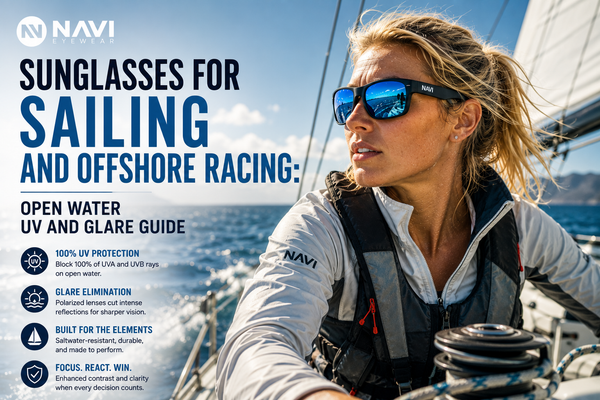

Sunglasses for Sailing and Offshore Racing: Open Water UV and Glare Guide
Sailing is one of the highest sustained UV exposure activities in recreational sport — hours of open ocean time with no shade, full sky UV from above, near-complete water surface reflection from below, and the UV amplification of offshore environments where there is no land to interrupt the sky horizon. A full day of offshore racing or bluewater passage covers the complete peak UV arc from morning through late afternoon, often with no option to go below and break from UV exposure during an active race or passage. The right sunglass setup for sailing addresses sustained UV over multi-hour to multi-day exposure windows, with the saltwater durability requirements of offshore conditions. For the complete water sports context, see the complete water sports sunglasses guide.

1. The Sailing UV Environment
Why Open Ocean Is One of the Highest UV Environments
Open ocean sailing UV is amplified by several factors that combine to make it among the most UV-intense environments most recreational users encounter:
- No shade: a sailboat cockpit has no overhead shade during active sailing — the boom, sails, and rigging provide intermittent shade but not the sustained overhead cover that trees, buildings, or indoor environments provide. Sustained deck exposure means full sky UV for the entire session.
- Water reflection: open ocean reflects 25–80% of UV depending on sun angle and sea state. Calm glassy water at Brewster's angle approaches 100% reflection of the incident UV. Even in moderate sea states, ocean reflection significantly amplifies effective UV above the UV index alone.
- 360-degree sky exposure: at sea, the full hemisphere of sky is visible — no surrounding terrain, no buildings, no vegetation to limit lateral UV from the sky dome. UV reaches the eyes from a full 180-degree overhead arc rather than just the angle directly above.
- Offshore latitude effects: coastal and offshore sailing in tropical and subtropical latitudes (Florida Keys, Caribbean, Hawaii, Gulf of Mexico, Mediterranean) involves baseline UV indexes of 10–14 before reflection amplification.
Duration: The Defining Factor for Sailors
What distinguishes sailing from most other outdoor activities is duration — a full day of offshore racing or a bluewater passage involves 8–12+ hours of continuous open water UV exposure with no option for extended indoor breaks. A sailor who races from dawn to dusk in an offshore regatta accumulates more total UV than most recreational outdoor users accumulate in a week of typical daily outdoor exposure. Consistent, all-day UV protection is not optional for offshore sailing; it is a fundamental gear requirement alongside sunscreen and UV-protective clothing.
2. Lens Specification for Sailing
Copper Cat 3 Polarized UV400 Polycarbonate: The Offshore Standard
The offshore and bluewater sailing lens specification:
- Copper polarized: the definitive tint for open ocean sailing. Reading wind on the water surface — the dark patches of pressure and the lighter water of wind shadows — is the most critical visual skill in performance sailing, and it is dramatically clearer through copper polarized lenses than any other tint. Copper's strong blue absorption eliminates the blue-toned surface reflection of open ocean water, revealing the subtle pressure variations beneath the glare that determine tactical sailing decisions. Beyond tactical sailing, copper polarization makes the entire ocean environment more visually readable: wave structure, current lines, debris and hazards below the surface in clear water, and the color of approaching weather.
- Cat 3 (8–18% light transmission): for full-day offshore racing and bluewater passages at peak UV hours. The sustained high UV of open ocean sailing warrants Cat 3 for the peak UV window (10am–3pm). Cat 2 for early morning and late afternoon sailing when UV is lower but wind reading remains important.
- Polarized: non-negotiable for open water sailing — the tactical and visual performance benefits of polarization for wind reading and surface reading are as significant as the UV protection benefit.
- UV400 polycarbonate: complete UV protection in the highest UV accumulation environment recreational sailors encounter, with impact resistance for the physical contact possibilities of offshore conditions (wave spray, boom contact, equipment handling).
Gray Cat 2 for Overcast Offshore and Night Watches
For offshore passages involving night watches and low-light sailing: gray Cat 1–2 polarized UV400 for the periods when UV is minimal but glare from reflected moonlight, bioluminescence navigation, and reading chart displays is relevant. Gray maintains color accuracy for chart and instrument reading; Cat 1–2 provides adequate light transmission for low-light offshore navigation. Many offshore sailors carry two pairs — copper Cat 3 for peak UV hours and gray Cat 2 for overcast and lower-light offshore periods.
3. The Wind Reading Advantage: Why Polarization Transforms Sailing
Reading Pressure on the Water
Experienced sailors read the water surface constantly for wind information — patches of dark, ruffled water indicate stronger wind pressure; lighter, smoother water indicates wind shadow or reduced pressure. This subtle surface texture information is partially obscured by the glare and reflection that non-polarized lenses leave intact. Polarized lenses eliminate the surface reflection layer, making the pressure variations and wind patterns on the water surface significantly more visible — the dark and light patches of wind are clearer, more distinct, and readable from greater distances through polarized lenses.
This is not a marginal improvement in tactical sailing — experienced offshore racers consistently cite the ability to read pressure more accurately as one of the primary performance benefits of sailing with quality copper polarized lenses. The tactical advantage of seeing a shift or a pressure band approaching 30 seconds earlier than competitors is meaningful in close-quarter racing.
Current Lines and Tide Rips
Ocean current boundaries — tide rips, current shear lines, and the interface between different water masses — are visible at the surface as color and texture differences in the water. Polarized lenses that eliminate surface glare make these boundaries significantly more visible, helping sailors identify favorable current and avoid adverse tidal streams. In coastal racing with significant tidal influence, the ability to read current lines through the water surface is a navigational advantage with direct performance implications.
4. Frame Requirements for Sailing
Saltwater Durability: The Priority
Offshore sailing is among the most demanding saltwater environments for hardware — salt spray is continuous in moderate to heavy air, spray immersion occurs in rough conditions, and the sustained multi-hour to multi-day exposure of bluewater passages exceeds the saltwater exposure of most water sports sessions. The saltwater durability requirements for offshore sailing are among the most stringent of any use case:
- Anti-saltwater coating on all lens surfaces — required for offshore use
- Stainless steel 5-barrel hinges — the minimum hardware standard for regular offshore use
- TR90 frame — chemical resistance to sustained saltwater, sunscreen, and the UV degradation that accelerates plastic breakdown in offshore UV environments
- Hydrophobic coating — continuous spray on the lens surface requires maximum water sheeting performance to maintain optical clarity during active sailing
Retention for Offshore Conditions
Offshore conditions create frame loss risk through a specific mechanism: a wave that comes over the bow during a tack, a boom that grazes the head, or leaning over the side to clear a sheet can dislodge a frame without a retention strap. In offshore racing, losing glasses overboard means sailing without UV protection for the remainder of the race — often hours. Retention straps (standard sport croakies or sailing-specific floating straps) are standard equipment for offshore racing crews and recommended for any sailing beyond protected inshore waters.
Floating retention straps are specifically relevant for sailing — a frame that goes overboard in a capsize or man-overboard scenario that includes the glasses needs to float at the surface to be retrievable. Non-floating straps keep the glasses on the head but don't help if the strap fails; floating frames or floating straps ensure retrievability if the glasses enter the water.
Polarization and Instrument Compatibility
A practical consideration for racing sailors with polarized lenses: some chartplotter and instrument displays use LCD screens that interact with polarized lenses at certain orientations, potentially causing the display to appear dark at the viewing angle. Marine instrument manufacturers are aware of this and design displays for polarized lens compatibility; most modern chartplotters and instruments handle polarized lens viewing without significant darkening. Check specific instrument compatibility if reading LCD instruments at a fixed helm position with fixed lens orientation is critical to the racing program.
5. Sailing Contexts: Daysailing vs Offshore Racing vs Bluewater Passage
Daysailing and Club Racing
Daysailing and club racing — 2–4 hour sessions, typically in protected or semi-protected waters, with the option to return to dock — have the same lens specification needs as offshore but lower durability demands. Copper Cat 2–3 polarized UV400 with standard anti-saltwater and hydrophobic coating; retention strap optional depending on conditions. Browse UV400 polarized options at navieyewear.com.
Offshore Racing (Overnight to Multi-Day)
Offshore racing that extends beyond a day requires consideration of watch schedules — crew members rotating through active sailing watches and off-watch rest below. UV protection is needed during all deck watches regardless of time of day; the peak UV window typically falls during at least one watch period per 24 hours. The two-pair approach (copper Cat 3 for peak UV watches, gray Cat 2 for night and low-light watches) covers the full 24-hour offshore watch cycle.
Bluewater Passage (Offshore to Transoceanic)
Bluewater passages of multiple days to multiple weeks represent the most sustained UV exposure scenario in recreational sailing. Tropical and subtropical passages — Pacific, Atlantic, Caribbean — involve sustained UV index 10–14 at peak hours for the duration of the passage. Multiple pairs are appropriate for extended passages: primary copper Cat 3 pair, backup copper Cat 3 pair, and gray Cat 2 pair for night and overcast watches. Lens replacement capability (if available) for the primary pair after extended UV exposure that degrades coatings is worth planning for very long passages.
6. Recommended Setup by Sailing Context
| Sailing Context | Primary Lens | Secondary Lens | Retention | Key Durability Need |
|---|---|---|---|---|
| Daysailing, protected waters | Copper Cat 2–3 polarized | — | Grip contacts | Anti-saltwater coating |
| Club and inshore racing | Copper Cat 3 polarized | Backup pair | Retention strap recommended | Anti-saltwater; stainless hardware |
| Offshore racing | Copper Cat 3 polarized | Gray Cat 2 for night | Retention strap required | Full coating suite; stainless hardware |
| Bluewater passage | Copper Cat 3 polarized | Gray Cat 2; backup pair | Floating strap; backup pair | Maximum durability all components |
| Tropical sailing (Caribbean, Pacific) | Copper Cat 3 polarized | Backup pair essential | Retention strap required | UV index 12–14; anti-saltwater critical |
Frequently Asked Questions
What sunglasses are best for sailing?
Copper Cat 3 polarized UV400 polycarbonate with anti-saltwater, hydrophobic, and oleophobic coatings in a TR90 frame with stainless steel hinges and a retention strap. Copper polarization is the optimal tint for open ocean sailing — it eliminates the blue-toned water surface glare of ocean reflection and provides the clearest wind and pressure reading of any lens color. Cat 3 for peak UV open water hours; Cat 2 for early morning and late afternoon sailing.
Why do sailors use polarized lenses specifically?
Two independent reasons: UV protection (open ocean reflected UV amplification makes polarized UV400 the appropriate protection standard) and tactical performance (reading wind pressure on the water surface, current lines, and hazards below the surface is dramatically clearer through polarized lenses that eliminate surface reflection). The tactical benefit of seeing pressure on the water is significant enough that copper polarized lenses are standard equipment among competitive offshore racers independent of any UV protection consideration.
Do I need a retention strap for sailing?
For offshore and offshore racing: yes. Frame loss overboard is a realistic scenario in offshore conditions, and losing UV protection for the remainder of a multi-hour race or overnight passage has meaningful health consequences. For daysailing in protected waters with low capsize and spray risk: grip contacts may be adequate, but a retention strap adds security for minimal inconvenience.
How do I protect sunglasses during sailing?
Retention strap to prevent overboard loss; fresh water rinse after every salt spray session; storage in a hard case below deck when not in use; weekly mild soap cleaning to remove sunscreen and salt residue. For extended bluewater passages, carry a backup pair — no marine chandlery or equivalent supplier is available for replacement at sea, and the UV consequences of sailing without glasses in tropical conditions are significant.
Can I use copper polarized sunglasses for reading charts and instruments?
Copper polarized lenses are compatible with most modern marine chartplotters and instrument displays. Some older LCD instrument displays may appear slightly darkened at certain orientations through polarized lenses — rotate the viewing angle slightly if this occurs. Paper chart reading is unaffected by copper polarization. Backlit instrument displays (GPS, VHF, depth sounder) are typically designed for polarized lens compatibility in current marine electronics.
What about sailing at night?
UV is negligible at night — night watches do not require UV protection. Gray Cat 0–1 or no-tint (clear) lenses for night watches where the concern is maintaining light adaptation and instrument readability rather than UV protection. Some offshore sailors use clear lenses with anti-reflective coating for night watches to reduce glare from navigation lights and instrument displays without reducing overall light transmission.
The Bottom Line
Sailing is one of the highest sustained UV environments in recreational sport — open ocean, full sky exposure, water reflection amplification, and session durations of 8–12+ hours make consistent UV400 protection not optional but essential. Copper Cat 3 polarized UV400 polycarbonate with the full coating suite and a retention strap is the offshore sailing standard. Beyond UV protection, copper polarized lenses provide the tactical advantage of clearer wind and pressure reading on the water surface that experienced offshore racers rate as significant. For bluewater passages, carry a backup pair — there are no replacement options at sea. navieyewear.com/collections/polarized — Buy 1, Get 3 Free for $119.
Related Reading
- The Complete Water Sports Sunglasses Guide | Navi Eyewear
- Sunglasses for Cruise and Open Water | Navi Eyewear
- The Complete Fishing Sunglasses Guide | Navi Eyewear
- How Polarized Sunglasses Work | Navi Eyewear
- The Science of Lens Color | Navi Eyewear
- UV and Eye Disease: The Complete Guide | Navi Eyewear
- Sunglasses for Kayaking and Paddleboarding | Navi Eyewear
- Shop Polarized UV400 Sunglasses | Navi Eyewear
Sources & Citations
[1] Sliney DH. "Ocular exposure to environmental light and ultraviolet." Journal of AAPOS, 2014. View source →
[2] WHO. "Global solar UV index: a practical guide." World Health Organization, 2002. View source →
[3] Hecht E. "Optics." 4th edition. Addison Wesley, 2002. View source →
[4] Dain SJ. "Sunglasses and sunglass standards." Clinical and Experimental Optometry, 2003. View source →
[5] Taylor HR, et al. "Effect of ultraviolet radiation on cataract formation." New England Journal of Medicine, 1988. View source →
[6] ISO 12312-1:2013. "Eye and face protection — Sunglasses and related eyewear." International Organization for Standardization. View source →