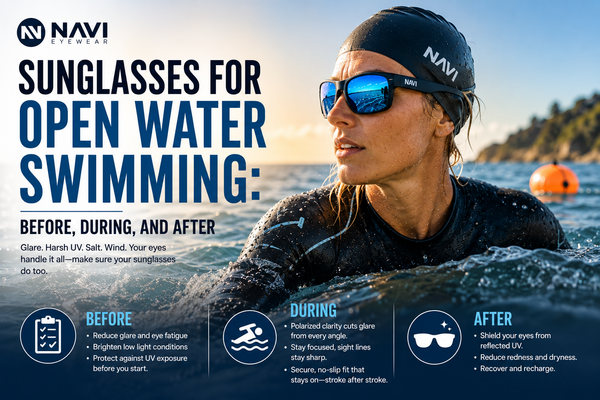

Sunglasses for Open Water Swimming: Before, During, and After
Open water swimming presents the most unusual sunglasses use case in water sports: standard sunglasses cannot be worn during the freestyle swim stroke — the face-in-water technique of competitive open water swimming makes sunglass use physically incompatible with the sport itself. But the UV exposure surrounding an open water swim — waiting at the start, standing in the shallows, transition areas, and post-race recovery — is substantial, often in the highest-UV environments (ocean, lake, reservoir) at peak UV hours (race start times of 7–9am at major events, midday training sessions). This guide covers what eye protection works for open water swimmers at every stage, and why the pre- and post-swim UV exposure is worth taking seriously. For the full water sports context, see the complete water sports sunglasses guide.

1. The Open Water Swimming UV Profile
When Open Water Swimmers Actually Get UV
The UV exposure profile of an open water swimmer differs from other water sports because the sport's active phase is mostly incompatible with sunglass use. UV accumulates in these specific windows:
- Pre-swim warm-up and staging: race starts and training sessions often involve 30–60 minutes of standing, stretching, and warming up at the water's edge before entry. For mass-start events, the staging area can involve an hour or more of outdoor time in direct sun.
- The swim itself: the face-in-water technique means eyes are either submerged or briefly exposed to air during the breathing stroke. UV reaches the eyes briefly during the air phase of each breath cycle, and reflected UV from the water surface reaches the eyes when sighting (lifting the head to navigate). Swim goggles — a separate product with a face-sealing gasket — are the appropriate eye protection during the swim stroke itself.
- Transition areas (triathlon): for triathletes doing open water swim legs, transition from swim to bike is a UV exposure moment — goggles removed, sunglasses put on as part of the T1 transition before mounting the bike. This transition sunglasses use case is well-established in triathlon culture.
- Post-swim recovery: finish areas, recovery zones, and post-race social time at outdoor venues involve extended UV exposure in the high-UV water environments where open water events take place.
Race Venue UV Amplification
Open water events are held in high-UV environments by definition — ocean bays, reservoirs, lakes, and rivers all reflect UV from their surfaces, amplifying effective UV exposure above what the UV index alone indicates. A race at a lake venue at 9am in summer involves the morning UV ramp (UV index 4–6) amplified by lake surface reflection, with participants standing in open areas with no shade during staging and finish areas. The cumulative pre- and post-swim UV at a race venue is meaningful for regular competitors who race frequently.
2. Swim Goggles vs Sunglasses: The Right Tool for Each Phase
Swim Goggles: For the Swim
Tinted swim goggles — available in UV-blocking tinted lenses with a face-sealing gasket — are the appropriate eye protection during the actual swim stroke. They seal to the face, prevent water entry, and provide UV-blocking tinted lenses that protect the eyes during the brief air-phase UV exposure of the breathing stroke and the more significant UV exposure during sighting strokes. UV-blocking swim goggles specifically designed for open water use provide the most complete protection during the swim itself.
Key swim goggle features for UV protection: UV400 lens coating (many swim goggles specify this), tinted lens (copper or amber for open water, mirrored for bright conditions), and anti-fog treatment. Swim goggles are not sunglasses and are outside the scope of this guide — they are a necessary component of the open water swimmer's UV protection kit alongside sunglasses for the non-swim phases.
Sunglasses: For Everything Else
UV400 polarized sunglasses for all the non-swimming phases of an open water swim session or race: warm-up, staging, transitions (in triathlon), recovery, and all pre- and post-venue time. The sunglass specification for open water swimmers prioritizes the beach and open water environment rather than the swim stroke itself — copper or amber Cat 2–3 polarized UV400 polycarbonate for the high-reflectance open water venue.
3. Lens Specification for Open Water Swimmers
Pre-Swim and Post-Swim: Copper or Amber Cat 2 Polarized
The sunglass lens for open water swimmer pre- and post-swim use is the standard coastal/beach specification:
- Copper polarized Cat 2 for ocean and coastal open water events — maximum water surface glare elimination, appropriate for the blue-toned reflection of saltwater venues, Cat 2 for the morning UV ramp of typical race start times (7–9am) where Cat 3 would be uncomfortably dark in the lower-angle morning light.
- Amber polarized Cat 2 for freshwater lake and reservoir events — amber's contrast enhancement for the green-brown water tones of freshwater venues, Cat 2 for variable morning light conditions.
- Cat 3 for either tint in midday training sessions where UV index is at peak — morning race UV typically warrants Cat 2; afternoon training sessions at UV index 8–12 warrant Cat 3.
Triathlon T1 Transition Sunglasses
For triathletes, the T1 (swim-to-bike) transition sunglasses are a distinct use case — they need to be grabbed quickly from the transition bag, put on rapidly while moving, and worn immediately for cycling. The triathlon transition sunglass is typically the athlete's primary cycling pair — amber Cat 2 polarized UV400 in a sport frame that works for both the brief on-foot transition run and the extended bike leg. Pre-positioning the glasses open in the transition bag (temple arms spread) allows a one-motion grab-and-place that minimizes transition time while ensuring UV400 coverage for the bike leg that begins immediately after exiting transition. Browse UV400 polarized sport options at navieyewear.com.
4. Saltwater and Chlorine Considerations
Saltwater Open Water Events
Ocean and saltwater open water events expose sunglasses to the same saltwater requirements as other ocean water sports — anti-saltwater coating, stainless steel hardware, and fresh water rinsing after every session. Sunglasses worn at the staging area of an ocean event and during post-swim recovery receive salt spray and may be handled with salt-contaminated hands — the same care protocol applies: rinse before drying, clean with mild soap weekly, store in a case.
Chlorinated Pool Training Sessions
Some open water swimmers train in pools with open water technique sets — flip turns excluded, swimming long sets in a chlorinated environment. Chlorine is less corrosive to sunglass hardware than saltwater but is still a mild chemical that degrades some coating systems over time with direct contact. Sunglasses worn at the pool deck, during warm-up, and post-session are not typically in direct chlorine contact — the exposure is ambient rather than immersion. Fresh water rinsing after pool sessions where the frame received splash or handling with chlorine-wet hands is a simple precaution.
5. Open Water UV Hotspots: Race Venues Worth Noting
High-UV Open Water Venues
Open water events at high-UV locations warrant extra UV protection awareness:
- Hawaii open water races: Waikiki Roughwater Swim, Kaiwi Channel crossings — tropical Pacific UV index 12–14, saltwater amplification, extended pre-race staging in full sun
- Catalina Channel and La Jolla Cove (Southern California): summer UV index 10–12, open ocean with no shade at swim venues
- Florida Gulf and Atlantic open water events: year-round high UV, flat water with high reflectance at typical race staging times
- Colorado and mountain reservoir events: altitude UV amplification (10–12% per 1,000 meters) at reservoir venues above 5,000 feet adds meaningfully to the UV dose at mountain open water events
- Texas and Gulf Coast events: high summer UV, flat reflective water surfaces, minimal natural shade at race venues
6. Building a Complete Open Water Swimmer UV Kit
The Two-Product Approach
Complete UV protection for open water swimming requires two products covering two phases:
- UV-blocking tinted swim goggles: for the swim stroke itself — UV400 tinted goggle lenses protect during sighting strokes and the brief air phase of each breath cycle
- UV400 polarized sunglasses: for all pre- and post-swim phases — staging, warm-up, transition, recovery, and all venue time outside the water
Neither product substitutes for the other. Swim goggles do not provide the peripheral coverage, wraparound UV protection, or the polarized glare elimination of sunglasses for staging and venue time. Sunglasses cannot be worn during the freestyle swim stroke. Both are needed for complete coverage across an open water swim session.
The Transition Bag Setup for Triathletes
For triathletes, the transition bag setup that includes sunglasses in a pre-opened position (ready to grab) allows seamless UV400 coverage from swim exit through bike and run legs. The same amber or copper polarized UV400 pair that works for the bike leg cycling UV exposure handles the post-swim staging and transition area UV in the brief window between removing goggles and donning the cycling helmet. One pair covers multiple UV exposure phases of the triathlon.
Frequently Asked Questions
Can you wear sunglasses while open water swimming?
Not during the freestyle swim stroke — the face-in-water technique is incompatible with standard sunglass frames, which would fill with water, create drag, and come off during the stroke. Tinted UV-blocking swim goggles are the appropriate eye protection during the swim. Sunglasses for all pre- and post-swim phases: staging, warm-up, transition, and recovery.
What goggles are best for open water swimming UV protection?
UV400 tinted swim goggles designed specifically for open water use — typically with amber or copper tinted lenses, UV400 coating, anti-fog treatment, and a wider field of view than pool goggles to support open water sighting. Mirrored UV400 goggles for very bright conditions (midday Hawaii or Florida open water events). Goggle selection is outside the scope of Navi Eyewear's product range — Navi provides the sunglass component of the open water swimmer's eye protection kit.
What sunglasses should I wear at an open water swim event?
Copper Cat 2 polarized UV400 polycarbonate for ocean and saltwater events; amber Cat 2 polarized UV400 for freshwater lake events. Cat 2 for morning race starts; Cat 3 for midday training sessions. TR90 sport frame with rubber grip contacts and anti-saltwater coating for coastal events. The same pair worn pre-swim can handle post-swim recovery without requiring a separate pair for venue use.
How do triathlon sunglasses fit into the T1 transition?
Position sunglasses open (temple arms spread) in the transition bag on top of other gear, oriented for a quick grab with the left hand while the right hand handles helmet straps. Many experienced triathletes practice the goggle-off, glasses-on, helmet-on sequence until it is automatic — shaving seconds in T1 while ensuring UV400 coverage for the bike leg begins immediately. Amber polarized UV400 for the combined bike and run UV exposure of the non-swim legs.
Do I need special sunglasses for open water swimming or will regular sport sunglasses work?
UV400 polarized polycarbonate sport sunglasses work for the pre- and post-swim phases of open water events. The additional requirement for saltwater events is anti-saltwater coating — a regular sport frame without this coating will degrade with regular saltwater exposure. For freshwater events, a standard UV400 polarized sport frame is fully adequate for venue use.
The Bottom Line
Open water swimming requires a two-product UV protection approach: UV400 tinted swim goggles for the swim stroke, UV400 polarized sunglasses for all pre- and post-swim phases. The staging areas, warm-up zones, transition areas, and recovery spaces of open water events are high-UV outdoor environments where meaningful UV accumulates — particularly at coastal ocean venues where water reflection amplifies effective UV above the UV index alone. Copper Cat 2 polarized UV400 for ocean events, amber Cat 2 polarized UV400 for freshwater events, with anti-saltwater coating for coastal use. navieyewear.com/collections/polarized — Buy 1, Get 3 Free for $119.
Related Reading
- The Complete Water Sports Sunglasses Guide | Navi Eyewear
- Sunglasses for Surfing | Navi Eyewear
- Sunglasses for Kayaking and Paddleboarding | Navi Eyewear
- Sunglasses for Outdoor Exercise | Navi Eyewear
- How Polarized Sunglasses Work | Navi Eyewear
- Summer UV: Peak Season Eye Protection | Navi Eyewear
- Sunglasses for Beach Volleyball | Navi Eyewear
- Shop Polarized UV400 Sunglasses | Navi Eyewear
Sources & Citations
[1] WHO. "Global solar UV index: a practical guide." World Health Organization, 2002. View source →
[2] Sliney DH. "Ocular exposure to environmental light and ultraviolet." Journal of AAPOS, 2014. View source →
[3] Dain SJ. "Sunglasses and sunglass standards." Clinical and Experimental Optometry, 2003. View source →
[4] Taylor HR, et al. "Effect of ultraviolet radiation on cataract formation." New England Journal of Medicine, 1988. View source →
[5] Rosenthal FS, et al. "The effect of sunglasses on ocular exposure to ultraviolet radiation." American Journal of Public Health, 1988. View source →
[6] ISO 12312-1:2013. "Eye and face protection — Sunglasses and related eyewear." International Organization for Standardization. View source →