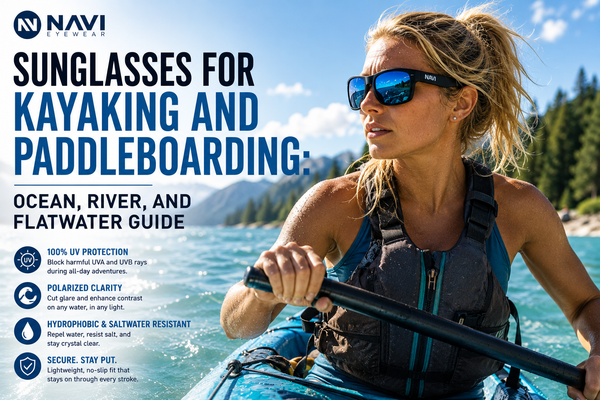

Sunglasses for Kayaking and Paddleboarding: Ocean, River, and Flatwater Guide
Kayaking and paddleboarding cover three distinct water environments with meaningfully different UV and optical demands: ocean coastal paddling (high reflected UV, salt spray, potential for capsizing), whitewater river kayaking (spray, rapid head movement, capsizing risk in moving water), and flatwater inland paddling on lakes and rivers (moderate UV, low capsizing risk, extended duration). The lens tint, retention strategy, and frame spec that works for ocean sea kayaking differs from what works for whitewater, which differs from a flatwater SUP session on a calm lake. This guide covers each environment separately. For the full water sports specification context, see the complete water sports sunglasses guide.

1. Ocean and Coastal Kayaking
The Environment
Ocean sea kayaking and coastal paddling involve sustained open-water UV exposure with water reflection amplification, salt spray on lenses and hardware, wind at paddling pace, and the possibility of capsize in surf zones, crossings, and offshore conditions. Multi-hour ocean kayak tours and crossings are among the highest sustained UV dose events of any paddle sport — open ocean with no shade, reflected UV from the water surface, and the sustained exposure duration of a 3–6 hour tour combine to produce significant UV accumulation.
Lens Specification
Copper Cat 3 polarized UV400 polycarbonate — the ocean kayaking specification matches the ocean surfing and sailing specification. Copper for maximum water surface glare elimination in the blue-dominated ocean reflection environment; Cat 3 for sustained peak-UV open water exposure; polarized for the water surface glare that makes ocean navigation and wave reading genuinely clearer through a polarized lens. Anti-saltwater, hydrophobic, and oleophobic coatings are required for the salt spray and sunscreen exposure of ocean paddling. Browse copper polarized UV400 options at navieyewear.com.
Frame and Retention
TR90 wraparound sport frame with rubber grip contacts and a retention strap for ocean kayaking. The capsize risk of ocean crossings and surf zone launches makes retention strap use appropriate — a frame lost in an ocean capsize is irretrievable, and surfing through a break during a beach landing creates wave impact forces comparable to those in surfing. Floating retention straps are worth considering for multi-day expeditions where frame loss at sea would leave the paddler without eye protection for the remainder of the trip.
2. Whitewater Kayaking
The Environment
Whitewater river kayaking involves the most dynamic frame retention demands of any paddle sport — roll practice and combat rolls submerge the paddler completely, rapid head movement through technical sections, spray and aerated water in Class III+ conditions, and the physical contact scenarios of rock gardens and hydraulics. Whitewater UV is typically lower than ocean UV (rivers are often in canyons or surrounded by canyon walls that limit sky exposure), but the retention and impact resistance demands are the highest of any water activity.
Lens Specification
Amber Cat 2 polarized UV400 polycarbonate for whitewater. Amber rather than copper: whitewater rivers reflect greenish-brown water tones rather than the blue-sky reflection of ocean surfaces — amber's warm spectrum enhancement improves contrast for reading water features (holes, eddies, pillows, standing waves) in the turbulent visual environment of moving water. Cat 2 for the variable light of river canyons where canyon walls and tree cover create alternating shade and sun that Cat 3 would handle poorly. Polycarbonate specifically for the impact resistance that rock garden contact makes relevant — a polycarbonate lens that takes a rock hit stays intact; a glass or budget plastic lens may not.
Frame and Retention
TR90 wraparound sport frame with maximum rubber grip contacts, rubber temple tips, and a neoprene retention strap fitted snug enough to stay on through rolls. For dedicated whitewater paddlers who roll regularly, the retention strap must be fitted correctly — not so tight as to be uncomfortable during a full day of paddling, but tight enough that the frame stays on through the hydrodynamic force of a roll. Many whitewater kayakers use a strap one size tighter than they'd use for flatwater paddling to account for roll forces.
Helmet compatibility is a practical consideration for whitewater kayaking — the helmet worn for Class III+ whitewater sits over the ears, and some helmet designs conflict with standard temple arm routing. Low-profile temple arms and frames designed to sit closer to the face work better under whitewater helmets than standard sport frames with prominent temple arm geometry.
3. Flatwater Kayaking and Stand-Up Paddleboarding
The Environment
Flatwater kayaking on lakes and calm rivers, and stand-up paddleboarding (SUP) on lakes, bays, and calm ocean water, share a UV environment that is lower-intensity than open ocean but still significant for extended sessions — particularly on high-reflection lake surfaces at midday, or ocean bay SUP in summer. Capsize risk on flatwater is significantly lower than in surf or whitewater, which changes the retention requirement. Extended flatwater sessions — a 2–3 hour SUP tour, a full day of lake kayaking — accumulate meaningful UV over their duration even at lower per-hour UV intensities.
Lens Specification
Copper or amber Cat 2 polarized UV400 polycarbonate for flatwater paddling. Copper for flatwater SUP on bays and calm ocean water where the reflection is still blue-dominated; amber for inland lake and river flatwater where the reflection character is more green-brown. Cat 2 for the variable light conditions of a flatwater session that moves between sun and cloud, open water and tree-shaded shoreline. Polarization is as valuable on flatwater as on open ocean — calm water at Brewster's angle produces near-complete polarization of surface reflection, and the sub-surface visibility that polarization provides (reading depth, bottom features, marine life) is one of the most rewarding aspects of flatwater paddling with polarized lenses.
Frame and Retention for SUP
Stand-up paddleboarding presents a unique retention consideration — standing upright on an unstable platform, falling to one side or forward onto the board or into the water is a regular occurrence, particularly for beginners. The height of a fall from standing position on a SUP board is greater than a seated kayak capsize, and the impact of hitting the water from standing height is more jarring. Rubber grip contacts and close-fitting wraparound geometry are adequate for most SUP use; a retention strap is appropriate for open water SUP where falling overboard in a current or wind could separate the paddler from the board before glasses can be retrieved.
For SUP specifically, floating frames or floating retention straps have particular value — a frame that falls in the water during a SUP fall floats at the surface and can be retrieved; a frame that sinks in 10 feet of water is gone. Browse UV400 polarized options suitable for flatwater paddling at navieyewear.com.
4. Paddling-Specific Vision Benefits of Polarized Lenses
Reading Water Features
Experienced kayakers and paddleboarders read the water surface for navigation information — current direction, depth, obstacles, and hazards visible through the surface in clear water. Non-polarized lenses render the water surface as a partially reflective mirror that obscures sub-surface information; polarized lenses eliminate the reflection layer, revealing sub-surface features that are invisible to non-polarized vision. In shallow rivers, this means seeing rocks and ledges that would otherwise be hidden by surface glare until the paddler is on top of them. In coastal waters, it means reading the bottom contour, kelp beds, and reef features that influence wave behavior.
Glare Fatigue on Long Paddles
Multi-hour flatwater and ocean paddling sessions involve sustained exposure to water surface reflection that produces visual fatigue through the glare mechanism — the eye repeatedly contracts the pupil to manage high-luminance surface glare while the scene behind it requires more aperture. Over a 3–4 hour paddle, this sustained glare management produces measurable fatigue that accumulates to end-of-session eye strain and headache. Polarized lenses eliminate the glare stimulus rather than dimming it proportionally — removing the fatigue driver rather than reducing it. Paddlers who switch to polarized consistently report less end-of-session eye fatigue than with unpolarized or non-polarized lenses.
Wildlife and Marine Life Visibility
For recreational kayakers and paddleboarders, one of the most practically appreciated benefits of copper polarized lenses is the dramatically improved sub-surface visibility for marine life — sea turtles, rays, fish schools, dolphins below the surface — that is invisible through non-polarized lenses and clearly visible through copper polarized. In clear water kayak and SUP touring destinations (Florida Keys, Hawaii, Caribbean, Pacific Coast), the marine life viewing improvement alone is frequently cited by paddlers as the most immediately noticeable benefit of upgrading to polarized copper lenses.
5. Paddle Sport Lens Comparison by Context
| Paddling Context | Tint | Category | Retention | Key Requirement |
|---|---|---|---|---|
| Ocean sea kayaking | Copper polarized | Cat 3 | Strap required | Anti-saltwater coating; floating strap for expeditions |
| Coastal surf zone launching | Copper polarized | Cat 3 | Strap required | Wave impact retention; same spec as surfing |
| Whitewater Class I–II | Amber polarized | Cat 2 | Strap recommended | Polycarbonate impact resistance |
| Whitewater Class III+ | Amber polarized | Cat 2 | Strap required; helmet compatible | Roll retention; helmet fit; impact resistance |
| Flatwater lake kayaking | Amber or copper polarized | Cat 2 | Grip contacts adequate | Sustained UV protection for long sessions |
| Ocean/bay SUP | Copper polarized | Cat 2–3 | Floating strap recommended | Fall-off-board retention; anti-saltwater coating |
| Inland flatwater SUP | Amber or copper polarized | Cat 2 | Grip contacts adequate for calm water | Sub-surface visibility; variable light Cat 2 |
| Kayak fishing | Copper polarized | Cat 3 | Floating strap — frame loss risk | Maximum sub-surface fish visibility |
6. Caring for Paddle Sport Sunglasses
Fresh Water Rinse After Every Session
The post-session care rule for all paddle sports involving saltwater or river water is identical: rinse completely with fresh water before salt, sediment, or river mineral deposits dry on the lens or hardware. For kayak fishing where frame handling with fish-scented hands is frequent, mild soap cleaning after sessions prevents organic residue buildup that attracts insects and creates lens smearing. Store in a case when not in use to prevent mechanical scratching from loose gear in kayak hatches or SUP bags.
Hatch and Pocket Storage
Kayak cockpit storage and deck bags for SUP create environments where sunglasses can be scratched by loose gear — paddle parts, dry bag closures, and equipment clips all scratch lens surfaces in unprotected storage. A hard case or semi-rigid neoprene case in the hatch or bag keeps lenses protected between sessions and during transport. The hard case that protects glasses on land protects them equally in a kayak hatch from the movement-induced scratching of loose deck gear.
Frequently Asked Questions
Do I need a retention strap for paddleboarding?
For ocean and open bay SUP where falling off the board could result in frame loss at sea: yes, a floating retention strap is appropriate. For flatwater and protected water SUP where falls result in retrievable frames: rubber grip contacts and a close-fitting frame are typically adequate. The floating strap adds security on open water where a dropped frame sinks in deep water or drifts away in current or wind.
What's the best lens color for kayaking?
Copper for ocean and coastal kayaking — maximum water surface glare elimination in the blue-dominated ocean reflection environment, and best sub-surface visibility for reef, bottom, and marine life viewing. Amber for whitewater and inland river kayaking — better contrast for reading turbulent water features and more appropriate for the variable light of river canyon environments. Amber or copper Cat 2 for flatwater lake paddling depending on whether the water environment is more ocean-influenced (copper) or freshwater inland (amber).
Can I wear regular sunglasses for kayaking?
Lifestyle sunglasses with UV400 polarized polycarbonate lenses and adequate grip contacts work for low-intensity flatwater kayaking and SUP where capsizing is unlikely. For ocean kayaking and whitewater, the additional requirements — anti-saltwater coating, retention strap, stainless hardware, TR90 frame — matter for durability and retention in the demanding conditions of those environments. The lens specification can be the same; the frame and retention requirements differ.
Are polarized lenses worth it for paddleboarding?
Absolutely — the sub-surface visibility improvement from polarized lenses on clear water is one of the most dramatic optical differences in any use case. Calm lake or ocean water at Brewster's angle produces near-complete surface reflection that polarized lenses eliminate, making fish, bottom features, and underwater obstacles that are invisible without polarization clearly visible. For SUP touring in clear water locations, copper polarized lenses change the experience of being on the water fundamentally — not marginally.
How do I stop my sunglasses from fogging during kayaking?
Fogging occurs when humid air is trapped between a close-fitting lens and the face — common in high-intensity paddling where body heat and exertion elevate facial temperature and humidity. Solutions: frames with ventilation channels or slots that allow air circulation; anti-fog lens coatings; and lifting the frame slightly off the face between efforts to ventilate. For whitewater where close fit is required for retention and spray protection, anti-fog treatment applied to the lens interior surface is the most practical solution.
What about prescription lenses for kayaking?
Prescription water sport sunglasses are available in impact-resistant polarized polycarbonate — an appropriate and practical solution for prescription eyeglass wearers who kayak regularly. Alternatively, soft contact lenses worn under non-prescription UV400 polarized water sport sunglasses are a common and practical approach. Hard contact lenses are not recommended for water sport use — water contact can dislodge them; soft lenses are more stable in water environments, though they should be replaced after water sport sessions per standard contact lens hygiene.
The Bottom Line
Kayaking and paddleboarding span three UV and optical environments that require meaningfully different lens tints and retention approaches: copper Cat 3 with retention strap for ocean and coastal paddling, amber Cat 2 with roll-rated retention strap for whitewater, and copper or amber Cat 2 with grip contacts or floating strap for flatwater. All share the UV400 polycarbonate polarized foundation and the TR90 stainless frame requirements that make water sport sunglasses durable and functional across seasons of regular use. The sub-surface visibility improvement of polarized lenses on clear water is one of the most immediately and consistently appreciated optical improvements any paddler makes. navieyewear.com/collections/polarized — Buy 1, Get 3 Free for $119.
Related Reading
- The Complete Water Sports Sunglasses Guide | Navi Eyewear
- Sunglasses for Surfing | Navi Eyewear
- The Complete Fishing Sunglasses Guide | Navi Eyewear
- How Polarized Sunglasses Work | Navi Eyewear
- The Science of Lens Color | Navi Eyewear
- Sunglasses for Cruise and Open Water | Navi Eyewear
- The Complete Hiking Sunglasses Guide | Navi Eyewear
- Shop Polarized UV400 Sunglasses | Navi Eyewear
Sources & Citations
[1] Sliney DH. "Ocular exposure to environmental light and ultraviolet." Journal of AAPOS, 2014. View source →
[2] WHO. "Global solar UV index: a practical guide." World Health Organization, 2002. View source →
[3] Dain SJ. "Sunglasses and sunglass standards." Clinical and Experimental Optometry, 2003. View source →
[4] Hecht E. "Optics." 4th edition. Addison Wesley, 2002. View source →
[5] ISO 12312-1:2013. "Eye and face protection — Sunglasses and related eyewear." International Organization for Standardization. View source →
[6] Taylor HR, et al. "Effect of ultraviolet radiation on cataract formation." New England Journal of Medicine, 1988. View source →