
Sunglasses for Surfing: What Actually Stays On in the Waves
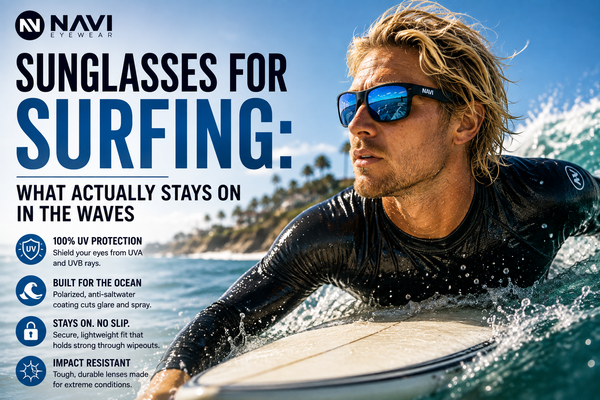
Surfing is one of the most demanding environments for sunglasses of any outdoor activity. Wave impact forces that would dislodge any frame not secured with a retention strap, sustained salt spray and full submersion in wipeouts, intense UV from both overhead sun and water reflection, and the physical demands of paddling, duck-diving, and popping up on the board — all combine to make a standard sport sunglass inadequate for in-water surfing. The honest answer about wearing sunglasses while actively surfing is that a retention strap is mandatory, and many experienced surfers wear glasses for paddling out and waiting for sets but remove them for the actual wave ride. This guide covers what works, when it works, and the complete spec for surfers who want UV protection at the beach and in the water. For the complete water sports overview, see the complete water sports sunglasses guide.

1. The Surfing UV Environment
UV From Above and Below Simultaneously
The surfing environment is one of the highest-UV contexts most people encounter. Ocean water reflects 25–100% of UV depending on sun angle and surface conditions — at the angles typical of a morning or midday surf session, effective UV reaching the face and eyes includes direct overhead UV plus a significant reflected component from the water surface. Lying on the board paddling out — a supine or prone position facing the horizon — exposes the face directly to forward-angle sun and to reflected UV from the water surface in front of and below the visual field.
Surfers who spend 2–4 hours in the water during a session accumulate UV at rates comparable to sustained beach UV exposure, amplified by the water reflection component. The face and eyes of a regular surfer who doesn't use UV protection accumulate significant lifetime UV dose — contributing directly to the elevated rates of photokeratitis, pterygium, and cataract documented in occupational and recreational surfer populations.
Pterygium and the Surfer
Surfers have some of the highest documented pterygium rates of any recreational group — "surfer's eye" is a colloquial term specifically because of the well-established association between surfing and pterygium formation. The mechanism is directly UV-related: the nasal limbus receives concentrated UV from temporal sun angles (the UV entering from the temporal side focusing on the nasal limbus), amplified by water reflection from below, and exacerbated by wind and salt spray that adds the co-factor of conjunctival irritation. Wraparound frames that block temporal UV entry — the specific UV pathway to the nasal limbus where pterygium originates — are particularly relevant for surfers. See the complete pterygium guide.
2. The Reality of Wearing Glasses While Surfing
What Happens Without a Retention Strap
A sunglass frame without a retention strap in an active surfing session will not stay on the face through a wipeout. When a wave takes the surfer underwater — even briefly — the hydrodynamic force of water rushing past the face removes any frame that relies only on nose contact and temple friction for retention. The frame floats to the surface (if the lenses provide enough buoyancy), the surfer surfaces 5–20 meters from where they went under, and the glasses are gone by the time they can look for them. Without a retention strap, losing glasses in the surf is not a question of if but when.
The Retention Strap: Mandatory for Active Surfing
A neoprene or silicone retention strap connecting the two temple tips behind the head is the minimum equipment addition that makes wearing sunglasses during active surfing viable. The strap keeps the frame on the head through wipeouts and duck-dives, prevents the frame from floating away on submersion, and provides the consistent tension that keeps the frame in position during the vigorous head movement of paddling and popping up.
Strap fit matters: too loose and the frame still moves during wave impact; correctly tensioned (slight pressure on temples during wear, not uncomfortable) and the frame stays in position through most wipeout scenarios. The neoprene material of most surf-specific retainers has the slight grip against wetsuit or skin that helps maintain position without slipping during rapid head movement.
When Surfers Actually Wear Glasses: The Practical Zones
Experienced surfers typically use sunglasses in specific zones of the surf session rather than continuously:
- Beach and pre-entry: full UV400 protection while on the beach, waxing the board, watching the break, and walking to the water. This is the most consistent UV protection opportunity and requires no special retention.
- Paddling out: glasses with retention strap worn during the paddle out, particularly in offshore conditions where the paddle is long and sun exposure is sustained. Removed or retained by strap through duck-dives.
- Waiting for sets: sitting on the board in the lineup between waves — the most sustained stationary sun exposure of a surf session, particularly in glassy conditions where water reflection is most intense. Retention-strapped glasses during this period provide significant UV protection for the extended wait times at popular breaks.
- Wave riding: many surfers remove glasses before taking a wave to avoid the distraction and loss risk of a wipeout. Others wear them with full retention straps for the wave. This is personal preference — the retention strap handles the physics of wave impact, but some surfers prefer the unrestricted visual field and zero-distraction of glasses-free wave riding.
3. The Surf-Specific Lens Specification
Copper Cat 3 Polarized UV400 Polycarbonate
The surf lens specification is the purest water sports application of the copper polarized case:
- Copper tint: maximum water surface glare elimination through strong blue absorption combined with polarization. Reading the ocean — identifying incoming sets, reading wave faces, spotting rips and channels — is dramatically clearer through copper polarization than any other lens color. The water turns from a blinding mirror to a readable surface through which depth, bottom features (in clear water), and wave structure are visible.
- Cat 3 (8–18% light transmission): peak UV conditions at the beach and open ocean in a typical surf session — combined overhead and reflected UV warrants Cat 3 darkness during peak midday surf hours. Cat 2 is acceptable for dawn patrol and late afternoon sessions when UV index is lower.
- Polarized: non-negotiable for ocean use — eliminates the specific horizontally polarized component of water surface reflection that makes ocean glare uniquely intense and disruptive.
- UV400 polycarbonate: complete UV blocking in the highest UV accumulation environment many recreational users encounter, with impact resistance for the physical contact possibilities of surf equipment.
Lens Coatings for Saltwater
Anti-saltwater coating, hydrophobic coating, and oleophobic coating are the three coating requirements for surfing specifically. Salt spray hits the lens continuously during paddling and sitting in the lineup; hydrophobic coating causes droplets to bead and run off rather than forming an obscuring water film; anti-saltwater coating prevents the coating degradation and delamination that occurs without it under sustained saltwater exposure; oleophobic coating allows sunscreen residue to be cleaned off without smearing. Browse UV400 polarized options with full coating suite at navieyewear.com.
4. Frame Selection for Surfing
TR90 Wraparound Sport Frame
TR90 nylon is the correct frame material for surfing — chemically resistant to the combination of saltwater, sunscreen, and UV that degrades other materials; flexible enough to absorb wave impact and equipment contact without fracturing; shape-memory so it returns to original geometry after being bent; and light enough that the frame doesn't drag down on the nose under water tension when submerged.
Wraparound geometry is appropriate for the elevated peripheral UV of the surf environment — UV enters from multiple directions in the open ocean, and close-fitting wraparound designs that reduce the gap between lens edge and face minimize peripheral UV entry from water-reflected angles that flat-lens designs leave exposed. The temporal UV entry gap that flat-lens designs leave is specifically the UV pathway to the nasal limbus that drives surfer's pterygium — wraparound coverage closes this gap.
Rubber Grip Contacts and Temple Tips
Rubber nose contacts and rubber temple tips that grip the skin provide the primary retention mechanism before the retention strap engages. On the paddle-out and while waiting between sets — when the surfer is upright and the strap isn't under tension — rubber grip contacts and temple tips keep the frame in position without relying on the strap. The strap is backup for the wipeout scenario; rubber contacts are the primary retention for normal active use.
Hinge and Hardware Durability
Stainless steel 5-barrel hinges resist the saltwater corrosion that seizes standard steel hinges after a season of regular saltwater exposure. For year-round surfers, hardware quality is a meaningful durability factor — stainless steel hardware on a quality TR90 frame should last multiple surf seasons with proper post-session rinsing; standard alloy hardware in salt water typically begins to corrode within one season.
5. Post-Session Care for Surf Sunglasses
The Rinse-First Rule
After every surf session: rinse the complete frame, lenses, and hardware with fresh water before any salt deposits dry. This is the single most important maintenance practice for extending surf sunglass life — dry salt crystals abrade lens coatings when wiped, and dried salt on hinges and hardware accelerates corrosion. Rinsing within minutes of exiting the water, before the salt spray dries in the sun, prevents the majority of saltwater damage.
Sunscreen Removal
Sunscreen is the other major lens contaminator for surfers — zinc oxide and chemical sunscreen formulas adhere strongly to lens surfaces and can smear into an opaque film if not properly removed. Mild dish soap (a drop on wet fingers, gentle circular cleaning of the lens surface, followed by thorough fresh water rinse) removes sunscreen residue that water rinsing alone doesn't clear. Oleophobic-coated lenses reduce adhesion, making removal easier.
6. Dawn Patrol vs Midday Surf: UV Timing Considerations
Dawn Patrol (Before 8am)
UV index at dawn patrol hours — 5:30am to 8am — is typically 0–3 depending on season and location. Cat 1–2 lenses are appropriate for dawn sessions where brightness reduction matters more for comfort than UV protection intensity. Amber Cat 2 or copper Cat 2 for dawn patrol: contrast enhancement helps read the ocean in the lower-contrast light of early morning, when wave faces and surface features can be harder to distinguish than in bright midday sun.
Midday Surf (10am–2pm)
Peak UV hours in the surf are among the highest-UV scenarios most recreational users encounter. UV index 10–13 at beach locations in summer, amplified by water reflection, makes Cat 3 the appropriate category and copper polarized UV400 the correct specification for sustained midday surf sessions. This is not a theoretical UV risk — regular surfers who session through midday without eye protection accumulate among the highest recreational UV doses of any outdoor group.
Sunset Sessions
Late afternoon and sunset surf sessions involve lower UV index but increasingly direct low-angle sun across the horizon — the setting sun directly at the surfer's eye level as they face toward shore or the horizon. Copper polarized Cat 2 for sunset sessions — adequate darkness for the lower UV, maximum glare elimination for the direct low-angle reflected glare off the water surface at sunset sun angles.
Frequently Asked Questions
Can you surf with sunglasses on?
Yes — with a retention strap. Without a retention strap, frames come off during wipeouts and are typically lost. With a properly fitted neoprene or silicone retention strap, most frames stay on through all but the most violent wipeouts. Many experienced surfers wear glasses with retention straps during paddling and lineup time and make a personal choice about whether to wear them while actively riding waves.
What are the best sunglasses for surfing?
Copper Cat 3 polarized UV400 polycarbonate in a TR90 wraparound sport frame with rubber grip contacts, anti-saltwater coating, hydrophobic coating, oleophobic coating, stainless steel 5-barrel hinges, and a neoprene retention strap. This covers all the environmental demands of the surf context: maximum water glare elimination, UV amplification from ocean reflection, saltwater durability, and wave impact retention.
What is surfer's eye?
Surfer's eye is a colloquial term for pterygium — a UV-driven fibrovascular growth that develops on the conjunctiva (white of the eye) and spreads across the corneal surface. Surfers have significantly elevated pterygium rates compared to the general population due to the combination of high ocean UV, wind and salt spray irritation, and the specific UV geometry of the surf environment that concentrates temporal UV onto the nasal limbus where pterygium originates. UV400 wraparound eyewear that blocks temporal UV entry is the primary prevention. See the complete pterygium guide.
Will saltwater damage my sunglasses?
Without anti-saltwater coating and proper post-session care, yes — saltwater deposits salt crystals that abrade lens coatings when wiped dry, the ionic content of salt water corrodes standard metal hardware, and sustained saltwater exposure degrades non-protected coatings through delamination and clouding. With anti-saltwater coating, stainless steel hardware, and a discipline of fresh water rinsing after every session, quality surf sunglasses last multiple seasons in regular use.
Do I need special surfing sunglasses or will regular sport sunglasses work?
Regular sport sunglasses that lack anti-saltwater coating will degrade faster in regular surf use. More critically, regular sport frames without retention strap capability will be lost in the first significant wipeout. The lens specification (UV400 polycarbonate polarized) is shared — the additional surf requirements are anti-saltwater coating, hydrophobic coating, stainless hardware, and retention strap compatibility. Many TR90 sport frames accept standard retention strap widths without modification.
Should I wear sunglasses for dawn patrol?
Yes — UV at dawn patrol hours (5:30–8am) is lower than midday but not zero in summer, and the eye health case for consistent UV protection applies even at lower UV index values for regular daily exposure. The performance case for copper or amber polarized is also relevant at dawn: reading the ocean surface in the flat, lower-contrast light of early morning is genuinely clearer through contrast-enhancing polarized lenses than without. Cat 1–2 for dawn sessions where Cat 3 would be unnecessarily dark.
The Bottom Line
Surfing is a high-UV, high-saltwater, high-dynamic-force environment that demands a specific sunglass setup: copper Cat 3 polarized UV400 polycarbonate, anti-saltwater and hydrophobic coatings, TR90 wraparound frame with stainless hardware, and a neoprene retention strap. Surfers who surf regularly without UV eye protection accumulate significant UV dose and have documented elevated rates of pterygium, photokeratitis, and cataracts. The retention strap solves the "glasses come off in waves" problem that makes many surfers think sunglasses aren't viable for surfing — they are, with the right setup. navieyewear.com/collections/polarized — Buy 1, Get 3 Free for $119.
Related Reading
- The Complete Water Sports Sunglasses Guide | Navi Eyewear
- Pterygium: UV, Prevention, and Why Wraparound Frames Matter | Navi Eyewear
- How Polarized Sunglasses Work | Navi Eyewear
- Sunglass Lens Coatings Explained | Navi Eyewear
- Sunglasses for Beach Volleyball | Navi Eyewear
- Summer UV: Peak Season Eye Protection | Navi Eyewear
- UV and Eye Disease: The Complete Guide | Navi Eyewear
- Shop Polarized UV400 Sunglasses | Navi Eyewear
Sources & Citations
[1] Coroneo MT. "Pterygium as an indicator of ultraviolet-B radiation damage." Eye, 1993. View source →
[2] Threlfall TJ and English DR. "Sun exposure and pterygium of the eye: a dose-response curve." American Journal of Ophthalmology, 1999. View source →
[3] Sliney DH. "Ocular exposure to environmental light and ultraviolet." Journal of AAPOS, 2014. View source →
[4] WHO. "Global solar UV index: a practical guide." World Health Organization, 2002. View source →
[5] Dain SJ. "Sunglasses and sunglass standards." Clinical and Experimental Optometry, 2003. View source →
[6] Moran DJ and Hollows FC. "Pterygium and ultraviolet radiation: a positive correlation." British Journal of Ophthalmology, 1984. View source →