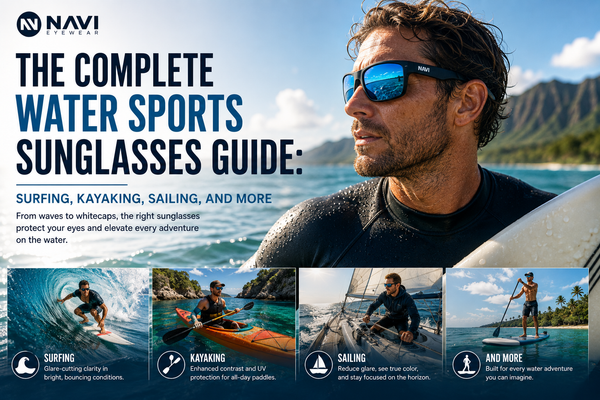

The Complete Water Sports Sunglasses Guide: Surfing, Kayaking, Sailing, and More
Water sports impose the most demanding conditions of any outdoor activity on sunglasses — intense reflected UV from water surfaces, saltwater exposure that degrades unprotected coatings and hardware, physical impact risk from waves and equipment, and the requirement for frame retention through vigorous movement in dynamic water environments. The lens specification for water sports is not a compromise of everyday and sport requirements: it is its own specification set, anchored by copper polarized UV400 polycarbonate for maximum surface glare elimination and sub-surface water visibility, anti-saltwater coating for durability, and sport frame geometry for retention under wave impact and physical activity. This guide covers every major water sport and the lens and frame requirements that distinguish water sports eye protection from general outdoor sport protection.
Contents
- 1. Why Water Sports Demand a Different Specification
- 2. The Water Sports Lens Specification
- 3. Tint Selection for Water Sports
- 4. Frame Requirements: Retention, Saltwater Resistance, Coverage
- 5. Activity-by-Activity Recommendations
- 6. Polarization and Water: The Physics of Why It Matters So Much
- 7. Saltwater Damage: What It Does and How to Prevent It
- 8. Retention Strategies for Dynamic Water Environments
- 9. The Complete Water Sports Specification Checklist
- 10. Frequently Asked Questions
- 11. Supporting Articles in This Cluster

1. Why Water Sports Demand a Different Specification
The Water Environment Is Uniquely Demanding
Three factors make water sports environments categorically more demanding than other outdoor activities for sunglasses:
- UV amplification through water reflection: water reflects 25–100% of UV depending on sun angle and wave state, with calm water at Brewster's angle (approximately 53 degrees from vertical) reflecting near-completely. Combined with direct overhead UV, water sports participants receive UV from both above and below simultaneously — effective UV doses significantly higher than the UV index alone would suggest for non-reflective environments.
- Saltwater corrosion: salt spray, immersion, and sweat all deposit salt on lens surfaces, frames, and hardware. Untreated metal hardware (hinges, screws, nose contact frames) corrodes and seizes in sustained saltwater exposure. Coatings without anti-saltwater protection degrade, cloud, and delaminate. Salt crystal deposits on lens surfaces abrade lens coatings during lens wiping if not properly rinsed first.
- Dynamic retention requirements: wave impact, paddling motion, swimming, and the postural changes of water sport all challenge frame retention in ways that sedentary or low-impact sport does not. A frame that fits adequately for running fails in a surf session — wave impact forces are significantly higher than running headbob forces.
2. The Water Sports Lens Specification
UV400 Polycarbonate: The Non-Negotiable Foundation
UV400 polycarbonate is the minimum lens specification for any water sport — UV400 for the amplified UV environment, polycarbonate for impact resistance against wave, board, or equipment contact. In water sports, lens impact events that would be improbable on land (a wave driving a board into the face, paddle equipment contact, surfboard rail impact) are realistic event possibilities. Polycarbonate's impact resistance specifically addresses this risk. Browse UV400 polarized polycarbonate options at navieyewear.com.
Polarization: Non-Negotiable for Water
Polarization is the single most impactful lens feature for water sports — more so than for any other outdoor activity. Water surface glare is the most efficiently polarized common glare source, with near-complete horizontal polarization at Brewster's angle. Polarized lenses eliminate this glare with near-complete effectiveness, transforming opaque mirror-like water surfaces into visually transparent ones. Non-polarized lenses at any darkness level cannot achieve this — they reduce glare proportionally but cannot eliminate the specific polarized component that makes water surface glare uniquely disruptive. Any serious water sports use requires polarization.
Anti-Saltwater Coating: Non-Negotiable for Coastal and Ocean Use
Anti-saltwater coating on lens surfaces prevents the salt crystal deposition and ionic corrosion that degrades untreated lenses in saltwater environments. Without it, repeated saltwater exposure produces lens surface clouding, coating delamination, and degraded optical clarity within one to two seasons of regular coastal water sport use. All Navi Eyewear lenses include anti-saltwater coating as standard — essential for the full water sports use case rather than an optional upgrade.
Oleophobic and Hydrophobic Coatings
Oleophobic coating prevents sunscreen and salt residue adhesion to the lens surface — both highly relevant in water sports where sunscreen reapplication and salt spray are continuous. Hydrophobic coating causes water to bead and sheet off the lens surface rather than forming an obscuring water film — critical for maintaining optical clarity when spray, splash, or rain hits the lens during activity.
3. Tint Selection for Water Sports
Copper: The Primary Water Sports Tint
Copper polarized is the standard tint recommendation for most water sports — beach, surfing, kayaking, fishing, sailing, and boating. Copper's selective blue and blue-green absorption addresses water surface glare more completely than amber, because water surface reflection is predominantly blue-polarized (reflecting the blue sky). Copper's strong blue absorption combined with the polarization filter removes the blue-toned water reflection more thoroughly than amber polarization at the same efficiency level. Sub-surface water visibility — seeing through the water surface to depth, bottom features, and wave structure — is maximized by copper polarization.
Amber: For Freshwater and Variable Light Water Sports
Amber polarized is appropriate for freshwater kayaking, paddleboarding on inland lakes and rivers, and water sports in variable light conditions (partly cloudy, morning, afternoon low-angle sun). Amber's contrast enhancement benefits are more relevant on freshwater where the surface reflection is less purely blue-toned than ocean reflection, and amber's stability in variable light (maintaining contrast as cloud cover shifts) suits inland water environments that don't have the sustained high-UV intensity of coastal ocean conditions.
Gray: For Overcast Ocean and Low-Light Water Conditions
Gray polarized Cat 1–2 for low-light water sport conditions — overcast ocean sailing, early morning paddling, dawn surf sessions. Gray maintains color accuracy without contrast enhancement that is most useful in bright conditions; Cat 1–2 provides adequate transmission for low-light water activity where Cat 3 would be unnecessarily dark.
Cat 3 for Peak UV Water Environments
Cat 3 (8–18% light transmission) for sustained peak-UV water sport use — midday beach, offshore sailing in tropical conditions, open ocean kayaking at summer UV peaks. Water's UV amplification effect makes the effective UV dose in open water environments equivalent to Cat 3 conditions even when the UV index alone might suggest Cat 2. The combination of overhead UV plus water-reflected UV makes Cat 3 the appropriate category for sustained midday water sport in all but low-UV environments.
4. Frame Requirements: Retention, Saltwater Resistance, Coverage
Frame Retention for Dynamic Water Environments
Water sport frame retention requires more than the rubber grip contacts that suffice for running. Wave impact, swimming, and the head submersion of whitewater kayaking and surfing demand either:
- Retention strap (croakie/keeper): an elastic strap connecting the two temple tips behind the head, preventing the frame from floating away on submersion. Essential for surfing, whitewater kayaking, and any water sport where full head submersion occurs or where dropping glasses into water is a significant loss risk.
- Wraparound close-fit with maximum grip contacts: for water sports with limited submersion risk (sailing, stand-up paddleboarding, fishing), a close-fitting wraparound frame with aggressive rubber grip contacts provides adequate retention without requiring a retention strap.
- Floating frames: some water sport frames are constructed with buoyant temple arms that allow the frame to float if dropped into water rather than sinking — a practical feature for fishing, boating, and kayaking where dropping glasses overboard is a risk.
Saltwater-Resistant Hardware
Stainless steel hinges — specifically marine-grade or saltwater-rated stainless — resist the corrosion and seizing that standard steel and non-stainless alloy hardware experiences in sustained saltwater exposure. All Navi Eyewear frames use stainless 5-barrel hinges that provide the corrosion resistance required for regular coastal and water sport use. Frames with plated-zinc alloy or standard steel hardware corrode, seize, and fail significantly faster in saltwater environments than stainless steel construction.
TR90 Nylon Frames for Water Sport
TR90 nylon is the appropriate frame material for water sports — chemically resistant to saltwater, sweat, and sunscreen; dimensionally stable across the temperature variations of water environments; flexible enough to absorb wave and equipment impact without fracturing; and lighter than alternative materials, reducing the tendency to slide under sweat and water. Acetate frames, while aesthetically excellent, are less chemically resistant to prolonged saltwater and sunscreen exposure and are not recommended for regular water sport use.
Wraparound Coverage for UV and Wind
Wraparound frame geometry that reduces peripheral UV and wind entry is specifically valuable in water environments where UV comes from multiple directions (sky + water reflection) and where wind at boat or board speed produces significant airstream exposure around standard frame gaps. Close-fitting wraparound designs that minimize the gap between lens edge and face provide the most complete UV and wind protection for water sport use.
5. Activity-by-Activity Recommendations
Surfing
Copper Cat 3 polarized UV400 polycarbonate in a TR90 wraparound sport frame with retention strap. The surf environment combines peak ocean UV with wave impact risk, salt spray, and the submersion events of wipeouts that make retention straps essential. Full wraparound coverage for the UV-from-below angle of lying on the board paddling out. Many surfers remove glasses for the actual surfing and wear them for paddling, waiting for sets, and beach time — the retention strap keeps them on the body rather than requiring removal and storage. See the complete surfing sunglasses guide.
Kayaking and Paddleboarding
Copper or amber Cat 2–3 polarized UV400 in a TR90 sport frame with retention strap for whitewater kayaking; copper Cat 3 for ocean kayaking; amber Cat 2 for flatwater and inland paddling. Retention strap for whitewater and ocean kayaking where capsizing is possible; grip contacts adequate for flatwater SUP where submersion risk is low. See the kayaking and paddleboarding guide.
Sailing and Offshore Racing
Copper Cat 3 polarized UV400 in a TR90 wraparound frame. Sailing involves sustained open-water UV exposure at high reflectance over multi-hour sessions, often in offshore conditions with significant wind. The glare elimination of copper polarization on open water is the most functionally significant visual benefit for sailing — reading wind on the water surface, tracking other vessels, and monitoring horizon conditions all benefit from the glare-free water surface visibility that copper polarization provides. See the sailing and offshore racing guide.
Fishing
Copper Cat 3 polarized UV400 polycarbonate — the fishing specification is the purest expression of the copper polarized water sport case. Sub-surface fish and structure visibility is maximized by copper polarization's blue absorption and polarization filter combination. Fishing involves sustained stationary water-surface monitoring over extended periods at peak UV hours — the highest sub-surface visibility and sustained UV protection requirements of any water activity. See the complete fishing sunglasses guide.
Wakeboarding and Water Skiing
Copper or amber Cat 3 polarized UV400 in a close-fitting wraparound frame with retention strap. High-speed water sports add significant airstream and spray exposure at the cable or tow boat speeds involved — close-fitting frame geometry and retention strap are mandatory, not optional. At speed, water droplet impact on the face is a real consideration; close-fit frames that minimize the gap between lens and face reduce the spray that bypasses the lens. See the wakeboarding and water skiing guide.
Open Water Swimming
Open water swimming presents the most challenging retention scenario — full head submersion on every stroke, dynamic head movement, and prolonged salt water exposure. Standard sunglasses are generally not worn during open water swimming strokes; tinted swim goggles (a different product category with seal-to-face gaskets) are the appropriate tool for the in-water swimming portion. UV400 sunglasses for before and after the swim — at the start area, during warm-up, and post-race — are appropriate and important given the high UV of open water venues. See the open water swimming guide.
6. Polarization and Water: The Physics
Brewster's Angle and Maximum Polarization
When light reflects from a horizontal water surface at Brewster's angle (approximately 53 degrees from the vertical for water, meaning a sun elevation of approximately 37 degrees above the horizon), the reflected light is essentially completely horizontally polarized. At this sun elevation, a polarized lens with its transmission axis vertical eliminates the water surface reflection with near-complete effectiveness — the surface appears transparent, and sub-surface features become visible. At other sun angles, the polarization of the reflection is less complete, but still predominantly horizontal and still significantly reduced by the polarized filter.
This is why copper polarization on a fishing trip transforms the experience in a way that no amount of lens darkness alone can match: the anglers who can see the fish through the water surface are not using darker lenses — they are using polarized lenses that specifically eliminate the polarized component of surface reflection that makes the water opaque to non-polarized vision.
Why Copper Outperforms Amber at Water
Ocean water surface reflection has a specific blue-dominant spectral character — it reflects the blue sky. Copper's selective strong absorption of blue wavelengths (more aggressive blue absorption than amber) means that even after the polarization filter has eliminated the horizontally polarized component of the surface reflection, the residual atmospheric and diffuse skylight reflected from the water surface — which is not fully polarized — is also attenuated by copper's blue absorption. Amber polarization eliminates the same polarized glare but leaves more residual blue-toned diffuse reflection. The combined effect gives copper a measurable edge over amber for water surface visibility, particularly in ocean environments with high blue-sky reflection.
7. Saltwater Damage: What It Does and How to Prevent It
Mechanisms of Saltwater Damage
- Salt crystal abrasion: when salt-contaminated lenses are wiped dry without rinsing first, salt crystals abrade lens coatings — producing microscratches that accumulate over a season into visible surface degradation. Always rinse with fresh water before wiping.
- Ionic corrosion: dissolved salt is an electrolyte that accelerates corrosion of metal hardware — hinges, screws, nose contact frames. Stainless steel resists but does not completely prevent this; non-stainless hardware corrodes rapidly.
- Coating osmotic degradation: sustained saltwater exposure draws moisture through some coating systems through osmotic processes, causing delamination and cloudiness in non-saltwater-rated coatings. Anti-saltwater coatings resist this degradation.
Post-Use Care
After every water sport session: rinse the entire frame with fresh water immediately after use, before any salt deposits dry. Shake off excess water and allow air drying in shade (not direct sun, which accelerates UV degradation of some coating systems). Weekly cleaning with mild soap and water removes accumulated sunscreen and salt residue. Dry storage in a case prevents dust scratch accumulation between sessions.
8. Retention Strategies for Dynamic Water Environments
Retention Strap (Croakie) Selection
Retention straps for water sport come in two primary types:
- Floating straps: made from buoyant foam or hollow construction that keeps the frame floating at the surface if it comes off in water. Essential for fishing, boating, and kayaking where frame loss overboard is a primary concern.
- Neoprene straps: close-fitting neoprene that grips the temple tips securely and stretches to stay in position during active head movement. Standard for surfing and active water sports where submersion and vigorous movement are expected.
Strap Fit
A retention strap that is too loose provides no meaningful retention — the frame still shifts or comes off in wave impact. A strap adjusted to hold the frame firmly against the face with light tension provides effective retention without being uncomfortably tight during extended wear. Adjust the strap length so it applies slight tension to the temples during normal wear rather than hanging loosely behind the head.
9. The Complete Water Sports Specification Checklist
- UV400 — explicitly stated ✓ / ✗
- Polycarbonate lens material — explicitly stated ✓ / ✗
- FDA impact resistance — explicitly stated ✓ / ✗
- Polarized — verifiable ✓ / ✗
- Copper tint for ocean/coastal use (amber for freshwater) ✓ / ✗
- Cat 3 for midday peak UV water sport (Cat 2 for variable/low light) ✓ / ✗
- Anti-saltwater coating — explicitly stated ✓ / ✗
- Oleophobic coating — explicitly stated ✓ / ✗
- Hydrophobic coating — explicitly stated ✓ / ✗
- TR90 frame material — explicitly stated ✓ / ✗
- Stainless steel hinges — explicitly stated ✓ / ✗
- Retention strap (for submersion-risk activities) ✓ / ✗
- Wraparound coverage for peripheral UV and wind ✓ / ✗
- Floating frame or strap (for overboard-loss risk activities) ✓ / ✗
10. Frequently Asked Questions
What sunglasses are best for water sports?
Copper Cat 3 polarized UV400 polycarbonate in a TR90 wraparound sport frame with anti-saltwater, oleophobic, and hydrophobic coatings and stainless steel hinges. For submersion-risk activities (surfing, whitewater kayaking), add a retention strap. This specification addresses all the specific demands of water environments: maximum polarized glare elimination, UV amplification from reflection, saltwater durability, and dynamic retention.
Why is polarization so much more important for water than other sports?
Water surface glare is near-completely horizontally polarized at certain sun angles — the most efficiently polarized of any common outdoor glare source. A polarized lens eliminates this specific component with near-complete effectiveness, turning an opaque reflective water surface visually transparent. Non-polarized lenses of any darkness cannot achieve this — they reduce all light proportionally but cannot specifically eliminate the polarized component. For water sports, the difference between polarized and non-polarized is not marginal — it is the difference between seeing through the water surface and not.
Do I need a retention strap for water sports?
For any water sport with submersion risk (surfing, whitewater kayaking, open water swimming adjacent activities) or significant loss-overboard risk (fishing, boating, sailing): yes. A retention strap prevents frame loss in capsizing, wave impact, and head submersion events that would otherwise send the frame to the bottom. For lower-submersion water activities (flatwater paddleboarding, beach walking, sailing in calm conditions), close-fitting wraparound frames with rubber grip contacts may provide adequate retention without a strap.
Can I use regular sunglasses for water sports?
Regular lifestyle frames lack the specific features that water environments require: anti-saltwater coating (regular frames corrode and cloud), retention capability (regular frames slide off in wave impact), wraparound coverage (regular frames leave peripheral gaps in high-UV water environments), and the hydrophobic coating that prevents water from sheeting across the lens. UV400 polycarbonate polarization is the shared foundation — the rest of the water sports specification is what separates a purpose-built water sports pair from a lifestyle pair used at the water.
What's the difference between copper and amber for water sports?
Copper provides maximum surface glare elimination at ocean water surfaces — its strong blue absorption addresses the blue-toned reflection character of ocean water more completely than amber. Amber provides excellent glare elimination and contrast enhancement that is better suited to freshwater environments and variable light conditions where the reflection character is less purely blue-toned. For ocean and coastal use: copper. For inland lakes, rivers, and freshwater kayaking: amber. Both are substantially better than gray for water surface visibility.
How do I clean sunglasses after saltwater use?
Rinse the complete frame with fresh water immediately after every saltwater session — before any salt deposits dry. Salt crystals that dry on the lens surface will abrade coatings if the lens is wiped without rinsing first. After rinsing, shake off excess water, gently pat dry with a clean microfiber cloth, and store in a case. Weekly cleaning with mild soap and warm water removes accumulated sunscreen, salt, and oil residue. Never wipe a dry salt-contaminated lens.
11. Supporting Articles in This Cluster
- Sunglasses for Surfing: What Actually Stays On in the Waves | Navi Eyewear
- Sunglasses for Kayaking and Paddleboarding | Navi Eyewear
- Sunglasses for Open Water Swimming | Navi Eyewear
- Sunglasses for Sailing and Offshore Racing | Navi Eyewear
- Sunglasses for Wakeboarding and Water Skiing | Navi Eyewear
- The Complete Fishing Sunglasses Guide | Navi Eyewear
The Bottom Line
Water sports demand the most complete sunglass specification of any outdoor activity: copper Cat 3 polarized UV400 polycarbonate for maximum glare elimination and UV protection in amplified UV environments; anti-saltwater, oleophobic, and hydrophobic coatings for durability under sustained saltwater exposure; TR90 frames with stainless steel hinges for chemical and corrosion resistance; wraparound geometry for peripheral UV coverage; and retention straps for submersion-risk activities. All Navi Eyewear lenses meet the lens specification standard. navieyewear.com/collections/polarized — Buy 1, Get 2 Free for $85.
Related Reading
- How Polarized Sunglasses Work | Navi Eyewear
- Sunglass Lens Coatings Explained | Navi Eyewear
- The Science of Lens Color | Navi Eyewear
- TR90 Nylon Frames: Why the Material Matters | Navi Eyewear
- Sunglasses for Cruise and Open Water | Navi Eyewear
- Summer UV: Peak Season Eye Protection | Navi Eyewear
- UV and Eye Disease: The Complete Guide | Navi Eyewear
- Shop Polarized UV400 Sunglasses | Navi Eyewear
Sources & Citations
[1] Dain SJ. "Sunglasses and sunglass standards." Clinical and Experimental Optometry, 2003. View source →
[2] Sliney DH. "Ocular exposure to environmental light and ultraviolet." Journal of AAPOS, 2014. View source →
[3] WHO. "Global solar UV index: a practical guide." World Health Organization, 2002. View source →
[4] Hecht E. "Optics." 4th edition. Addison Wesley, 2002. View source →
[5] ISO 12312-1:2013. "Eye and face protection — Sunglasses and related eyewear." International Organization for Standardization. View source →
[6] Taylor HR, et al. "Effect of ultraviolet radiation on cataract formation." New England Journal of Medicine, 1988. View source →