
Blue Light, Screens, and UV: The Complete Modern Eye Health Picture
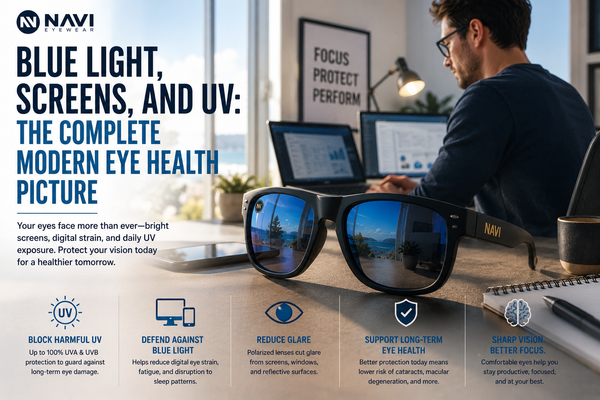
Two eye health topics dominate modern wellness conversations: UV from outdoor sun exposure and blue light from screens. They are not equivalent threats. UV radiation is a documented, dose-dependent cause of cataracts, age-related macular degeneration, pterygium, and photokeratitis — backed by decades of epidemiological and laboratory evidence. Blue light from screens is 100–1,000 times less intense than solar blue light, and while digital eye strain is a real and common problem, the evidence that screen blue light causes permanent eye damage is limited and disputed. Understanding the difference matters for making sensible eye protection decisions: UV400 sunglasses outdoors are the evidence-based priority; blue-light-filtering glasses for screens are optional and address comfort more than documented disease risk.

1. What Blue Light Actually Is
Blue Light in the Visible Spectrum
Blue light is the short-wavelength portion of the visible light spectrum — approximately 380–500nm. It sits between UV-A (315–400nm) and the longer visible wavelengths of green, yellow, and red. The sun is the most powerful source of blue light that humans encounter — solar blue light reaching the Earth's surface is several orders of magnitude more intense than blue light from any artificial screen or indoor light source. The human eye evolved in this solar blue light environment and has structural adaptations — macular pigment (lutein and zeaxanthin) that absorbs blue wavelengths at the macula — that provide some natural protection against the solar blue light that reaches the retina.
Screen Blue Light vs Solar Blue Light
Digital screens (phones, tablets, laptops, monitors) emit blue light as a component of the white LED backlighting or OLED display technology. The blue light intensity from screens is dramatically lower than solar blue light:
- A typical smartphone screen emits blue light at approximately 1–10 lux
- Indoor artificial lighting emits blue light at 100–500 lux
- Outdoor daylight (overcast) produces blue light at 1,000–10,000 lux
- Direct outdoor sunlight produces blue light at 10,000–100,000+ lux
Screen blue light is 100–1,000 times less intense than outdoor daylight blue light. An hour of outdoor walking produces more blue light exposure to the eye than a full day of screen use indoors. This intensity difference is the foundation for the scientific skepticism about screen blue light as a significant source of permanent eye damage — the eye is adapted to manage solar blue light orders of magnitude more intense than anything a screen produces.
2. What UV Actually Does: The Documented Evidence
UV Is the Proven Outdoor Eye Threat
UV radiation (280–400nm) causes documented, dose-dependent damage to multiple eye structures:
- Cataracts: UV-B absorption in the crystalline lens drives oxidative modification of lens crystallin proteins — the mechanism of cortical cataract formation. WHO estimates 20% of global cataracts are UV-attributable. The Taylor et al. 1988 NEJM study established the dose-response relationship between cumulative UV-B and cortical cataract risk. See the complete cataract prevention guide.
- Age-related macular degeneration: UV and blue light from solar sources contribute to oxidative stress in the retinal pigment epithelium, amplified by lipofuscin photosensitization in aging eyes. Multiple epidemiological studies find associations between cumulative sun exposure and AMD risk. See the AMD and UV guide.
- Photokeratitis: UV-B causes direct DNA damage in corneal epithelial cells, producing the acute corneal sunburn that presents 6–12 hours after exposure as severe eye pain and photophobia. Completely prevented by UV400 protection. See the photokeratitis guide.
- Pterygium: UV exposure drives the strongest dose-response relationship of any common ocular condition — conjunctival fibrovascular growth with documented geographic, occupational, and cumulative UV dose associations. See the pterygium guide.
The UV-eye disease evidence base is strong: decades of epidemiological data, documented biological mechanisms, animal model confirmation, and WHO guidelines explicitly citing UV as a modifiable risk factor for cataract and AMD. This is the eye health threat that outdoor UV400 protection addresses.
3. The Blue Light and Screen Evidence: What It Actually Shows
Digital Eye Strain Is Real — Blue Light Is Not the Primary Cause
Digital eye strain (also called computer vision syndrome) is a real and common condition — symptoms include eye fatigue, dryness, headache, blurred vision after extended screen use, and neck and shoulder discomfort. It affects a large proportion of people who spend multiple hours daily on screens. It is not primarily caused by blue light.
The leading causes of digital eye strain are:
- Reduced blink rate: people blink 40–60% less frequently during focused screen use than during other activities. Reduced blinking causes tear film instability and the dryness and irritation that characterize eye strain.
- Accommodative fatigue: sustained focus on a fixed near distance (screen distance, typically 50–70cm) fatigues the ciliary muscle that controls lens shape for focus. This produces the blur and focus instability experienced after extended near viewing.
- Poor ergonomics: screen position, ambient lighting, glare on screen surfaces, and monitor refresh rate all contribute to eye strain independently of blue light.
- Screen glare: reflective glare on glossy screen surfaces from overhead lighting causes visual discomfort through the same mechanism as outdoor glare — high-luminance reflected light competing with the screen content.
Blue light from screens contributes minimally to digital eye strain in most research — clinical trials of blue-light-filtering glasses for digital eye strain consistently show modest or non-significant reductions in eye strain symptoms compared to clear lenses with anti-reflective coating. The American Academy of Ophthalmology does not recommend blue-light-filtering glasses for digital eye strain, citing insufficient evidence for their effectiveness above placebo.
Does Screen Blue Light Cause Permanent Eye Damage?
The evidence for screen blue light causing permanent retinal damage is limited. In vitro (cell culture) studies find that high-intensity blue light can damage retinal cells — but the intensities used in these studies are far higher than any realistic screen exposure. The leap from "high-intensity blue light damages cells in a dish" to "screen blue light damages human retinas" requires bridging an intensity gap of several orders of magnitude that current evidence does not support.
The American Academy of Ophthalmology, the American Optometric Association, and most major ophthalmological bodies do not recommend blue-light-filtering glasses to prevent eye disease from screen use. They do recommend addressing digital eye strain through the 20-20-20 rule (every 20 minutes, look at something 20 feet away for 20 seconds), increasing blink awareness, optimizing screen ergonomics, and using artificial tears for dryness.
Solar Blue Light and AMD: A Legitimate Concern
The more legitimate blue light concern is solar blue light — not screen blue light — and its contribution to AMD risk through lipofuscin photosensitization in aging eyes. The macular pigment (lutein and zeaxanthin) that filters blue wavelengths at the macula is the eye's natural defense against solar blue light at the macula. UV400 sunglasses block the UV component of solar radiation; they do not filter solar blue light wavelengths (400–500nm). Some premium sunglass lenses include blue light filtering in addition to UV400 — blocking wavelengths from 380–450nm. This solar blue light filtering may have AMD prevention relevance for high-risk individuals, though the evidence is less established than for UV blocking. Dietary lutein and zeaxanthin (from dark leafy greens) supports macular pigment density as the internal protection against solar blue light.
4. The Modern Eye Health Priority Framework
What the Evidence Supports
| Threat | Evidence Strength | Primary Intervention | Priority |
|---|---|---|---|
| Solar UV — cataracts | Very strong — decades of epidemiology, WHO guidelines | UV400 sunglasses outdoors | High |
| Solar UV — AMD | Moderate — epidemiological associations, biological mechanism | UV400 sunglasses; AREDS2 supplements | High |
| Solar UV — photokeratitis | Very strong — direct photochemical mechanism | UV400 sunglasses (complete prevention) | High |
| Solar UV — pterygium | Strong — strongest UV dose-response of any eye condition | UV400 wraparound sunglasses | High |
| Digital eye strain | Strong — condition well established, causes well identified | 20-20-20 rule; blink awareness; ergonomics; artificial tears | Medium (comfort, not disease) |
| Screen blue light — permanent damage | Weak — in vitro evidence at non-physiological intensities | No proven intervention needed beyond normal screen habits | Low |
| Solar blue light — AMD contribution | Moderate — mechanism plausible; evidence developing | Dietary lutein/zeaxanthin; blue-filtering sunglass lenses (optional) | Medium for AMD-risk individuals |
The Practical Implication
The evidence-based modern eye health priority is UV400 polarized sunglasses for all outdoor time — the intervention with the strongest evidence for preventing the most consequential UV-related eye diseases. Blue-light-filtering glasses for screen use are optional and address comfort rather than documented disease prevention. If digital eye strain is a problem, the interventions with the best evidence are behavioral (20-20-20 rule, blink awareness) and ergonomic (screen position, anti-reflective coating, ambient lighting), not blue-light-filtering lens tints.
5. Practical Guidance: Managing Both Concerns
Outdoors: UV400 Polarized — Non-Negotiable
UV400 polycarbonate polarized sunglasses for all outdoor time above UV index 3 — driving, commuting, exercise, social outdoor time, travel. This addresses the documented UV-related eye disease risks with the only intervention that provides complete UV blocking. Browse UV400 polarized options at navieyewear.com. The complete multi-pair placement strategy — car, bag, sport kit, home entry — ensures availability at every outdoor moment. See the complete modern life UV guide.
Indoors at Screens: Behavioral Management
For digital eye strain from extended screen use:
- 20-20-20 rule: every 20 minutes of screen use, look at something 20 feet away for 20 seconds. This relaxes accommodative fatigue and allows the tear film to restabilize.
- Blink awareness: consciously blink fully and regularly during screen use. Setting a reminder or habit cue can help override the reduced blink rate during focused screen viewing.
- Screen ergonomics: position the screen 50–70cm from the eyes, slightly below eye level. Use matte screen covers or anti-glare filters to reduce screen surface reflection. Ensure ambient lighting is not dramatically brighter than the screen, which forces the eye to manage high contrast.
- Anti-reflective coating on prescription lenses: reduces internal reflections within lens elements that become more distracting under screen lighting conditions.
- Artificial tears: lubricating eye drops for dry eye symptoms from extended screen use address the reduced blink rate-driven tear film instability.
Blue-Light-Filtering Glasses: When They May Help
Blue-light-filtering glasses are not harmful and may provide marginal comfort benefits for some screen users — there is no evidence that they cause harm, and the placebo benefit alone may be valuable for individuals who feel better wearing them. For individuals with diagnosed intermediate AMD or significant AMD risk factors, some ophthalmologists recommend solar blue light filtering in sunglasses as a precautionary measure alongside UV400 blocking. For general population screen use without AMD risk factors, blue-light-filtering glasses are an optional comfort measure, not an evidence-based disease prevention tool.
Frequently Asked Questions
Are blue light glasses worth it?
For screen use and digital eye strain: possibly for comfort, not proven for disease prevention. Clinical trials show modest or non-significant reductions in eye strain compared to standard anti-reflective lenses. If you experience significant digital eye strain, the higher-evidence interventions are the 20-20-20 rule, blink awareness, and screen ergonomics. For outdoor use, UV400 polarized lenses are the evidence-based priority — they address documented UV-related diseases rather than a disputed comfort concern.
Is blue light from screens damaging my eyes?
The evidence for permanent eye damage from screen blue light is weak — screen blue light intensity is 100–1,000 times lower than solar blue light, and the in vitro studies showing retinal cell damage used intensities far above realistic screen exposure. Digital eye strain from extended screen use is real and common but is primarily caused by reduced blink rate and accommodative fatigue, not by blue light. The major ophthalmological bodies do not recommend blue-light-filtering glasses to prevent eye disease from screen use.
Should I wear sunglasses outside and blue light glasses inside?
UV400 polarized sunglasses for all outdoor time — yes, this is the evidence-based priority. Blue light glasses for screen use — optional, and not recommended as a disease prevention measure by major ophthalmological bodies. If digital eye strain is a concern, address it through behavioral and ergonomic interventions first. If AMD risk is elevated, discuss solar blue light filtering in sunglasses with an ophthalmologist as a supplemental measure alongside UV400 outdoor protection.
What is the 20-20-20 rule for screen use?
Every 20 minutes of screen use, look at an object at least 20 feet away for at least 20 seconds. This relaxes the ciliary muscle from sustained near-focus accommodation (addressing accommodative fatigue) and allows the blink rate to return to normal for the 20-second distance viewing period (addressing tear film instability). It is the simplest, best-supported behavioral intervention for digital eye strain and costs nothing to implement.
Does UV cause the same damage as blue light?
UV and blue light cause different types of damage through different mechanisms, at very different intensity levels. Solar UV causes photochemical damage to lens proteins (cataracts), RPE oxidative stress (AMD contribution), corneal epithelial DNA damage (photokeratitis), and conjunctival cellular changes (pterygium) — all well-documented in decades of epidemiological and laboratory research. Screen blue light has not been shown to cause equivalent damage at realistic exposure intensities. Solar blue light (not screen blue light) contributes to macular oxidative stress through lipofuscin photosensitization — a legitimate but less definitively established pathway that UV400 sunglasses partially address alongside dietary lutein and zeaxanthin.
Can I get UV damage through a window while using my phone?
Standard glass windows block UV-B but transmit UV-A at 50–70%. Extended sitting near south- or west-facing windows during peak UV hours produces meaningful UV-A exposure that screen time doesn't cause but that occurs simultaneously with it. The UV protection concern from window-adjacent screen use is the window UV, not the screen blue light. UV-blocking window film or UV400 sunglasses for outdoor breaks address the window UV gap.
The Bottom Line
The modern eye health picture involves two distinct concerns that are routinely conflated: UV from outdoor sun exposure (documented, consequential, addressable with UV400 sunglasses) and blue light from screens (real as a comfort concern for digital eye strain, not established as a significant cause of permanent eye disease at screen intensities). Prioritize accordingly: UV400 polarized sunglasses for all outdoor time is the evidence-based intervention for the most consequential eye health threats of adult life. For screen use, the 20-20-20 rule, blink awareness, and screen ergonomics address digital eye strain more effectively than blue-light-filtering lenses. The complete modern eye protection setup: UV400 polarized outdoors, behavioral habits at screens, dietary lutein and zeaxanthin for macular support. navieyewear.com/collections/polarized — Buy 1, Get 3 Free for $119.
Related Reading
- UV and Eye Disease: The Complete Guide | Navi Eyewear
- Macular Degeneration and UV | Navi Eyewear
- UV and Cataracts: Prevention and Research | Navi Eyewear
- Sunglasses for Modern Life: UV Protection in the Digital Age | Navi Eyewear
- Sunglasses and Remote Work | Navi Eyewear
- Eye Health and Aging: UV Protection After 50 | Navi Eyewear
- The Complete Sunglass Buyer's Guide | Navi Eyewear
- Shop Polarized UV400 Sunglasses | Navi Eyewear
Sources & Citations
[1] Sheppard AL and Wolffsohn JS. "Digital eye strain: prevalence, measurement and amelioration." BMJ Open Ophthalmology, 2018. View source →
[2] American Academy of Ophthalmology. "Should you be worried about blue light?" AAO, 2021. View source →
[3] Lawrenson JG, et al. "The effect of blue-light blocking spectacle lenses on visual performance, macular health and the sleep-wake cycle." Cochrane Database of Systematic Reviews, 2017. View source →
[4] Taylor HR, et al. "Effect of ultraviolet radiation on cataract formation." New England Journal of Medicine, 1988. View source →
[5] West SK, et al. "Exposure to sunlight and other risk factors for age-related macular degeneration." Archives of Ophthalmology, 1989. View source →
[6] WHO. "Global solar UV index: a practical guide." World Health Organization, 2002. View source →
[7] Sliney DH. "Ocular exposure to environmental light and ultraviolet." Journal of AAPOS, 2014. View source →
[8] AREDS2 Research Group. "Lutein/zeaxanthin for the treatment of age-related macular degeneration." JAMA Ophthalmology, 2013. View source →