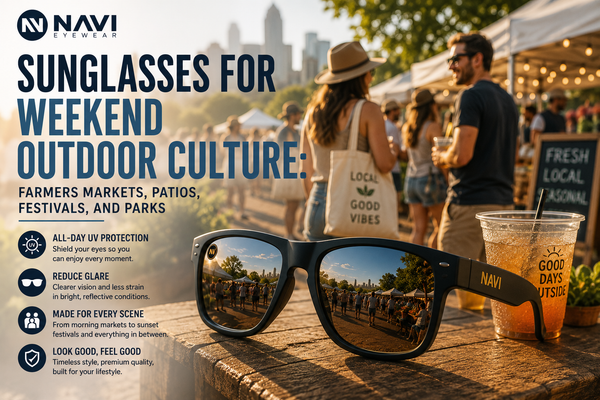

Sunglasses for Weekend Outdoor Culture: Farmers Markets, Patios, Festivals, and Parks
Weekend outdoor culture — the Saturday farmers market, the Sunday patio brunch, the outdoor music festival, the park afternoon, the rooftop happy hour — is where modern indoor workers concentrate their most significant UV exposure. An adult who spends most weekday daylight hours indoors may accumulate the majority of their weekly UV dose across Saturday and Sunday outdoor sessions that run from mid-morning through late afternoon. These social outdoor settings don't feel like high-UV events — they feel like leisure time — which is precisely why they are the most under-protected UV context in many people's lives.

1. The Weekend UV Concentration Effect
How Indoor Weekdays Set Up High-UV Weekends
Office workers, school-based professionals, and anyone with an indoor work schedule spend the peak UV hours of Monday through Friday (10am–2pm) largely indoors. Their weekday UV accumulation comes primarily from commuting and lunch breaks — real but limited. On weekends, the same people spend 4–8 hours outdoors at exactly the UV intensities they've avoided all week. A Saturday that includes a morning farmers market run (9–11am), a park picnic (12–2pm), and a rooftop happy hour (4–6pm) exposes someone to sustained UV across the full arc of weekend daylight — more total UV than many outdoor workers accumulate in a weekday.
The weekend UV concentration effect is amplified by the fact that weekend outdoor activities are often at higher-UV locations than weekday commuting: beach parks, open-air markets, outdoor festival grounds, rooftop venues — environments with high sky exposure, reflective surfaces, and minimal shade. The UV index at an outdoor festival at noon in July in Phoenix or San Diego is 10–12; the UV index during the same person's weekday commute is 3–5. Weekend outdoor culture is the high-UV event of the modern indoor worker's week.
The Casualness Problem
The social outdoor setting actively works against UV protection habits. The beach day triggers sunscreen and sunglasses automatically — it is categorized as a "sun exposure event." The farmers market, the park picnic, and the patio brunch are categorized as social activities, not sun exposure events, even when they occur at identical UV indexes and durations. The cognitive category determines the protective behavior; the UV accumulates regardless of the cognitive category.
This is the specific gap that weekend outdoor culture creates: high UV accumulation in a context that doesn't trigger the protective habits that equivalent outdoor conditions in other contexts would. The fix is the bag pair — UV400 polarized sunglasses in the bag that travels to the farmers market, the park, and the festival, present at every outdoor moment without requiring a special decision to bring them.
2. Weekend Outdoor Contexts: UV Profile by Setting
Farmers Markets and Outdoor Markets
Outdoor markets — farmers markets, flea markets, craft fairs, street markets — typically run Saturday and Sunday mornings from 8am or 9am through 1pm or 2pm, covering the full UV ramp from moderate morning UV to peak midday UV. Market environments offer minimal shade: vendor tents provide some overhead shade but leave lateral UV angles open, and the time spent walking between stalls is full open-sky UV exposure. An hour and a half at an outdoor market from 9:30am to 11am involves meaningful UV accumulation at UV indexes rising from 3 to 7 across that window in summer.
The market setting is socially interactive — conversations with vendors and friends, browsing and stopping — which makes it a sustained outdoor UV context with minimal movement that would otherwise create natural shade changes. Gray Cat 2 polarized UV400 handles market UV: color neutral for seeing the produce, flowers, and craft goods accurately; Cat 2 for the morning light conditions that don't require Cat 3 darkness; polarized for the reflective surfaces of market environments.
Patio Dining and Rooftop Venues
Patio dining — the weekend brunch, the outdoor lunch, the evening rooftop bar — involves sustained stationary UV exposure in a social context where sunglasses may feel socially awkward to introduce mid-meal. The patio table that's in full sun from 11am to 1pm during a brunch exposes diners to UV index 8–10 for the full dining duration while they sit relatively still facing whatever direction the table is set. The rooftop venue at 5pm in summer involves UV index 4–6 with full sky exposure and building reflection amplification.
Patio UV is particularly easy to underestimate because the social setting and table shade (umbrellas, overhead structures) create a sense of protection. Table umbrellas block direct overhead UV but not the diffuse sky UV from open angles, not reflected UV from surrounding surfaces, and not UV at sun angles that bypass the umbrella edge. UV400 sunglasses provide complete protection that table umbrellas alone do not.
Outdoor Music Festivals and Events
Multi-hour outdoor festivals — music festivals, food and wine events, outdoor sporting events, art fairs — are the highest single-day UV dose events in most people's social calendar. A day at an outdoor music festival from 11am to 7pm involves 8 hours of outdoor UV exposure across the full peak UV window, at an open-field venue with minimal natural shade, at whatever UV index the location and season produce. UV index 10 at noon at an outdoor summer festival in the Sun Belt over 8 hours produces more UV accumulation than multiple days of typical outdoor commuting. Festival goers who wear sunscreen often skip eye protection — the festival is the ideal context for the sport pair (amber Cat 3 polarized UV400 for peak sun hours) or the everyday bag pair for lower-UV morning and evening festival time.
Parks and Outdoor Recreation Areas
Park time — the weekend afternoon in a city park, the picnic, the dog walk, the frisbee game, the reading on the grass — is extended stationary or light-activity outdoor time during the UV-intense afternoon hours. Parks offer some shade from trees but open lawn areas and athletic fields have full sky exposure. A two-hour afternoon park session from 1pm to 3pm at UV index 8 accumulates meaningful UV dose during what feels like a passive, relaxing activity.
Park UV is the archetype of the under-protected casual outdoor UV context — low physical intensity, social or relaxing purpose, no sense of "being in the sun" the way a beach session would create. The bag pair that's always present covers park UV as a zero-friction behavior: sunglasses in the bag that went to the park, worn when the sun is direct, removed in deep shade.
Outdoor Sports Spectating
Watching outdoor sports — soccer matches, baseball games, tennis matches, golf tournaments — involves extended stationary outdoor UV exposure in stadium or field environments with partial shade at best. A three-hour baseball game on a Sunday afternoon at an open stadium exposes spectators to direct sun for whatever portion of the seating is not under the stadium roof. Outdoor tennis and golf spectating involves moving across largely unshaded grounds for extended periods at peak UV hours. The spectating context is another stationary, social outdoor setting where UV accumulates without triggering the protection habits of active outdoor sport participation.
3. What to Wear: Lens Specification for Weekend Outdoor Culture
The Social Setting Tension
Weekend outdoor social settings create a minor practical tension: sunglasses worn in social contexts can reduce eye contact and social warmth in conversation. This is real but manageable — and not a reason to forgo UV protection. Lenses that are not heavily mirrored allow eyes to be visible through the lens in most lighting conditions. Frames that fit well and look intentional rather than sport-utility are appropriate for social outdoor settings. Gray polarized UV400 in a classic or lifestyle frame handles patio dining, farmers markets, and casual social outdoor settings with appropriate aesthetics while providing complete UV protection.
Gray Cat 2 Polarized for Social Outdoor Use
Gray Cat 2 polarized UV400 is the all-purpose weekend outdoor social specification:
- Color neutral — food at the farmers market looks accurate; wine at the rooftop bar looks correct; the social environment's colors are not shifted
- Cat 2 — appropriate for morning market UV and afternoon rooftop UV without being too dark for shade transitions at a park or covered patio
- Polarized — eliminates the reflective surface glare of outdoor tables, wet pavement between venues, and the glass facades of urban outdoor settings
- Classic or lifestyle frame aesthetic — appropriate for social settings where sport frames would look out of place
Amber Cat 3 for High-UV Afternoon Events
For sustained high-UV outdoor events — the midday festival, the afternoon outdoor sporting event, the beach park afternoon — amber Cat 3 polarized UV400 provides the peak-UV specification: maximum appropriate darkness reduction for brightness comfort, contrast enhancement for the natural outdoor environment, and maximum polarization efficiency for reflective surface glare. The sport pair that handles outdoor exercise during the week doubles as the peak-UV event pair for weekend high-UV outdoor time.
4. The Bag Pair: The Universal Weekend Solution
Why the Bag Pair Covers All Weekend Contexts
The everyday bag or weekend bag that travels to the farmers market, the park, and the festival is the natural placement for the weekend outdoor social UV pair. The pair in the bag doesn't require planning for each weekend activity — it's present at the market, the park, the rooftop, and every spontaneous outdoor moment of the weekend day without requiring a separate decision for each context. One placement decision covers the full range of weekend outdoor UV contexts.
Navi Eyewear's Buy 1, Get 3 Free — $119 for four pairs — covers the complete multi-location strategy: car pair for weekday commuting, bag pair for weekend social outdoor use, sport pair for outdoor exercise, and home entry pair for remote work outdoor breaks. The weekend outdoor social UV context is fully covered by the bag pair that handles all non-exercise weekday outdoor time as well.
5. Children at Weekend Outdoor Events
Higher UV Vulnerability in Social Outdoor Settings
Children at farmers markets, parks, festivals, and outdoor social events accumulate UV at higher rates than adults — younger lenses transmit more UV to the retina, and children's outdoor activity at these events often involves more direct sun exposure than adults' stationary social behavior (running through park fields, playing in open areas while adults sit in partial shade). The adult UV protection habit at weekend outdoor events should extend to ensuring children in the group are also protected with UV400 polycarbonate sunglasses. See the complete children's UV protection guide.
Frequently Asked Questions
Do I need sunglasses at an outdoor farmers market?
Yes — outdoor markets run during morning to midday hours at UV indexes that accumulate meaningfully over a 1–2 hour market visit. The market UV context is particularly easy to underestimate because the social, errand-like setting doesn't feel like a "sun exposure event." UV index 5–8 at a mid-morning farmers market in summer produces the same UV accumulation per minute as any other outdoor setting at the same UV index. The bag pair covers this without requiring a special decision to bring sunglasses to the market.
Should I wear sunglasses at a rooftop bar?
During daylight hours — yes. Afternoon and early evening rooftop venues involve meaningful UV index (UV index 3–6 at 5–6pm in summer) with full sky exposure and building reflection amplification. At night, UV is negligible. Gray Cat 2 polarized UV400 is appropriate for the social rooftop setting — not too dark for the social and conversational context, adequate for the afternoon UV index, and polarized for the reflective building and surface glare common in urban rooftop environments.
What sunglasses work for outdoor music festivals?
For all-day festival use across the peak UV window: amber Cat 3 polarized UV400 for peak midday sun hours (11am–3pm), transitioning to gray Cat 2 polarized UV400 for morning and late afternoon lower-UV hours if the Cat 3 becomes uncomfortably dark in shade. A sport frame handles the physical activity of festival movement; a lifestyle frame is more appropriate for stationary festival viewing. The single-pair practical choice: gray Cat 2 polarized UV400 in a lifestyle frame handles the full festival day UV range without the darkening excess of Cat 3 in lower-UV morning and evening hours.
How much UV do I get at a park picnic?
A two-hour open-field park picnic from 1pm to 3pm in summer at mid-latitudes involves UV index 7–10 for the full duration — equivalent UV accumulation to a similar duration beach session at the same UV index. Tree-shaded park areas reduce UV by 50–70% depending on canopy density; open lawn areas have full sky UV. The UV at a sunny park afternoon is not trivially different from beach UV — the setting feels different, but the physics is the same.
Is it socially awkward to wear sunglasses at outdoor social events?
Sunglasses in daylight outdoor social settings are universally socially accepted — they are standard outdoor eyewear that no social context prohibits. Heavily mirrored lenses that obscure eyes entirely can reduce social warmth in close conversation; standard UV400 lenses that allow eye visibility through the lens are appropriate for all outdoor social settings. Removing sunglasses in deep shade during direct conversation and replacing them in direct sun is a natural, socially unobtrusive behavior that manages both the social and UV protection requirements of outdoor social time.
The Bottom Line
Weekend outdoor culture is the highest-UV single context in many modern indoor workers' weeks — concentrated outdoor time at high UV indexes in social settings that don't trigger the protective habits that equivalent beach or sport UV would. Farmers markets, patio brunches, outdoor festivals, park afternoons, and rooftop venues all accumulate real UV during the leisure hours that feel least like UV exposure events. The solution is the bag pair: gray Cat 2 polarized UV400 in the bag that goes everywhere on weekends, present at every outdoor social moment without planning or deliberate retrieval. navieyewear.com/collections/polarized — Buy 1, Get 3 Free for $119.
Related Reading
- Sunglasses for Modern Life: UV Protection in the Digital Age | Navi Eyewear
- How Many Pairs of Sunglasses Do You Actually Need? | Navi Eyewear
- Sunglasses for Urban and City Travel | Navi Eyewear
- Sunglasses for Outdoor Exercise | Navi Eyewear
- UV Protection for Children | Navi Eyewear
- Holiday and Winter Gift Sunglasses | Navi Eyewear
- Summer UV: Peak Season Eye Protection | Navi Eyewear
- Shop Polarized UV400 Sunglasses | Navi Eyewear
Sources & Citations
[1] WHO. "Global solar UV index: a practical guide." World Health Organization, 2002. View source →
[2] Sliney DH. "Ocular exposure to environmental light and ultraviolet." Journal of AAPOS, 2014. View source →
[3] Taylor HR, et al. "Effect of ultraviolet radiation on cataract formation." New England Journal of Medicine, 1988. View source →
[4] Rosenthal FS, et al. "The effect of sunglasses on ocular exposure to ultraviolet radiation." American Journal of Public Health, 1988. View source →
[5] Dain SJ. "Sunglasses and sunglass standards." Clinical and Experimental Optometry, 2003. View source →