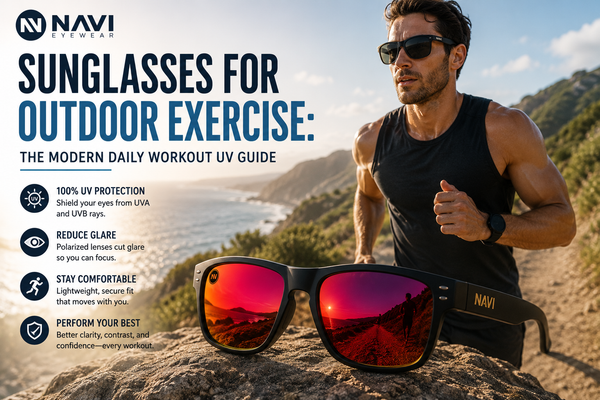

Sunglasses for Outdoor Exercise: The Modern Daily Workout UV Guide
Outdoor exercise is now a daily health habit for a large proportion of modern adults — running, cycling, walking, outdoor fitness classes, and hiking integrated into the routine rather than reserved for weekends. This is genuinely good for health in most respects. It is also a consistent daily UV exposure at times — morning runs, lunchtime walks, outdoor afternoon workouts — when UV eye protection is rarely worn. The UV case for sunglasses during outdoor exercise is straightforward: the UV accumulates regardless of whether you're exercising or sitting still, and the visual performance case for polarized lenses during exercise adds a second independent reason to wear them. The right sport pair serves both simultaneously.

1. Outdoor Exercise as a UV Exposure Context
The Daily Run: UV by the Numbers
A 45-minute morning run at 7:30am in Los Angeles in July exposes the runner to UV index 4–5 for the full run duration. A 45-minute lunchtime run at the same location in July exposes them to UV index 9–11. These are not trivial numbers — and the key behavioral difference is that the same runner who would wear sunscreen and sunglasses at the beach at UV index 10 may run at noon without eye protection because "it's just a run." The UV does not know the difference between a beach chair and a running pace; it accumulates at the same rate per unit time at the same UV index regardless of activity.
Across a year of daily 45-minute outdoor runs, the total UV accumulation from running alone represents a significant proportion of total annual UV exposure — comparable to or exceeding weekend recreational outdoor time for many adults who are otherwise indoors during the week. The daily running habit is a daily UV exposure habit; treating it as one changes the eye protection calculus.
Morning vs Midday vs Evening: UV Profile by Exercise Timing
| Exercise Timing | Typical UV Index (Summer, Mid-Latitude) | UV Protection Priority | Notes |
|---|---|---|---|
| Early morning (5:30–7am) | 0–2 | Low — UV negligible before sunrise and just after | Eye protection still beneficial for glare and debris |
| Morning (7–9am) | 2–5 | Moderate — meaningful for sustained daily exercise | UV accumulates; Cat 1–2 appropriate |
| Late morning (9–11am) | 5–8 | High — approaching peak UV; protection important | Cat 2 recommended; amber for contrast |
| Midday (11am–2pm) | 8–12+ | Very high — peak UV; protection essential | Cat 2–3; avoid unprotected exercise in this window |
| Afternoon (2–4pm) | 5–8 | High — still significant UV | Cat 2 appropriate |
| Late afternoon / evening (4–6pm) | 2–5 | Moderate — declining but still cumulative | Cat 1–2; amber for low-light contrast |
| Evening (after 6pm) | 0–2 | Low — UV minimal after late afternoon | Protection for wind and debris; UV minimal |
The Cumulative Year Calculation
An adult who runs 45 minutes daily, 5 days per week, at 8am in a Sun Belt city accumulates approximately 195 hours of UV exposure from running alone annually. At UV index 4 (a conservative average for 8am in summer and the lower UV indexes of fall and spring), this represents significant cumulative UV dose — delivered at a time and in a context where sunglasses are consistently absent for most runners. Switching to UV400 polarized during daily runs eliminates this accumulation entirely.
2. The Performance Case: Why Polarized Lenses Make Exercise Better
Running: Road and Trail Surface Visibility
Beyond UV protection, polarized amber lenses provide measurable visual performance improvements for running that are independent of the health case:
- Road hazard visibility: amber's contrast enhancement makes road surface irregularities — cracks, raised edges, wet patches, debris — more visually distinct against the road background. This is not a marginal improvement; experienced runners who switch to amber polarized consistently report seeing road hazards more clearly, particularly in variable light conditions.
- Glare elimination on wet surfaces: post-rain running on wet roads and sidewalks involves intense reflective glare from the wet surface. Polarization specifically eliminates this wet surface glare — the most disruptive glare environment for road runners after direct sun.
- Trail surface definition: on unpaved trails, amber contrast enhancement makes terrain features, root exposure, rock placement, and trail edge definition more visually distinct. Trail runners who have switched from no glasses to amber polarized report improved terrain reading, particularly in the dappled light of tree-covered trails where shadow-to-sun transitions can obscure surface features.
- Wind and debris protection: at running pace, airborne debris — dust, pollen, insects — reaches the eye at speeds that cause discomfort and distraction. Even a standard non-sport frame provides meaningful debris protection during running; a close-fitting sport frame with wraparound coverage provides more complete protection.
Cycling: The Case Is Even Stronger
For cycling, the performance case for sport sunglasses is stronger than for running — higher speeds mean more wind-driven debris, the road surface glare at cycling pace is more intense and more visually disruptive, and the consequences of road hazard missed due to poor visibility are higher at cycling speeds than at running speeds. Amber polarized lenses at cycling pace reduce road surface glare, enhance road hazard contrast, and prevent the airborne debris, insects, and wind tears that impair vision during sustained road riding.
Cat 2 for cycling in variable light (cloudy mornings, partial shade, variable conditions). Cat 3 for sustained peak-sun riding where brightness reduction is more important than light transmission. Sport frame with rubber grip contacts for retention during cycling effort. See the complete cycling sunglasses guide.
Outdoor Fitness Classes: Yoga, HIIT, Boot Camp
Outdoor fitness classes — yoga on the beach, outdoor HIIT, boot camp in a park, CrossFit in a parking lot — produce sustained outdoor UV exposure at the UV intensities of midday and late morning when most outdoor group classes are scheduled. Participants lie, sit, and stand in various orientations that expose the eyes to direct sun from multiple angles — including supine positions (lying on the back) that expose the eyes to direct overhead UV with no natural shading from the brow. Sunglasses appropriate for outdoor fitness classes need to stay in position across a wide range of body orientations and exercise intensities — sport frame with rubber grip contacts and temples that secure behind the ear.
Walking: The Most Underrated Exercise UV Context
Walking for exercise — the daily 30-minute walk, the 10,000-step goal, the neighborhood loop — is among the most common outdoor exercise habits and among the least likely to be paired with sunglasses. Walking feels too casual to trigger the sport sunglass habit but too extended to be dismissed as incidental UV exposure. A 30-minute daily walk at UV index 6 (common in mid-morning in summer) accumulates more UV than a 20-minute intense outdoor workout at the same UV index — duration determines UV dose at a given UV index, not exercise intensity. The everyday bag pair or home entry pair covers walking UV without requiring a sport pair.
3. The Exercise Pair: What Makes It Different
Sport Frame Requirements for Exercise
Exercise-specific UV protection requires more from the frame than everyday lifestyle wear:
- Retention under movement: the frame must stay in position during vigorous movement — running pace headbob, cycling handlebar vibration, exercise orientation changes. Rubber grip nose contacts and rubber temple tips that grip behind the ear are the primary retention mechanisms. Frames that pass a "shake test" (shake head vigorously while wearing — the frame should not shift) will generally stay in position during running and cycling.
- Sweat management: sweat on nose contacts and temple tips reduces grip. Rubber grip materials maintain adhesion under sweat better than smooth plastic or metal contacts. Hydrophobic lens coatings prevent sweat droplets from sheeting across the lens and obscuring vision during exercise.
- Wraparound coverage: close-fitting wraparound geometry reduces peripheral UV entry and wind-driven debris, both more relevant at exercise pace than at rest.
- Ventilation: close-fitting frames can trap humid air between the lens and face, causing lens fogging during aerobic exercise. Some sport frames incorporate ventilation slots in the frame body or lens channels to allow air circulation and reduce fogging.
The Exercise Pair Specification
Amber Cat 2 polarized UV400 polycarbonate in a TR90 sport frame with rubber grip contacts — the standard exercise pair specification. Amber for road, trail, and terrain contrast enhancement. Cat 2 for the variable light conditions of morning and afternoon outdoor exercise (not so dark as to be unsafe in shade; adequate for full sun at exercise UV intensities). Polarized for road surface and wet surface glare. UV400 polycarbonate for complete UV protection and impact resistance in a context where lens impact from debris is possible. TR90 frame for the flexibility and shape memory that handles the physical contact of sport without cracking. Browse UV400 polarized sport options at navieyewear.com.
4. The Exercise Kit Placement
In the Kit, Not in the Bedroom
The exercise pair that's in the bedroom or in a drawer is the pair that gets skipped on early morning runs when the alarm has already been pressed twice. The exercise pair that's in the gym bag, clipped to the running vest, in the cycling jersey pocket, or in the workout kit is the pair that gets worn without a separate retrieval decision. The placement principle that applies to all UV protection applies with particular force to exercise: the pair at the point of departure is the pair that gets used.
For runners: in the running kit bag with the shoes, socks, and GPS watch. For cyclists: in the cycling jersey or helmet storage. For gym-to-outdoor exercisers: in the gym bag alongside the water bottle. The exercise pair lives with the exercise gear; it travels with the exercise kit; it is present at every outdoor workout departure without requiring a separate decision.
5. Common Exercise UV Misconceptions
"It's Not That Bright This Morning"
UV does not correlate linearly with perceived brightness. UV index 4 at 8am produces meaningful UV accumulation even when the morning sky feels mild and comfortable. Overcast skies at UV index 5 produce more UV than clear skies at UV index 3 might suggest — cloud cover reduces UV by 30–50%, not 90%. The perception of "not that bright" is a poor guide to UV intensity; UV index is the reliable measure, and UV index above 3 warrants protection for sustained outdoor exercise.
"I'm Only Out for 20 Minutes"
20 minutes at UV index 8 accumulates the same UV as 20 minutes at the beach at UV index 8. Session duration matters; activity type does not affect UV accumulation rate at a given UV index. A 20-minute HIIT class outdoors at noon accumulates meaningful UV. A 20-minute lunchtime run at UV index 9 accumulates significant UV. Duration × UV index = UV dose, regardless of whether the context is exercise or recreation.
"I'll Squint — I Don't Need Glasses"
Squinting reduces visible light discomfort but provides minimal UV protection — the eyelid gap during squinting still allows direct UV to reach the cornea and iris. The UV dose to the lens and retina is not substantially reduced by squinting. Squinting addresses the brightness comfort problem; UV400 lenses address the UV protection problem. Squinting is also a sustained muscular effort that produces eye fatigue — polarized lenses that eliminate glare reduce squinting and the associated fatigue, improving exercise comfort as well as UV protection.
Frequently Asked Questions
Should I wear sunglasses on a morning run?
Yes — UV index at 7–9am in summer is 2–5 at mid-latitudes, meaningful for daily accumulated exercise UV. Beyond UV protection, amber polarized lenses improve road and trail surface visibility for safer and more comfortable running. An amber Cat 2 sport pair in the running kit is the recommended specification — present every run without requiring a separate retrieval decision.
Do sunglasses affect running performance?
No negative effect on performance — running physiology is unchanged by wearing sunglasses. Positive effects: reduced squinting and associated facial muscle fatigue, improved road hazard visibility reducing the cognitive load of terrain monitoring, and wind and debris protection that prevents the eye irritation and tearing that can disrupt running comfort. Many runners who adopt polarized sport sunglasses report that they feel more comfortable and less fatigued at the end of runs, attributing the difference to reduced squinting and glare management effort.
What are the best sunglasses for running?
Amber Cat 2 polarized UV400 polycarbonate in a TR90 sport frame with rubber grip contacts. The amber tint enhances road and trail contrast; Cat 2 handles variable morning and afternoon light conditions; polarization eliminates road surface glare; UV400 polycarbonate provides complete UV protection with impact resistance; TR90 sport frame provides retention during running movement without pressure points during sustained wear. See the complete running sunglasses guide.
Can I wear regular sunglasses for outdoor exercise?
Regular lifestyle frames can work for lower-intensity outdoor exercise (walking, yoga) where frame movement is limited. For running and cycling, a sport frame with rubber grip contacts is practically necessary — standard frames without grip contacts slide off during vigorous movement, and frames that require constant repositioning are a distraction during exercise. The sport frame requirement is functional, not aesthetic.
Should I wear sunglasses for outdoor yoga?
Yes — outdoor yoga classes often run at late morning to early afternoon hours with significant UV index, and the supine positions of yoga practice directly expose the eyes to overhead UV with no brow shading. A sport frame with rubber grip contacts stays in position across the range of yoga orientations; UV400 lenses provide protection during direct overhead sun exposure in supine positions that upright activity doesn't involve.
What tint is best for trail running?
Amber Cat 2 polarized — amber's contrast enhancement is most valuable on natural terrain where trail surface definition, root and rock visibility, and terrain texture discrimination all benefit from warm-spectrum contrast enhancement. In shaded forest trails with variable light, amber's stability in shifting light conditions is particularly helpful — it maintains visual contrast as you transition between sun and shade patches on the trail. Cat 2 for the variable light of typical trail environments; Cat 3 for sustained alpine exposure above treeline.
The Bottom Line
Outdoor exercise is a daily UV exposure — the UV index during a morning run or lunchtime walk is real, the duration is extended, and the annual cumulative dose from daily outdoor exercise is substantial. The polarized performance case adds a second independent reason to wear sport sunglasses during exercise: amber lenses improve road hazard visibility, trail surface definition, and wet surface glare management in ways that make exercise safer and more comfortable. The solution is an amber Cat 2 polarized UV400 sport pair in the exercise kit — present at every outdoor workout departure as part of the standard exercise setup. navieyewear.com/collections/polarized — Buy 1, Get 3 Free for $119.
Related Reading
- Sunglasses for Modern Life: UV Protection in the Digital Age | Navi Eyewear
- The Complete Running Sunglasses Guide | Navi Eyewear
- The Complete Cycling Sunglasses Guide | Navi Eyewear
- The Complete Hiking Sunglasses Guide | Navi Eyewear
- Polarized vs Non-Polarized Sunglasses | Navi Eyewear
- The Science of Lens Color: What Tint Does Your Vision Need? | Navi Eyewear
- Sunglasses by Season: The Complete Year-Round UV Guide | Navi Eyewear
- Shop Polarized UV400 Sunglasses | Navi Eyewear
Sources & Citations
[1] WHO. "Global solar UV index: a practical guide." World Health Organization, 2002. View source →
[2] Sliney DH. "Ocular exposure to environmental light and ultraviolet." Journal of AAPOS, 2014. View source →
[3] Dain SJ. "Sunglasses and sunglass standards." Clinical and Experimental Optometry, 2003. View source →
[4] Taylor HR, et al. "Effect of ultraviolet radiation on cataract formation." New England Journal of Medicine, 1988. View source →
[5] Rosenthal FS, et al. "The effect of sunglasses on ocular exposure to ultraviolet radiation." American Journal of Public Health, 1988. View source →
[6] ISO 12312-1:2013. "Eye and face protection — Sunglasses and related eyewear." International Organization for Standardization. View source →