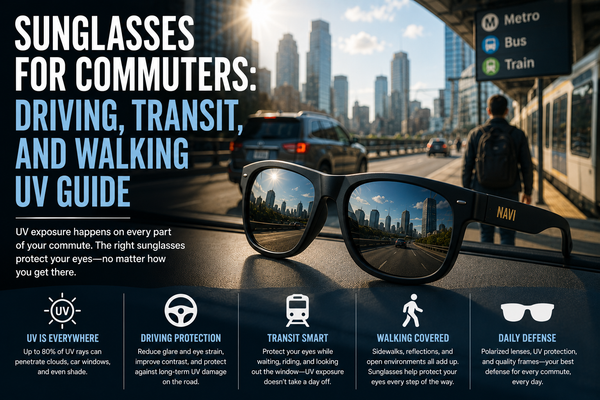

Sunglasses for Commuters: Driving, Transit, and Walking UV Guide
Daily commuting is among the most consistent and most overlooked sources of UV accumulation for modern adults. A 30-minute car commute exposes the driver's left side to UV-A through the side window five days a week, 50 weeks a year — enough to produce documented asymmetric skin and eye UV accumulation over decades. Transit and walking commuters face morning and evening direct sun at street level twice daily at UV intensities that are meaningful for sustained exposure. The commute is predictable, repeated, and fixable with a single placement decision: a dedicated UV400 pair in the car or bag that handles every commute without requiring a daily retrieval decision.

1. Car Commuting: The Side Window Problem
What Car Windows Actually Block
Modern car windshields are laminated glass — a PVB (polyvinyl butyral) interlayer bonded between two glass sheets that blocks essentially all UV-B and approximately 95% of UV-A. The windshield provides strong UV protection for the driver's face. Side windows and rear windows are tempered glass — no interlayer, no UV-blocking additive in most standard vehicles — and transmit UV-A at 50–70% while blocking UV-B. The practical result: significant UV-A reaches the driver through the side window whenever the sun is at a lateral angle to the vehicle.
UV-A is the longer-wavelength UV that penetrates deeper into ocular tissues — the lens and potentially the macula — and is the wavelength range that contributes to nuclear cataract formation and macular oxidative stress. The windshield blocks the UV-B that causes photokeratitis and cortical cataracts; the side window transmits the UV-A that drives deeper ocular UV accumulation. UV400 sunglasses block both — providing complete UV protection that the windshield alone does not deliver.
The Asymmetry Effect
Left-hand-drive commuters (US, Europe, most of the world) receive disproportionately more side window UV on the left side — the driver's window side. Studies of dermatologists and dermatology clinics have documented higher rates of left-side facial skin changes in frequent drivers, and some optometric literature notes the left-eye UV accumulation asymmetry in long-term daily drivers. The asymmetric UV accumulation from daily car commuting over 20–30 years of working life is a real occupational UV exposure that is addressed entirely by a car pair of UV400 sunglasses.
The West-Facing Afternoon Commute
Westbound afternoon commuters face direct sun through the windshield at low sun angles — the setting sun directly in the driver's line of sight during the return commute. At these low angles, the sun's UV and visible light intensity is concentrated along the driver's visual axis. Polarized lenses specifically address the road surface glare at these low angles — the direct and reflected glare from road surfaces at low sun angles is predominantly horizontally polarized and is eliminated by polarization. The late afternoon westbound commute is the highest-glare driving scenario most daily commuters encounter, and it occurs five days a week. Gray polarized UV400 Cat 2 is the specification that handles both the UV-A side window exposure and the low-angle afternoon road glare of the car commute.
The Car Pair Solution
A dedicated UV400 pair stored in the center console or glove compartment — never removed from the car — eliminates the primary commuter UV gap without any daily behavioral decision. The car pair is present every time the car is entered; putting it on is a conditioned place association (get in car, put on glasses) rather than a retrieval task. The pair doesn't need to be the everyday best pair — it needs to be UV400 polycarbonate polarized and available. Browse gray polarized UV400 options at navieyewear.com.
2. Transit Commuting: Bus, Train, Subway
Outdoor Transit Exposure
Transit commuters — bus riders, train riders, subway users — have outdoor UV exposure concentrated in the walks between home, transit stops, and workplace. A transit commute involving a 10-minute walk each way to the station and a 5-minute walk at the other end produces 30 minutes of daily outdoor UV exposure at morning and evening sun angles. In summer at mid-latitudes, morning UV index at 8am is 3–5; afternoon UV index at 6pm is 2–4. These are not trivial numbers for sustained daily exposure across a working year.
Transit riders on above-ground trains or in open-air bus stops also receive UV during the transit itself — the waiting period at outdoor platforms and open-air stops is outdoor UV exposure time equivalent to street-level walking exposure. Underground subway riders have minimal UV during the transit portion but full street-level UV at all entry and exit points.
Open-Top and Glass-Roof Transit
Some transit — open-top sightseeing buses, glass-roof commuter trains, outdoor ferry routes — provides sustained UV exposure throughout the transit journey, not just at entry and exit points. Glass roofs on commuter trains typically block UV-B but transmit UV-A (standard glass behavior), producing UV-A exposure during the full transit duration for window-seat riders in south-facing carriages during peak UV hours.
The Everyday Bag Pair for Transit Commuters
The bag that travels with the transit commuter — backpack, work bag, briefcase — is the natural placement for the transit commuter's UV pair. The pair in the bag is present at every station walk, every bus stop wait, every outdoor transit moment without needing to be carried separately or remembered separately from the regular bag. Gray Cat 2 polarized UV400 handles all transit commute UV contexts — morning and evening sun at moderate UV index, reflective urban surfaces (wet pavement, glass buildings), and the incidental outdoor time of the transit commute day.
3. Walking Commuters: The Full Outdoor Exposure
Walking Commute UV Profile
Walking commuters receive more commute UV than car or transit commuters — the full walk is outdoor UV exposure at street level with direct sky exposure, building and pavement reflection, and no vehicle shell providing partial UV reduction. A 20-minute walking commute each way at UV index 5 (typical morning conditions in summer) produces a meaningful daily UV dose — approximately equivalent to 10 minutes at the beach at UV index 10. Repeated daily across a working year, the walking commuter's commute UV accumulation is comparable to regular recreational sun exposure.
Urban UV Amplification
Urban walking environments amplify UV through reflection from glass building facades, concrete surfaces, and wet pavement — all of which reflect both UV and visible light, increasing the effective UV reaching the eye above what the overhead UV index would predict. High-rise glass buildings on both sides of a street canyon effectively surround the walker with reflective surfaces, increasing lateral UV exposure. Polarized sunglasses specifically eliminate the horizontally polarized component of building and pavement reflection — the most visually disruptive glare component of urban walking — while UV400 addresses the health case for all UV directions.
The Urban-Optimized Lens: Gray Polarized Cat 2
For walking commuters in urban environments: gray Cat 2 polarized UV400. Gray for color accuracy in environments with traffic signals, signage, and navigation cues. Polarized for building glass, wet pavement, and car hood reflection that makes urban walking visually demanding. Cat 2 for the variable light conditions of a city walk that moves between sun, shade, building shadows, and indoor-outdoor transitions multiple times during a commute. See the urban and city sunglasses guide for the complete urban UV framework.
4. Commute UV Across Seasons
Summer: Peak Commute UV
Summer commutes in mid-latitude US cities involve UV index 4–7 at 8am (morning commute) and UV index 2–4 at 6pm (evening commute) — meaningful UV at both commute endpoints. Summer afternoon westbound car commutes face direct low-angle sun; summer morning walking commutes face UV index already sufficient for meaningful accumulation. Cat 2 handles summer commute UV appropriately — adequate darkness reduction for comfort without being too dark for the shade transitions of a city commute.
Winter: Lower but Present
Winter commute UV index is lower — UV index 1–3 at typical winter commute hours in most US mid-latitude cities — but not zero. UV accumulation at UV index 2 over a 30-minute daily commute across winter months is real, particularly for car commuters who accumulate side window UV-A regardless of season. UV-A does not reduce proportionally with the UV index changes that primarily reflect UV-B variation — UV-A reaches the surface at a higher proportion of total solar UV in winter than in summer. The car pair worn year-round addresses UV-A accumulation in winter commutes that the UV index alone might suggest are safe to skip.
Spring and Fall: The Underestimated UV Window
Spring and fall commutes occur during rapidly changing UV conditions — UV index rising sharply from March through May, declining from September through November. Commuters who establish summer UV protection habits but drop them in spring and fall miss the transitional months when UV is already significant but the protective behavior hasn't been activated. Year-round placement of the commute pair — car or bag — eliminates the seasonal behavior switching that produces spring and fall UV gaps.
5. Commute-Specific Lens Recommendations
| Commute Type | Primary UV Source | Recommended Lens | Why |
|---|---|---|---|
| Daily car commute | Side window UV-A; road surface glare | Gray polarized UV400 Cat 2 | Color accuracy for signals; polarization for road glare; UV400 for side window UV-A |
| Westbound afternoon car commute | Direct low-angle sun; road surface glare | Gray polarized UV400 Cat 2–3 | Polarization essential for low-angle road glare; Cat 3 if direct sun is intense |
| Urban walking commute | Direct sky UV; building/pavement reflection | Gray polarized UV400 Cat 2 | Color accuracy for navigation; polarization for urban reflective surfaces |
| Transit (outdoor walks) | Street-level UV at commute angles | Gray polarized UV400 Cat 2 | General purpose for variable transit UV contexts |
| Cycling commute | Direct UV; road surface glare; wind | Amber polarized UV400 Cat 2 (sport frame) | Contrast enhancement for road hazards; sport frame for retention and wind coverage |
| E-bike or scooter commute | Direct UV; road surface glare at speed | Amber or gray polarized UV400 Cat 2 (sport frame) | Wraparound coverage for wind; polarization for road glare at speed |
6. The Cycling Commuter
UV and Performance Combined
Cycling commuters have both the UV protection need of any outdoor commuter and the performance need of active outdoor riders — retention during pedaling, road hazard visibility in variable light, and wind protection at riding speeds. The cycling commute specification combines these: amber Cat 2 polarized UV400 in a close-fitting sport or cycling frame with rubber grip contacts that stay in position during sustained physical effort.
Amber rather than gray for cycling: road surface contrast enhancement in amber makes road hazards — cracks, debris, wet patches, shadows — more visually distinct against the road background. This is a safety benefit in addition to the UV protection and comfort benefits. See the complete cycling sunglasses guide for the full specification framework.
7. Commute Placement: The One Decision That Replaces All Daily Decisions
Car Commuters
One pair in the center console. Gray Cat 2 polarized UV400. Never removed from the car. This single placement decision — done once — eliminates the UV gap for every car commute for as long as the pair lasts. The behavioral model: get in the car, put on the glasses. Not "remember to bring glasses," not "decide if today's commute warrants protection." The pair is there; the habit is triggered by entering the car.
Walking and Transit Commuters
One pair in the bag. Gray Cat 2 polarized UV400. In the front pocket of the backpack, in the small compartment of the work bag, clipped to the bag exterior. The pair travels with the bag; the bag travels every day; the glasses are present at every transit walk and outdoor moment of the commute without separate management. Navi Eyewear's Buy 1, Get 3 Free at $119 for four pairs makes equipping both the car and the bag simultaneously a practical first purchase rather than a sequential upgrade.
Frequently Asked Questions
Do car windows protect against UV?
Windshields (laminated glass) block essentially all UV-B and approximately 95% of UV-A — strong UV protection. Side and rear windows (tempered glass in most vehicles) block UV-B but transmit UV-A at 50–70%. UV400 sunglasses block 100% of both UV-A and UV-B, completing the UV protection that the windshield alone doesn't provide through the side windows.
Is the morning commute UV significant?
Yes — at typical morning commute hours (7–9am) in summer at mid-latitudes, UV index is 3–6. Sustained 30-minute daily exposure at UV index 4 accumulates meaningfully over a working year. Morning UV is not as intense as midday UV but occurs during a period of consistent daily exposure that compounds over years of commuting. Year-round car pair or bag pair placement addresses morning commute UV without requiring awareness of the daily UV index.
What sunglasses are best for driving to work?
Gray Cat 2 polarized UV400 polycarbonate — gray for color accuracy at traffic signals and road markings, Cat 2 for the range of light conditions in a typical commute (morning shade and sun, variable clouds), polarized for road surface and wet pavement glare. See the complete driving sunglasses guide for the full specification and use-case breakdown.
Should I wear sunglasses walking to the subway?
Yes — the street-level walk to and from transit is full outdoor UV exposure at morning and evening sun angles. The UV index at 8am in summer is sufficient for meaningful daily accumulation when repeated every workday. The bag pair that travels with you handles transit walking UV without any additional behavioral decision beyond keeping one pair in your regular commute bag.
Do I need special sunglasses for cycling to work?
A sport frame with rubber grip contacts and wraparound coverage is preferable to a standard lifestyle frame for cycling — retention during sustained pedaling and wind protection at riding speed are the additional requirements beyond UV400 polarized lenses. Amber Cat 2 polarized in a sport frame is the cycling commute specification. The same pair used for the cycling commute works for recreational cycling and other outdoor sport.
How do I stop forgetting sunglasses for my commute?
Don't rely on daily memory — use location-based placement. Car pair in the center console, bag pair in the front pocket of the commute bag. The glasses are present at the commute departure point without requiring daily retrieval. If both placements are filled with a UV400 pair, the commute UV gap is closed regardless of whether you specifically remember sunglasses that morning.
The Bottom Line
Daily commuting is a consistent, year-round UV exposure that accumulates meaningfully over a working life — through car side window UV-A, street-level UV during transit and walking, and the direct sun of outdoor commute moments. It is also the most behaviorally fixable UV gap: one placement decision per commute type closes the gap entirely. Gray Cat 2 polarized UV400 in the car console covers the car commuter; the same specification in the everyday bag covers the transit and walking commuter; amber Cat 2 polarized sport frame covers the cycling commuter. All available at navieyewear.com/collections/polarized — Buy 1, Get 3 Free for $119.
Related Reading
- Sunglasses for Modern Life: UV Protection in the Digital Age | Navi Eyewear
- Best Sunglasses for Driving | Navi Eyewear
- The Complete Cycling Sunglasses Guide | Navi Eyewear
- Sunglasses for Urban and City Travel | Navi Eyewear
- Polarized vs Non-Polarized Sunglasses | Navi Eyewear
- How Many Pairs of Sunglasses Do You Actually Need? | Navi Eyewear
- Sunglasses for Road Trips and Long-Haul Driving | Navi Eyewear
- Shop Polarized UV400 Sunglasses | Navi Eyewear
Sources & Citations
[1] Sliney DH. "Ocular exposure to environmental light and ultraviolet." Journal of AAPOS, 2014. View source →
[2] WHO. "Global solar UV index: a practical guide." World Health Organization, 2002. View source →
[3] Rosenthal FS, et al. "The effect of sunglasses on ocular exposure to ultraviolet radiation." American Journal of Public Health, 1988. View source →
[4] Dain SJ. "Sunglasses and sunglass standards." Clinical and Experimental Optometry, 2003. View source →
[5] Taylor HR, et al. "Effect of ultraviolet radiation on cataract formation." New England Journal of Medicine, 1988. View source →
[6] ISO 12312-1:2013. "Eye and face protection — Sunglasses and related eyewear." International Organization for Standardization. View source →