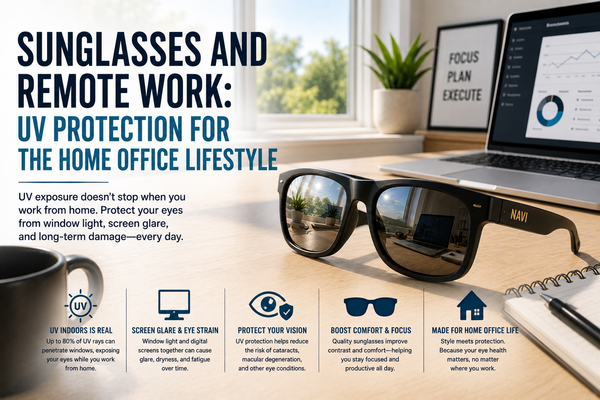

Sunglasses and Remote Work: UV Protection for the Home Office Lifestyle
Remote work has created a UV exposure pattern that didn't exist at scale before: frequent short outdoor breaks from a home office that feel incidental but accumulate meaningful UV across a workday. The morning coffee on the patio, the lunchtime neighborhood walk, the afternoon backyard break, the outdoor video call — none of these feel like "outdoor activities" that warrant sunglasses, but together they represent real daily UV exposure at times when eye protection is rarely worn. The fix is simple: a UV400 pair at the home entry or outdoor break location, present at every outdoor moment without requiring a deliberate decision to retrieve them.

1. The Remote Worker's UV Exposure Profile
How Remote Work Changed Outdoor Time
Office workers largely experience outdoor UV in predictable blocks — the commute, the lunch break, the commute home. Remote workers experience UV as scattered micro-sessions distributed across the workday: stepping outside to check the mail, taking a call while walking the block, working at a patio table for an hour, watering the garden between meetings. These sessions are shorter and less deliberate than commute or lunch break UV, which makes them less likely to trigger protective behavior — and more likely to occur at the high-UV midday hours when the remote worker is most active at home.
The aggregate UV accumulation of a remote workday that includes four or five outdoor micro-sessions may exceed the UV accumulation of an office workday commute, even though no individual session feels significant. This is the remote work UV gap: real cumulative exposure distributed across moments that don't feel like UV exposure events.
The Midday UV Problem
Remote work schedules concentrate outdoor breaks at times office workers are indoors. The lunchtime walk taken at noon, the 2pm backyard break, the outdoor afternoon meeting — all occur at or near peak UV index hours when a typical office worker would be inside. UV index 8–10 at noon in summer in Southern California means that a 20-minute outdoor lunch break accumulates UV at the same rate as a beach session of equivalent duration. The remote worker who takes three 20-minute outdoor breaks between 11am and 3pm has accumulated a meaningful UV dose — distributed, but real.
2. Specific Remote Work UV Contexts
The Patio Work Session
Working outdoors — at a patio table, in a backyard, on a rooftop deck — for one to two hours during the workday is common in remote work culture, particularly in warm-weather regions. A two-hour outdoor work session at UV index 8 produces significant UV accumulation to the face and eyes. The person is seated and focused on their screen, not moving, not in sun-protection mode — but receiving sustained direct UV nonetheless. UV400 polarized sunglasses during outdoor work sessions protect the eyes and reduce screen glare simultaneously — polarization eliminates the reflected glare from the laptop screen surface that makes outdoor screen use uncomfortable, while UV400 addresses the health case.
The Outdoor Call
Taking calls outside — standing on a patio, walking the neighborhood, sitting in the backyard — is standard remote work behavior. A 30-minute outdoor phone or video call at midday accumulates UV at peak-UV rates with zero protection if sunglasses weren't already worn going outside. The call doesn't feel like a UV exposure event; it feels like a work activity that happens to be outside. The home entry pair that's at the door handles this — the sunglasses are there when stepping outside for the call, without requiring a separate retrieval decision.
The Neighborhood Walk Break
A midday or afternoon walk break — 20–40 minutes around the neighborhood — is both the most UV-intense and the most beneficial outdoor activity in the remote workday. UV intensity at 11am–2pm is the highest of any outdoor timing; the walk duration is long enough for meaningful UV accumulation. The walk break that incorporates UV400 polarized sunglasses provides both the UV protection appropriate for this timing and the visual comfort (reduced glare on road surfaces, increased visual contrast in the outdoor environment) that makes walking more pleasant.
Window and Skylight UV in the Home Office
Working near south- or west-facing windows provides meaningful UV-A exposure through standard window glass. Tempered glass used in residential windows transmits UV-A at 50–70% — less than full outdoor exposure but not zero over a full workday of window-adjacent sitting. Laminated glass (common in newer construction and some replacement windows) blocks more UV. For remote workers with significant window sun exposure during peak UV hours, UV-blocking window film reduces UV-A transmission and may be worth considering as a home office modification. Sunglasses at the home entry rather than worn indoors at a window are the more practical everyday UV management solution.
3. The Home Entry Placement: The Remote Worker's Key Fix
Why Placement Beats Habit
Building a sunglass habit around deliberate daily retrieval — remembering to bring sunglasses when going outside — fails for the remote work outdoor break pattern because the breaks are spontaneous and frequent. The person steps outside for a 5-minute stretch, forgets sunglasses are inside, and makes the calculation that retrieving them isn't worth it for a brief outdoor moment. Repeat this calculation 4–5 times daily and the UV protection gap is open for the majority of outdoor time.
Location-based placement eliminates the retrieval decision. UV400 polarized sunglasses at the home entry — on the key hook, in a small tray by the door, hanging from the door handle — are present every time the door is opened. No retrieval decision; no threshold of outdoor duration that justifies getting them. Every outdoor moment starts with sunglasses already available.
Secondary Placement: The Outdoor Work Zone
For remote workers who regularly work at a specific outdoor location — a patio table, a backyard chair, a rooftop deck — a dedicated pair at that location (in a case on the outdoor table, on the patio ledge) eliminates even the trip to the door. The outdoor work pair is at the outdoor work zone; putting it on is as automatic as opening the laptop. Browse UV400 polarized options at navieyewear.com.
4. Lens Specification for Remote Work Outdoor Use
Gray Cat 2 Polarized: The Home Entry Default
Gray Cat 2 polarized UV400 handles the full range of remote work outdoor contexts: adequate for noon outdoor calls (not too dark for brief transitional moments), color-neutral for the varied outdoor lighting of a neighborhood walk, polarized for the road surface and glass glare of suburban outdoor environments. Cat 2 is the correct category for the variable light conditions of work breaks that span morning, midday, and afternoon — not so dark as to be uncomfortable in the shade, not so light as to be inadequate in direct noon sun.
Amber Cat 2 for Exercise-Integrated Breaks
Remote workers who integrate exercise into their outdoor breaks — running, cycling, outdoor workout — benefit from amber Cat 2 polarized in a sport frame for the exercise portion, with the gray home entry pair covering non-exercise outdoor moments. The two-pair approach for the home office — gray at the entry for breaks, amber sport in the exercise kit — covers all remote work outdoor UV contexts without compromise.
5. Screen Use and Eye Comfort Outdoors
Outdoor Laptop Use and Glare
Outdoor laptop use is visually uncomfortable primarily because of ambient light competing with screen luminance and reflected glare on the screen surface. Polarized sunglasses reduce the reflected glare on the screen surface — the horizontally polarized reflection from the glossy display — improving outdoor screen visibility. They do not increase the screen's absolute brightness, which is limited by display hardware, but they reduce the competing glare that makes the screen hard to see. For remote workers who regularly work outdoors, polarized lenses are the practical optical tool for outdoor screen visibility as well as UV protection.
Blue Light and Indoor Screen Use
Remote work involves extended indoor screen time that has led to interest in blue-light-filtering lenses for indoor use. The evidence for blue light from screens causing significant eye damage is limited — screen brightness is orders of magnitude lower than solar blue light. Digital eye strain from extended screen use is real but primarily caused by reduced blink rate and accommodative fatigue, not by blue light specifically. UV400 sunglasses for outdoor use and standard clear lenses (with or without anti-reflective coating) for indoor screen use is the appropriate specification split. See the complete blue light and UV guide.
6. The Remote Worker's UV Coverage Setup
Minimum Setup: Two Pairs
- Home entry pair: gray Cat 2 polarized UV400 — at the door for all outdoor breaks, calls, and neighborhood walks
- Sport/exercise pair: amber Cat 2–3 polarized UV400 in sport frame — in the exercise kit for outdoor workouts integrated into the workday
Full Setup: Three Pairs
- Home entry pair: gray Cat 2 polarized UV400
- Car pair: gray Cat 2 polarized UV400 — for errands and the days that include driving
- Sport/exercise pair: amber Cat 2–3 polarized UV400 sport frame
Navi Eyewear's Buy 1, Get 3 Free — $119 for four pairs — covers the full setup with a spare or beach/travel pair at approximately $30 per pair.
Frequently Asked Questions
Do I need sunglasses for a 10-minute outdoor break?
At UV index 8 (common at midday in summer in most US locations), 10 minutes of outdoor exposure accumulates UV at the same rate as 10 minutes of beach UV. Five 10-minute outdoor breaks during a workday add 50 minutes of UV exposure — meaningful daily accumulation. The home entry pair that's at the door makes wearing sunglasses for any duration outdoor break a zero-friction behavior.
Is working near a window at home a UV concern?
Standard residential glass transmits 50–70% of UV-A — less than full outdoor exposure but not zero. Sustained daily UV-A exposure through south- or west-facing windows during peak UV hours contributes to the remote worker's UV accumulation profile. For significant window sun exposure, UV-blocking window film is a home office modification worth considering. UV400 sunglasses worn outdoors during breaks remain the primary UV protection strategy.
What's the best sunglass setup for someone who works from home?
Gray Cat 2 polarized UV400 at the home entry for all outdoor breaks, neighborhood walks, and outdoor calls. Amber Cat 2–3 polarized sport frame in the exercise kit for outdoor workouts. Car pair if driving regularly for errands. The home entry pair is the most critical placement — it catches the frequent outdoor micro-sessions that constitute the majority of the remote worker's daily UV exposure.
Do sunglasses help with outdoor screen glare?
Yes — polarized lenses reduce the reflected glare on glossy screen surfaces that makes outdoor laptop use uncomfortable. The polarization specifically targets the horizontally polarized reflection from the screen surface, reducing competing glare without reducing the screen's actual display output. For remote workers who work outdoors regularly, polarized UV400 lenses serve double duty: UV protection and outdoor screen visibility improvement.
Should I wear sunglasses during an outdoor video call?
Yes for UV protection — the outdoor video call is a UV exposure event regardless of how brief it feels. For the appearance on camera, standard UV400 lenses (not heavily mirrored) allow the eyes to be visible through the lens in most lighting conditions. If appearing on camera without sunglasses visible is preferred, shade the camera position where possible and wear sunglasses for all outdoor time when not on camera.
The Bottom Line
Remote work has created a new daily UV exposure pattern — frequent short outdoor breaks distributed across the workday at peak UV hours — that accumulates meaningful UV without triggering the protective habits that deliberate outdoor activity would. The solution is placement rather than habit: UV400 polarized sunglasses at the home entry and outdoor work zone, present at every outdoor moment without requiring retrieval. Gray Cat 2 polarized for all-conditions outdoor break use; amber Cat 2–3 sport pair for integrated outdoor exercise. At $119 for four pairs, the complete remote work UV setup is one Navi Eyewear order. navieyewear.com/collections/polarized — Buy 1, Get 3 Free for $119.
Related Reading
- Sunglasses for Modern Life: UV Protection in the Digital Age | Navi Eyewear
- Sunglasses for Commuters | Navi Eyewear
- Sunglasses for Outdoor Exercise: The Modern Daily Workout UV Guide | Navi Eyewear
- Blue Light, Screens, and UV: The Complete Modern Eye Health Picture | Navi Eyewear
- How Many Pairs of Sunglasses Do You Actually Need? | Navi Eyewear
- Polarized vs Non-Polarized Sunglasses | Navi Eyewear
- Sunglasses by Season: The Complete Year-Round UV Guide | Navi Eyewear
- Shop Polarized UV400 Sunglasses | Navi Eyewear
Sources & Citations
[1] WHO. "Global solar UV index: a practical guide." World Health Organization, 2002. View source →
[2] Sliney DH. "Ocular exposure to environmental light and ultraviolet." Journal of AAPOS, 2014. View source →
[3] Rosenthal FS, et al. "The effect of sunglasses on ocular exposure to ultraviolet radiation." American Journal of Public Health, 1988. View source →
[4] Taylor HR, et al. "Effect of ultraviolet radiation on cataract formation." New England Journal of Medicine, 1988. View source →
[5] Dain SJ. "Sunglasses and sunglass standards." Clinical and Experimental Optometry, 2003. View source →