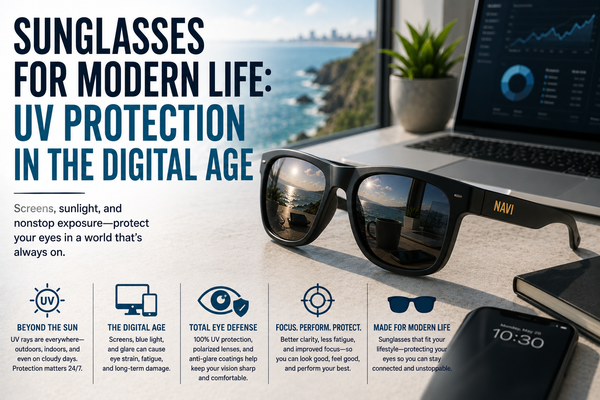

Sunglasses for Modern Life: UV Protection in the Digital Age
Modern daily life involves a specific pattern of UV exposure that differs from prior generations: frequent short indoor-outdoor transitions rather than sustained outdoor sessions, integrated outdoor exercise as part of the workday routine, extended commuting through car and transit environments, and concentrated weekend outdoor time at high-UV destinations. The total UV accumulation from these modern exposure patterns is substantial — and the fragmented nature of modern outdoor time makes the single-pair sunglass habit less effective than it was for more predictable outdoor schedules. This guide covers how UV fits the modern lifestyle and how consistent UV400 protection maps to how people actually live now.
Contents
- 1. The Modern UV Exposure Profile: How It Has Changed
- 2. The Commuter's UV Exposure
- 3. The Remote Worker and the Outdoor Break
- 4. Integrated Outdoor Exercise: The Modern Daily Run
- 5. Weekend Outdoor Culture: Concentrated High-UV Time
- 6. Travel and High-UV Destinations
- 7. Indoor-Outdoor Transitions: The Forgotten UV Gap
- 8. The Multi-Pair Strategy for Modern Life
- 9. Lens Specification for Modern Lifestyle Use
- 10. Frequently Asked Questions
- 11. Supporting Articles in This Cluster

1. The Modern UV Exposure Profile: How It Has Changed
Fragmented but Substantial
A generation ago, UV exposure patterns were more binary: outdoor workers received sustained high-dose UV; indoor workers received minimal occupational UV and concentrated weekend or vacation UV. Modern work and lifestyle patterns have blurred this division. Remote work creates hybrid schedules with outdoor breaks built into the workday. Urban professional culture integrates outdoor exercise (running, cycling, outdoor gym classes) as a daily health habit. Commuting through car, transit, and foot travel creates morning and evening UV exposure that didn't exist for workers who walked from a residential neighborhood to a local workplace. Weekend outdoor culture — farmers markets, patios, outdoor festivals, trail runs, beach days — concentrates the highest-UV activities into 48-hour windows of maximum exposure.
The result: modern adults in mid-latitude high-UV regions accumulate UV across more hours and more contexts than the simple indoor-worker model would predict — but in shorter, more fragmented sessions that are less likely to trigger a dedicated sunglass habit. The runner who goes out at 7am without sunglasses because "it's not that bright yet." The remote worker who takes a 20-minute patio break without glasses because "I'm only going to be outside briefly." The commuter driving west at 5pm into direct sun without a car pair because the good sunglasses are at home. Each gap is small; the cumulative year-round total is meaningful.
UV Index and Modern Outdoor Timing
UV index peaks between 10am and 2pm — the hours when most office workers are indoors. Modern lifestyle outdoor activity skews to the edges of this window: morning runs (7–9am, UV rising but not at peak), lunchtime walks (11am–1pm, within or near peak UV), evening commutes (5–7pm, UV declining but still significant in summer), and weekend outdoor activity (variable, often concentrated in mid-morning to afternoon peak UV hours). The modern outdoor activity schedule hits both the rising UV of morning and the lingering UV of afternoon while largely missing the peak office hours that represent maximum UV exposure in a traditional outdoor worker's day. This doesn't mean the UV accumulation is low — it means it's distributed differently, with significant accumulation at times the UV protection habit may be least established.
2. The Commuter's UV Exposure
Car Commuting
Daily car commuting is one of the most consistent and most overlooked sources of UV accumulation for modern adults. A 30-minute daily commute — 60 minutes round-trip, five days a week — represents approximately 250 hours of potential UV exposure annually, concentrated in the morning and late afternoon sun angles that produce direct driver-side window UV. Laminated windshields block most UV-B but transmit 50–70% of UV-A through standard tempered side windows. The left hand on the steering wheel and the left side of the face — both receiving direct side window sun — accumulate measurably more UV than the right side in left-hand-drive countries, producing asymmetric skin and eye UV accumulation over decades of commuting.
Gray polarized UV400 Cat 2 in the center console — a dedicated car pair that never leaves the car — eliminates the availability gap that causes most commuters to drive unprotected. The car pair doesn't need to be premium or stylish; it needs to be UV400 polycarbonate polarized and present every time the car is entered. See the road trip and long-haul driving guide for extended driving UV coverage.
Walking and Transit Commuting
Walking commuters and transit users who walk between home, station, and workplace accumulate UV through exposure at typical morning and evening sun angles — often with direct sun exposure at street level with minimal shade. A 20-minute walk each way adds 40 minutes of daily UV exposure at times when sun angles produce significant UV index despite not being peak midday hours. Summer morning UV index at 8am in Los Angeles or Phoenix is already 3–5 — meaningful for sustained daily exposure.
The everyday bag pair — gray or amber polarized UV400 Cat 2 in the bag that travels to work daily — addresses the walking commuter's UV gap. The pair that's always in the bag is available at every transit and walking moment without requiring a deliberate decision to bring sunglasses.
3. The Remote Worker and the Outdoor Break
The Outdoor Break UV Pattern
Remote work has produced a specific UV exposure pattern that didn't exist at scale before the mid-2010s: the outdoor break taken from a home office. A morning coffee on the patio, a lunchtime walk around the neighborhood, an afternoon break in the backyard — these micro-outdoor sessions collectively represent significant UV accumulation without triggering the sunglass habit that a deliberate outdoor activity would. The outdoor break is perceived as a brief transition, not a UV exposure event, and sunglasses are left inside while meaningful UV accumulates.
For remote workers, the home entry pair — UV400 polarized at the door, on the key hook, or at the outdoor break location — is the critical availability placement. The pair that's at the door when the door is opened for a patio break catches the micro-outdoor sessions that deliberate outdoor activity doesn't. See the remote work and outdoor break UV guide for the complete remote worker framework.
The Home Office Patio and Window UV
Remote workers who work near windows or on outdoor patios accumulate UV through window glass (UV-A transmission through standard glass is significant) and direct outdoor UV. Working outdoors — on a patio, in a garden, at an outdoor café — during peak UV hours (10am–2pm) while not wearing sunglasses accumulates substantial UV over a work session. The remote work lifestyle that integrates outdoor time into the workday requires integrating UV protection into those same outdoor work sessions.
4. Integrated Outdoor Exercise: The Modern Daily Run
Exercise as Daily UV Exposure
Outdoor exercise has become a near-universal health habit in modern professional culture — running, cycling, outdoor fitness classes, trail hiking, and walking programs integrated into the daily routine rather than occasional weekend recreation. A daily 45-minute morning run, five days a week, represents approximately 195 hours of outdoor UV exposure annually in a context where eye protection is frequently overlooked. Runners without sunglasses at 7am in summer accumulate UV at UV index 4–6 — meaningful for daily sustained exposure.
The sport pair — amber polarized UV400 Cat 2–3 in a sport frame that lives in the gym bag or running kit — addresses this gap. Amber for contrast enhancement on trail and road surfaces; Cat 2 for morning light that is substantial but not peak; sport frame for retention during vigorous activity. The pair in the kit rather than in the bedroom is the pair that gets worn on the morning run without requiring a special decision to bring it. See the complete running sunglasses guide and the cycling sunglasses guide for sport-specific coverage.
Lunchtime Outdoor Activity
Lunchtime outdoor activity — the noon walk, the lunchtime run, the outdoor workout class — occurs precisely at peak UV hours. UV index 8–12 at midday in summer in Sun Belt states means that a 45-minute lunchtime run at noon produces a UV dose equivalent to several morning runs combined. The lunchtime outdoor session is among the highest-UV exposures of the modern workday — and among the most likely to be undertaken without UV eye protection because it feels like a brief break rather than a serious outdoor activity.
5. Weekend Outdoor Culture: Concentrated High-UV Time
The Weekend UV Concentration Effect
Modern indoor work culture concentrates the most UV-intense outdoor activities into weekend windows. The Saturday beach trip, the Sunday trail run, the outdoor festival, the farmers market, the patio brunch — all in the 10am–3pm window that represents peak UV exposure. An adult who is largely indoors Monday through Friday may accumulate a significant proportion of their weekly UV dose in a few peak-UV weekend hours. This concentration means that weekend outdoor UV protection habit has disproportionately high UV reduction value relative to the time it represents.
Social Outdoor Settings
Outdoor dining, rooftop bars, outdoor events, and patio culture expose eyes to UV at times and in settings where sunglasses are not always socially salient — a patio restaurant at 11am involves meaningful UV exposure but may not trigger the "this is a UV exposure event" awareness that a beach day would. The social outdoor setting is a significant source of cumulative UV in modern adult life precisely because it doesn't feel like a dedicated outdoor activity. A pair in the everyday bag handles this context — the pair that travels everywhere is available when the patio table is in full sun.
6. Travel and High-UV Destinations
Vacation UV: The Annual High-Dose Event
Modern vacation culture concentrates high-UV outdoor time into 1–2 week blocks of maximum UV exposure — the beach vacation, the ski trip, the national park tour — at destinations specifically chosen for their outdoor and natural environments, which are typically the highest-UV environments the traveler encounters all year. A week at a tropical beach at UV index 12–14 represents more UV dose than several months of typical daily UV accumulation in a mid-latitude city. The annual vacation is the highest-UV event of most modern adults' year and deserves specific UV protection planning. See the traveler's complete sunglasses guide.
Business Travel
Business travel creates UV exposure through airport transit (outdoor parking, terminal walks), car rental driving in unfamiliar high-UV cities, and client entertainment in outdoor settings. The business traveler who forgets sunglasses for a two-day trip to Phoenix or Miami in July accumulates significant unprotected UV in a high-UV destination during a period when they are most likely to be carrying minimal gear. A compact folding UV400 pair as permanent business travel kit solves this specific availability gap.
7. Indoor-Outdoor Transitions: The Forgotten UV Gap
The Transition Moment
Modern lifestyle involves more indoor-outdoor transitions than most people consciously track — leaving the office for lunch, stepping outside to take a phone call, walking from a parking garage to a building, exiting a gym, moving from indoors to an outdoor patio, transitioning between stores in an outdoor shopping area. Each transition is brief, but the aggregate of daily transitions represents meaningful UV exposure time — and transitions are specifically the moments when sunglasses are least likely to be on, because the outdoor time is perceived as incidental rather than deliberate.
The availability solution for transition UV is the bag pair — the UV400 pair that goes everywhere the person goes, available for every transition, every outdoor call, every parking lot walk. The bag pair requires no planning or advance decision; it's present at every indoor-outdoor moment without effort. See the urban and city sunglasses guide for the complete urban UV exposure framework.
8. The Multi-Pair Strategy for Modern Life
The Four Placements
The modern lifestyle UV exposure pattern — fragmented, context-varied, distributed across commuting, exercise, work breaks, and social outdoor time — requires UV protection at multiple points of outdoor access rather than a single pair managed deliberately. The four-placement strategy addresses the four primary departure points of modern outdoor life:
- Car (center console): gray Cat 2 polarized — covers commuting, errands, and all car-based outdoor access without requiring retrieval from elsewhere
- Everyday bag: gray or amber Cat 2 polarized — covers walking commutes, lunchtime outdoor activity, transitions, social outdoor settings, and all non-car outdoor time
- Sport or exercise kit: amber Cat 2–3 polarized in sport frame — covers morning runs, lunchtime workouts, cycling, hiking, and all dedicated outdoor exercise
- Home entry: gray or amber Cat 2 polarized — covers outdoor breaks from home office, neighborhood walks, backyard time, and spontaneous outdoor moments from home
Navi Eyewear's Buy 1, Get 3 Free at $119 for four pairs provides exactly this four-placement set at the complete UV400 polycarbonate polarized specification for approximately $30 per pair.
Why the Single-Pair Model Fails Modern Life
The single-pair model works when outdoor time is predictable and centralized — the dedicated beach day, the planned hiking trip, the deliberate outdoor recreation session. Modern life's outdoor time is incidental, fragmented, and multi-contextual. The single pair that works for the deliberate beach trip is at home when the spontaneous lunchtime run happens, in the gym bag when the afternoon commute needs it, and left in yesterday's jacket when the patio coffee morning occurs. The behavioral math of single-pair ownership in a modern lifestyle produces UV protection for planned outdoor sessions and gaps for everything else — which is most of the actual outdoor UV accumulation.
9. Lens Specification for Modern Lifestyle Use
The Modern Lifestyle Default: Gray Cat 2 Polarized
Gray Cat 2 polarized UV400 polycarbonate handles the widest range of modern lifestyle outdoor contexts adequately: driving, commuting, outdoor dining, urban walking, lunchtime outdoor activity, and most social outdoor settings. It is color-neutral for the color-accuracy demands of city navigation, driving, and reading; polarized for the road, glass, and wet surface glare of urban environments; Cat 2 for the moderate UV conditions of typical daily outdoor time that doesn't require Cat 3 darkness.
Amber Cat 2 for Exercise-Primary Users
For users whose primary outdoor time is dedicated exercise — running, cycling, hiking — amber Cat 2 polarized handles daily exercise better than gray through contrast enhancement on roads, trails, and terrain. If a single pair needs to cover both driving and exercise, gray is the more conservative choice for driving accuracy; amber is the better choice for the exercise context. The four-pair strategy resolves this by using gray for the car and bag pairs and amber for the sport kit pair.
Cat 3 for Weekend High-UV
For the weekend beach day, the outdoor festival at noon, the high-UV travel destination — Cat 3 provides the brightness reduction appropriate for peak UV environments that daily Cat 2 doesn't need to handle. The sport kit pair in Cat 3 amber or copper covers both the daily exercise and the high-UV weekend use cases.
10. Frequently Asked Questions
Do I need sunglasses for a short outdoor break?
Yes — UV accumulates proportionally to exposure time regardless of session length. A 15-minute outdoor break at UV index 8 contributes meaningfully to daily UV accumulation, particularly when it occurs repeatedly every workday. The aggregate of daily short outdoor breaks over a year represents substantial UV exposure. The availability solution is a home entry or desk pair that's present for every outdoor break without deliberate retrieval.
Is car window UV significant enough to need sunglasses?
Yes — side windows transmit 50–70% of UV-A. A 30-minute daily commute with direct side window sun exposure adds up to meaningful annual UV accumulation, and the asymmetric left-side exposure of left-hand-drive commuting produces documented UV-related skin and eye asymmetries over decades. A car pair that's always in the center console addresses this without requiring any behavioral change beyond keeping one pair in the car.
Should I wear sunglasses during a morning run?
Yes — UV index at 7–9am in summer in most US locations is 3–6, and sustained 45-minute UV exposure at these levels is meaningful for daily accumulation. The morning run is also the context where the sport-specific case for sunglasses is strongest: amber polarized lenses enhance road and trail contrast for safer and more comfortable running, and UV400 provides eye protection throughout. An amber sport pair in the running kit addresses both the UV protection and the performance case.
What's the best sunglass setup for someone who works remotely?
Two primary placements: a home entry pair for outdoor breaks, patio work sessions, and neighborhood walks (gray Cat 2 polarized), and a sport pair in the exercise kit for outdoor workouts (amber Cat 2–3 polarized sport frame). If the remote worker also drives regularly, a dedicated car pair. The three-placement setup — entry, car, sport — covers the primary outdoor UV contexts of the remote work lifestyle without any pair needing to migrate between locations.
How do I build a consistent sunglasses habit for modern life?
Location-based placement is more reliable than deliberate decision-making. Place UV400 pairs at every outdoor departure point — car console, bag pocket, entry hook, sport kit — so the glasses are always present when outdoor moments happen. The habit becomes "put on the glasses at the door / get in the car" rather than "remember to bring the glasses." Reduce the behavior to a conditioned place association rather than an active daily memory task. At Navi Eyewear's four-pair pricing, equipping all four locations costs $119 — less than most single-pair premium purchases.
Do I need different sunglasses for different seasons?
Not necessarily different pairs — but awareness of seasonal UV variation and appropriate wearing habits across seasons. Cat 2 gray polarized handles the full range from winter low-UV daily use to summer moderate-UV daily use. Cat 3 amber or copper for peak summer beach and outdoor sport provides the additional darkness reduction appropriate for summer high-UV environments. Year-round daily wearing of Cat 2 with Cat 3 for peak summer sessions is the standard recommendation. See the complete seasonal UV guide.
11. Supporting Articles in This Cluster
- Sunglasses and Remote Work: UV Protection for the Home Office Lifestyle | Navi Eyewear
- Sunglasses for Commuters: Driving, Transit, and Walking UV Guide | Navi Eyewear
- Sunglasses for Outdoor Exercise: The Modern Daily Workout UV Guide | Navi Eyewear
- Sunglasses for Weekend Outdoor Culture | Navi Eyewear
- Blue Light, Screens, and UV: The Complete Modern Eye Health Picture | Navi Eyewear
The Bottom Line
Modern life produces UV exposure across more contexts, more times of day, and more fragmented sessions than the simple outdoor-worker vs indoor-worker model predicts. Commuting, outdoor exercise integrated into the daily routine, remote work outdoor breaks, social outdoor culture, and concentrated weekend high-UV time collectively add up to substantial annual UV accumulation — distributed across moments when a single-pair habit is least likely to produce consistent wearing. The solution is multi-placement UV400 protection: gray Cat 2 polarized at every regular outdoor departure point, sport amber Cat 2–3 in the exercise kit, Cat 3 for high-UV weekend and travel contexts. Four pairs, four locations, consistent availability at every outdoor moment. navieyewear.com/collections/polarized — Buy 1, Get 3 Free for $119.
Related Reading
- UV and Eye Disease: The Complete Guide | Navi Eyewear
- The Complete Sunglass Buyer's Guide | Navi Eyewear
- How Many Pairs of Sunglasses Do You Actually Need? | Navi Eyewear
- Sunglasses by Season: The Complete Year-Round UV Guide | Navi Eyewear
- The Traveler's Complete Sunglasses Guide | Navi Eyewear
- Sunglasses for Urban and City Travel | Navi Eyewear
- Polarized vs Non-Polarized Sunglasses | Navi Eyewear
- Shop Polarized UV400 Sunglasses | Navi Eyewear
Sources & Citations
[1] WHO. "Global solar UV index: a practical guide." World Health Organization, 2002. View source →
[2] Sliney DH. "Ocular exposure to environmental light and ultraviolet." Journal of AAPOS, 2014. View source →
[3] Rosenthal FS, et al. "The effect of sunglasses on ocular exposure to ultraviolet radiation." American Journal of Public Health, 1988. View source →
[4] Taylor HR, et al. "Effect of ultraviolet radiation on cataract formation." New England Journal of Medicine, 1988. View source →
[5] Dain SJ. "Sunglasses and sunglass standards." Clinical and Experimental Optometry, 2003. View source →
[6] ISO 12312-1:2013. "Eye and face protection — Sunglasses and related eyewear." International Organization for Standardization. View source →