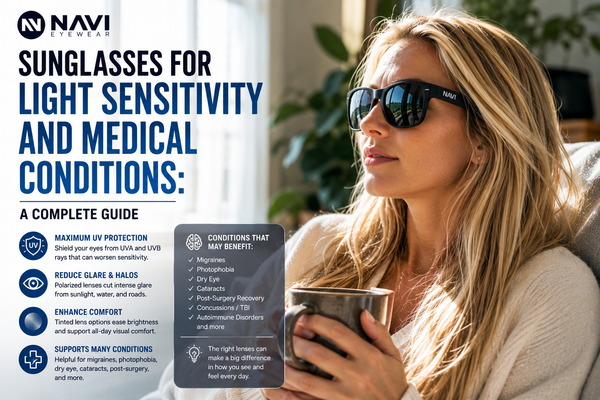

Sunglasses for Light Sensitivity and Medical Conditions: A Complete Guide
Light sensitivity — photophobia in clinical terms — is a symptom that spans a wide range of medical conditions: migraine, traumatic brain injury, post-surgical eye recovery, dry eye disease, diabetes-related eye changes, cataract, uveitis, medication side effects, and neurological conditions. For people managing these conditions, sunglasses are not a lifestyle accessory or a UV protection tool — they are a functional management device that reduces the light stimulus driving discomfort, pain, or visual impairment. The lens specification that helps depends on the condition: migraine photophobia requires a specific wavelength profile that standard tints don't provide; post-LASIK recovery requires gentle light reduction without UV blockage disruption; dry eye requires wind-reducing wraparound geometry as much as tint. This guide covers the right specification for each medical context and the practical strategies that work alongside sunglasses for light-sensitive individuals.
Contents
- 1. Understanding Photophobia: What Light Sensitivity Actually Is
- 2. Migraine and Photophobia: The FL-41 Lens Question
- 3. Post-LASIK and Post-Surgical Eye Recovery
- 4. Dry Eye Disease: Frame Geometry Matters as Much as Tint
- 5. Diabetes and Eye Health: UV Protection as Medical Management
- 6. Cataract-Related Light Sensitivity
- 7. Medication-Induced Photosensitivity
- 8. Neurological Conditions: TBI, Concussion, and Visual Processing
- 9. Uveitis and Inflammatory Eye Conditions
- 10. General Principles for Medical Sunglass Use
- 11. Frequently Asked Questions
- 12. Supporting Articles in This Cluster

1. Understanding Photophobia: What Light Sensitivity Actually Is
The Mechanism
Photophobia is not a visual impairment — it is a pain or discomfort response to light stimulation. In most photophobic conditions, the visual system itself functions normally; the problem is that light signals that would be processed normally in a healthy system instead trigger pain, discomfort, or neurological disturbance. The pathways involved vary by condition:
- Trigeminal pathway: in migraine, the trigeminal nerve — which innervates both the meninges (brain lining) and the eye — is sensitized during a migraine attack. Light stimulating the retina activates the trigeminal system, which is already in a hyperexcitable state, producing pain that originates in the brain rather than in the eye itself.
- Corneal nociceptors: in dry eye and ocular surface conditions, the corneal pain receptors are sensitized by inflammation and dryness — light stimulation activates these already-sensitized receptors, producing ocular surface discomfort that is experienced as light sensitivity.
- Retinal ganglion cell (ipRGC) pathway: intrinsically photosensitive retinal ganglion cells, which are responsible for pupillary light reflex and circadian entrainment, are disproportionately responsive to blue-green wavelengths (480nm peak). In conditions affecting this pathway, blue-green light produces disproportionate photophobic responses.
- Central sensitization: in TBI, concussion, and some neurological conditions, central visual processing areas become sensitized — light inputs that would be processed normally are amplified to uncomfortable levels through central sensitization mechanisms.
How Sunglasses Help
Sunglasses help photophobic individuals through two mechanisms: reducing total light intensity (the brightness reduction of any tinted lens) and selectively filtering specific wavelengths that drive photophobic responses in specific conditions. The first mechanism is universal — any tinted lens reduces light intensity and thereby reduces the light stimulus that drives discomfort. The second is condition-specific and is where lens tint selection becomes clinically meaningful rather than cosmetically arbitrary.
2. Migraine and Photophobia: The FL-41 Lens Question
Migraine Photophobia: A Specific Wavelength Problem
Migraine photophobia has a specific spectral characteristic — research from the University of Utah (Noseda et al., 2010, Nature Neuroscience) found that green light (520–540nm) produced significantly less photophobic pain in migraine sufferers than other wavelengths, and that blue light (480nm) produced the most intense photophobic pain. This wavelength specificity is consistent with the role of intrinsically photosensitive retinal ganglion cells (ipRGCs), which have peak sensitivity at approximately 480nm and project to the trigeminal nucleus — the same pain pathway sensitized in migraine.
FL-41 Tint: The Research-Based Migraine Lens
FL-41 is a rose-pink tinted lens originally developed to filter fluorescent light wavelengths that triggered photophobic responses — it selectively absorbs blue-green wavelengths (450–550nm) while transmitting red and pink wavelengths. Several clinical studies have found FL-41 lenses reduce migraine frequency and photophobic symptoms in migraine sufferers. The mechanism is consistent with the wavelength specificity of migraine photophobia — FL-41 specifically filters the blue-green wavelengths that produce the most intense migraine photophobic pain.
FL-41 is not a standard sunglass tint — it is a specialty lens available through optical providers who serve the migraine population. Navi Eyewear's standard tints (gray, amber, copper) are not FL-41. For migraine sufferers seeking the specific FL-41 benefit, an optical provider who specializes in migraine lens tints is the appropriate resource. For general outdoor UV protection alongside migraine management, UV400 polarized sunglasses (amber or copper for their warm-tinted nature, which filters some blue wavelengths) provide UV protection and may provide some photophobic relief through blue absorption, though they are not FL-41 equivalents.
Practical Outdoor Sunglasses for Migraine Sufferers
For outdoor UV protection and general photophobia management during outdoor activity, migraine sufferers benefit from:
- Amber or copper polarized UV400 — warm tints that absorb blue-green wavelengths more than gray, providing some spectral filtering in the migraine-relevant wavelength range alongside UV protection
- Cat 3 for peak sun conditions where the higher light intensity drives more severe photophobic responses
- Wraparound frames that reduce peripheral light entry — peripheral light stimulation activates the trigeminal pathway in photophobic individuals even when the central visual field is shaded; wraparound coverage reduces this peripheral stimulus
- Polarization — eliminating reflected glare reduces the high-luminance transient stimuli (a flash of reflected sunlight from a car or water surface) that can trigger migraine in sensitized individuals
Browse amber and copper polarized UV400 options at navieyewear.com. See also the complete migraine and photophobia guide.
3. Post-LASIK and Post-Surgical Eye Recovery
Why Post-Surgical Eyes Are UV-Sensitive
LASIK, PRK, cataract surgery, corneal transplant, and other anterior segment procedures temporarily or permanently alter the UV transmission characteristics and recovery requirements of the eye. Post-surgical corneas have disrupted epithelial barriers and altered wound healing responses that make UV exposure more damaging in the immediate post-operative period. Post-LASIK patients specifically are advised to avoid UV exposure during corneal flap healing to reduce the risk of corneal haze and UV-related healing complications.
Specification for Post-Surgical Use
UV400 polycarbonate is the minimum specification for outdoor use in the post-operative period — complete UV blocking during the healing window when UV sensitivity is elevated. Photophobia is common in the immediate post-operative period for most eye surgeries — the corneal surface is more sensitive to light stimulation during healing, and Cat 2–3 tinted lenses reduce the light stimulus driving post-operative photophobia.
Wraparound designs are recommended for post-surgical UV protection — peripheral UV entry around standard flat-lens frames reaches the healing corneal surface from angles that overhead shade doesn't address. Post-cataract surgery patients who receive UV-blocking intraocular lenses (IOLs) have internal UV protection at the lens level, but the corneal surface remains UV-sensitive and periorbital skin UV protection remains important. See the complete post-LASIK and eye surgery guide.
4. Dry Eye Disease: Frame Geometry Matters
How Sunglasses Address Dry Eye
Dry eye disease — inadequate tear quantity or quality causing ocular surface inflammation and discomfort — is worsened by two environmental factors that sunglasses address directly: wind exposure (which accelerates tear evaporation from the ocular surface) and UV-driven ocular surface inflammation (which contributes to the inflammatory cycle of dry eye disease). Sunglasses help dry eye through both mechanisms: wraparound frames that reduce wind reaching the ocular surface slow tear evaporation; UV400 lenses reduce UV-driven ocular surface inflammation.
Frame Geometry as the Primary Dry Eye Intervention
For dry eye, frame geometry is as clinically relevant as lens tint. A flat-lens lifestyle frame with gaps between the lens edge and the face allows airflow to reach the ocular surface — wind dries tears and exacerbates dry eye symptoms during outdoor activity. A close-fitting wraparound frame that reduces the airflow gap around the lens edge significantly reduces wind-driven tear evaporation, maintaining the tear film longer during outdoor activity.
Moisture-seal frames — a specialized design with a foam gasket around the frame that creates a humid microenvironment around the eye — are the most complete dry eye frame solution for individuals with severe dry eye. These are available as specialized products for dry eye management. Standard wraparound sport frames provide meaningful but less complete wind protection compared to moisture-seal designs. See the complete dry eye sunglasses guide.
5. Diabetes and Eye Health: UV Protection as Medical Management
Diabetic Eye Vulnerability
Diabetes produces several eye changes that interact with UV exposure and light sensitivity:
- Accelerated cataract formation: diabetics develop cataracts significantly earlier and at higher rates than non-diabetics — glycation of lens proteins adds a non-UV pathway to the UV-driven oxidative modification that causes cataract. UV protection reduces the UV-driven component of cataract formation that compounds with the diabetes-driven component.
- Diabetic retinopathy: UV is not a direct cause of diabetic retinopathy, which is driven by microvascular changes from hyperglycemia. However, the oxidative stress environment of diabetic retinopathy may be worsened by UV-driven oxidative stress, and UV protection is appropriate as a general macular protective measure.
- Pupillary reflex changes: autonomic neuropathy in diabetes can impair the pupillary light reflex — the pupil's response to light changes. Impaired pupillary reflex means the eye doesn't constrict appropriately in bright light, potentially increasing UV and light exposure to the lens and retina in bright outdoor conditions. UV400 sunglasses compensate for the impaired pupillary reflex by providing external light and UV management.
See the complete diabetes and eye health guide.
6. Cataract-Related Light Sensitivity
How Cataract Causes Glare and Light Sensitivity
Cataracts produce light scatter within the clouded lens — scattered light spreads across the retina as diffuse glare rather than focusing to a sharp image. This scatter produces glare halos around point light sources, reduced contrast sensitivity, and increased sensitivity to bright conditions. Polarized sunglasses reduce the surface glare component that adds to the total glare burden — eliminating the horizontally polarized reflected glare from road surfaces, water, and other reflective surfaces that the cataractous lens scatters most disruptively.
Cat 3 for individuals with symptomatic cataracts who find peak outdoor brightness uncomfortable — the greater brightness reduction of Cat 3 reduces the total light input to the scattering lens, improving visual comfort. Anti-reflective coating on the lens (reducing internal reflections within the sunglass lens itself) is worth considering for cataract patients who are sensitive to secondary reflections within the lens. See the post-cataract surgery guide.
7. Medication-Induced Photosensitivity
Common Photosensitizing Medications
Several commonly prescribed medications increase photosensitivity — both skin sensitivity to UV and ocular light sensitivity:
- Tetracycline antibiotics (doxycycline, minocycline) — widely prescribed for acne and infections; increase UV skin and eye sensitivity
- Fluoroquinolone antibiotics (ciprofloxacin, levofloxacin) — increase UV photosensitivity
- Diuretics (hydrochlorothiazide) — a commonly overlooked photosensitizer; significantly increases UV skin sensitivity and is associated with elevated ocular UV sensitivity
- NSAIDs (ibuprofen, naproxen) at high doses — mild photosensitization
- Amiodarone (cardiac drug) — deposits in the cornea and lens over time, increasing UV sensitivity and visual side effects
- Chlorpromazine and phenothiazines — antipsychotics that significantly increase UV photosensitivity
- Some chemotherapy agents — various mechanisms, variable ocular effects
Practical Response to Medication-Induced Photosensitivity
For individuals on photosensitizing medications: UV400 protection becomes more urgent, not less — the increased UV sensitivity means the same outdoor UV exposure produces more damage. Cat 3 for bright outdoor conditions; UV400 non-negotiably. Discuss medication-induced photosensitivity with the prescribing physician — some photosensitizing medications can be taken in the evening rather than morning to reduce peak daytime photosensitivity, and some have non-photosensitizing alternatives. Browse UV400 polarized options at navieyewear.com.
8. Neurological Conditions: TBI, Concussion, and Visual Processing
Post-Concussion Photophobia
Traumatic brain injury (TBI) and concussion frequently produce significant photophobia — light sensitivity that can be severe enough to prevent normal indoor function, let alone outdoor activity. The mechanism involves central sensitization of visual processing pathways rather than ocular surface changes. Post-concussion photophobia can persist for months to years in moderate to severe TBI and is one of the most functionally disabling post-concussion symptoms.
For post-concussion photophobia, darker lens tints (Cat 3 or even Cat 4 for severe cases) reduce the total light stimulus driving central sensitization. Wraparound frames that prevent peripheral light entry are particularly important — peripheral light stimulation activates the sensitized pathways even when central vision is shaded. Blue-light-blocking tints may provide additional relief through the ipRGC pathway contribution to photophobia.
Post-concussion individuals often require sunglass use indoors as well as outdoors — indoor fluorescent and LED lighting can be photophobic triggers. In these cases, tinted indoor eyewear (including FL-41 tinted lenses) is clinically appropriate and should be discussed with the managing neurologist or concussion specialist. See the migraine and photophobia guide for overlapping management strategies.
9. Uveitis and Inflammatory Eye Conditions
Uveitis and Light Sensitivity
Uveitis — inflammation of the uveal tract (iris, ciliary body, choroid) — produces pupillary spasm and ciliary muscle inflammation that make light exposure intensely painful. Active uveitis typically requires management with dilating drops (cycloplegics) that paralyze the ciliary muscle and relieve the spasm — the dilated pupil created by cycloplegics then requires UV400 dark lenses to compensate for the inability to constrict.
UV400 Cat 3 lenses are appropriate for uveitis patients on dilating drops — the Cat 3 darkness compensates for the dilated pupil that cannot reduce its aperture in response to bright light. Without sunglasses, a uveitis patient on cycloplegic drops outdoors in bright light is receiving UV with a fully dilated pupil — the highest possible UV dose to the lens and retina. UV400 Cat 3 protection is clinically necessary, not optional, for uveitis patients outdoors on dilating drops.
10. General Principles for Medical Sunglass Use
Conditions That Require Darker Lenses
Conditions where Cat 3 or darker is appropriate for outdoor use:
- Active uveitis (especially with dilating drops)
- Post-concussion severe photophobia
- Symptomatic cataract with significant glare sensitivity
- Medication-induced severe photosensitivity
- Acute migraine during outdoor activity
Conditions That Require Wraparound Coverage Specifically
Conditions where peripheral light reduction matters:
- Migraine photophobia — peripheral light activates trigeminal pathways
- Post-concussion photophobia — peripheral sensitization
- Dry eye — wind reduction through wraparound geometry
- Post-surgical recovery — peripheral UV reaches healing surfaces
- Pterygium prevention — temporal UV pathway to nasal limbus
When to Consult an Eye Care Professional
Sunglasses are an adjunctive management tool — they reduce the light stimulus that drives symptoms but do not treat the underlying conditions. New or worsening photophobia warrants evaluation by an ophthalmologist or optometrist. Conditions that cause photophobia (uveitis, TBI, post-surgical complications) require medical management; sunglasses support that management but do not replace it. Discuss lens tint selection with your eye care provider if managing a specific photophobic condition — they can provide guidance on whether FL-41, standard tints, or specialty tints are most appropriate for the specific condition being managed.
11. Frequently Asked Questions
What sunglasses are best for light sensitivity?
Depends on the cause. For general outdoor photophobia: amber or copper Cat 3 polarized UV400 in a wraparound frame that reduces peripheral light entry. For migraine: FL-41 tinted lenses from an optical provider who specializes in migraine eyewear, plus UV400 polarized for outdoor UV protection. For post-surgical recovery: UV400 Cat 2–3 wraparound as directed by the surgical team. For dry eye: UV400 wraparound with close-fitting geometry to reduce wind exposure, amber or copper tint for outdoor comfort.
Do darker lenses help with light sensitivity?
Yes — darker lenses reduce total light intensity reaching the eye, reducing the photophobic stimulus. Cat 3 reduces light transmission to 8–18% of ambient, providing substantial brightness reduction. Cat 4 (3–8%) is available for severe photophobia but is not suitable for driving. However, lens darkness alone is not always the most important variable — for conditions with spectral specificity (migraine's preference for green light and sensitivity to blue-green), the wavelength filtering of the tint may matter more than the overall darkness level.
Can wearing sunglasses indoors for light sensitivity make it worse over time?
This is a clinical concern in photophobia management — some evidence suggests that wearing very dark lenses indoors can perpetuate and worsen photosensitivity by reducing light adaptation and maintaining heightened sensitivity. For post-concussion photophobia specifically, graduated light exposure therapy (progressively increasing light tolerance) is the evidence-based rehabilitation approach, not prolonged dark adaptation through constant dark lens use. Discuss indoor sunglass use with the managing neurologist or concussion specialist.
What are FL-41 lenses and where do I get them?
FL-41 is a rose-pink tinted lens that selectively absorbs blue-green wavelengths (450–550nm), originally developed to filter fluorescent light wavelengths that triggered photophobic responses. Research supports its use for migraine photophobia. FL-41 lenses are available through specialty optical providers and some optometry practices that serve the migraine and photophobia population — they are not standard retail sunglass inventory. Search for optical providers offering "migraine lenses" or "photophobia management" in your area.
Should I wear sunglasses after LASIK?
Yes — UV400 sunglasses are typically advised for all outdoor time in the weeks following LASIK during corneal flap healing. The post-LASIK eye has an altered corneal surface that is more UV-sensitive during healing, and photophobia is common in the immediate post-operative period. Your LASIK surgeon will provide specific guidance on timing and duration of required UV protection post-operatively. See the complete post-LASIK guide.
Do sunglasses help with dry eye?
Yes — through two mechanisms: reducing wind exposure to the ocular surface (wraparound frames specifically slow tear evaporation) and reducing UV-driven ocular surface inflammation that contributes to the inflammatory cycle of dry eye disease. Wraparound frame geometry is the most important sunglass feature for dry eye management — a standard flat-lens lifestyle frame provides UV protection but less wind protection than a close-fitting wraparound design. See the complete dry eye guide.
12. Supporting Articles in This Cluster
- Sunglasses for Migraine and Photophobia | Navi Eyewear
- Sunglasses After LASIK and Eye Surgery | Navi Eyewear
- Sunglasses and Diabetes: Eye Health Considerations | Navi Eyewear
- Sunglasses for Dry Eye Disease | Navi Eyewear
- Sunglasses After Cataract Surgery | Navi Eyewear
The Bottom Line
Light sensitivity from medical conditions spans a wide range of mechanisms and requires different lens and frame specifications depending on the underlying condition. The shared foundation — UV400 polarized polycarbonate in a wraparound frame — provides UV protection, polarized glare elimination, and peripheral light reduction that benefit most photophobic conditions. Condition-specific requirements (FL-41 for migraine, moisture-seal frames for severe dry eye, Cat 3+ for uveitis on dilating drops) layer on top of this foundation. Consult your eye care provider for condition-specific guidance. For outdoor UV400 polarized protection across all conditions: navieyewear.com/collections/polarized — Buy 1, Get 3 Free for $119.
Related Reading
- UV and Eye Disease: The Complete Guide | Navi Eyewear
- Eye Health and Aging: UV Protection After 50 | Navi Eyewear
- UV and Cataracts: Prevention and Research | Navi Eyewear
- Macular Degeneration and UV | Navi Eyewear
- The Science of Lens Color | Navi Eyewear
- The Complete Sunglass Buyer's Guide | Navi Eyewear
- Polarized vs Non-Polarized Sunglasses | Navi Eyewear
- Shop Polarized UV400 Sunglasses | Navi Eyewear
Sources & Citations
[1] Noseda R, et al. "A neural mechanism for exacerbation of headache by light." Nature Neuroscience, 2010. View source →
[2] Katz BJ and Digre KB. "Diagnosis, pathophysiology, and treatment of photophobia." Survey of Ophthalmology, 2016. View source →
[3] Wilkins AJ, et al. "Tinted spectacles and visual stress." Expert Review of Ophthalmology, 2015. View source →
[4] Sliney DH. "Ocular exposure to environmental light and ultraviolet." Journal of AAPOS, 2014. View source →
[5] Taylor HR, et al. "Effect of ultraviolet radiation on cataract formation." New England Journal of Medicine, 1988. View source →
[6] Dain SJ. "Sunglasses and sunglass standards." Clinical and Experimental Optometry, 2003. View source →
[7] WHO. "Global solar UV index: a practical guide." World Health Organization, 2002. View source →