
Sunglasses for Migraine and Photophobia: What Actually Helps
Migraine photophobia is not simply discomfort from brightness — it is a specific neurological response to light stimulation during a sensitized state, driven primarily through the trigeminal pain pathway rather than through the eye itself. The research on which wavelengths drive migraine photophobia most intensely, and which drive it least, has practical implications for lens tint selection that are more nuanced than simply "darker is better." This guide covers the science of migraine photophobia, what the clinical evidence shows about FL-41 and other tinted lenses, the practical outdoor sunglasses setup for migraine sufferers, and the one important caution about overuse of dark lenses. For the complete medical conditions overview, see the complete guide to sunglasses for light sensitivity and medical conditions.

1. The Neuroscience of Migraine Photophobia
Why Light Hurts During Migraine
The pain of migraine originates in the meninges — the membranes covering the brain — through activation and sensitization of the trigeminal nerve. During a migraine attack, inflammatory mediators sensitize the trigeminal system to a state of heightened excitability. Light stimulation of the retina activates a specific neural pathway that projects from the retina through the thalamus to the trigeminal nucleus — a pathway that, in the sensitized state of an active migraine, generates or amplifies pain rather than simply processing light information.
This mechanism explains why migraine photophobia is a pain response rather than a visual impairment — the eyes themselves function normally, but the neural signals they generate during a migraine are processed through a pain-amplifying system rather than a normal visual processing pathway. It also explains why migraine photophobia occurs even in blind individuals with functioning retinas — the retina's non-visual output (through intrinsically photosensitive retinal ganglion cells, or ipRGCs) to the trigeminal pathway is sufficient to drive pain even without conscious visual processing.
The Wavelength Specificity: Blue-Green Drives the Most Pain
A landmark 2010 study by Noseda et al. in Nature Neuroscience identified the specific wavelengths most responsible for migraine photophobic pain. The researchers found that green light (520–540nm) produced significantly less photophobic exacerbation than other wavelengths, while blue light (480nm) produced the most intense pain amplification. This wavelength pattern is consistent with the spectral sensitivity of ipRGCs, which have peak sensitivity at approximately 480nm and project directly to the trigeminal nucleus via the olivary pretectal nucleus.
The practical implication: not all light is equally photophobic for migraine sufferers. A lens that specifically filters blue and blue-green wavelengths (450–520nm) while transmitting other wavelengths may provide more effective photophobia relief than a lens that simply darkens all wavelengths equally — the same total light reduction but with more selective filtering of the most photophobic wavelengths.
2. FL-41: The Research-Based Migraine Lens
What FL-41 Is
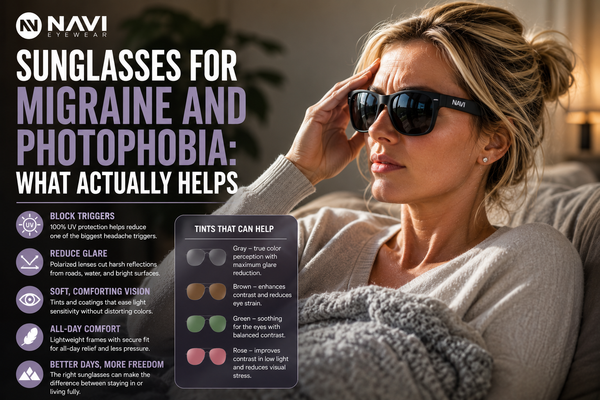
FL-41 is a rose-pink tinted lens with selective absorption of blue-green wavelengths in the 450–550nm range — the range that research identifies as most responsible for migraine photophobic pain. It was originally developed to filter the fluorescent light wavelengths (primarily blue-green) that triggered photophobic responses in individuals with fluorescent light sensitivity. Its application to migraine management emerged from clinical observations that migraine sufferers found rose-pink tinted lenses more comfortable than clear or standard tinted lenses.
Clinical Evidence for FL-41
Several clinical studies have examined FL-41 lenses for migraine photophobia:
- Blackburn and Karanovic (2016) found that FL-41 tinted lenses reduced headache frequency and photophobic symptoms in a small clinical cohort of migraine sufferers compared to control tints.
- Stringham and Hammond (2008) found that macular pigment (lutein and zeaxanthin, which filter blue wavelengths at the retina) was associated with reduced photophobic sensitivity — consistent with the blue-wavelength mechanism of migraine photophobia.
- The University of Utah migraine research group has produced multiple papers supporting the blue-green wavelength specificity of migraine photophobia and the theoretical basis for FL-41's clinical benefit.
The evidence base for FL-41 is encouraging but limited by study size and design — larger randomized controlled trials are needed to definitively establish efficacy. Clinical neurologists who specialize in headache medicine increasingly recommend FL-41 as an adjunctive tool for photophobia management, though it is not yet a standard of care recommendation from major headache societies.
Where to Get FL-41 Lenses
FL-41 lenses are not available through standard retail sunglass channels — they require prescription or non-prescription optical lens ordering through providers who stock the tint. Sources include:
- Specialty optical providers who advertise "migraine lenses" or "photophobia management eyewear"
- Online optical retailers that accept custom tint orders (some offer FL-41 as a specialty tint option)
- Neurologists and headache specialists who maintain referral relationships with optical providers who stock FL-41
- Some university headache centers that work with optical partners to provide FL-41 access to their migraine patients
Navi Eyewear's standard tints (gray, amber, copper) are not FL-41 equivalents — they do not have the specific blue-green absorption profile of FL-41. For individuals specifically seeking FL-41 for migraine management, specialty optical channels are the appropriate source.
3. Standard Sunglasses for Migraine: What Helps Without FL-41
Warm Tints Filter Some Blue-Green Wavelengths
While not FL-41, warm-tinted lenses (amber and copper) absorb more blue and blue-green wavelengths than gray lenses — moving in the direction of FL-41's spectral profile without reaching FL-41's specific absorption curve. Amber and copper polarized lenses filter a meaningful portion of the blue-green wavelengths most responsible for migraine photophobic pain while providing UV400 protection and polarized glare elimination.
For migraine sufferers who cannot access FL-41, or who want outdoor UV protection alongside photophobia management, amber or copper Cat 2–3 polarized UV400 provides the best available standard lens option for migraine-related outdoor photophobia management. Gray, by contrast, transmits blue-green wavelengths proportionally with all others — providing equal brightness reduction across all wavelengths without the selective blue-green filtering that migraine photophobia research identifies as most beneficial. Browse amber and copper polarized UV400 options at navieyewear.com.
Polarization for Transient Glare Triggers
For many migraine sufferers, the triggering factor is not sustained light exposure but transient high-luminance stimuli — a flash of reflected sunlight from a car windshield, the glare off a water surface, the sun breaking through clouds after overcast conditions. These transient high-luminance events produce rapid, intense light stimulation that activates the sensitized trigeminal pathway and can trigger or worsen migraine attacks.
Polarized lenses specifically eliminate the reflected glare component responsible for many of these transient triggers — the horizontally polarized reflection from car surfaces, wet pavement, and water that creates the flash glare that migraine sufferers find particularly triggering. For this specific mechanism, polarization provides a protective effect that non-polarized lenses of the same darkness level do not.
Wraparound Frames for Peripheral Light Reduction
Peripheral light stimulation activates the trigeminal pathway in migraine sufferers even when central vision is shaded — the ipRGC pathway that drives migraine photophobia receives input from across the retinal surface, not just the central visual field. Peripheral light entering around the edges of flat-lens frames reaches the peripheral retina and activates the photophobic pathway even when the direct overhead and forward sun is blocked by the lens.
Wraparound frames that reduce peripheral light entry address this peripheral stimulation pathway. For migraine sufferers who find that even well-shaded outdoor conditions cause photophobic symptoms, a close-fitting wraparound frame that minimizes the gap between lens edge and face provides more complete peripheral light blockade than standard frames.
4. Cat Level Selection for Migraine
Interictal (Between Attacks) vs Ictal (During Attack) Use
Migraine sufferers have different light sensitivity levels at different stages of the migraine cycle:
- Interictal (between attacks): many migraine sufferers have baseline elevated light sensitivity even between attacks due to chronic trigeminal sensitization. Cat 2 amber or copper polarized for daily outdoor use — adequate protection for elevated baseline sensitivity without excessive darkness that would impair adaptation.
- Prodromal (before attack): the prodromal phase can involve increasing light sensitivity as the migraine builds. Cat 2–3 as sensitivity escalates; some migraine sufferers learn to recognize prodromal light sensitivity as a warning to increase UV and light protection before the attack peaks.
- Ictal (during attack): peak migraine photophobia may require Cat 3 or even Cat 4 for severe photophobia — any light may be intolerable during severe attacks, warranting the darkest practical outdoor lens category. Rest in a dark room is typically the most effective management for severe ictal photophobia; outdoor activity during severe attacks is rarely possible regardless of lens category.
- Postdromal (after attack): lingering trigeminal sensitization persists into the postdromal phase — Cat 2–3 protection as sensitivity slowly normalizes over 24–48 hours post-attack.
5. The Indoor Sunglass Caution
Dark Adaptation and Photophobia Sensitization
A clinically important concern for migraine photophobia management: wearing very dark lenses indoors, or wearing sunglasses more hours than necessary, can perpetuate and worsen photosensitivity over time. The mechanism involves dark adaptation — sustained reduction of light exposure keeps the visual system in a state of heightened sensitivity (adapted for dark environments), which makes subsequent light exposure more intense and more photophobic than it would be in a normally light-adapted individual.
Many headache neurologists and concussion specialists caution their photophobic patients against wearing sunglasses indoors except during active attacks — recommending instead graduated light exposure therapy that progressively increases light tolerance by gently challenging the sensitized system. The goal of photophobia management is not permanent avoidance of light (which perpetuates sensitization) but reduction of the light stimulation that triggers pain, while maintaining and gradually increasing light tolerance through controlled exposure.
This applies specifically to indoor sunglass use. Outdoor UV400 sunglasses for all outdoor time remain appropriate and important for migraine sufferers — outdoor UV exposure at typical UV indexes is genuinely too bright for comfortable management without photophobia protection. The caution is against extending sunglass use indoors to routine indoor environments where the light levels are manageable without glasses.
6. Migraine Triggers Beyond Light: What Sunglasses Can and Can't Address
What Sunglasses Address
- Photophobic pain amplification from light stimulation during and between attacks
- Transient glare triggers from reflected light (via polarization)
- Peripheral light stimulation from outdoor environments (via wraparound geometry)
- UV accumulation that may contribute to baseline inflammatory state (via UV400)
What Sunglasses Don't Address
- Hormonal migraine triggers (menstrual cycle, hormonal fluctuation)
- Dietary triggers (caffeine, alcohol, aged cheese, MSG)
- Sleep disruption triggers
- Weather and barometric pressure triggers
- Stress triggers
- The underlying neurological mechanism of migraine — sunglasses are symptom management, not disease modification
Sunglasses for migraine management are an adjunctive tool alongside pharmacological management (preventive and acute medications), lifestyle modification, and behavioral trigger management. They are not a substitute for medical management of migraine as a neurological condition.
7. Building the Migraine-Optimized Outdoor Eye Kit
The Two-Pair Approach
- FL-41 specialty lenses (from optical provider) for indoor and low-light outdoor use where selective blue-green filtration is the priority and overall darkness matters less — managing fluorescent and LED indoor light sensitivity alongside outdoor use in low UV conditions
- Amber or copper Cat 2–3 polarized UV400 (Navi Eyewear) for outdoor UV protection with warm-tinted partial blue-green filtering, polarized glare elimination, and wraparound coverage for peripheral light reduction
The two-pair kit addresses both the indoor photophobia management need (FL-41 specialty tint) and the outdoor UV protection and glare management need (amber or copper UV400 polarized). Browse outdoor UV400 polarized options at navieyewear.com — the Buy 1, Get 3 Free at $119 makes equipping multiple locations (car, bag, sport kit, home entry) economically practical for migraine sufferers who benefit from consistent UV and glare management across all outdoor contexts.
Frequently Asked Questions
What color lenses are best for migraine?
FL-41 rose-pink tinted lenses have the most direct clinical support for migraine photophobia through selective blue-green wavelength filtering. Among standard sunglass tints, amber and copper absorb more blue-green wavelengths than gray and are the better choices for migraine sufferers. Gray, which transmits all wavelengths proportionally, provides brightness reduction without the selective blue-green filtering that migraine photophobia research identifies as most beneficial.
Do polarized lenses help with migraine?
Yes — for the specific mechanism of transient glare triggers. Many migraine sufferers identify sudden reflected glare (from car surfaces, water, wet pavement) as a migraine trigger or exacerbating factor. Polarized lenses specifically eliminate this horizontally polarized reflected glare, removing the transient high-luminance stimuli that activate the sensitized trigeminal pathway. Non-polarized lenses of the same darkness level provide brightness reduction but not the specific glare elimination that addresses transient trigger events.
Can sunglasses prevent migraines?
Sunglasses can reduce the frequency of light-triggered migraine attacks by reducing the photophobic light stimulation that triggers or exacerbates attacks. They are an adjunctive tool that reduces one category of migraine trigger — light stimulation — but do not address other triggers (hormonal, dietary, stress, weather) or the underlying neurological mechanism. For individuals whose migraines are predominantly light-triggered, appropriate lens selection may meaningfully reduce attack frequency. For individuals with multiple diverse triggers, the contribution of light management is proportionally smaller.
Should I wear sunglasses indoors if I have migraines?
During active attacks when light is intolerable: yes. As a routine indoor habit between attacks: exercise caution — many headache specialists advise against routine indoor sunglass use because it can perpetuate dark adaptation and worsen photosensitivity over time. Graduated light exposure, not light avoidance, is the long-term management approach for interictal photophobia. Discuss indoor sunglass use with your neurologist or headache specialist.
Are there sunglasses specifically made for migraine?
Yes — FL-41 tinted lenses, and several specialty brands (Axon Optics, Theraspecs) that market specifically to the migraine population with FL-41 and related tints in both prescription and non-prescription versions. These are not standard retail sunglasses — they are medical-adjacent optical products available through specialty channels. For outdoor UV protection alongside migraine management, standard amber or copper UV400 polarized sunglasses provide the best available combination of UV protection, blue-green filtering, and glare elimination in a standard retail product.
What is the best frame style for migraine photophobia?
Wraparound designs that reduce peripheral light entry — close-fitting frames that minimize the gap between lens edge and face. Peripheral light reaching the temporal and nasal retina activates the ipRGC pathway and the trigeminal photophobic response even when central vision is shaded. Flat-lens frames leave peripheral light gaps that allow this peripheral stimulation; close-fitting wraparound frames reduce it. For severe photophobia, side shields or brow bar extensions that further reduce peripheral light entry may be appropriate.
The Bottom Line
Migraine photophobia has a specific neurological mechanism — trigeminal sensitization activated by light via the ipRGC pathway, with blue-green wavelengths (480nm peak) driving the most intense pain. FL-41 rose-pink lenses that specifically filter these wavelengths have clinical support for migraine photophobia management and are available through specialty optical providers. For outdoor UV protection and standard glare management, amber or copper Cat 2–3 polarized UV400 in a wraparound frame provides the best combination of warm-tinted blue-green filtering, polarized glare elimination, and peripheral light reduction available in standard sunglasses. Avoid routine indoor dark lens use between attacks — graduated light exposure, not permanent avoidance, is the long-term management direction. navieyewear.com/collections/polarized — Buy 1, Get 3 Free for $119.
Related Reading
- Sunglasses for Light Sensitivity and Medical Conditions | Navi Eyewear
- The Science of Lens Color | Navi Eyewear
- How Polarized Sunglasses Work | Navi Eyewear
- Polarized vs Non-Polarized Sunglasses | Navi Eyewear
- Sunglasses for Dry Eye Disease | Navi Eyewear
- Blue Light, Screens, and UV: The Complete Modern Eye Health Picture | Navi Eyewear
- UV and Eye Disease: The Complete Guide | Navi Eyewear
- Shop Polarized UV400 Sunglasses | Navi Eyewear
Sources & Citations
[1] Noseda R, et al. "A neural mechanism for exacerbation of headache by light." Nature Neuroscience, 2010. View source →
[2] Katz BJ and Digre KB. "Diagnosis, pathophysiology, and treatment of photophobia." Survey of Ophthalmology, 2016. View source →
[3] Stringham JM and Hammond BR. "Macular pigment and visual performance under glare conditions." Optometry and Vision Science, 2008. View source →
[4] Digre KB and Brennan KC. "Shedding light on photophobia." Journal of Neuro-Ophthalmology, 2012. View source →
[5] Sliney DH. "Ocular exposure to environmental light and ultraviolet." Journal of AAPOS, 2014. View source →
[6] Wilkins AJ, et al. "Tinted spectacles and visual stress." Expert Review of Ophthalmology, 2015. View source →