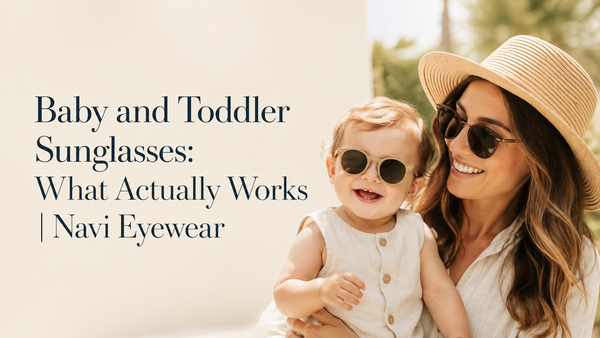

QUICK ANSWERBaby and toddler sunglasses work when three things align: genuine UV400 polycarbonate lenses (not just dark tint), elastic strap retention that prevents removal, and correct sizing for the child's face. The market is full of frames that fail on one or more of these. This guide covers what to look for, what to avoid, and what actually keeps protective eyewear on the faces of the most removal-motivated age group in existence. |

The 0–3 age window is the most challenging for sunglass compliance and also the period when children's eyes are most UV-vulnerable. The infant crystalline lens transmits up to 70% more UV to the retina than an adult lens — and it's at its most transparent in the first years of life. Combined with the reality that infants and toddlers spend substantial outdoor time and cannot advocate for their own protection, this places the full burden of eye protection on parents navigating a market that contains as much decorative merchandise as genuine eye protection.
For the full science of why this age group matters most for UV protection, see theUV Protection for Children: Complete Family Eye Health Guide. This post focuses specifically on what to buy and how to make it work for the 6-month to 3-year window.
1. The Critical Safety Issue: Toy Sunglasses vs Real UV Protection
|
⚠ Dark Lenses Without UV400 Certification Are Actively Harmful A dark lens that blocks visible light without blocking UV causes pupil dilation — the eye perceives darkness and opens wider — while transmitting full UV radiation to the retina. This means dark decorative sunglasses with no UV400 certification expose a child's retina to MORE UV than if they wore no sunglasses at all. This is the most important safety fact for parents buying infant and toddler sunglasses: tint darkness tells you nothing about UV protection. Only explicit UV400 certification matters. |
The infant and toddler sunglasses market has a significant problem: a large proportion of frames marketed to parents — particularly character-themed frames, fashion accessories, and cheap multi-packs — carry no genuine UV400 certification. They are designed as accessories, not eye protection, and they are sold without the disclosure that they provide no meaningful UV blocking.
Studies testing children's sunglasses from general retail channels consistently find that a substantial proportion fail UV transmission standards despite carrying vague 'UV protection' language on packaging. The distinction between genuine UV400 certification and a marketing claim matters most at this age, when the eyes are most vulnerable.
How to Identify Genuine UV400 Certification
2. What Babies and Toddlers Need From a Sunglass Frame
Elastic Strap Retention: The Non-Negotiable for Under-3
Standard temple-arm frames will not stay on a baby or toddler. Infants cannot support the weight and the arms fall forward; toddlers remove them immediately. Elastic headband or strap retention that wraps around the back of the head is the only practical design for consistent wearing below age 3.
A well-fitted elastic strap changes the compliance equation entirely. Most infants and toddlers who have elastic-strap frames placed on them will attempt removal a few times, find it requires more effort than a simple pull, and move on. The habit of wearing normalizes faster when frames stay in place through the initial novelty-and-resistance phase.
The strap should be adjustable, soft, and not tight enough to cause pressure. It should hold the frame level across the face without pulling the temples up or down. The goal is 'stays in place without noticing it,' not 'secured so tightly removal is impossible.'
Lens Width: Sizing for a Child's Face
Infant and toddler face proportions are significantly smaller than adult frames, and using adult or older-child frames means the lenses do not align correctly with the eyes — reducing coverage quality even with correctly certified lenses. Approximate sizing by age:
|
Age |
Lens Width |
Bridge Width |
Frame Notes |
|
6–12 months |
35–40mm |
12–14mm |
Very small, lightweight, elastic headband essential |
|
12–18 months |
38–42mm |
13–15mm |
Slightly larger, elastic strap, rubberized nose grip |
|
18–36 months (Toddler) |
40–44mm |
14–16mm |
Toddler-specific sizing, flexible frame, strap retention |
Frame Material: Safety Before Style
Infant and toddler sunglass frames need to meet a higher safety bar than adult frames because of how they are used — dropped, sat on, chewed, thrown, and pulled on repeatedly. The frame material requirements:
Lens Material: Polycarbonate Required
Polycarbonate is the only appropriate lens material for infants and toddlers. It is approximately 10 times more impact-resistant than standard optical plastic, does not shatter into sharp fragments on impact, and provides structural UV400 protection independent of any surface coatings. Glass lenses are completely inappropriate for this age group. Standard optical resin (CR-39) lacks the impact resistance for active children.
Polycarbonate is also lighter than glass, contributing to the frame weight reduction that improves compliance. Quality polycarbonate lenses should be optically clear — look through the lens at a straight horizontal line (like a doorframe) to verify there is no optical distortion, which would indicate low-quality or incorrectly cured lenses.
Polarization for Babies and Toddlers: A Real Benefit
Polarized lenses eliminate horizontal reflected glare from surfaces — water, sand, pavement, playground equipment. Infants and toddlers spend significant time at ground level and in stroller height, looking across these reflective surfaces at precisely the angle where polarized glare is most intense. For any child spending regular outdoor time, polarized UV400 polycarbonate is meaningfully better than non-polarized UV400. It also makes the sunglasses more comfortable to wear — reducing the squinting and light-response that makes some infants pull frames off. BrowseUV400 polarized options at navieyewear.com for adult pairs to model alongside your child's protection.
NAVI EYEWEAR — UV400 POLARIZED SUNGLASSESBuy 1, Get Any 3 Pairs Free — $119.00 for 4 pairs. Discount auto-applies at cart. Free shipping. Free replacements. 30-day return on unworn pairs. Every lens: UV400 certified polycarbonate · FDA-cleared impact resistance · polarized PVA film · oleophobic coating · anti-saltwater coating · TR90 nylon frames · stainless 5-barrel hinges. |
3. Age-by-Age Guide: 0 to 3 Years
0–6 Months: Shade Is the Strategy
Sunglasses are not practical for newborns and infants under approximately 6 months. They cannot support frame weight on their face, they lack the motor control to cooperate with wearing, and the frames present a safety complexity (frame must be entirely smooth, no small parts) that most infant-safe frames don't fully resolve. The correct UV strategy before 6 months is physical shade:
These physical shade strategies provide meaningful UV protection without the compliance and safety complexity of frames on a very young infant.
6–12 Months: First Sunglasses
From approximately 6 months, infants have enough head control for elastic-strap sunglasses to be practical. The compliance reality at this age: infants are curious about everything on their face and will attempt removal. Elastic straps mean removal requires more effort than a simple pull. The frame will be removed repeatedly at first; this is normal. The goal at this age is establishing the routine, not achieving perfect wearing compliance from day one.
Practical implementation:
12–18 Months: Increasing Mobility, Increased Removal Motivation
The 12–18 month window often sees increased removal behavior as motor skills develop and the toddler becomes more deliberate about removing things from their face. The elastic strap remains the key retention mechanism, and a well-fitted strap at this age significantly reduces successful removal compared to loose or poorly-adjusted straps.
This is also the age when frame selection starts to matter for compliance reasons beyond fit. Infants at this age respond to color and novelty — frames in bright colors or with simple patterns they respond to can reduce the novelty-removal cycle and increase comfortable wearing.
18–36 Months: The Toddler Years
The 18–36 month window is the most challenging phase for sunglass compliance across the entire childhood span. Toddlers are in a developmental phase characterized by autonomy assertion — their central developmental task is discovering their ability to influence their environment, which manifests as 'no' to many adult-imposed things. Sunglasses sit on their face, are visible to them, and are easy to notice and remove. This is not defiance in an adult sense; it's developmental.
Strategies that work at this age:
4. What to Avoid: The Market Hazards
Character-Print Fashion Frames
The single highest-risk category for UV protection failure is character-themed infant and toddler sunglasses — frames featuring licensed characters, novelty prints, or fashion themes sold through toy retailers, gift shops, and general merchandise stores. These are designed as accessories, not eye protection, and a disproportionate number carry no genuine UV400 certification. The character branding and dark tint provide the appearance of protection without the substance.
The verification test is the same regardless of how cute the frames are: explicit UV400 certification, polycarbonate lens material, brand with documented UV testing standards. If any of these three is absent, the frames are not providing the protection the dark tint implies.
Cheap Multi-Packs
Multi-pack infant and toddler sunglasses — three or five pairs for a low flat price — are almost universally fashion accessories rather than certified eye protection. The price point alone makes genuine polycarbonate UV400 lens certification economically implausible. These frames are common as impulse purchases at beach retail, tourist shops, and online marketplaces, and they are commonly given as gifts without awareness of the UV certification gap.
Glass Lenses
Glass lenses are not appropriate for infant or toddler use under any circumstances. Glass can shatter on impact into sharp fragments — an infant or toddler's face is a predictably active impact zone. Any infant or toddler frame with glass lenses should be treated as a safety hazard regardless of UV certification.
Oversized Adult Frames on Small Faces
An adult or older-child frame on an infant or toddler face does not provide correct UV coverage — the lens geometry relative to the eye is wrong, creating gaps in coverage precisely where reflected UV from ground-level surfaces enters. It also looks uncomfortable and is uncomfortable, increasing removal motivation. Correctly sized infant frames are not just aesthetically appropriate — they provide meaningfully better UV protection.
5. Practical Parent Questions
What do I do about sand and water getting on the lenses?
For water: quality polarized lenses typically have oleophobic and hydrophobic coatings that make water bead and wipe off cleanly. For sand: rinse with clean water before wiping — rubbing dry sand on a lens will scratch the surface over time. Keep a small lens cloth in the diaper bag. Scratched lenses don't lose UV400 protection (which is a material property) but they do affect optical clarity and are a sign that replacement is due.
My baby sweats and the frames slide. What helps?
Rubberized nose grip pads and temple contact surfaces significantly reduce sweat-related slipping. Most quality infant frames use rubberized or silicone nose contacts specifically because infant and toddler skin is more prone to sweat and movement than adult skin. If frames are sliding consistently, look for frames with rubberized nose and temple contacts specifically designed for this — or add sport-grip nose pads compatible with the frame.
How often do I need to replace infant/toddler sunglasses?
UV400 protection in polycarbonate does not degrade with normal use — it's a material property, not a surface coating. Replace when: the child outgrows the frame size (check fit every 6 months for infants, annually for toddlers); the frame is cracked or damaged; the lenses are significantly scratched; or the elastic strap has degraded and no longer provides adequate retention. Practically, most infant frames get replaced within a year due to growth; toddler frames typically last 1–2 years.
Can my baby wear sunglasses in the car?
Yes — and car UV exposure through side windows is a real concern. Standard car side glass transmits UVA radiation even when it blocks the visible glare of direct sun. Prolonged car travel, particularly on long trips, produces meaningful UV exposure through side windows that UV400 lenses protect against. For infants in rear-facing car seats with side window exposure, UV400 protective sunglasses are appropriate for extended travel. For the complete driving UV guide, seebest sunglasses for driving.
Are there sunglasses safe to use during naps in a stroller?
No — sunglasses of any kind should not be worn by sleeping infants or toddlers. A sleeping child cannot respond to discomfort or frame movement, and the elastic strap that provides retention during waking hours becomes a pressure point during sleep. Remove sunglasses when the child falls asleep and use the stroller canopy and physical shade for UV protection during nap time.
Frequently Asked Questions
What age can babies start wearing sunglasses?
From approximately 6 months, when they have enough head control to make wearing practical and safe. Before 6 months, physical shade strategies — stroller canopy, wide-brim hat, avoiding peak UV hours — are the appropriate UV protection approach. From 6 months, UV400 polycarbonate sunglasses with elastic retention are appropriate for direct-sun outdoor time.
How do I keep sunglasses on a baby?
Elastic strap retention frames are the only reliable solution for babies and toddlers. Standard temple-arm frames will fall off or be removed immediately. A properly fitted elastic headband or strap retention system reduces the ease of removal to the point where most infants and toddlers stop trying after the initial novelty. No behavioral strategy alone is as effective as the correct frame design.
Do babies really need sunglasses?
For direct outdoor sun exposure, yes — particularly from 6 months onward. The infant crystalline lens transmits significantly more UV to the retina than an adult lens, making UV protection more important at this age, not less. The UV dose accumulated in the first years of life is directly additive to the cumulative lifetime UV dose that determines eye health outcomes in adulthood. Physical shade before 6 months; UV400 polycarbonate sunglasses from 6 months onward for sun exposure.
What's the best UV protection for a newborn?
Physical shade: stroller canopy, wide-brim hat, tree or building shade. Avoid direct sun exposure during peak UV hours (10am–4pm). Sunscreen is not recommended for newborn skin. Sunglasses are not practical for newborns. The shade-first strategy is appropriate and sufficient for newborn UV eye protection when combined with avoiding unnecessary direct sun exposure.
Is it safe for a baby to wear sunglasses with an elastic strap?
Yes, with correct fitting. The elastic strap should be adjusted to hold the frame level on the face without pressure — not tight enough to cause discomfort or leave marks after removal. Remove immediately if the infant shows discomfort beyond the initial novelty-curiosity response. Never allow an infant to sleep in elastic-strap sunglasses. Within those parameters, elastic-strap retention is the specifically recommended design for infant UV400 eye protection.
What's the difference between infant and toddler sunglasses?
Primarily frame sizing — infant frames (6–12 months) are very small at 35–40mm lens width with 12–14mm bridge, while toddler frames (1–3 years) run 40–44mm lens width with 14–16mm bridge. Both require elastic strap retention and UV400 polycarbonate lenses. Toddler frames may be slightly more durable in frame construction given the more active physical environment of a walking toddler compared to a stroller-carried infant.
Can I use the same sunglasses for my baby at the beach and in the stroller?
Yes — UV400 polycarbonate polarized frames that are correctly sized and properly retained are appropriate for both contexts. The beach is a higher UV exposure environment (water reflects UV from multiple angles; sand reflects UV upward) where polarization is particularly beneficial. For stroller use, the frames provide UV protection through shade gaps and from reflected UV. Any well-fitted UV400 polycarbonate frame with elastic retention serves both contexts. For adult UV protection at the beach, seeNavi Eyewear's polarized collection — Buy 1, Get 3 Free for $119.
My toddler scratched the lenses. Do I need to replace them?
Scratched lenses do not lose UV400 protection — UV400 is a material property of polycarbonate, not a surface coating that can be scratched off. However, significant scratching affects optical clarity and visual comfort. Light surface scratches are functionally acceptable; heavy scratching that affects vision clarity or creates distracting visual artifacts is a signal to replace the lenses or frames. When evaluating, look through the lens in normal light to assess whether the scratches affect vision noticeably.
The Bottom Line
Baby and toddler sunglasses that actually work share three properties: genuine UV400 polycarbonate certification (not just dark tint), elastic strap retention (the practical foundation of compliance at this age), and correct sizing for the child's face. The market contains plenty of frames that look the part without meeting these requirements — character-themed fashion frames and cheap multi-packs are the highest-risk categories. Buying from brands with verifiable UV400 certification and polycarbonate lens construction, sized specifically for the age group, eliminates most of the market hazard. For parents who want to model consistent UV protection for their infants and toddlers,Navi Eyewear's UV400 polarized collection offers Buy 1, Get 3 Free for $119 — quality adult pairs that make consistent parental modeling practical.
Sources & Citations[1] Coroneo MT, et al.."UV radiation and the crystalline lens in children."Archives of Ophthalmology, 2002.View source → [2] Dain SJ."Sunglasses and sunglass standards."Clinical and Experimental Optometry, 2003.View source → [3] Rosenthal FS, et al.."The effect of sunglasses on ocular exposure to ultraviolet radiation."American Journal of Public Health, 1988.View source → [4] American Academy of Ophthalmology."Kids and UV protection — sunglasses for children."AAO EyeSmart, 2023.View source → [5] FDA."Sunglasses — protecting your eyes from ultraviolet radiation."FDA Consumer Health Information, 2022.View source → [6] Sliney DH."Ocular exposure to environmental light and ultraviolet."Journal of AAPOS, 2014.View source → |