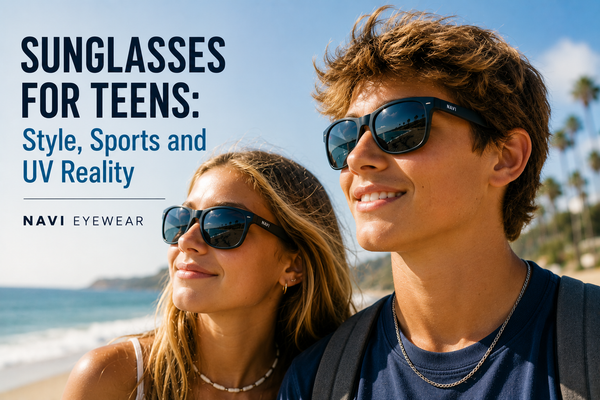

QUICK ANSWERTeenagers are in a unique position: their UV lens vulnerability is still higher than adults', they often spend more time outdoors than most adults, and the cumulative UV damage accumulating in the teen years is what manifests as cataracts and macular degeneration in their 50s and 60s. The compliance challenge is real — style and peer context drive wearing behavior more than health arguments at this age. The solution isn't to override style preferences but to find quality UV400 polarized frames within them, and to make the performance and identity case rather than the health case. |

Teenage sun protection sits at the intersection of developing adult-level UV risk and the most compliance-resistant phase of childhood. The health argument — 'protect your eyes now or regret it at 60' — is accurate but poorly calibrated to how teenagers actually make decisions. Style, social identity, athletic performance, and peer norms drive teenage behavior far more reliably than long-term health projections.
This guide takes that reality seriously and builds from it rather than against it. For the full science of why UV accumulation in the teenage years matters, see theUV Protection for Children: Complete Family Eye Health Guide. For age-specific guidance across all childhood stages, seebest sunglasses for kids by age.
1. The UV Reality Teenagers Need to Know
Why the Teen Years Matter More Than Most Realize
By the teenage years, a child's crystalline lens has developed significantly more UV-filtering capacity than in early childhood — but it hasn't reached adult levels until the late teens. More importantly, the cumulative UV dose model means that the UV exposure being accumulated between 13 and 18 is directly additive to everything accumulated in the preceding years. There is no reset button. Every hour of unprotected UV exposure in the teenage years is UV damage that compounds with what came before and with what will accumulate in adulthood.
The eye conditions most directly linked to lifetime UV accumulation — cataracts, age-related macular degeneration (AMD), and pterygium — have onset decades after the exposure that contributes to them. A 16-year-old spending summers unprotected at the beach, on a sports field, or near water is making a choice that shows up in their late 40s and 50s as accelerated cataract formation or earlier AMD onset.
→ UV and cataract risk — NEJM research
Teenagers Are Outdoors More Than Most Adults
The practical exposure reality compounds the biological one. High school and college-age individuals often spend more sustained outdoor time than adults in workplace settings — organized sport, outdoor recreation, beach days, water activities, and general social time outdoors. An adult who commutes to an office and spends weekends intermittently outdoors accumulates far less UV per year than a high school athlete spending multiple hours per day at outdoor practice.
The Lens Vulnerability Window Is Closing But Not Closed
The adolescent crystalline lens transmits less UV to the retina than an infant or toddler lens, but more than a fully developed adult lens. The gradual development of natural chromophores in the lens — the molecules that provide some UV filtering — continues through the late teens and into early adulthood. This means teenage eyes are still meaningfully more UV-vulnerable than adult eyes, even if far less so than young children's.
2. What Teenagers Actually Care About: Working With It
Style and Social Identity
For most teenagers, sunglasses are a style item first and a health item second — or not at all. This is not a problem to overcome; it is the compliance mechanism to work with. A teenager who sees quality polarized sunglasses as a style identity marker will wear them consistently. A teenager who sees them as a health requirement imposed by parents will wear them inconsistently if at all.
The practical implication: involve the teenager in frame selection to the maximum degree possible within the UV400 polycarbonate requirement. The frames they choose are the frames they'll wear. Aesthetic alignment with their peer group, activity context, or personal style identity is not a concession — it's the strategy.
Athletic Performance
For athletically active teenagers, the performance framing outperforms the health framing significantly. Polarized lenses provide concrete, immediately perceptible performance benefits in outdoor sport:
Many competitive teenage athletes who try quality polarized lenses for a practice session report immediate, noticeable improvement in visual comfort. Experience is the strongest compliance driver at this age — one session with quality polarized lenses in bright conditions tends to produce lasting adoption.
The Science Argument for Evidence-Responsive Teens
Some teenagers are genuinely persuaded by evidence clearly presented. For this subset, the direct argument is: UV damage to the eye is cumulative and irreversible. The UV you accumulate between 13 and 18 is directly additive to what came before and what will come after. The cataracts and macular degeneration that develop in your 50s and 60s are partly determined by the UV choices you're making now. There is no adult phase of 'catching up' on protection — you can only reduce future accumulation.
This argument lands differently with teenagers who value long-term thinking, who have seen UV-related conditions in family members, or who are health-conscious in other areas (fitness, nutrition). It does not work well as a generic teen compliance strategy but is worth making directly with teenagers who are receptive to it.
3. What to Buy: Lens and Frame Specifications
The Non-Negotiables
Beyond these, everything else — frame style, color, shape, tint — is the teenager's domain. Find the intersection of UV400 polycarbonate polarized and what they'd actually choose.Navi Eyewear's polarized collection offers UV400 certified polycarbonate polarized lenses in styles that don't read as medical equipment.
Lens Tint by Activity
|
Tint |
Best For |
Performance Benefit |
Cat Level |
|
Gray polarized |
Everyday wear, driving, general outdoor |
Cat 2–3 |
|
|
Amber / brown polarized |
Ball sports, hiking, trail running |
Enhances contrast, improves object tracking, defines terrain |
Cat 2–3 |
|
Copper polarized |
Fishing, water sport, beach |
Sub-surface water visibility, maximum glare cut on water |
Cat 2–3 |
|
Cat 3 (darker gray/amber) |
Beach, ski slope, intense summer sun |
Maximum brightness reduction for high-UV environments |
Cat 3 |
|
Cat 4 |
Alpine glaciers only |
Not for driving — too dark for general use |
Cat 4 (limited use) |
Frame Style Considerations for Teenagers
Teenagers are sizing into adult frames by 13–15 in most cases — standard adult lens widths of 50–56mm are appropriate for most older teenagers. Key style categories and their UV protection alignment:
4. Sport-Specific Guidance for Active Teenagers
Outdoor sport is the highest UV exposure context for most teenagers, and the one where sport-specific frame design matters most alongside UV protection.
NAVI EYEWEAR — UV400 POLARIZED SUNGLASSESBuy 1, Get Any 3 Pairs Free — $119.00 for 4 pairs. Discount auto-applies at cart. Free shipping. Free replacements. 30-day return on unworn pairs. Every lens: UV400 certified polycarbonate · FDA-cleared impact resistance · polarized PVA film · oleophobic coating · anti-saltwater coating · TR90 nylon frames · stainless 5-barrel hinges. |
Baseball and Softball
Sky tracking — looking up into bright sky for fly balls — is one of the most acute UV and glare situations in any sport. Amber or brown polarized lenses in a sport frame with good coverage are the standard recommendation. Polarization specifically helps with the glare off the infield and outfield grass. See also the dedicated guide tosunglasses for baseball and softball.
Tennis and Pickleball
Court surfaces, particularly hard courts, produce significant reflected glare. Amber or brown polarized lenses improve ball visibility against bright sky and court backgrounds. Secure retention is essential for the lateral movement demands of racquet sports. Seesunglasses for tennisfor the complete guide.
Soccer and Field Sports
Field sports combine extended duration outdoor exposure with high-intensity aerobic movement that makes frame security critical. Amber or brown polarized in a close-fitting sport frame with rubber grip nosepad and temple tips is the functional specification. UV exposure during a 90-minute outdoor soccer practice in afternoon sun is substantial — among the highest daily UV doses a teenager regularly accumulates.
Swimming and Water Sports
Water reflects up to 25% of UV, and the surface reflection creates intense horizontal glare that polarized lenses specifically eliminate. Copper polarized tint provides the best combination of glare elimination and sub-surface visibility for water activities. Hydrophobic lens coating is valuable in water environments. BrowseUV400 polarized options at navieyewear.com.
Skiing and Snowboarding
Snow reflects up to 80% of UV, and altitude increases UV intensity by approximately 10–12% per 1,000 meters. The combination makes winter mountain sport among the highest UV exposure contexts across any age group. Cat 3 polarized lenses with full goggle or close-fitting wraparound coverage are appropriate. Teenagers who ski or snowboard regularly are accumulating very high UV doses even in winter months — this is the outdoor context where protection is most urgently needed.
5. The Style Guide: UV Protection Without Compromising Aesthetic
The false premise in most teen sun protection guidance is that UV protection and style are in tension. They're not — the tension is between cheap, uncertified dark lenses and stylish frames, not between protection and aesthetics. Quality UV400 polarized sunglasses are available in every style category that has meaning for teenagers.
Match to Peer and Activity Context
Different peer groups have different sunglass aesthetics. Athletic peer groups often align around sport performance frames — wraparound, branded, technical. Creative or arts-oriented peer groups may gravitate toward retro shapes, oversized frames, or distinctive colors. Streetwear and urban aesthetic peer groups often align with classic silhouettes or specific style brands. None of these aesthetics is incompatible with UV400 polycarbonate polarized — it's a lens specification, not a style category.
The Quality Signal
Teenagers are perceptive about quality signals. Well-made frames with optical-quality polycarbonate lenses look and feel different from cheap fashion frames with uncertified dark plastic lenses. The optical clarity of quality polarized polycarbonate, the solid feel of stainless hinge hardware, and the fit consistency of TR90 frames read as quality to people who are paying attention — which teenagers in style-conscious peer groups typically are. The false economy of cheap fashion sunglasses is that they look cheap to discerning peers. Quality UV protection and quality aesthetic signal can be the same thing.
For Parents: How to Navigate Frame Selection With a Teenager
Set the non-negotiable baseline privately: UV400 certified, polycarbonate lenses, genuine polarization. Then bring the teenager to the selection from there, letting them choose within those parameters without making the parameters the focus of the conversation. 'These are the ones that actually work' is a one-time statement; the selection process from that point is theirs. Teenagers who feel they had genuine authority over the style choice wear those frames. Teenagers who feel they were managed into a frame don't.

Frequently Asked Questions
What size sunglasses do teenagers need?
Most teenagers 13–15 can fit into adult small-to-medium sizing; by 15–18, most are in standard adult sizing. Lens width of 50–54mm suits most teenagers; face width should be measured if buying online. The frame should sit level, cover the full eye orbital area without resting on the cheekbone, and have temples that reach around the ear without excessive gap. For sport, the frame should be secure enough to stay in place during rapid movement.
Are polarized sunglasses worth it for teenagers?
Yes — and the performance argument is often more compelling to teenagers than the health argument. Polarized lenses eliminate the horizontal surface glare that causes squinting and visual fatigue in outdoor sport, improve contrast for ball and terrain tracking, and provide noticeably better visual comfort in bright conditions. The experience difference between quality polarized and non-polarized is immediately perceptible, and most teenagers who try polarized lenses in an outdoor sport context voluntarily prefer them going forward.Browse polarized UV400 options at Navi Eyewear.
My teenager says sunglasses give them headaches. Is that possible?
Yes, but it's almost always a lens quality or fit issue rather than an inherent incompatibility. Low-quality lenses can have optical distortion that causes eye strain. Polycarbonate lenses from reputable sources are optically clear without measurable distortion. If a teenager experiences headaches with a specific pair, check whether straight lines appear curved when viewed through the lens — distortion is the signal. Also check fit — a frame that sits at the wrong height or presses on the temples can cause headache from pressure. Switching to quality polycarbonate lenses typically resolves the issue.
What about blue-light-blocking lenses for teenagers who spend time on screens?
Blue-light-blocking lens coatings for screen use are a separate product category from UV400 sunglasses — UV400 sunglasses are for outdoor UV protection. The evidence base for blue-light-blocking coatings providing meaningful benefit for screen-related eye strain is currently limited. The relevant concern for teenagers is UV exposure outdoors, not screen-emitted blue light, which is orders of magnitude lower intensity than outdoor UV. For the science on this, seeblue light vs. UV: what actually matters for your eyes.
Should teenagers wear sunglasses year-round, including in winter?
Yes. UV is present year-round, and winter contexts — particularly skiing and snowboarding — represent the highest UV exposure environments teenagers commonly encounter. Snow reflects up to 80% of UV, altitude amplifies UV intensity, and the extended outdoor time of a ski day produces UV exposure comparable to a full summer beach day. Year-round is the correct answer for consistent protection.
Is it safe for teenagers to drive with polarized sunglasses?
Yes — gray or amber polarized lenses are appropriate and beneficial for daytime driving. Polarization eliminates road surface glare and windshield reflections that are significant driving hazards. The only contraindications are Cat 4 lenses (too dark for driving — not appropriate for general use) and any lens at night (never use tinted lenses for night driving). Gray polarized is the standard recommendation for teenage drivers and adults alike.
My teenager keeps losing or breaking sunglasses. What's the practical approach?
Quality frames in TR90 nylon are significantly more durable than cheap fashion frames — they bend rather than snap and maintain shape under repeated stress. That said, teenagers will lose and break frames, and the practical approach is to have replacements available. Navi Eyewear's Buy 1, Get 3 Free offer —$119 for 4 pairs at navieyewear.com/collections/polarized — is specifically useful here: multiple UV400 polarized pairs at a price that makes replacement realistic without a purchasing event each time one is lost. Four pairs means backups in a school bag, sport bag, and car.
At what age do teenagers not need special 'children's' sunglasses?
By approximately 13–14, most teenagers have grown into adult frame sizing and no longer need specialized children's eyewear — standard adult frames in appropriate size ranges are correct. The distinction between children's and adult sunglasses is primarily about frame sizing, face proportions, and retention design, not about lens specifications. UV400 polycarbonate polarized is the right lens specification at every age; the frame around it adjusts to fit the face.
The Bottom Line
Teenagers accumulate substantial UV exposure during years when their eyes are still somewhat more vulnerable than fully developed adult eyes, and the cumulative UV dose of the teenage years directly affects adult eye health outcomes decades later. The compliance challenge is real — health arguments alone don't drive teenage behavior reliably. The effective approach combines style autonomy (choose within UV400 polycarbonate polarized), performance framing for athletes, and parental modeling (adults who wear quality sunglasses consistently create the norm teenagers absorb). QualityUV400 polarized sunglasses are available in every style category that matters to teenagers — the tension between UV protection and style is a product quality problem, not an inherent conflict.
Sources & Citations[1] Coroneo MT, et al.."UV radiation and the crystalline lens in children and adolescents."Archives of Ophthalmology, 2002.View source → [2] Taylor HR, et al.."Effect of ultraviolet radiation on cataract formation."New England Journal of Medicine, 1988.View source → [3] West SK, et al.."Exposure to sunlight and other risk factors for age-related macular degeneration."Archives of Ophthalmology, 1989.View source → [4] Dain SJ."Sunglasses and sunglass standards."Clinical and Experimental Optometry, 2003.View source → [5] American Academy of Ophthalmology."UV protection and adolescent eye health."AAO EyeSmart, 2023.View source → [6] WHO."Global solar UV index: a practical guide."World Health Organization, 2002.View source → |