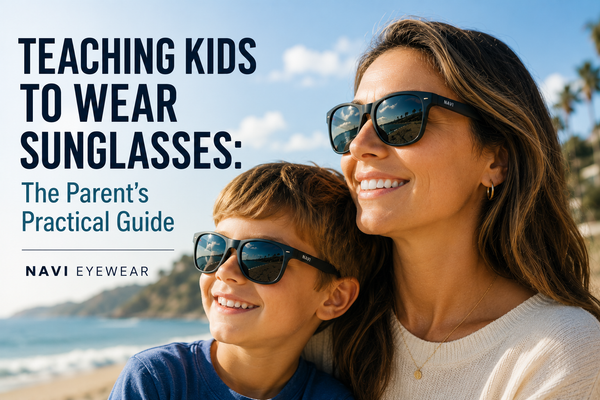

Every parent who has tried to get a two-year-old to keep sunglasses on understands the gap between UV protection knowledge and UV protection reality. The science is clear — children's eyes are more UV-vulnerable than adults', and the habits formed in childhood are the strongest predictor of lifetime sun protection behavior. The practical challenge is implementation: how do you build a genuine, durable sunglasses habit in a child who would rather throw the frames across the playground?
This guide approaches that challenge from a behavioral science and child development perspective, providing age-specific strategies that reflect what actually works rather than what sounds sensible in theory. For the full UV science behind why this matters, see theUV Protection for Children: Complete Family Eye Health Guide. For age-specific frame and lens recommendations, seebest sunglasses for kids by age.

Why Compliance Is Hard — and Why It Matters
The Developmental Reality
Young children resist sunglasses for straightforward developmental reasons. Toddlers are asserting autonomy and resisting anything imposed on them — sunglasses are particularly easy targets because removing them produces a reliable parental reaction. Preschoolers may find them uncomfortable before they've adapted to wearing them, or simply distracted by more interesting things. School-age children become aware of peer norms and may refuse if no one else in their group wears sunglasses. Teenagers navigate identity and social judgment in ways that complicate any parent-initiated health behavior.
None of this is unique to sunglasses — the same dynamics apply to hats, sunscreen, seatbelts, and helmets. The strategies that work for those habit-formations work here too.
Why It Matters Enough to Persist
The UV damage that causes cataracts, macular degeneration, and pterygium in adulthood accumulates from the first years of life. Children's eyes transmit significantly more UV to the retina than adult eyes, and children spend proportionally more time outdoors than most adults. Research suggests children may accumulate up to 80% of their lifetime UV exposure before age 18. Establishing a consistent sunglasses habit in childhood is not merely precautionary — it directly reduces the lifetime UV dose that determines adult eye health outcomes. For the full evidence, see thechildren's UV eye health guide.
The Single Most Effective Strategy: Parental Modeling
Before specific tactics by age, one principle outweighs all others in the research on children's health behaviors: parental modeling. Studies in pediatric sun safety consistently find that parental sunglasses and sunscreen behavior is the strongest single predictor of children's own sun protection habits — stronger than verbal instruction, stronger than understanding of UV science, stronger than any specific compliance technique.
This is not abstract. Children observe parental behavior constantly and form behavioral norms based on what they see the adults in their lives actually do, not what those adults say they should do. A parent who puts sunglasses on the child while leaving their own on the car seat creates a message that sunglasses are something children are made to wear, not something adults choose to wear. A parent who reaches for their own sunglasses at the same time as the child's creates a shared norm.
The practical implication: the most effective investment in your child's sun protection habit is your own consistent wearing of quality UV400 polarized sunglasses. If you need a pair you'll actually wear consistently,Navi Eyewear's polarized collection offers UV400 certified polycarbonate polarized lenses — and the Buy 1, Get 3 Free offer ($119 for 4 pairs) makes equipping the whole family practical.
Age-Specific Compliance Strategies
Infants (6–12 Months): Normalize Early, Minimize Fuss
The compliance advantage with infants is that they have no preconceived resistance to sunglasses — they don't yet have a narrative about not wanting to wear them. The window to establish sunglasses as simply 'what we do outdoors' is open in a way it won't be at 18 months. The practical strategy:
Toddlers (1–3 Years): The Hardest Phase — And Why Elastic Beats Everything
This is the phase most parents find most challenging, and with good reason. Toddlers are developmentally in a phase of autonomy assertion — their central developmental task is establishing that they can influence the world, which manifests as saying 'no' to many adult-imposed things. Sunglasses are a particularly easy target because they sit on the face in a highly accessible removal location.
The practical response has two components: frame design and behavioral strategy.
Early Childhood (4–7 Years): Routine Beats Reminder
By age 4–5, most children can understand simple explanations and respond to established routines. The compliance strategy shifts from purely behavioral management to routine embedding:
School Age (8–12 Years): Peer Context and Earned Independence
School-age children are increasingly influenced by peer behavior. If no one in their friend group wears sunglasses, there may be social friction around wearing them. Strategies for this age:
Teenagers (13–18 Years): Reframe Around Identity and Performance
Teenagers are least responsive to parental instruction and most responsive to peer norms, personal identity, and direct personal benefit. The compliance strategies that work in earlier childhood don't map well here:
NAVI EYEWEAR — UV400 POLARIZED SUNGLASSESBuy 1, Get Any 3 Pairs Free — $119.00 for 4 pairs. Discount auto-applies at cart. Free shipping. Free replacements. 30-day return on unworn pairs. Every lens: UV400 certified polycarbonate · FDA-cleared impact resistance · polarized PVA film · oleophobic coating · anti-saltwater coating · TR90 nylon frames · stainless 5-barrel hinges. |
Building the Routine: Practical Systems
The Trigger-Based Habit
The most durable habits are triggered by context rather than requiring conscious decision-making. 'Sunglasses go on when we go outside' is more powerful than 'remember sunglasses when it's sunny' because it doesn't require the child (or parent) to assess weather conditions and make a judgment call. It's a fixed response to a fixed trigger: outdoor = sunglasses.
Implement this by physically placing children's sunglasses in the same location as shoes or outdoor gear — so the routine cue (getting shoes) cues the next behavior (getting sunglasses). Proximity and routine placement are the behavioral architecture of habit formation.
The Family Culture Approach
Framing sun protection as 'what our family does' rather than 'what I'm making you do' creates a different relationship with the behavior. 'We all put our sunglasses on when we go outside' — said and modeled, not just said — establishes a family norm that children internalize rather than resist. This framing is particularly effective with school-age children who are developing their identity in relation to family membership.
Sunglasses Storage and Access
Practical barrier removal matters. If sunglasses are hard to find, in a different room, or require adult assistance to retrieve, the friction increases the likelihood of skipping. Keep children's sunglasses with their shoes or outdoor gear, in a consistent location, at a height the child can access themselves. For older children, keeping frames in a school bag or sport bag removes the 'I forgot them' barrier for out-of-home settings.
Quick-Reference: Compliance Strategies by Age✓ 6–12 months: Elastic retention frames · integrate into outdoor prep routine · model simultaneously ✓ 1–3 years: Elastic strap frames · offer choice between two options · avoid power struggles · shade if refused ✓ 4–7 years: Child-selected frames within UV400 requirement · routine embedding · brief science explanation ✓ 8–12 years: Style input · sport context · peer-acknowledgment · age-appropriate UV science ✓ 13–18 years: Style autonomy · performance framing · direct UV evidence · expectation not enforcement ✓ All ages: Consistent parental modeling is the single most effective strategy |
When Kids Flat-Out Refuse
Every parent will encounter periods of refusal, regardless of strategy. Some practical guidance:
Toddler Refusal
Don't fight it. Prioritize shade strategies for that outing — stroller canopy, hat, tree shade, avoiding peak UV hours. Try again next outing with fresh energy and no baggage from the previous refusal. The goal is to keep sunglasses as a normal, expected part of the outdoor routine, not to win every individual battle. A child who fights sunglasses every third outing but wears them two out of three times is building a habit; a child who is involved in a daily struggle is not.
School-Age Refusal Based on Peer Norms
Acknowledge the social reality honestly. 'I get it — not everyone wears them' is more connecting than dismissing the peer concern. Then hold the requirement without making it dramatic: 'Our family wears them. You can choose which pair.' Find contexts where sunglasses are socially normalized for their peer group — sport is usually the easiest entry point.
Teenager Refusal
State the expectation once, clearly, and don't nag. Repeated reminders from parents are the most effective way to turn health behavior into a rebellion target for teenagers. Provide quality frames they'd actually wear voluntarily, explain the evidence once, and trust that the expectation has been heard. Most teenagers will comply more when not policed, and will internalize the habit in their own time.
Comfort-Based Refusal at Any Age
Some refusal is genuinely about discomfort — frames that fit poorly, that slide down, that press on the nose or ears, or that feel heavy. Before attributing refusal to willfulness, check fit. A toddler who keeps pulling off sunglasses may be telling you the frame doesn't fit well. An elastic-strap frame adjusted too tightly is uncomfortable; adjusted correctly, most children forget it's there. For school-age and older children, involve them in identifying what's uncomfortable and finding a frame that resolves it.
What Makes Sunglasses Kids Actually Want to Wear
Frame design choices significantly affect compliance, independent of behavioral strategies:
For adults in the family who want quality UV400 polarized frames they'll actually wear — which is the most powerful investment in children's sun protection habits — browseNavi Eyewear's polarized collection.
Frequently Asked Questions
My toddler tears off sunglasses the instant I put them on. What do I do?
Switch to elastic-strap retention frames — toddlers cannot remove these as easily as temple-arm frames. Put them on as part of the outdoor routine without drama. Stay calm when they fuss rather than reacting strongly (big reactions teach that removal gets attention). If they refuse persistently, use shade strategies for that outing and try again. Consistency of attempt matters more than 100% compliance. Most toddlers who have sunglasses as a consistent routine expectation normalize wearing within a few weeks.
How do I explain UV protection to a young child?
Keep it simple and concrete: 'Sunglasses protect our eyes from the sun, the same way sunscreen protects our skin.' For slightly older children (5+): 'The sun sends invisible rays that can hurt our eyes over time, and sunglasses block those rays.' You don't need to explain UV400 wavelengths — the skin protection analogy is one children already understand and accept, and it transfers naturally to eye protection.
Should sunglasses be a rule or a choice for kids?
A rule with agency inside it — 'we wear sunglasses outside, and you choose which ones.' The UV protection requirement is non-negotiable; the frame style, color, and specific pair is the child's domain. This structure prevents the behavior becoming a power struggle while giving children the autonomy they need to own the habit. Turning it into a purely parent-imposed rule with no child input typically increases resistance; turning it into a pure choice produces inconsistent compliance.
What if my child says sunglasses give them a headache?
This is usually a fit issue rather than a fundamental incompatibility with sunglasses. Low-quality lenses can produce optical distortion that causes eye strain. Check lens quality — polycarbonate UV400 lenses should be optically clear without distortion. If the lens passes basic optical quality (no distortion when viewing straight lines), check fit — frames sitting too close to the face, temple arms pressing on the skull, or bridge sitting incorrectly can all cause genuine discomfort. Try different frames before concluding the child can't wear sunglasses.
How do I get my child to wear sunglasses at school when I'm not there?
School-age independence around sun protection is built on habits established at home. A child who wears sunglasses consistently in family contexts is more likely to do so independently at school. Keeping frames in the school bag so they're available removes the access barrier. For sport contexts, communicating with coaches about sun protection normalizes it within the team culture. Some schools have sun-safe policies that include sunglasses — knowing the school's policy and supporting it is more effective than trying to police behavior you can't see.
My teenager thinks sunglasses are uncool. How do I handle this?
Find frames they'd actually choose for themselves — among quality UV400 polarized options — and let them have full style authority within that constraint. The teenager who picks their own frames is meaningfully more likely to wear them. Connect to sport performance if they're athletic: polarized lenses reduce glare fatigue and improve contrast tracking. If they engage with health information, the UV accumulation science is compelling. State the expectation once and don't nag — repeated reminders are the most reliable way to turn a health behavior into a rebellion target.
Does it matter if my child only wears sunglasses sometimes?
Partial compliance provides partial protection and is meaningfully better than no compliance. That said, the long-term goal is consistent habit formation, because inconsistent UV protection means inconsistent accumulation reduction. Prioritize high-UV contexts — beach, ski slope, extended outdoor sport, midday sun — if you can't achieve consistent wearing. Any UV-protected time is better than none, and the habit tends to generalize as it becomes more ingrained.
The Bottom Line
There is no perfect compliance strategy that works for every child at every age. What the evidence consistently shows is that: parental modeling is the most powerful single driver; elastic retention resolves toddler compliance more than any behavioral strategy; child involvement in frame selection improves compliance at every age above toddler; and routine embedding produces more durable habits than case-by-case reminders.
The investment in children's sun protection habits pays out over decades in reduced lifetime UV accumulation. It starts with adults who model consistent wearing — which means having quality UV400 polarized sunglasses that you actually wear. BrowseNavi Eyewear's polarized collection — Buy 1, Get 3 Free for $119 — and start from the habit you model.
Sources & Citations[1] Stöppler MC, et al.."Pediatric sun protection behaviors and parental modeling."Pediatric Dermatology, 2019.View source → [2] Coroneo MT, et al.."UV radiation and the crystalline lens in children."Archives of Ophthalmology, 2002.View source → [3] Dain SJ."Sunglasses and sunglass standards."Clinical and Experimental Optometry, 2003.View source → [4] American Academy of Ophthalmology."Kids and UV protection — sunglasses for children."AAO EyeSmart, 2023.View source → [5] National Cancer Institute."Childhood sun protection and lifetime UV dose."NCI Cancer Prevention Overview, 2022.View source → |