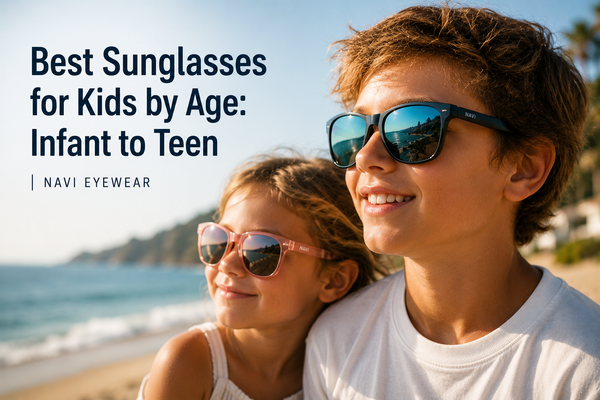

The question 'what sunglasses should my child wear?' has a different answer at 8 months than at 8 years, and a different answer again at 15. Children's UV vulnerability, face proportions, outdoor activities, and compliance realities all shift dramatically across the first two decades of life. This guide provides specific, age-matched recommendations — from the first outdoor outings of infancy through the athletic and social contexts of the teenage years. For the full science of why children need UV protection and what happens to unprotected eyes over time, see theUV Protection for Children: Complete Family Eye Health Guide.
All recommendations in this guide assume UV400 certified polycarbonate lenses as the baseline — non-negotiable for any age. The differences between age groups are in frame design, fit, retention, tint, and compliance strategy. For adults looking for their ownUV400 polarized sunglasses to model consistent wearing for their children, Navi Eyewear's Buy 1 Get 3 Free offer ($119 for 4 pairs) provides quality adult protection at a price point that makes equipping the whole family practical.

Age-by-Age Sunglasses Guide
|
0–6 Months:Shade First UV Risk Level: Highest relative UV vulnerability — lens not yet developed Frame Type: Avoid sunglasses — not practical at this age Retention: N/A — shade is the primary strategy Lens Recommendation: Physical UV blocking via shade Key Features: Stroller canopy · wide-brim hat · tree shade · avoid direct midday sun The infant eye at 0–6 months transmits more UV to the retina than at any other life stage. The crystalline lens has not yet developed its natural UV-filtering capacity, and the pupil response is less efficient. However, sunglasses are not practical for newborns and very young infants — they cannot support the frame on their face, will remove them immediately, and physical shade is a more reliable and complete protection strategy. A stroller canopy that blocks direct sun, a hat with at least a 3-inch brim, and scheduling outdoor time outside peak UV hours (before 10am and after 4pm) are the practical UV strategies for this age group. |
|
6–12 Months: First Sunglasses UV Risk Level: Very high — outdoors frequently, UV lens vulnerability still significant Frame Type: Infant UV wrap — very small, flexible, close-fitting Retention: Elastic headband or wrap-around retention — essential Lens Recommendation: UV400 polycarbonate — polarized preferred Key Features: Flexible rubber or TR90 · no hard sharp edges · washable · very lightweight From approximately 6 months, when infants have some head control, UV-protective eyewear becomes both practical and recommended for direct-sun outdoor time. The key at this age is retention — standard temple-arm frames will not stay on an infant. Look for frames specifically designed for infant use with elastic headbands or wrap-style retention that sits securely without pressure. Lens width of 35–40mm is appropriate. Frames should have no hard protrusions, sharp edges, or small detachable parts. Rubber or soft silicone materials are ideal. Polarization adds comfort in bright conditions — stroller rides through sunny environments involve sustained squinting exposure that polarized lenses significantly reduce. |
|
1–3 Years: Toddler — The Hardest Age UV Risk Level: High — maximum outdoor time, maximum UV lens vulnerability, minimum compliance Frame Type: Flexible sport-style toddler frame, very small Retention: Elastic strap retention — non-negotiable Lens Recommendation: UV400 polycarbonate + polarized for active outdoor use Key Features: Unbreakable · washable · colorful to encourage wearing · rubberized nose · strap · lens width 40–44mm Toddlers are the most challenging age group for sunglass compliance and also one of the most important ages for UV protection. They spend substantial time outdoors in high-UV environments — playgrounds, beaches, parks — and their eyes are still developing their natural UV filtering capacity. The practical priority is a frame they will actually keep on. Elastic strap retention prevents removal; flexible rubberized frames resist the drops and throws that are inevitable with toddlers. Letting the child choose between two approved color options gives them ownership that significantly improves compliance. Polarized lenses are genuinely beneficial at this age — toddlers spend a lot of time at ground level near sand, water, and concrete, all high-glare surfaces. |
|
4–7 Years: Early Childhood UV Risk Level: High — extended outdoor play, sport begins, increasing independence outdoors Frame Type: Kids' sport or lifestyle frame — slightly larger Retention: Close-fit temples adequate; strap recommended for active sport Lens Recommendation: UV400 polarized — gray for everyday, amber for sport Key Features: Polycarbonate confirmed · TR90 frame · correct face sizing (lens width 44–48mm) · lightweight By age 4–5, most children accept and often enjoy wearing sunglasses when it is established as a routine. This age group begins organized outdoor sport — soccer, T-ball, gymnastics — where sport-appropriate frame design becomes relevant alongside UV protection. The lens tint choice matters more at this age: gray polarized for everyday and general outdoor use provides color-accurate vision that suits most situations; amber or brown polarized enhances contrast for sport and active play, making moving objects easier to track. Ensure frames are sized for a child's face — many 'children's' frames in this category still have lens widths of 50mm+ that are proportioned for older children or small adults. |
|
8–12 Years: School Age UV Risk Level: High — school sport, recess, after-school activities accumulate significant UV Frame Type: Kids' lifestyle or activity-matched sport frame Retention: Standard temples for everyday; retention strap for sport Lens Recommendation: UV400 polarized — match to primary activity Key Features: Durable for active use · correct sizing (lens width 48–52mm) · activity-matched tint · impact-resistant School-age children accumulate some of the highest daily UV doses of any age group. Recess, PE, after-school sport, and weekend outdoor activities can add up to 2+ hours of unprotected outdoor exposure on a typical school day. The UV habits established in this window carry through to adolescence. Compliance is generally good at this age when sunglasses are part of the outdoor routine — children who have worn sunglasses consistently since early childhood typically continue without resistance. For children playing organized sport, a sport-specific frame with wrap design and retention is worth the investment alongside everyday frames. |
|
13–18 Years:Teenagers UV Risk Level: Moderate-High — high sport/activity exposure; UV lens vulnerability reducing but not adult level Frame Type: Adult or near-adult sizing — style is the compliance driver Retention: Standard temples; sport retention for athletic use Lens Recommendation: UV400 polarized — style-matched and sport-matched Key Features: Style appropriate to peer context · sport-specific if athletic · lens width 50–54mm · genuine UV400 certified Teenagers present a different challenge than younger children: the UV science case can be made directly to them, but style and peer context are the primary compliance drivers. A pair of UV400 polarized sunglasses that a teenager would choose for themselves is worth far more than a medically optimal pair they will leave in a drawer. The practical approach is allowing style input within the UV400 polycarbonate non-negotiable baseline. The performance argument is also effective with athletic teenagers: polarized lenses reduce glare fatigue, improve contrast for tracking fast-moving objects, and reduce squinting that affects visual acuity during sport. Many teenage athletes who try quality polarized lenses for sport report immediate noticeable improvement in visual comfort and object tracking. |
At-a-Glance Reference: Key Specs by Age
|
Age |
Lens Width |
Bridge Width |
Retention |
Tint |
Polarized? |
|
0–6 mo |
Shade only |
— |
Canopy/hat |
— |
— |
|
6–12 mo |
35–40mm |
12–14mm |
Elastic headband |
Gray or neutral |
Preferred |
|
1–3 yr |
40–44mm |
14–16mm |
Elastic strap required |
Gray or amber |
Preferred |
|
4–7 yr |
44–48mm |
14–17mm |
Strap for sport |
Gray everyday / amber sport |
|
|
8–12 yr |
48–52mm |
15–18mm |
Strap for sport |
Activity-matched |
|
|
13–18 yr |
50–54mm |
16–19mm |
Standard temples |
Style/activity matched |
NAVI EYEWEAR — UV400 POLARIZED SUNGLASSESBuy 1, Get Any 3 Pairs Free — $119.00 for 4 pairs. Auto-applies at cart. Free shipping. Free replacements. 30-day return on unworn pairs. Every lens: UV400 certified polycarbonate · FDA-cleared impact resistance · polarized PVA film · oleophobic coating · anti-saltwater coating · TR90 nylon frames · stainless 5-barrel hinges. |
What to Look For at Every Age: The Non-Negotiables
Regardless of the specific age group, several requirements apply to every children's sunglass purchase:
UV400 Certification — Verified, Not Assumed
The most important specification — and the one most often faked or omitted in cheap children's frames. UV400 means 100% blockage of UVA and UVB to 400 nanometers. This must be explicitly stated, not implied by a dark tint. Dark lenses without UV400 certification are actively harmful — they cause pupil dilation that increases UV to the retina without blocking any of it. Only buy from brands that explicitly certify UV400. See7 signs your sunglasses aren't protecting your eyesfor the full verification checklist.
Polycarbonate Lenses — Impact Safety Is Not Optional
Polycarbonate is approximately 10 times more impact-resistant than standard optical plastic and does not shatter into sharp fragments. For children, who drop, sit on, throw, and generally abuse eyewear in ways adults do not, the impact safety of polycarbonate is not a performance upgrade — it is a basic safety requirement. Glass lenses are not appropriate for any child. Standard optical resin (CR-39) is not appropriate for active children. Polycarbonate only.
Correct Sizing for the Child's Face
An adult frame on a child's face provides poor UV coverage regardless of UV400 certification, because the lens does not align correctly with the eye. The frame must be sized for the child's actual face width and bridge dimensions. The coverage quality of a correctly sized UV400 frame is significantly better than an oversized one, even if both carry the same lens certification.
Polarization: The Comfort Upgrade
Polarized lenses eliminate horizontal reflected glare — the intense reflected light from water, sand, pavement, and playground surfaces that causes squinting and visual fatigue. For children who spend time outdoors in these environments, polarized lenses are a meaningful functional upgrade that also makes the experience of wearing sunglasses more comfortable, improving compliance.Browse polarized UV400 options at navieyewear.com.
Sunglasses for Children's Sports
Organized outdoor sport is where children's UV exposure accumulates most rapidly and where sport-specific frame design matters most. Key considerations:
For children who play baseball, tennis, soccer, or other ball sports in direct sun, polarized amber or brown UV400 lenses provide both UV protection and a genuine performance advantage — improved contrast makes tracking fast-moving objects easier and reduces visual fatigue over the course of a game. See alsothe complete guide to sunglasses for ball sports.
Frequently Asked Questions
What age should kids start wearing sunglasses?
From approximately 6 months — when they have enough head control to make wearing practical. Before 6 months, physical shade is the primary strategy. The earlier a consistent habit is established, the more naturally it continues through childhood.
Are there sunglasses safe for babies?
Yes — infant sunglasses with elastic headband retention, flexible soft frames with no sharp edges or small detachable parts, and UV400 polycarbonate lenses are appropriate from around 6 months. Look for products specifically marketed and designed for infant use, not scaled-down adult or toddler frames.
What's the difference between kids' UV400 and adult UV400?
The UV400 certification is the same standard — 100% UVA and UVB blocking to 400nm. The differences are in frame size (proportioned to children's smaller faces), frame material durability (children's frames need more flexibility and impact resistance), retention design (elastic straps for young children), and in some cases lens category (children's everyday frames are often Cat 2, avoiding the very dark Cat 3–4 lenses appropriate for adult extreme sport contexts).
Should I buy polarized sunglasses for my child?
For any child spending regular time outdoors in sunny conditions, polarized UV400 is the recommended upgrade over non-polarized UV400. The glare elimination is particularly relevant for children who play near water, sand, or pavement. There is no safety concern with polarized lenses at any age — they simply block an additional type of light (horizontal reflected glare) that causes squinting and visual fatigue.Browse polarized options at Navi Eyewear.
How often do children's sunglasses need replacing?
UV400 protection in polycarbonate lenses does not meaningfully degrade with normal use — UV400 is a material property, not a surface coating. Replace when: the child outgrows the frame size (check annually), the frame is physically damaged, the lenses are significantly scratched (affecting optical clarity, not UV protection), or the retention system fails. Most children's frames last 1–2 years before one of these factors triggers replacement.
Can toy sunglasses hurt my child's eyes?
Yes — this is one of the most important safety points for parents. Toy or fashion sunglasses with dark lenses but no UV400 certification cause pupil dilation while blocking no UV radiation, resulting in greater retinal UV exposure than wearing no sunglasses at all. Always verify UV400 on any dark-lensed product a child wears. Decorative character-print frames are particularly likely to lack genuine UV certification.
What lens tint is best for kids?
Gray polarized for everyday use — color-neutral, appropriate for most situations, reduces squinting without distorting colors. Amber or brown polarized for outdoor sport and active play — enhances contrast and makes tracking moving objects easier. Avoid very dark tints (Cat 4) for children's everyday use — these are designed for alpine glaciers and are too dark for general outdoor activities. For more on tint science, seethe complete guide to lens tints.
My child won't wear sunglasses. What do I do?
See the dedicated guideTeaching Kids to Wear Sunglasses: The Parent's Practical Guide for practical strategies. The short version: involve the child in frame selection, use elastic retention for toddlers, model consistent adult wearing, make it part of the outdoor routine rather than a situational judgment, and don't make it a power struggle — use shade strategies when a child refuses and try again.
The Bottom Line
The right children's sunglasses at every age share the same core: UV400 certified polycarbonate lenses, correctly sized for the child's face, with retention appropriate for the age and activity. Everything else — tint, frame style, polarization — sits on top of that foundation. Starting early, being consistent, and modeling the habit yourself produces the best long-term outcomes for your child's eye health. For the complete science behind children's UV vulnerability, see theUV Protection for Children pillar guide. For polarized UV400 sunglasses for the adults in your family:navieyewear.com/collections/polarized— Buy 1, Get 3 Free for $119.
Sources & Citations[1] Sliney DH."Ocular exposure to environmental light and ultraviolet."Journal of AAPOS, 2014.View source → [2] Coroneo MT, et al.."UV radiation and the crystalline lens in children."Archives of Ophthalmology, 2002.View source → [3] Dain SJ."Sunglasses and sunglass standards."Clinical and Experimental Optometry, 2003.View source → [4] American Academy of Ophthalmology."Kids and UV protection — sunglasses for children."AAO EyeSmart, 2023.View source → [5] Taylor HR, et al.."Effect of ultraviolet radiation on cataract formation."New England Journal of Medicine, 1988.View source → |