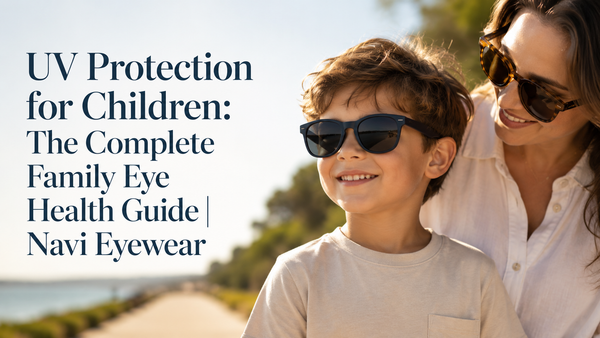

QUICK ANSWERChildren's eyes transmit significantly more UV to the retina than adult eyes — up to 70% more in infants compared to adults. This means cumulative UV damage begins in the first years of life, not adulthood. UV400 polarized sunglasses are appropriate from approximately 6 months of age outdoors, and consistent UV protection through childhood is one of the most impactful investments in long-term eye health a family can make. |
Contents
1. Why Children's Eyes Need More UV Protection Than Adults'
2. UV Exposure by Age Group: Infants, Toddlers, School Age, Teens
3. What to Look For in Children's Sunglasses
4. Age-by-Age Buying Guide
5. Fit, Safety and Frame Considerations
6. Building UV Protection as a Family Habit
7. Common Questions Parents Ask
8. Scenario Table: UV Risk by Activity and Age
9. Frequently Asked Questions
10. Supporting Articles in This Cluster
1. Why Children's Eyes Need More UV Protection Than Adults'
The single most important fact for parents to understand about UV eye protection is this: a child's eye is not a miniature adult eye. It is structurally different in ways that make it significantly more vulnerable to UV radiation — and that vulnerability is greatest in the earliest years of life.
The Crystalline Lens: A Child's Missing UV Filter
In adults, the crystalline lens of the eye has accumulated natural chromophores — light-absorbing molecules — over decades of exposure. These provide a degree of natural UV filtering, blocking a portion of short-wavelength UV before it reaches the retina. In children, particularly infants and young children, this natural filter is not yet developed. Studies published in the Archives of Ophthalmology have found that the infant crystalline lens transmits up to 70% more UV radiation to the retina than an adult lens.
This is not a minor difference. It means that when a 4-year-old and a 40-year-old stand in the same sunlight without eye protection, the child's retina receives substantially more UV radiation. The lens filtering function develops gradually through adolescence, reaching something close to adult levels only in the late teens.
→ UV transmission in the pediatric eye — PubMed
Pupil Size and Light Regulation
Children's pupils are typically larger in diameter than adults' at equivalent light levels, allowing more total light — including UV-adjacent high-energy visible light — into the eye. Combined with the lower lens filtration, this compounds the UV exposure differential between children and adults under identical outdoor conditions.
Cumulative Damage Begins Early
UV damage to the eye is cumulative and largely irreversible. The cataracts, macular degeneration, and pterygium that manifest in adulthood have their roots in the total UV dose accumulated over a lifetime. Research consistently shows that a significant proportion of lifetime UV exposure is received before age 18 — with some estimates suggesting that children and adolescents receive up to 80% of their lifetime UV exposure by the time they reach adulthood, simply because they spend more time outdoors.
This means that UV protection in childhood is not precautionary in a vague sense. It is directly protective of the eye health outcomes the child will experience 30, 40, and 50 years later.
→ Cumulative UV ocular exposure across the lifespan — PubMed
The Public Awareness Gap
Sunscreen has been established as a childhood norm for decades — most parents understand that children need SPF protection on skin. Eye protection has lagged significantly behind. Studies across multiple countries consistently find that children wear sunglasses at far lower rates than adults, and that fewer than half of parents regularly provide UV-protective eyewear for young children outdoors. Closing this awareness gap is one of the highest-impact actions in pediatric preventive eye health.
2. UV Exposure by Age Group: Infants, Toddlers, School Age, Teens
UV risk and sun protection needs evolve across childhood. Each developmental stage has different characteristics in terms of outdoor time, activity type, parental control over compliance, and the level of UV exposure being accumulated.
Infants (0–12 Months)
Infants under 6 months should not be in direct sunlight at all — their skin and eyes are too sensitive for any UV exposure, and the protective mechanisms are undeveloped. When unavoidable outdoor exposure occurs (stroller walks, family activities), physical shade via stroller canopies, wide-brimmed hats, and protective clothing is the primary strategy. Sunglasses for very young infants are technically available but difficult to keep on and generally less practical than shade-first strategies.
From approximately 6 months onwards, when infants can sit with some head control, UV-protective eyewear appropriate for age and fit becomes practical and recommended for direct-sun outdoor time.
Toddlers (1–3 Years)
Toddlers are both highly mobile outdoors and highly resistant to wearing anything on their face. This is the most challenging age for consistent UV protection, and also the age at which the combination of high outdoor time and maximum UV lens vulnerability makes protection most important. Lightweight, flexible frames with secure elastic-strap retention systems are the practical solution — standard temple-arm frames will not stay on a toddler.
Toddlers also spend significant time at ground level, playing in sand and near water — both high-UV-reflectance surfaces that amplify UV exposure. This is precisely the context where polarized lenses provide a protection benefit beyond UV400 certification alone, eliminating the intense reflected glare from playground surfaces, water features, and sandpits.
School Age (4–12 Years)
School-age children spend substantial time outdoors in relatively uncontrolled settings — playground, PE, organized sport, after-school activities. This age group accounts for some of the highest outdoor UV exposure per day of any age group, with typical outdoor times during school recess and after-school activity often exceeding an hour of unprotected midday sun exposure.
Compliance improves significantly in this age group, and proper-fitting UV400 polarized sunglasses are both practical and effective. This is also the age at which sport-specific eyewear becomes relevant — many school-age children participate in organized outdoor sports where UV protection and sports-appropriate frame design should be considered together.
Teenagers (13–18 Years)
The teenage years present a different challenge: physical UV vulnerability is reducing as the crystalline lens matures, but social dynamics mean teenagers are more likely to prioritize style over function, and less likely to wear eyewear a parent selects for them. The positive reframe is that teenagers are old enough to understand and care about UV science when it is presented clearly — the connection between teenage sun exposure and adult cataract and macular degeneration risk is a factual argument that resonates with health-conscious teens.
This is also the age group where sport performance and style intersect productively with UV protection. A polarized amber lens that enhances contrast on the sports field or a stylish pair of gray polarized sunglasses for daily wear serves both functional and social needs simultaneously.
3. What to Look For in Children's Sunglasses
Children's sunglasses are not just smaller versions of adult pairs. The functional requirements differ in important ways, and the market for children's eyewear contains significant variation in quality — particularly in UV certification.
UV400 Certification: Non-Negotiable
The foundational requirement for any children's sunglasses is genuine UV400 certification — blocking 100% of UVA and UVB radiation to 400 nanometers. This is a material property of the lens, independent of lens darkness or brand price point. The critical caveat: UV400 labeling without certification is meaningless, and a significant proportion of inexpensive children's sunglasses fail UV transmission testing despite carrying UV protection claims. For children, whose lenses transmit more UV to the retina than adults, the quality of UV400 certification is more important, not less. Buy from brands that explicitly certify their lenses to UV400 standards rather than those making vague 'UV protection' claims. For the full UV certification guide, see7 signs your sunglasses aren't protecting your eyes.
Polycarbonate Lenses: Impact Resistance for Active Kids
Polycarbonate is the only lens material recommended for children's eyewear. It is approximately 10 times more impact-resistant than standard optical plastic and does not shatter into sharp fragments on impact — a critical safety property for active children. Polycarbonate also provides inherent UV protection independent of any coatings, meaning the UV400 property is structural rather than surface-dependent. Children's sunglasses in glass or standard optical resin are not appropriate.
→ Polycarbonate lens safety standards — FDA
Frame Material: Flexibility and Durability
Children's frames need to survive the physical demands of childhood — dropped on pavement, sat on, thrown in bags, and worn through sport. Flexible frame materials that bend rather than break are specifically important. TR90 nylon — the material in quality adult sport frames — is excellent for children's frames for the same reasons: it maintains flexibility in cold and heat, resists impact without shattering, and holds its shape under repeated stress. Cheap brittle plastic frames that crack or shatter on impact are not appropriate for children.
Fit and Coverage
Children's frames must fit the specific proportions of a child's face — narrower bridges, smaller total width, and different temple length than adult frames. An oversized adult frame on a child's face provides poor UV coverage because the lens alignment relative to the eye is incorrect. Children's frames should sit at the correct eye level with lenses that cover the orbital area without resting on the cheekbones.
Coverage is particularly important for children's UV protection. Frames with a slight wraparound design and deeper lenses provide superior peripheral UV blocking compared to minimal fashion frames. Children spend more time looking at ground-level UV-reflective surfaces than adults, making lower-field lens coverage more important proportionally.
Retention Systems
For children under approximately 5, standard temple-arm retention is insufficient — the frame will fall off or be removed within minutes. Elastic strap or sports-retainer systems that wrap around the back of the head are essential for this age group. For older children participating in sport, retention straps remain valuable. For everyday school-age and teenage wear, standard temple design is generally appropriate.
Polarization: A Meaningful Upgrade for Kids
Polarization is not just a performance feature for adults. Children spend time in high-glare environments — water play, playground sand, car windows, pavement — where reflected horizontal glare is intense. Polarized lenses eliminate this glare, reducing visual fatigue and improving comfort in exactly the outdoor environments where children spend most of their time. For any child spending significant outdoor time, especially near water or in sport contexts, polarized lenses are a meaningful upgrade over non-polarized UV400. Browse theNavi Eyewear polarized collection for UV400 polarized options adults can also model for their children.

NAVI EYEWEAR — POLARIZED UV400 SUNGLASSESBuy 1, Get Any 3 Pairs Free — $119.00 for 4 pairs. Discount auto-applies at cart. Free shipping. Free replacements. 30-day return on unworn pairs. Every Navi lens: UV400 certified polycarbonate · FDA-cleared impact resistance · quality-controlled polarized PVA film · oleophobic coating · anti-saltwater coating · TR90 nylon frames · stainless 5-barrel hinges. |
4. Age-by-Age Buying Guide
|
Age Group |
Frame Type |
Retention |
Lens Priority |
Key Features |
|
0–6 months |
Avoid — use shade |
N/A |
Physical shade |
Stroller canopy, wide-brim hat, tree shade |
|
6–12 months |
Infant UV wrap, very small |
Elastic headband essential |
UV400 polycarbonate |
Lightweight, rubberised nose, flexible frame |
|
1–3 years (Toddler) |
Flexible sport-style, small |
Elastic strap required |
UV400 polycarbonate + polarized |
Unbreakable, washable, TR90 or flexible rubber |
|
4–7 years (Early childhood) |
Kids' sport or lifestyle |
Strap or close-fit temples |
UV400 polycarbonate + polarized |
Polycarbonate lens confirmed, TR90 frame, close fit |
|
8–12 years (School age) |
Kids' lifestyle or sport |
Standard temples or strap for sport |
UV400 + polarized |
Durable, activity-matched style, correct face sizing |
|
13–18 years (Teen) |
Standard adult-style sizing |
Standard temples |
UV400 polarized preferred |
Style-appropriate, sport-matched if athletic |
5. Fit, Safety and Frame Considerations
Sizing for Children's Faces
Children's face proportions differ significantly from adults'. Bridge width, face width, and lens depth all scale down, and frames need to match these proportions for both correct UV coverage and wearing comfort. A rough guide to lens width by age:
These are approximate ranges. Children's face width varies, and the three-number temple arm stamp (lens width – bridge width – temple length) should be checked for any purchase. The lens should cover the full eye area without resting on the cheekbone.
Safety Standards for Children's Eyewear
In the United States, children's sunglasses should meet ANSI Z80.3 optical standards for lens quality. For sport applications, ASTM F803 provides impact resistance standards. Polycarbonate lenses inherently exceed impact resistance requirements for non-sport use; sport-specific eyewear may carry explicit ASTM certification. Check that any children's sunglasses carry an explicit UV400 or 100% UVA/UVB statement, not a vaguer 'UV protection' label.
Toy Sunglasses vs Genuine Eye Protection
A significant market hazard in children's sunglasses is the 'toy sunglass' category — decorative plastic frames and lenses sold as accessories rather than eye protection. These often carry no UV certification, and dark lenses without UV protection are actively harmful: they cause the pupil to dilate while providing no UV blocking, meaning the child's retina receives more UV radiation than if they wore no sunglasses at all. Any children's sunglasses sold as dress-up accessories, fashion accessories, or novelty items should be assumed to lack genuine UV protection unless explicitly certified.
The test is the same as for adult sunglasses: look for explicit UV400 or 100% UVA/UVB language, polycarbonate lens material, and a reputable brand with verifiable certification — not just a dark tint and a decorative character print on the frame.
6. Building UV Protection as a Family Habit
The Modeling Effect
Children learn sun protection behaviors from parental modeling far more effectively than from instruction. Studies in pediatric sun safety consistently find that parental sunscreen and sunglass habits are the strongest predictor of children's own sun protection behaviors. A parent who wears sunglasses consistently outdoors creates a normative expectation; a parent who explains sun protection while not modeling it creates inconsistency that children resolve in favor of the modeled behavior.
The most effective family sun protection strategy is one where adults and children wear UV protection together, as a shared habit, in the same contexts. This is also why having quality adult polarized sunglasses that the parent actually wears consistently is part of the family sun protection equation — not just buying frames for the children.
Making It Routine, Not an Event
The most durable habits are those triggered by context rather than requiring daily decision-making. 'Sunglasses go on with shoes when we leave the house' is a more powerful habit structure than 'remember to put on sunglasses when it's sunny.' The latter requires weather assessment and judgment; the former is automatic. For families with young children, establishing sunglasses as part of the outdoor-preparation routine — same step as shoes, hats, or sunscreen — produces significantly higher compliance than treating it as a situational choice.
Addressing Refusal: Practical Strategies
Many young children resist wearing sunglasses, particularly in the toddler phase. Practical strategies that improve compliance:
School, Sport and Out-of-Home Settings
Children spend substantial outdoor time in school and sport settings that parents do not directly control. Communicating UV protection norms to school-age children clearly — explaining the why, not just the rule — helps them maintain the habit independently. For sport contexts, many organized sports now encourage or require eye protection, and the performance case (polarized lenses reduce glare and improve contrast tracking of balls and players) is increasingly being recognized by coaches and sports organizations.
7. Common Questions Parents Ask
What age can children start wearing sunglasses?
Children can begin wearing UV-protective sunglasses from approximately 6 months old, when they have sufficient head control to make wearing practical. Before 6 months, physical shade is the primary UV strategy for any necessary outdoor time. From 6 months onward, UV400 polycarbonate sunglasses with elastic retention are appropriate and recommended for direct-sun exposure.
Do children need stronger UV protection than adults?
Not 'stronger' in the sense of a different standard — UV400 is the universal benchmark for complete UVA and UVB blocking. But children need UV protection more consistently and across more contexts than adults, because their eyes transmit more UV to the retina, they accumulate UV exposure rapidly due to high outdoor time, and the cumulative lifetime damage model means early exposure is particularly consequential.
Are polarized sunglasses safe for children?
Polarized lenses are entirely safe for children and generally beneficial. Polarization eliminates reflected horizontal glare from surfaces children commonly encounter — water, sand, pavement, playground equipment — reducing visual fatigue and discomfort. There is no contraindication for polarized lenses in any age group. For school-age children and teenagers, polarized UV400 is the recommended standard.
Can wearing dark lenses damage a child's eyes if they don't have UV protection?
Yes — this is the critical safety hazard with uncertified 'toy sunglasses.' Dark lenses without UV400 protection cause pupil dilation (the eye perceives darkness and opens wider) while blocking none of the UV radiation. The result is that the dark lens actually increases UV exposure to the retina compared to no sunglasses at all. Always verify UV400 certification before allowing children to wear any tinted eyewear.
How long do children's sunglasses last before needing replacement?
Lens UV protection properties in quality polycarbonate frames are not meaningfully degraded by normal use — UV400 is a material property, not a coating. However, surface scratches can affect optical clarity, and frame damage can affect fit and coverage. Practically, most children's frames need replacement every 1–2 years due to physical damage, outgrowing the frame size, or lens scratching that affects visibility. Check fit annually as children grow.
8. Scenario Table: UV Risk by Activity, Setting and Age
|
Activity / Setting |
UV Risk Level |
Age Group |
Recommended Lens |
Notes |
|
Beach or poolside play |
Very High |
All ages |
Water reflects UV from below as well as above; polarization eliminates surface glare |
|
|
Playground (midday) |
High |
Toddler–School age |
Sand and concrete reflect UV; shade-seek when possible |
|
|
School sport / PE |
High |
School age–Teen |
60+ min unprotected midday exposure is typical |
|
|
Skiing / snowboarding |
Very High |
All ages |
Snow reflects 80% UV; altitude increases UV by 10–12% per 1,000m |
|
|
Morning/evening outdoor walk |
Moderate |
All ages |
UV is present year-round; lighter lens appropriate for low-angle sun |
|
|
Overcast outdoor play |
Low–Moderate |
All ages |
Clouds transmit 80% of UV; protection still meaningful |
|
|
Car travel |
Moderate |
All ages |
Side windows transmit UVA; prolonged car UV exposure is significant |
|
|
Fishing / water sport |
Very High |
School age–Teen |
Water glare plus UV; copper tint improves sub-surface visibility |

9. Frequently Asked Questions
When should I start putting sunglasses on my child?
From 6 months of age for any outdoor time in direct sunlight. Before 6 months, protect with physical shade — stroller canopy, wide-brim hat, and avoiding direct midday sun. From 6 months onward, UV400 polycarbonate sunglasses with elastic retention are appropriate and beneficial. The key is starting early and making it a consistent habit before it becomes a negotiating point.
What is the safest type of sunglasses for kids?
UV400 certified polycarbonate lenses in flexible, impact-resistant frames — TR90 nylon is the best frame material for active children. Polycarbonate is approximately 10 times more impact-resistant than standard plastic and does not shatter on impact, which is the critical safety property for children. Never use glass lenses for children. Avoid toy or fashion sunglasses with dark lenses but no UV400 certification.
Are cheap children's sunglasses effective?
Only if they have genuine UV400 certification with polycarbonate lenses — and the low end of the market frequently does not. Studies consistently find a significant proportion of cheap children's sunglasses fail UV transmission testing. Dark lenses without UV protection are worse than no sunglasses. Price alone is not a reliable guide; explicit UV400 certification and polycarbonate lens material are. Many mid-range children's eyewear brands provide genuine UV400 polycarbonate protection at accessible prices — buy based on certification, not tint darkness.
How do I get my toddler to keep sunglasses on?
Elastic strap retention is the practical foundation — a toddler cannot remove a properly fitted elastic-strap sunglass as easily as a temple-arm pair. Beyond the physical design: involve the child in color/style choices when possible, frame it as 'everyone wears these outside,' model consistent adult wearing, start with short outdoor periods, and don't fight it if they refuse — use shade strategies for that outing and try again. Most toddlers normalize sunglasses wearing within a few weeks of consistent exposure to the routine.
Can my child wear the same sunglasses for driving?
For teenagers who drive: yes, if the sunglasses are UV400 polarized with gray or amber tint — both safe for daytime driving. Never use Cat 4 lenses for driving (too dark); never use yellow-tinted lenses at night (not shown to help night driving). Gray polarized is the standard driving recommendation for any age. For the complete driving sunglasses guide, seebest sunglasses for driving.
Do children need different lens tints than adults?
The same tint logic applies to children as adults, scaled to their activities. Gray polarized is the all-round everyday tint — color-neutral and appropriate for most situations. Amber or brown polarized enhances contrast for outdoor sport and is excellent for school-age children in active outdoor settings. Copper polarized is the specialist choice for fishing and water activities at any age. Avoid very dark tints (Cat 4) for general use — they're designed for extreme UV conditions like alpine glaciers and are unnecessarily dark for everyday childhood activities.
How do I know if children's sunglasses actually block UV?
Look for explicit UV400 or '100% UVA and UVB protection' language on the frame or packaging — not just 'UV protection' which is a vague and unverified claim. Check that the lens material is stated as polycarbonate. Buy from brands with verifiable certifications rather than unbranded or novelty products. When in doubt, a basic UV transmission tester (available cheaply online) can verify whether a pair blocks UV400 wavelengths.
Are wraparound sunglasses better for children?
For active use and high UV environments — beach, skiing, water sport — yes. Wraparound designs provide superior peripheral coverage from sides and below, which matters particularly in environments where UV reflects from all angles. For everyday use, a standard frame with good lens coverage is sufficient if it fits well. The most important factor is that the frame sits at the correct height covering the full eye, with no gap between the top of the lens and the brow.
Should children wear sunglasses year-round?
Yes. UV radiation is present year-round, including in winter and on overcast days. Clouds transmit approximately 80% of UV, and snow reflects up to 80% of UV back toward the face — making winter and snowy environments among the highest UV exposure contexts for children. The sun protection habit should be identical in December as in July: sunglasses on for outdoor time.
How do I get teenagers to wear sunglasses consistently?
The style argument is more effective than the health argument for most teenagers. Quality polarized sunglasses that match their style identity and activity context — sport performance, fashion streetwear, casual lifestyle — are more likely to be worn consistently than frames a parent selected for UV properties alone. The performance case also resonates: polarized lenses reduce glare fatigue during sport, improve contrast and object tracking, and reduce squinting. Once teenagers experience the visual comfort difference of quality polarized lenses, consistent wearing tends to follow naturally.
Supporting Articles
→ Best Sunglasses for Kids by Age: Infant to Teen | Navi Eyewear
→ Teaching Kids to Wear Sunglasses: The Parent's Practical Guide | Navi Eyewear
→ Sunglasses for Teens: Style, Sports and UV Reality | Navi Eyewear
→ Baby and Toddler Sunglasses: What Actually Works | Navi Eyewear
→ Sunglasses as a Family Habit: Building Year-Round UV Protection | Navi Eyewear
Protect Your Family's Eyes — Starting TodayNavi Eyewear UV400 polarized sunglasses: Buy 1, Get Any 3 Pairs Free for $119.00. Four pairs of certified UV400 polarized protection — for every member of the family who needs them. |
Sources & Citations[1] Sliney DH."Ocular exposure to environmental light and ultraviolet — the impact of spectacles and sunglasses."Journal of AAPOS, 2014.View source → [2] Coroneo MT, et al.."The crystalline lens, UV radiation and cataract formation in children."Archives of Ophthalmology, 2002.View source → [3] Taylor HR, et al.."Effect of ultraviolet radiation on cataract formation."New England Journal of Medicine, 1988.View source → [4] West SK, et al.."Exposure to sunlight and other risk factors for age-related macular degeneration."Archives of Ophthalmology, 1989.View source → [5] Dain SJ."Sunglasses and sunglass standards."Clinical and Experimental Optometry, 2003.View source → [6] Rosenthal FS, et al.."The effect of sunglasses on ocular exposure to ultraviolet radiation."American Journal of Public Health, 1988.View source → [7] American Academy of Ophthalmology."Kids and sunglasses — UV protection for children."AAO EyeSmart, 2023.View source → [8] WHO."Global solar UV index: a practical guide."World Health Organization, 2002.View source → |