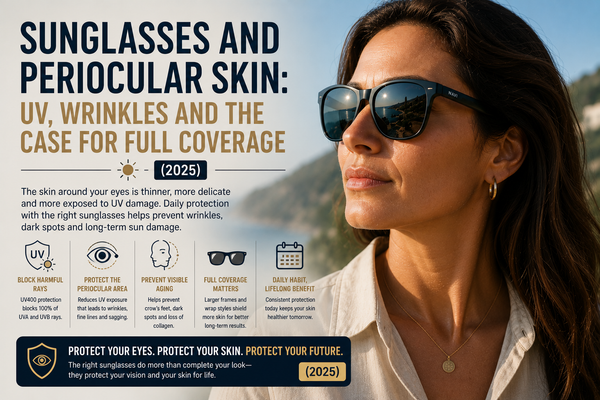

Sunglasses and Periocular Skin: UV, Wrinkles and the Case for Full Coverage
The skin around the eyes is not the same as the skin on your cheek or forehead. It is the thinnest skin on the face — as thin as 0.5mm in the eyelid, compared to 2mm on the cheek. It has fewer sebaceous glands, less supporting dermis, and less structural collagen than other facial skin areas. It is also, by the nature of sunglass geometry, the zone of the face most likely to receive UV that has scattered around the edges of an inadequately sized sunglass frame.
The result: the periocular area — the eyelids, crow’s feet zone, under-eye skin, and lateral orbital rim — ages faster with UV exposure than most other facial skin zones, and carries a disproportionate risk of UV-induced skin cancers. The case for adequate sunglass frame coverage is not only about the eyes inside the frame; it is about the periocular skin around it.
This is the final C22 Anti-Aging & Longevity supporting post and the final post of Phase 3. It links back to the cluster pillar atsunglasses, anti-aging and longevity: the complete eye health guide.
Quick Answer
Periocular skin — eyelids, crow’s feet zone, under-eye area, and lateral orbital rim — is the thinnest skin on the face and among the most UV-sensitive. UV exposure causes photoaging (collagen loss, wrinkling, laxity) and photocarcinogenesis (disproportionately high rates of basal cell carcinoma and squamous cell carcinoma around the eyelids). Sunglasses with adequate frame coverage reduce the UV dose to this zone. Wraparound and wide-frame geometries provide the most coverage. SPF sunscreen applied carefully to the periocular skin — without entering the eye — is the complementary protective measure for uncovered periocular skin zones.

Table of Contents
Part 1: Periocular Skin — What Makes It Different
The skin of the periocular zone has structural characteristics that make it both more UV-sensitive and more visibly age-affected by UV than most other facial skin:
Part 2: UV Photoaging of Periocular Skin
UV-induced skin aging (photoaging) is distinct from chronological aging in its mechanisms and appearance. Chronological aging produces fine skin laxity from gradual collagen and elastin loss. Photoaging produces more dramatic structural changes: deep wrinkling, irregular pigmentation, skin thickening followed by thinning, and loss of the even texture of young skin.
In the periocular zone, photoaging is particularly visible because the baseline skin is already thin, already mobile, and already under mechanical stress from blinking and facial expression. UV exposure accelerates the photoaging process that produces the crow’s feet, eyelid crepe texture, and lateral orbital wrinkling that are among the most visible signs of facial aging.
The UV that drives periocular photoaging comes from three directions:
Part 3: The Collagen and Elastin Mechanism
The structural integrity of periocular skin — its ability to resist wrinkling and maintain smooth texture — depends on the collagen and elastin network in the dermis. UV radiation damages this network through two primary mechanisms:
Collagen Photodegradation
UVB radiation directly damages collagen fibers and activates matrix metalloproteinases (MMPs) — enzymes that degrade the collagen matrix. Chronic UV exposure creates a deficit: MMPs degrade existing collagen faster than fibroblasts can synthesize new collagen. The net result is progressive collagen depletion in the dermis. In thin periocular skin with its limited starting collagen reserve, this deficit becomes visibly apparent as wrinkling earlier than in thicker facial skin zones.
Elastin Degradation and Solar Elastosis
UVA radiation (315–400nm) penetrates deeper into the dermis than UVB, reaching the elastin fibers that provide the skin’s springback property. Chronic UVA exposure produces solar elastosis — the accumulation of degraded, dysfunctional elastin that gives chronically sun-exposed skin its characteristic thickened, yellow, leathery texture. In periocular skin, elastin damage produces the loss of lid tightness and orbital skin recoil that is visible as skin laxity around the eyes.
Both UVB and UVA are blocked by UV400 polycarbonate lenses. The reduction in UV dose to the periocular skin from adequate sunglass frame coverage directly reduces the rate of both MMP-driven collagen degradation and UVA-driven elastin damage in this zone.
Part 4: UV and Crow’s Feet — Why the Outer Canthus Ages First
The crow’s feet zone — the lateral orbital area extending from the outer corner of the eye across the temporal cheek — is typically the first periocular zone to show visible photoaging for several converging reasons:
Sunglasses specifically reduce crow’s feet UV exposure in two ways: the lens and frame block direct UV from entering the lateral orbital zone, and the reduction in glare eliminates the squinting that mechanically stresses the already-UV-challenged skin. Adequate frame width is required for both benefits.
Part 5: Periocular Skin Cancer — A Disproportionate Risk Zone
The periocular area accounts for approximately 5–10% of all skin surface area on the face but accounts for a disproportionately high proportion of facial skin cancers — estimated at 5–10% of all skin cancers occurring on the face. The eyelid in particular is a common site for basal cell carcinoma (BCC), which is the most common skin cancer in the US.
The reasons for this disproportionate cancer risk:
Part 6: Basal Cell Carcinoma and the Eyelid
Basal cell carcinoma is the most common skin cancer in the United States, with approximately 3.6 million diagnoses annually. The eyelid is one of the most common BCC sites on the face, with the lower eyelid and medial canthal area (inner corner of the eye) being the most frequently affected zones.
Eyelid BCC presents particular treatment challenges because of its proximity to the eye structure. Surgical excision (Mohs micrographic surgery is the preferred technique for eyelid BCC) must achieve complete margin clearance while minimizing functional damage to the eyelid’s role in protecting and lubricating the eye. Complex eyelid reconstructions may be required for larger tumors. The periocular location makes eyelid BCC more clinically significant than equivalently-sized BCC at other body sites.
UV400 sunglasses with adequate frame coverage reduce the UV dose to the lower eyelid, medial canthal area, and lateral orbital rim — the primary BCC risk zones — from the overhead and lateral UV sources that standard facial sunscreen application often misses.
Part 7: Squamous Cell Carcinoma Around the Eye
Squamous cell carcinoma (SCC) is the second most common skin cancer in the US, with approximately 1 million diagnoses annually. SCC of the eyelid and periocular skin, though less common than BCC in this zone, carries a higher risk of perineural invasion (spread along nerve pathways) and regional metastasis than BCC.
SCC is more strongly correlated with cumulative UV exposure than BCC, making it a disease that reflects lifetime UV burden in a direct way. The periocular skin’s high cumulative UV exposure — from multi-directional UV plus the chronic underprotection of this zone by sunscreen — creates a cumulative UV dose environment that reflects in the SCC incidence at this anatomical location.
Regular dermatological examination of the periocular area is appropriate for individuals with high lifetime UV exposure, personal history of skin cancer, or immunosuppression. UV400 sunglass coverage, combined with careful SPF application to the periocular zone, reduces the UV burden that contributes to SCC risk at this site.
Part 8: How Sunglass Frames Affect Periocular UV Dose
Not all sunglass frames provide equivalent periocular UV protection. The UV dose reduction to periocular skin depends on how much of the periocular zone the frame and lens cover. Several frame design factors determine this:
✨ NAVI EYEWEAR — UV400 COVERAGE FOR THE EYE AND THE SKIN AROUND IT.UV400 polycarbonate. Polarized. Adequate frame coverage for periocular zone protection. The sunglass habit that protects not just the eye but the skin around it from UV aging and cancer risk. Buy 1, Get Any 3 Pairs Free — $119 for four pairs (~$30 each). Free shipping. Free replacements. |
Part 9: The Geometry of Frame Coverage
|
Periocular Zone |
Primary UV Source |
Sunglass Frame Protection |
Supplemental Protection Needed |
|
Upper eyelid |
Overhead UV; brow gap scatter |
Frames with upper lens edge near brow |
SPF on brow-proximal skin; hat brim |
|
Lower eyelid |
Overhead UV; reflected UV from below |
Larger lens extending toward cheek |
SPF on lower eyelid (carefully, avoiding eye) |
|
Medial canthus (inner corner) |
Scattered ambient UV; nasal bridge gap |
Frame design affects nasal gap coverage |
SPF for medial canthal area |
|
Lateral orbital (crow’s feet) |
Direct lateral UV; temporal gap scatter |
Wraparound frames; wider temporal coverage |
SPF on crow’s feet zone |
|
Under-eye / upper cheek |
Reflected UV from below; overhead |
Lower lens edge coverage extent |
SPF on upper cheek and under-eye |
|
Brow zone |
Overhead UV |
Limited sunglass coverage |
Hat brim; SPF on brow |
Part 10: Wraparound Frames and Lateral Coverage
The crow’s feet zone and lateral orbital area are the periocular zones most poorly protected by standard sunglass frames. Standard non-wraparound frames have an open temporal side that leaves the lateral orbital rim, crow’s feet skin, and temporal cheek exposed to UV from the side.
Wraparound frame geometry — where the lens curves around the temporal side of the face to reduce the gap between lens edge and face — addresses this gap.
The wraparound design provides:
For outdoor activities with significant lateral UV exposure — cycling, running, hiking, skiing — wraparound UV400 frames provide both ocular and periocular skin protection advantages over standard open-frame geometries.
Part 11: SPF as the Complementary Periocular Protection
Sunglasses cannot cover every periocular skin zone. The medial canthal area, the zone between the upper frame edge and the brow, and the outer corners that even wraparound frames leave partially exposed all represent periocular skin zones that benefit from SPF sunscreen in addition to sunglass coverage.
SPF application to the periocular zone requires care because the ocular surface is sensitive to sunscreen ingredients, particularly chemical UV filters. Practical approaches:
The complete periocular protection stack: UV400 sunglass coverage + careful periocular SPF + hat brim for superior zone. These three elements together address the full periocular UV exposure geometry that sunglasses alone do not completely cover.
Part 12: The Anti-Aging Skin Case for UV400 Sunglasses
The anti-aging skin argument for UV400 sunglasses is distinct from the ocular health argument but equally compelling:
The aging prevention case for consistent UV400 use is developed more fully inprotecting your eyes from aging: the UV prevention guide.
Part 13: Comparison Table — Periocular UV Protection Methods
|
Protection Method |
Periocular Zones Covered |
UV Type Blocked |
Practical Considerations |
|
UV400 sunglass lenses |
Zones within the lens area |
UV-A and UV-B (all below 400nm) |
Most consistently applied; daily outdoor use; does not cover all periocular zones |
|
Wraparound UV400 frames |
Lens zone + improved lateral coverage |
UV-A and UV-B |
Better crow’s feet coverage than standard frames; useful for outdoor sport |
|
Standard non-wraparound frames |
Lens zone only |
UV-A and UV-B |
Leaves crow’s feet and lateral orbital zone exposed to lateral UV |
|
Mineral SPF sunscreen (periocular) |
Applied areas only |
UV-A and UV-B |
Covers zones sunglasses miss; requires careful application near eye; must be reapplied |
|
Hat brim (wide) |
Superior periocular (brow/upper orbital) |
UV-A and UV-B (overhead) |
Best for overhead UV reduction to brow zone; does not cover lateral or reflected UV |
|
Standard chemical SPF (periocular) |
Applied areas only |
UV-A and UV-B |
Higher ocular irritation risk than mineral; effective where tolerated |
|
No protection |
None |
None blocked |
Full periocular UV accumulation; highest photoaging and cancer risk |
Part 14: Best For
UV400 Wraparound Frames — Best For:
Standard UV400 Frames with Adequate Lens Size — Best For:
UV400 Sunglass + Mineral SPF + Hat Brim — Best For:
Part 15: Common Mistakes
Bottom Line
Periocular skin is the most UV-vulnerable zone of the face — the thinnest, the most mobile, and the most chronically underprotected by sunscreen. UV photoaging of this zone produces the crow’s feet, eyelid laxity, and under-eye skin quality changes that are among the most visible signs of facial aging. UV-driven carcinogenesis in the periocular zone, particularly BCC of the lower eyelid and medial canthal area, produces a disproportionately high skin cancer burden given the small skin surface area involved.
UV400 sunglasses with adequate frame coverage — broad lens size, close-fit frame, wraparound geometry for outdoor sport — reduce the UV dose to the periocular zone from above, from below in reflection environments, and from the lateral directions that standard frames leave exposed. The periocular skin protection case for sunglasses exists alongside and complementing the ocular protection case, and it provides an additional dimension of anti-aging and cancer prevention value to the UV400 daily outdoor habit.
The complete periocular protection: UV400 sunglass coverage + careful mineral SPF application to periocular gaps + hat brim for superior shading. All three are relevant. UV400 sunglasses are the most consistently applicable daily tool of the three.
Browse UV400 polarized options atnavieyewear.com/collections/polarized. Add 4 pairs — Buy 1, Get Any 3 Free auto-applies. Free shipping. Free replacements.

Frequently Asked Questions
Do sunglasses help prevent wrinkles around the eyes?
Yes, through two mechanisms. First, UV400 lens coverage reduces the UV dose to periocular skin in the orbital zone covered by the lens, slowing UV-driven collagen degradation and elastin damage that produce photoaging wrinkles. Second, the glare elimination from polarized lenses reduces squinting — the repeated orbicularis oculi muscle contractions from squinting in bright sun are a significant mechanical driver of crow’s feet formation on already UV-challenged thin periocular skin.
What type of sunglass frame provides the best periocular skin protection?
Frames with larger lens size, closer face fit, and wraparound temporal coverage provide the most periocular skin UV protection. Wraparound frames specifically reduce lateral UV entry into the crow’s feet and lateral orbital zone. For outdoor sport and high-UV activity, wraparound UV400 frames are optimal for both periocular skin and ocular protection. For urban daily use, frames with adequate lens size and close fit provide good orbital zone coverage.
Can I apply sunscreen around my eyes for periocular protection?
Yes, with appropriate product selection and technique. Mineral sunscreens (zinc oxide, titanium dioxide) are the preferred option for periocular application because they have lower ocular irritation risk than chemical UV filters. Apply to the orbital rim, crow’s feet zone, and under-eye area, stopping approximately 5mm from the lash line. Products specifically formulated for periocular use (eye-area SPF sticks) are available from dermatology brands and are the safest approach for close-to-eye application.
Is the skin around the eyes more prone to skin cancer?
Yes. The periocular area accounts for approximately 5–10% of all facial skin cancers despite representing a small proportion of facial skin surface. The lower eyelid and medial canthal area are common basal cell carcinoma sites. Eyelid BCC is treated with particular care (Mohs surgery preferred) because of its proximity to the eye structure. The cumulative UV from multiple directions, combined with chronic under-protection by sunscreen, explains this disproportionate skin cancer burden.
Do crow’s feet come from squinting or from UV?
Both, and they are compounding. Repeated orbicularis oculi muscle contraction from squinting creates the mechanical crease lines in the crow’s feet zone. UV photoaging degrades the collagen and elastin in this already-thin skin, reducing its ability to spring back from these repeated mechanical stresses. UV-protected periocular skin maintains better elasticity and collagen density, making it more resilient to the mechanical stress of expression. Sunglasses address both: UV400 blocking reduces the photoaging, and glare elimination reduces the squinting.
How does UV reach the periocular area if I’m wearing sunglasses?
UV reaches periocular skin from the gaps around the sunglass frame: above the upper frame edge toward the brow, below the lower lens edge toward the cheek, from the medial gap at the nose bridge, and particularly from the temporal/lateral gap to the crow’s feet zone. In non-wraparound frames this lateral gap is entirely open. Reflected UV from below (from snow, sand, water, concrete) also enters the periocular zone from underneath the frame, reaching the lower eyelid and under-eye skin at angles that the lens does not cover.
Does wearing sunglasses slow down eyelid aging?
UV400 sunglass coverage of the eyelid zone reduces the UV contribution to eyelid photoaging — the collagen degradation and elastin damage that produce eyelid laxity, crepey texture, and wrinkling. The reduction in UV dose, combined with reduced squinting from glare, addresses two of the modifiable drivers of eyelid skin aging. The rate of aging slowdown depends on how much of the eyelid zone the frame covers and how consistently the sunglasses are worn.
Should I see a dermatologist about periocular skin changes?
Any persistent, slow-growing, non-healing lesion on the eyelid margin or periocular skin warrants dermatological or ophthalmological evaluation. Loss of eyelid lashes from a focal area, irregular pigmentation at the lid margin, or a pearly or ulcerated lesion in the periocular zone are signs that warrant prompt evaluation for eyelid BCC or other periocular skin malignancy. Annual full-body skin examination by a dermatologist is appropriate for individuals with high lifetime UV exposure, multiple sunburns, or personal/family history of skin cancer.
Supporting Articles
UV400 COVERAGE. FOR THE EYE AND THE SKIN AROUND IT.UV400 polycarbonate. Polarized. Adequate frame coverage for periocular UV protection. Reduces crow’s feet UV photoaging. Eliminates squinting from glare. Reduces periocular skin cancer UV burden. Buy 1, Get Any 3 Pairs Free — $119 for four pairs. Free shipping. Free replacements. |
SOURCES & CITATIONS[1] Situm M, Buljan M, Cavka V, et al..“Skin changes in the elderly people — how strong is the influence of the UV radiation on skin aging?.”Collegium Antropologicum, 2010.View source [2] Brenner M, Hearing VJ.“The protective role of melanin against UV damage in human skin.”Photochemistry and Photobiology, 2008.View source [3] Cook BE Jr, Bartley GB.“Treatment options and future prospects for the management of eyelid malignancies.”Ophthalmology, 2001.View source [4] Rosenthal FS, Bakalian AE, Lou CQ, Taylor HR.“The effect of sunglasses on ocular exposure to ultraviolet radiation.”American Journal of Public Health, 1988.View source [5] Sliney DH.“UV radiation ocular exposure dosimetry.”Documenta Ophthalmologica, 1994.View source [6] American Academy of Ophthalmology.“Sunglasses: choosing the right pair for UV protection.”AAO EyeSmart, 2023.View source |