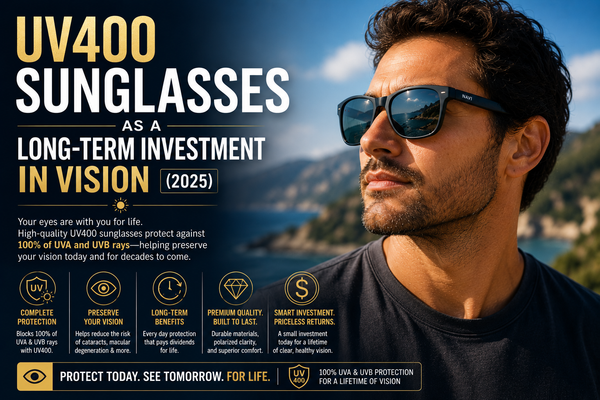

UV400 Sunglasses as a Long-Term Investment in Vision
Most sunglass purchases are framed as fashion decisions or short-term comfort choices. The $30 pair that reduces glare on a beach day. The $400 pair that matches the outfit. Neither framing captures what UV400 sunglasses actually are when viewed over a 40-year horizon: a medical prevention tool with a documented return on investment measurable in avoided surgeries, avoided injections, and decades of clearer functional vision.
This guide makes the investment case explicitly. It compares the cost of UV400 protection over a lifetime against the cost of the conditions that UV protection may delay or reduce risk for. It is not a guarantee that wearing sunglasses prevents eye disease — it is not. It is an analysis of what the research says about UV’s contribution to the most common age-related eye conditions, what the treatment cost of those conditions is in the US, and what the cost of consistent lifetime UV400 protection amounts to by comparison.
This is a C22 Anti-Aging & Longevity supporting post. It links back to the cluster pillar atsunglasses, anti-aging and longevity: the complete eye health guide.
Quick Answer
Cataract surgery costs $3,500–6,000 per eye out of pocket or $600–1,200 with Medicare. Anti-VEGF injections for wet AMD cost approximately $1,800–2,200 per injection, typically administered every 4–8 weeks, often for life. Consistent UV400 protection over 40 years starting at age 25 costs approximately $300–$600 in total sunglass expenditure at the Navi price point. The conditions being prevented are not fully preventable with sunglasses, but the UV-attributable fraction of cataracts (WHO: approximately 20%) and the documented UV contribution to AMD risk make UV400 sunglasses one of the highest return-per-dollar preventive health investments available.

Table of Contents
Part 1: The Investment Framework
Health investments can be evaluated on the same terms as financial investments: cost of the intervention versus expected value of the outcome avoided. The expected value calculation for a preventive health measure requires: the cost of the condition being prevented, the probability that the prevention actually reduces the condition’s occurrence or severity, and the cost of the preventive measure itself.
For UV400 sunglasses and age-related eye disease, the calculation has clear inputs:
Part 2: What UV400 Sunglasses Cost Over a Lifetime
The Navi pricing model: Buy 1, Get Any 3 Pairs Free for $119 — four pairs at approximately $30 each. Free replacements. Free shipping.
Lifetime cost model:assume one purchase of four pairs every two years for 40 years (age 25 to 65). That is 20 purchases at $119 each = $2,380 over 40 years, or approximately $60 per year. At one purchase per year (more conservative — one set of four every year): $119 per year, approximately $4,760 over 40 years.
Even at the more conservative annual purchase model, $119/year for UV400 protection across all outdoor daily life — commuting, recreation, sport, travel — is an exceptional cost-per-year for a medical prevention measure. The $60/year model for the two-year replacement cycle produces a lifetime prevention cost that most Americans spend on a single dinner out.
Part 3: What Cataracts Cost
Cataract surgery (phacoemulsification with intraocular lens implantation) is the most commonly performed surgical procedure in the United States, with approximately 4 million procedures annually.
Out-of-Pocket Cost Without Insurance
The out-of-pocket cost for standard cataract surgery with a monofocal IOL (covered by Medicare) ranges from approximately $3,500 to $6,000 per eye when performed without insurance. This range reflects geographic variation, surgeon fee, facility fee, and anesthesia. Bilateral cataract surgery (both eyes, typically performed in sequential procedures) therefore costs $7,000–12,000 total out of pocket for patients without insurance.
Cost With Medicare Coverage
Medicare Part B covers standard cataract surgery and a basic monofocal IOL. Patient responsibility (20% after deductible with Medicare) is approximately $600–1,200 per eye, or $1,200–2,400 for bilateral surgery, without supplemental insurance. Premium IOLs (multifocal, extended depth of focus, toric for astigmatism) are not covered by Medicare and add $1,500–3,000 per eye out of pocket.
Indirect Costs
The financial cost of the surgery is only part of the cataract burden. The period of progressive visual impairment before surgery — during which reading, driving, and precision visual tasks become impaired — has its own quality of life and potential economic cost. Driving restriction from cataract-impaired vision may affect employment for some patients. Fall risk increases with impaired vision in older adults.
Part 4: What AMD Costs
AMD treatment costs, particularly for the wet (neovascular) form requiring anti-VEGF injections, are among the highest of any outpatient chronic disease treatment in ophthalmology.
Anti-VEGF Injection Costs
The anti-VEGF agents used for wet AMD treatment include ranibizumab (Lucentis), aflibercept (Eylea), bevacizumab (Avastin, off-label), and faricimab (Vabysmo). Drug costs per injection:
Annual Treatment Burden
Anti-VEGF treatment for wet AMD is typically administered monthly for the first 3–6 months (loading doses), then every 4–8 weeks as needed. A first-year treatment course with a branded agent at monthly dosing: 12 injections at $1,900 average = approximately $22,800 at list price. With Medicare coverage, patient responsibility is 20% after deductible: approximately $4,600 in the first year.
Critically, wet AMD treatment is typically lifelong. Discontinuation leads to recurrence of neovascularization and rapid vision loss. A patient starting anti-VEGF treatment at age 70 who lives to 85 accumulates 15 years of treatment. Even at reduced dosing frequency (every 8 weeks), this represents 90–120 injections over the treatment course.
Geographic Atrophy (Dry AMD)
Geographic atrophy treatment options are in early clinical deployment. Complement inhibitors (pegcetacoplan/Syfovre, avacincaptad pegol/Izervay) were approved by the FDA in 2023 for geographic atrophy. These drugs also require intravitreal injection, with list prices in the $2,000–2,500 range per injection and monthly dosing. Their long-term treatment cost burden is comparable to wet AMD treatment.

Part 5: The UV Attributable Fraction — What Prevention Is Worth
The investment case for UV400 protection depends not just on the cost of the condition being prevented but on the probability that UV protection actually reduces occurrence. This is where the attributable fraction concept is useful:
These are expected value calculations across a population, not guarantees for individuals. Not everyone who goes without UV400 protection develops UV-attributable cataracts or AMD. Not everyone who wears UV400 protection avoids them. But the population-level expected value of reducing the UV-attributable fraction of these conditions, compared against the cost of the protective measure, produces a clear positive expected return.
Part 6: The Compounding Effect of Starting Early
The financial investment analogy extends to the compounding effect of early action. A 25-year-old who establishes UV400 outdoor use today gains 40 years of cumulative UV dose reduction before the age (65–70) when cataracts and AMD become clinically relevant. A 50-year-old who starts today gains 15–20 years of dose reduction.
The compounding is not financial — it is biological. Each year of UV400 protection is a year of reduced UV-driven crystallin protein oxidation, reduced RPE lipofuscin accumulation, and reduced drusen deposition. These processes are cumulative and irreversible. Early protection prevents early accumulation that cannot be reversed later.
The expected value of UV400 protection is therefore highest when started young and maintained consistently. The 25-year-old’s expected return from UV400 protection is far higher than the 50-year-old’s because they have more years of prevented accumulation ahead of them and because the UV accumulated in the 25–50 period is the most consequential for lifetime cataract and AMD risk.
✨ NAVI EYEWEAR — $30 PER PAIR. DECADES OF RETURN.UV400 polycarbonate. Polarized. The preventive health measure with the clearest cost-to-benefit ratio in ophthalmology. $119 for four pairs — ~$30 each. Free shipping. Free replacements included. Buy 1, Get Any 3 Pairs Free — $119 for four pairs. Free shipping. Free replacements. |
Part 7: The Quality of Life Dimension
The financial cost comparison understates the full value of UV400 protection because it does not capture the quality of life value of preserved vision. Functional vision in the 60s, 70s, and 80s is central to:
The dollar value of preserving these functions is not easily quantified, but the health economics literature on vision-related quality of life consistently finds that vision loss has among the highest quality-adjusted life year (QALY) impacts of any chronic disease — higher than many conditions that receive more attention and health spending.
Part 8: How This Compares to Other Preventive Health Investments
|
Preventive Measure |
Annual Cost |
Primary Condition Prevented |
Evidence Strength |
|
UV400 polarized sunglasses (Navi) |
~$60–$119/year |
Cortical cataract; AMD risk reduction; pterygium |
Moderate–strong (UV-cataract dose-response established) |
|
Sunscreen SPF 30+ daily |
~$50–$150/year |
Skin cancer; photoaging |
Strong (skin cancer prevention well-established) |
|
Statin therapy (generic) |
~$50–$200/year |
Cardiovascular disease; stroke |
Very strong (multiple large RCTs) |
|
Daily aspirin (prior recommendation, now revised) |
~$10–$30/year |
Previously: cardiovascular event reduction |
Revised — no longer routinely recommended for primary prevention |
|
Colonoscopy (preventive) |
~$100–$200/year (amortized over 10-year interval) |
Colorectal cancer |
Very strong (polyp removal prevents cancer progression) |
|
Annual flu vaccination |
~$0–$50/year (often covered) |
Influenza; associated cardiovascular events |
Strong |
|
AREDS2 supplements (intermediate AMD) |
~$300–$600/year |
AMD progression |
Strong (AREDS2 RCT) |
UV400 sunglasses compare favorably in cost to most preventive health measures that Americans routinely use. At $60–$119/year for daily UV400 outdoor protection, they are among the least expensive preventive health tools with a meaningful documented return in a common and costly age-related disease category.
Part 9: The Non-Financial Cost of Vision Loss
The economic framing of the UV400 investment case is useful but incomplete. The full case rests on something that does not reduce to dollars: the experience of losing functional vision in your 60s, 70s, and 80s versus maintaining it.
Cataract-impaired vision progressively dims and blurs the visual world over months and years before surgery becomes available and indicated. During that period, reading becomes difficult, night driving becomes unsafe, and the visual confidence to engage in normal daily activities declines. Cataract surgery restores function, but the period of impairment has its own cost in daily experience.
AMD’s central scotoma — when advanced — means that the face of the person you are speaking with disappears. The center of the book page you are trying to read is blank. The traffic signal ahead is in the peripheral zone that AMD tends to spare, but the license plate, pedestrian’s face, and signage that require central vision are gone. This is not a financial cost. It is a cost in lived experience that cannot be repaired by any surgery available today for geographic atrophy.
The investment case for UV400 protection rests as much on this non-financial dimension as on the financial comparison. Forty years of UV400 outdoor use to protect the vision used to read, drive, recognize faces, and engage with the world for the decades after 65 is not primarily a financial calculation. It is a calculation about what the next few decades of life look like.
Part 10: What UV400 Sunglasses Cannot Prevent
Precise claims require precise limits. UV400 sunglasses do not:
Part 11: The Complete Prevention Stack
The highest-return eye health investment is not a single tool — it is a combination of evidence-based behaviors that address different mechanisms:
UV400 sunglasses are the most cost-effective, most universally accessible, and most daily-actionable element of this stack. Every outdoor day is an opportunity to apply the intervention. The cost per day at the Navi price point is approximately $0.16 at the $60/year model.
Part 12: Comparison Table — Cost of Prevention vs Treatment
|
Scenario |
Cost |
Who Bears It |
Notes |
|
UV400 polarized sunglasses — 40 years |
$2,400–$4,760 total |
Individual (out of pocket) |
All outdoor UV protection for adult life; ~$60–$120/year |
|
Cataract surgery — bilateral, no insurance |
$7,000–12,000 |
Individual + insurer |
Most common US surgical procedure; effective but avoidable in UV fraction |
|
Cataract surgery — bilateral, Medicare |
$1,200–2,400 patient share |
Individual (20% after deductible) |
Premium IOL adds $1,500–3,000/eye not covered by Medicare |
|
Wet AMD anti-VEGF — first year (branded) |
~$22,800 list; ~$4,600 Medicare patient share |
Individual + insurer |
Monthly injection; lifelong treatment for most patients |
|
Wet AMD anti-VEGF — 10-year treatment |
~$100,000+ list; ~$20,000+ patient share |
Individual + insurer |
Off-label bevacizumab significantly reduces cost |
|
Geographic atrophy complement inhibitor — annual |
~$24,000–$30,000 list |
Individual + insurer |
New 2023 approvals; monthly injection required |
Part 13: Common Mistakes
Bottom Line
The investment case for UV400 sunglasses as a lifetime eye health measure is strong by any reasonable framework. The cost of consistent protection over 40 years is measured in hundreds of dollars. The cost of the conditions it partially prevents is measured in thousands to tens of thousands of dollars per event. The UV-attributable fraction of those conditions — the part that UV400 protection directly addresses — is real and documented in the epidemiological literature.
The non-financial return — functional central vision for reading, driving, and engaging with the world in the decades after 65 — is the part of the case that matters most and cannot be fully captured in cost-comparison tables. UV400 polarized sunglasses worn every outdoor day from as early as possible is the preventive eye health measure with the best cost-per-year-of-protection ratio of any available intervention. At $30 per pair with free replacements, the barrier to entry is lower than any comparable medical prevention tool.
Browse UV400 polarized options atnavieyewear.com/collections/polarized. Add 4 pairs — Buy 1, Get Any 3 Free auto-applies. Free shipping. Free replacements.
Frequently Asked Questions
Are UV400 sunglasses worth the cost for long-term eye health?
Yes, by a significant margin. The cost of consistent UV400 protection over 40 years at the Navi price point ($30/pair) is approximately $60–$120/year. The conditions it reduces risk for — UV-attributable cortical cataract and AMD — cost thousands to tens of thousands of dollars per event in treatment. The WHO estimates 20% of cataracts are UV-attributable, making UV400 protection one of the most cost-effective preventive eye health investments available.
How much does cataract surgery cost in the United States?
Standard cataract surgery with a basic monofocal IOL costs approximately $3,500–6,000 per eye without insurance. With Medicare coverage, patient responsibility is approximately $600–1,200 per eye (20% after deductible). Premium IOLs for additional vision correction (multifocal, toric) are not covered by Medicare and add $1,500–3,000 per eye. Bilateral surgery is the norm, so total costs are typically doubled.
How much do AMD injections cost?
Anti-VEGF injections for wet AMD range from approximately $50–70 per injection for off-label bevacizumab (Avastin) compounded to approximately $1,850–2,200 per injection for branded agents (Lucentis, Eylea, Vabysmo) at list price. With Medicare coverage, patient responsibility is 20% of the allowed amount per injection. Monthly loading doses followed by every 4–8 week maintenance means first-year treatment costs for a branded agent can reach $22,800 at list price, with substantial patient cost-sharing.
Can cheap UV400 sunglasses provide the same protection as expensive ones?
UV400 protection is determined by the polycarbonate lens material and UV-absorbing compounds, not by price. A certified UV400 lens at $30 provides the same UV protection as a certified UV400 lens at $300. Price differences reflect frame materials, brand premium, impact resistance upgrades, and optical quality for non-UV characteristics. For UV protection specifically, UV400 certification is the only relevant criterion, and it is equally achievable at any price point.
What is the best way to think about the ROI of UV400 sunglasses?
Think of it as expected value: the probability that UV400 protection delays or prevents UV-attributable eye disease multiplied by the cost of that disease. The WHO attributes 20% of cataracts to UV; bilateral cataract surgery costs $7,000–12,000 without insurance. The expected UV-attributable treatment cost is $1,400–2,400. Against a prevention cost of $60–$120/year over 40 years ($2,400–4,800 total), this is roughly a 1:1 to positive return on financial cost alone — before accounting for the quality of life value of preserved vision.
Is it too late to start if I’m already over 60?
Starting at 60 still reduces UV accumulation for the subsequent decades — the years when AMD progression risk is highest and when the quality-of-life value of preserved vision is greatest. The prevention value is highest when started early, but meaningful benefit exists at any age. UV400 use at 60+ primarily serves retinal UV protection for AMD risk management, as the lens has already accumulated natural yellowing that provides some self-protection.
Does sunglasses price correlate with UV protection quality?
No. Price and UV400 protection are uncorrelated. UV400 certification depends on the lens material and UV absorber compounds, not on frame cost, brand, or style. A UV400 polarized polycarbonate lens at $30 provides identical UV protection to a UV400 polarized lens at $300. The higher-priced option may offer better optical clarity, thinner lens profiles, or premium frame materials, but for the UV protection that drives the investment case, certification is the only relevant criterion.
What is the most cost-effective way to maintain consistent UV400 protection?
The four-pair purchase model at $119 is the most cost-effective approach: four UV400 polarized pairs for approximately $30 each, with different tints for different use cases (gray for driving, amber for outdoor recreation), backup pairs for when the primary pair is lost or damaged, and free replacements when lenses are scratched. Having multiple pairs removes the friction of not having the right pair available, which is the primary behavioral failure mode in consistent UV400 use.
Supporting Articles
$30 PER PAIR. DECADES OF RETURN.UV400 polycarbonate. Polarized. The preventive eye health measure with the clearest cost-to-benefit ratio. $60–$120/year vs $3,500–6,000/eye for cataract surgery. The math is clear. Buy 1, Get Any 3 Pairs Free — $119 for four pairs. Free shipping. Free replacements. |
SOURCES & CITATIONS[1] Taylor HR, West SK, Rosenthal FS, et al..“Effect of ultraviolet radiation on cataract formation.”New England Journal of Medicine, 1988.View source [2] World Health Organization.“Global solar UV index: a practical guide.”WHO/SDE/OEH/02.2, 2002.View source [3] Age-Related Eye Disease Study 2 Research Group.“Lutein + zeaxanthin and omega-3 fatty acids for age-related macular degeneration: the AREDS2 randomized clinical trial.”JAMA, 2013.View source [4] Stein JD, Sloan FA, Dougherty MK, et al..“Trends in use of ancillary ophthalmic testing for patients with open-angle glaucoma from 2001 to 2007.”Archives of Ophthalmology, 2011.View source [5] Rosenthal FS, Bakalian AE, Lou CQ, Taylor HR.“The effect of sunglasses on ocular exposure to ultraviolet radiation.”American Journal of Public Health, 1988.View source [6] American Academy of Ophthalmology.“Sunglasses: choosing the right pair for UV protection.”AAO EyeSmart, 2023.View source |