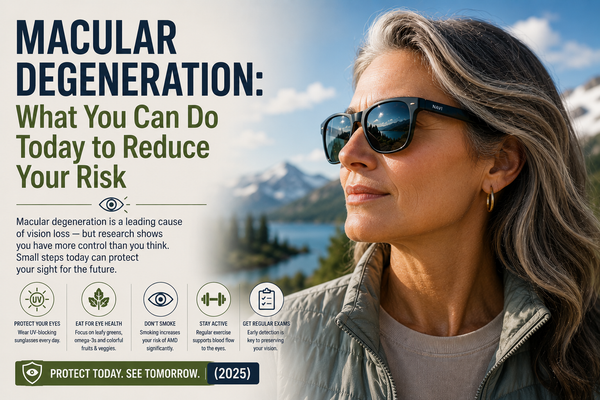

Macular Degeneration: What You Can Do Today to Reduce Your Risk
Age-related macular degeneration is the leading cause of irreversible vision loss in Americans over 50. It eliminates central vision — the sharp, detailed sight used for reading, recognizing faces, and driving. It does not typically cause total blindness, but the central scotoma it produces when advanced is among the most functionally devastating visual impairments a person can experience.
Advanced AMD, particularly geographic atrophy (dry AMD), has no curative treatment. Wet AMD can be managed with anti-VEGF injections that slow progression and sometimes preserve or partially restore vision, but treatment is typically lifelong once begun. The correct approach to AMD is not to wait for a diagnosis and manage it — it is to reduce modifiable risk factors before clinical disease develops.
The modifiable risk factors for AMD include smoking, diet, UV and light exposure, cardiovascular health, and body weight. None of these is the sole cause of AMD; the disease is multifactorial with a strong genetic component. But for individuals with normal or intermediate AMD risk, modifying these environmental factors is the most actionable prevention strategy available. This guide covers each one, with the UV400 and lifestyle measures that have the strongest evidence base.
This is a C22 Anti-Aging & Longevity supporting post. It links back to the cluster pillar atsunglasses, anti-aging and longevity: the complete eye health guide.

Quick Answer
The highest-impact modifiable risk reduction actions for AMD, ranked by strength of evidence: stop smoking (largest single modifiable risk factor, 2–4x increased risk for current smokers); maintain a diet rich in lutein, zeaxanthin, and antioxidants (AREDS2 supplements for intermediate AMD); consider UV400 and HEV light management (UV and blue light contribute to RPE oxidative damage); maintain cardiovascular health (hypertension and cardiovascular disease associated with AMD progression); maintain healthy BMI. UV400 sunglasses are one element of a multi-factor risk reduction approach.
Table of Contents
Part 1: What AMD Is and How It Progresses
Age-related macular degeneration is a progressive degenerative disease of the macula — the central 5mm of the retina responsible for sharp central vision. It progresses through defined stages:
Part 2: The Anatomy of the Macula
The macula occupies only a small fraction of the total retinal area but is responsible for virtually all detailed vision. Its central 1.5mm (the fovea) is the area of highest cone photoreceptor density and sharpest resolution. It is also the area with the highest metabolic demand, the highest oxygen consumption, and the most complex support requirements from the RPE.
The RPE — the single cell layer supporting and maintaining the photoreceptors — is the primary target of AMD pathology. RPE cells: recycle the outer segments of photoreceptors that are shed daily, deliver nutrients from the choroidal blood supply to the photoreceptors above, manage the waste products of phototransduction, and protect the photoreceptors from light damage. When RPE cells fail, the photoreceptors they support deteriorate and die.
The macula’s high metabolic activity combined with its intense light exposure — it is the area of the retina at the optical focal point of the eye — makes it the zone of highest cumulative oxidative stress in the body. This is why AMD specifically targets the macula rather than the peripheral retina.
Part 3: AMD’s Genetic Basis
AMD has a strong genetic component that significantly modifies individual risk. The two most important genetic risk variants are:
Genetic risk for AMD does not determine destiny, but it does establish the starting risk level that environmental and lifestyle factors modify around. An individual with high genetic risk who also smokes, has poor diet, and does not use UV400 protection has dramatically higher cumulative risk than a high-genetic-risk individual who manages all modifiable factors effectively. Conversely, low genetic risk combined with high cumulative modifiable risk (long-term smoking, lifetime UV exposure) can also produce AMD.
Genetic testing for AMD risk variants is available through ophthalmologists and genetic testing services. It is most relevant for individuals with family history of AMD or those diagnosed with early AMD who want to understand their progression risk.
Part 4: Smoking — The Largest Modifiable Risk Factor
Smoking is the most strongly evidenced modifiable risk factor for AMD. Current smokers have approximately 2–4 times the AMD risk of non-smokers in most epidemiological studies, with some studies finding higher relative risks in heavy smokers. Former smokers have intermediate risk between current smokers and never-smokers, with risk declining over years of cessation but never fully returning to never-smoker baseline.
The mechanism: smoking causes systemic oxidative stress, reduces plasma antioxidants (including carotenoids, vitamin C, and vitamin E), damages the choriocapillaris blood supply to the RPE, and induces choroidal vasoconstriction that reduces oxygen and nutrient delivery to the macula. These effects compound the direct oxidative damage from light exposure to the RPE.
For any AMD risk discussion, smoking cessation is the first and most impactful behavioral recommendation. Anti-VEGF treatment outcomes are worse in current smokers. AREDS2 supplementation benefits are attenuated in smokers. UV400 protection benefits cannot compensate for the systemic oxidative damage of active smoking. Stopping smoking is the highest-priority modifiable risk reduction action for AMD.
Part 5: UV and Light Exposure — The Retinal Mechanism
The mechanism by which light exposure contributes to AMD operates through the RPE’s lipofuscin accumulation and the phototoxicity of its most toxic component, A2E (a bis-retinoid byproduct of the visual cycle):
Part 6: The Research Linking Light Exposure to AMD
The EUREYE Study
The EUREYE study, examining 4,753 participants across seven European countries, found a significant association between blue light exposure and the prevalence of advanced AMD. Participants were asked about lifetime sun exposure, time spent outdoors, and use of eye protection. Those in the highest blue light exposure category had significantly elevated odds of advanced AMD compared to those in the lowest category, adjusting for age, sex, smoking, and other confounders.
The Beaver Dam Eye Study — AMD Data
Follow-up analyses of the Beaver Dam Eye Study cohort found associations between sun exposure history and both early AMD (drusen) and the incidence of advanced AMD over 10-year follow-up periods. The association was strongest in participants with the CFH risk genotype — consistent with a gene-environment interaction where UV/light exposure amplifies AMD risk in genetically susceptible individuals.
Blue Mountains Eye Study
The Blue Mountains Eye Study in Australia followed a population cohort over 10 years and found that leisure time sun exposure was positively associated with AMD incidence in individuals with specific AMD risk genotypes. The interaction between sun exposure and genetic risk suggests that UV/light management may be most protective in higher-genetic-risk individuals.
Part 7: What UV400 Sunglasses Do for AMD Risk
UV400 sunglasses reduce the UV component (below 400nm) of the retinal light load. This is meaningful for AMD risk because:
The caveat:the evidence for UV400 protection specifically reducing AMD incidence or progression in humans is less direct than the UV-cataract evidence. The EUREYE and Beaver Dam findings are observational and involve total light exposure, not isolated UV. The biological mechanism for A2E phototoxicity implicates blue-violet wavelengths above the UV400 cutoff. UV400 sunglasses are a UV-specific intervention that addresses one component of the total retinal light load relevant to AMD.
Part 8: Diet and Nutrition — Lutein, Zeaxanthin, and Antioxidants
Dietary antioxidants play an important role in AMD risk because the retina’s high metabolic activity generates significant oxidative stress that dietary antioxidants help neutralize. The most directly relevant dietary factors:
Lutein and Zeaxanthin
Lutein and zeaxanthin are the primary carotenoids that accumulate in the macula as the macular pigment. Macular pigment absorbs blue light before it reaches the photoreceptors and RPE, functioning as a natural blue-light filter. Higher macular pigment optical density (MPOD) is associated with lower AMD risk in prospective studies. Dietary intake of lutein and zeaxanthin from dark leafy greens (kale, spinach, collards), eggs, and corn increases MPOD.
Antioxidant Vitamins
Vitamins C and E are water-soluble and fat-soluble antioxidants respectively that support the retina’s oxidative defense. The AREDS and AREDS2 trials included high-dose vitamins C and E in the supplementation formula tested for AMD risk reduction.
Omega-3 Fatty Acids
DHA (docosahexaenoic acid) is the primary omega-3 in retinal photoreceptor membranes. Higher dietary omega-3 intake from oily fish is associated with reduced AMD risk in observational studies. The AREDS2 trial did not find significant benefit from omega-3 supplementation on AMD progression in an already-supplemented population, but dietary fish intake remains associated with AMD risk in epidemiological data.
Zinc
Zinc is a cofactor for many retinal enzymes and antioxidant systems. The original AREDS formula found that high-dose zinc supplementation reduced AMD progression in high-risk patients. AREDS2 included zinc as part of the core formula.
Part 9: The AREDS2 Trial — Evidence-Based Supplementation
The Age-Related Eye Disease Study 2 (AREDS2) was a major randomized clinical trial testing nutritional supplements for AMD progression. Published in JAMA in 2013, it enrolled 4,203 participants with intermediate or advanced AMD in one eye and followed them for 5 years.
Key findings: the AREDS2 formula (vitamins C 500mg, E 400 IU, zinc 80mg, copper 2mg, lutein 10mg, zeaxanthin 2mg) reduced the risk of AMD progressing to advanced stages by approximately 25% compared to placebo in high-risk participants. The substitution of lutein/zeaxanthin for beta-carotene (used in the original AREDS formula) provided similar efficacy without the elevated lung cancer risk in former smokers associated with high-dose beta-carotene.
The AREDS2 formula is evidence-based for individuals with intermediate AMD or advanced AMD in one eye. It is not indicated for individuals with no AMD or only early (small drusen) AMD, for whom the benefit is not established. The correct use is in consultation with an ophthalmologist who has evaluated AMD stage.
The relationship to UV400 sunglasses:AREDS2 supplementation supports the RPE’s antioxidant defense capacity. UV400 and HEV light management reduces the oxidative load that the supplementation is defending against. Both are complementary strategies.
✨ NAVI EYEWEAR — UV400 AS PART OF YOUR AMD RISK REDUCTION.UV400 polycarbonate. Polarized. Amber tint for additional HEV blue-violet filtering. One element of a complete AMD risk reduction approach: UV400 + diet + no smoking + monitoring. Buy 1, Get Any 3 Pairs Free — $119 for four pairs (~$30 each). Free shipping. Free replacements. |
Part 10: Cardiovascular Risk Factors and AMD
AMD and cardiovascular disease share several risk factors and biological mechanisms, consistent with their common theme of endothelial and vascular aging:
Part 11: Monitoring — The Amsler Grid and Regular Examination
AMD prevention requires active monitoring to detect progression from early to late stages, because the treatment for wet AMD is most effective when initiated early — before substantial permanent photoreceptor loss has occurred.
Amsler Grid
The Amsler grid is a simple monitoring tool: a card or screen display of a grid with a central fixation point, used by the patient at home to detect new visual distortion or gaps in the grid that may indicate AMD progression (particularly the onset of neovascular/wet AMD). Patients with intermediate AMD should use the Amsler grid daily for each eye separately, reporting any changes to their ophthalmologist promptly.
Regular Dilated Fundus Examination
Comprehensive dilated eye examination with fundus photography is the standard clinical monitoring for AMD. Optical coherence tomography (OCT) provides detailed imaging of retinal layers and drusen, and is the primary imaging modality for AMD staging and progression monitoring. The examination schedule recommended by the AAO:
Part 12: AMD Stages and When Intervention Matters
|
AMD Stage |
Clinical Features |
Vision Loss |
Key Intervention |
|
Early |
Small-medium drusen; mild RPE changes |
None |
Lifestyle modification: UV400, smoking cessation, diet; monitoring |
|
Intermediate |
Large drusen (≥125μm); RPE abnormalities |
Possible mild |
AREDS2 supplementation; continued lifestyle modification; close monitoring |
|
Late — Geographic atrophy |
RPE and photoreceptor loss; visible atrophy on exam |
Progressive central loss |
AREDS2 continued; close monitoring; emerging complement inhibitor therapies |
|
Late — Neovascular (wet) |
Choroidal neovascularization; fluid on OCT |
Rapid if untreated |
Anti-VEGF injections (urgent); continued AREDS2; monitoring fellow eye |
Part 13: Comparison Table — AMD Risk Reduction Interventions
|
Intervention |
Evidence Strength |
AMD Risk Reduction Effect |
Notes |
|
Smoking cessation |
Very strong |
2–4x risk reduction vs current smoking |
Largest modifiable factor; affects all AMD types |
|
AREDS2 supplementation |
Strong (RCT) |
~25% progression reduction in intermediate AMD |
Only for intermediate or advanced AMD in one eye; consult ophthalmologist |
|
UV400 sunglasses (daily) |
Moderate (observational) |
Reduces UV component of retinal light load |
Addresses UV-driven RPE oxidative damage; one component |
|
Amber/HEV-filtering lenses |
Preliminary |
May reduce blue-violet A2E activation |
Limited direct human trial evidence; biological mechanism supported |
|
Lutein/zeaxanthin diet |
Moderate (observational) |
Higher MPOD associated with lower AMD risk |
Dietary intake preferred; included in AREDS2 formula |
|
Mediterranean diet |
Moderate (cohort) |
Lower AMD incidence in adherent populations |
Anti-inflammatory; antioxidant-rich; cardiovascular benefit |
|
Hypertension management |
Moderate |
Reduced choroidal vascular damage |
General cardiovascular health benefit compounds AMD benefit |
|
Physical activity |
Moderate (observational) |
Reduced AMD incidence in active individuals |
Cardiovascular and anti-inflammatory mechanisms |
|
Regular eye examination |
Strong (clinical standard) |
Enables early intervention for wet AMD |
Amsler grid daily; dilated exam per AAO schedule |
Part 14: Best For
UV400 Polarized Daily Outdoor Use — Best For:
Amber Polarized UV400 — Best For:
Part 15: Common Mistakes
Bottom Line
AMD is the leading cause of irreversible vision loss in Americans over 50, and its burden will grow as the population ages. It is also partially preventable and substantially manageable through early detection and intervention. The modifiable risk factors — smoking, diet, UV/light exposure, cardiovascular health — collectively represent a significant proportion of population AMD burden.
The evidence-based action plan: stop smoking (most important), adopt a Mediterranean or anti-inflammatory dietary pattern with high lutein and zeaxanthin intake, wear UV400 sunglasses consistently outdoors (with amber tint for additional HEV benefit in outdoor activity contexts), manage blood pressure and cardiovascular risk factors, and establish a regular ophthalmologic examination schedule that detects AMD early enough for intervention when it matters.
UV400 sunglasses are one component of this plan — an affordable, daily, outdoor habit that reduces one of the modifiable environmental contributors to RPE oxidative damage. At $30 per Navi pair, the UV component of AMD risk reduction has a lower cost-per-year than virtually any other evidence-based health intervention.
Browse UV400 polarized options atnavieyewear.com/collections/polarized. Add 4 pairs — Buy 1, Get Any 3 Free auto-applies. Free shipping. Free replacements.

Frequently Asked Questions
Can I prevent macular degeneration?
You can reduce your risk of developing AMD and slow its progression through modifiable lifestyle factors. The strongest evidence supports: stopping smoking (2–4x reduced risk for current smokers who quit), adopting a diet rich in lutein, zeaxanthin, and antioxidants, using UV400 sunglasses consistently outdoors to reduce UV-driven RPE oxidative stress, and maintaining cardiovascular health. AMD cannot be fully prevented (genetic factors are beyond modification), but the modifiable factors collectively represent a significant share of AMD risk.
Does wearing sunglasses prevent macular degeneration?
UV400 sunglasses reduce the UV component of total retinal light exposure, which contributes to the RPE oxidative stress that is central to AMD pathology. The EUREYE study and the Beaver Dam Eye Study both found associations between cumulative light exposure and AMD risk. The biological mechanism (A2E phototoxicity from blue-violet light) involves wavelengths above 400nm (not fully blocked by UV400 alone), but UV exposure also contributes through direct RPE oxidative damage. UV400 sunglasses are one component of a multi-factor AMD risk reduction approach.
What are the most important things I can do to reduce AMD risk?
In order of evidence strength: stop smoking (the largest single modifiable risk factor), maintain a high-antioxidant diet with dark leafy greens and eggs (for lutein and zeaxanthin), consider AREDS2 supplementation if you have intermediate AMD or advanced AMD in one eye (consult your ophthalmologist), wear UV400 sunglasses outdoors consistently, maintain healthy blood pressure and cardiovascular health, exercise regularly, and have regular dilated eye examinations on the AAO-recommended schedule.
What are AREDS2 supplements and should I take them?
AREDS2 is a specific supplement formula tested in a major NIH-funded randomized trial: vitamins C 500mg and E 400 IU, zinc 80mg, copper 2mg, lutein 10mg, and zeaxanthin 2mg. The trial found approximately 25% reduction in AMD progression risk in participants with intermediate AMD or advanced AMD in one eye. AREDS2 is not indicated for people with no AMD or early AMD; the benefit was not demonstrated in those populations. Consult your ophthalmologist before starting AREDS2.
How does smoking affect macular degeneration risk?
Smoking is the most strongly evidenced modifiable risk factor for AMD. Current smokers have approximately 2–4 times the AMD risk of non-smokers. Smoking reduces systemic antioxidants, damages the choroidal blood supply to the RPE, and induces choroidal vasoconstriction. Former smokers have intermediate risk, with risk declining over years of cessation. Stopping smoking is the highest-priority AMD prevention action for anyone who smokes.
Does diet affect macular degeneration risk?
Yes. Lutein and zeaxanthin — found in dark leafy greens (kale, spinach, collards), eggs, and corn — accumulate in the macula as macular pigment that absorbs blue light before it reaches the photoreceptors and RPE. Higher macular pigment optical density is associated with lower AMD risk. A Mediterranean dietary pattern (high in vegetables, fruit, fish, olive oil; low in processed foods) is associated with reduced AMD incidence in multiple cohort studies.
What is the Amsler grid and should I use one?
The Amsler grid is a simple home monitoring tool — a printed or screen-displayed grid with a central fixation point. By looking at the center point with one eye at a time, the user can detect distortion, waviness, or blank areas in the grid that may indicate AMD progression, particularly the onset of wet AMD. People with intermediate AMD should use it daily for each eye separately. Any change should prompt prompt ophthalmologist contact. Wet AMD treated early preserves significantly more vision than wet AMD treated after significant progression.
How often should I have my eyes examined for AMD?
AAO recommendations: no AMD at age 55–64, every 1–2 years; no AMD at 65+, annually; early or intermediate AMD, annually or more frequently as recommended by your ophthalmologist; one eye with advanced AMD, every 3–6 months to monitor the fellow eye. If you have AMD risk factors (family history, smoking history, known CFH/ARMS2 genetic risk variants), earlier and more frequent monitoring may be appropriate.
Supporting Articles
UV400 FOR THE RETINA. ONE PART OF A COMPLETE AMD APPROACH.UV400 polarized. Amber for additional HEV filtering. One evidence-informed daily habit. Combined with no smoking, good diet, and regular exams — the complete AMD risk reduction plan. Buy 1, Get Any 3 Pairs Free — $119 for four pairs. Free shipping. Free replacements. |
SOURCES & CITATIONS[1] Age-Related Eye Disease Study 2 Research Group.“Lutein + zeaxanthin and omega-3 fatty acids for age-related macular degeneration: the AREDS2 randomized clinical trial.”JAMA, 2013.View source [2] Fletcher AE, Bentham GC, Agnew M, et al..“Sunlight exposure, antioxidants, and age-related macular degeneration.”Archives of Ophthalmology, 2008.View source [3] Cruickshanks KJ, Klein R, Klein BE, Nondahl DM.“Sunlight and the 5-year incidence of early age-related maculopathy: the Beaver Dam Eye Study.”Archives of Ophthalmology, 2001.View source [4] Seddon JM, Ajani UA, Sperduto RD, et al..“Dietary carotenoids, vitamins A, C, and E, and advanced age-related macular degeneration.”JAMA, 1994.View source [5] Chakravarthy U, Augood C, Bentham GC, et al..“Cigarette smoking and age-related macular degeneration in the EUREYE Study.”Ophthalmology, 2007.View source [6] American Academy of Ophthalmology.“Preferred practice pattern: age-related macular degeneration.”Ophthalmology, 2019.View source |