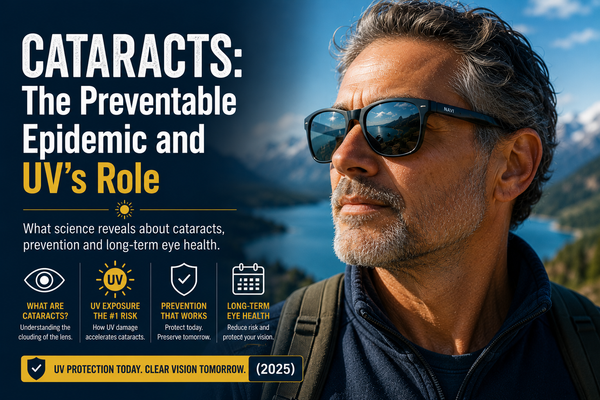

Cataracts: The Preventable Epidemic and UV’s Role
Cataract surgery is the most commonly performed surgical procedure in the United States. More than 4 million cataract surgeries are performed annually on Americans, a number that is projected to grow as the baby boomer generation ages. The surgical procedure is highly effective — a 20-minute outpatient operation restores vision that the opacity had obscured. But the fact that it is routinely performed and highly effective has led to a dangerous cultural normalization of cataracts: the sense that they are an inevitable part of aging, best managed when they arrive rather than prevented beforehand.
The evidence does not support this normalization. The WHO estimates that approximately 20% of cataract cases globally are attributable to UV exposure. UV exposure is a modifiable risk factor. UV400 sunglasses consistently worn outdoors are the primary tool for modifying it. A condition that is treated in 4 million Americans annually and that causes reversible blindness in hundreds of millions globally has a substantially preventable environmental component that is addressable with a $30 pair of UV400 polarized sunglasses.
This is a C22 Anti-Aging & Longevity supporting post. It links back to the cluster pillar atsunglasses, anti-aging and longevity: the complete eye health guide.
Quick Answer
Cataracts are not fully preventable — aging, genetics, and other factors contribute to lens opacity regardless of UV protection. But the cortical cataract type most strongly associated with UV exposure may be substantially preventable with consistent lifetime UV400 eye protection. The research connecting cumulative UV exposure to cortical cataract risk is robust. The mechanism is well understood. The intervention is clear: UV400 polarized sunglasses worn consistently outdoors from as early as possible in life.

Table of Contents
Part 1: What a Cataract Actually Is
The crystalline lens of the eye is the focusing element that adjusts to produce sharp images at varying distances. It is composed primarily of crystallin proteins arranged in a highly ordered, transparent architecture. This transparency is not an inherent property of the proteins themselves — it depends on the precise organization of the proteins and the molecular chaperone systems that prevent them from aggregating.
A cataract is the disruption of this organization. When crystallin proteins are chemically altered — by oxidation, glycation, UV-induced cross-linking, or other damage mechanisms — they lose their precise conformation and begin to aggregate into high-molecular-weight complexes. These aggregates scatter light rather than transmitting it. The optical result: the lens becomes increasingly opaque, producing the blurred, dim, and color-distorted vision that characterizes advanced cataract.
A mature cataract prevents adequate light from reaching the retina. The visual impairment can range from mild blur and glare sensitivity in early cataract to near-complete loss of functional vision in advanced cases. In the US, this is treated with routine surgical extraction of the clouded lens and implantation of a synthetic intraocular lens (IOL). The surgery is effective; the prevention is better.
Part 2: The Four Types of Cataract and Their UV Relationships
|
Cataract Type |
Location in Lens |
UV Association |
Other Key Risk Factors |
|
Nuclear sclerosis |
Lens nucleus (center) |
Moderate — UV one of several oxidative factors |
Age; smoking; low antioxidant status |
|
Cortical cataract |
Lens cortex (outer layer) |
Strong — most directly UV-linked type |
UV exposure; rural outdoor work; latitude |
|
Posterior subcapsular (PSC) |
Posterior capsule (back surface) |
Moderate — UV contributes; steroid use major risk |
Corticosteroid use; diabetes; radiation |
|
Congenital |
Present at birth |
Not UV-related |
Genetic; intrauterine infection; metabolic |
Cortical cataract is the type most strongly and specifically associated with cumulative UV-B exposure. Cortical cataracts begin as spoke-wheel opacities at the outer cortex of the lens — precisely the region most exposed to UV entering at oblique angles around the pupil edge. The Chesapeake Bay watermen study found the UV-cortical cataract relationship to be the most statistically significant association in a comprehensive cataract epidemiology investigation.
Part 3: The Crystalline Lens — Why It Cannot Repair Itself
The crystalline lens is one of the most unusual tissues in the body. It is avascular — it has no blood supply, because blood vessels would scatter light and impair visual function. Nutrients reach the lens by diffusion from the aqueous and vitreous humor surrounding it. Waste products leave the same way.
The lens fiber cells that form the bulk of the lens are among the most highly differentiated cells in the body. In the process of differentiation, lens fiber cells lose their nuclei, mitochondria, ribosomes, and other organelles that would scatter light. This radical specialization for optical transparency comes at a cost: these cells cannot synthesize new proteins or repair damaged ones. Once a lens protein is oxidized, cross-linked, or aggregated by UV damage, it stays that way.
The only lens component that retains some cellular activity is the lens epithelium — a monolayer of cells at the front of the lens. These cells can divide to produce new lens fiber cells, but they cannot repair the existing fiber cells of the nucleus and cortex. Damage to these cells is irreversible.
This biological architecture is why cataract prevention is so important and why the cumulative model of UV damage is the correct framework. There is no cellular repair waiting to undo the photochemical damage from an unprotected day in high UV. The damage accumulates.
Part 4: The UV Mechanism — How Radiation Damages the Lens
UVB radiation (280–315nm) is the primary driver of lens photodamage. UVA (315–400nm) also contributes, particularly through photosensitized reactions involving endogenous chromophores that accumulate in the aging lens. The mechanism has several steps:
Part 5: The Chesapeake Bay Watermen Study — The Landmark Evidence
The most influential epidemiological study connecting UV exposure to cataract risk was published by Hugh Taylor and colleagues in the New England Journal of Medicine in 1988. The study examined watermen — commercial fishermen and boat operators — working on the Chesapeake Bay in Maryland. This population was selected because their outdoor occupation provided a high-UV-exposure group with a clear occupational UV dose history.
The study measured the UV exposure history of 838 watermen using detailed questionnaires and validated dosimetry models, and examined the prevalence of different cataract types using standardized slit-lamp photography. The key finding: there was a significant positive dose-response relationship between lifetime UV-B exposure and the prevalence of cortical lens opacity. Men in the highest UV-B exposure tertile had nearly three times the odds of significant cortical cataract compared to those in the lowest tertile.
The study controlled for age, race, alcohol consumption, and other confounders, isolating UV-B as an independent risk factor for cortical cataract. The dose-response relationship — increasing cataract risk with increasing UV exposure — was consistent with a causal rather than merely associative interpretation.
This study established the foundation for subsequent research and the WHO’s UV-cataract public health position. It remains one of the most cited studies in ocular epidemiology.
Part 6: The Beaver Dam Eye Study — Population Confirmation
The Beaver Dam Eye Study, conducted in Beaver Dam, Wisconsin, is one of the longest-running and most comprehensive population studies in ophthalmology. Starting in 1988–90 with nearly 5,000 residents aged 43–84, the study has tracked eye health outcomes over multiple follow-up periods across more than 20 years.
The Beaver Dam data on UV and cataract confirmed and extended the Chesapeake Bay findings in a general population (not a selected outdoor-worker population). Analysis of sun exposure history (measured by cumulative hours of outdoor sun exposure across the lifetime) found that individuals in the highest quintile of lifetime sun exposure had significantly higher rates of cortical cataract at baseline examination compared to those in the lowest quintile.
The population-based nature of the Beaver Dam study is important because it shows that the UV-cataract association extends beyond occupationally exposed populations to the general American public — the variability in UV exposure that exists between individuals in normal daily life is enough to produce measurable differences in cortical cataract prevalence.

Part 7: WHO Global Estimates — The Attributable Fraction
The WHO has used the epidemiological evidence base to estimate the global public health burden of UV-attributable cataracts. Their estimate: approximately 20% of cataract cases globally may be attributable to UV exposure. This is an attributable fraction estimate — it represents the proportion of all cataracts that would not have occurred (at the observed time) if the UV-exposed individuals had maintained UV400 protection throughout their lives.
Translating the 20% attributable fraction to the US context:
These are estimates with significant uncertainty. The attributable fraction may be higher for cortical cataract specifically and lower for nuclear sclerosis. But even the conservative framing suggests that hundreds of thousands of cataract surgeries annually in the US occur in individuals whose lens opacity has a significant UV-driven component that was, in principle, preventable with consistent lifetime UV400 eye protection.
Part 8: Who Is at Highest Risk for UV-Linked Cataract?
Several factors amplify the individual UV-cataract risk above the population average:
✨ NAVI EYEWEAR — UV400 FOR THE LENS YOU CANNOT REPAIR.UV400 polycarbonate blocks all UV to 400nm. Every outdoor day. For the lens that cannot heal itself. The cortical cataract most strongly linked to UV exposure is the most preventable form. Buy 1, Get Any 3 Pairs Free — $119 for four pairs (~$30 each). Free shipping. Free replacements. |
Part 9: What UV400 Sunglasses Do for the Lens
UV400 polycarbonate lenses block all wavelengths below 400nm — the entire UV-A and UV-B range. This blocking is achieved through UV-absorbing compounds incorporated throughout the polycarbonate material, not just on the surface. The absorbed UV energy is dissipated as heat rather than passing through to the eye.
The cellular-level effect on the crystalline lens:
This is not a cure. UV400 sunglasses cannot reverse existing protein aggregates. They can slow the rate at which new aggregates form. Over decades, slowing this rate translates to a meaningful delay in the age at which cataracts reach the level of visual impairment that requires surgery. A cataract that would have become symptomatic at 65 may not reach that threshold until 75. The compression of the cataract-affected decade from the most productive years into later life is the practical outcome of lifetime UV400 protection.
Part 10: The Darkening Lens — Natural UV Protection in Aging
An important nuance in the UV-cataract story: the aging crystalline lens naturally yellows and develops some UV-absorbing capacity over time. By the 50s and 60s, the natural lens absorbs a substantial proportion of UV on its own — partially explaining why cortical cataract from UV exposure tends to develop over decades rather than rapidly.
This natural yellowing is itself a consequence of accumulated UV and oxidative damage — the tryptophan photoproducts that produce the yellow-brown coloration of the aging lens are the same compounds generated by UV irradiation of crystallin proteins. The lens’s own UV protection increases with age precisely because it has been progressively UV-damaged.
The implication for UV400 sunglasses: they are most important in early adulthood (20s and 30s) when the lens is most UV-transparent and provides the least self-protection. As the lens naturally yellows with age, it provides increasing internal UV protection. UV400 sunglasses in the 60s and 70s are still reducing UV dose to the retina (where AMD risk is highest at these ages), but the primary cataract-prevention benefit of UV400 use is compounded most in the early decades when the lens cannot protect itself.
Part 11: Cataract Surgery — Effective But Not the Goal
Cataract surgery (phacoemulsification with IOL implantation) is a medical success story. A 20-minute outpatient procedure under local anesthesia reliably restores functional vision in the vast majority of patients. Modern premium IOLs can correct refractive errors and even presbyopia. The complication rate is among the lowest of any surgical procedure.
But “easy to treat” is not the same as “good to have.” Surgery carries real risks, even at low rates: posterior capsule rupture, infection, elevated intraocular pressure, retinal detachment. The IOL is not as optically precise as a young, healthy crystalline lens. The surgery requires anesthesia, recovery time, and access to surgical eye care that is not uniformly available to all Americans. The cost — $3,500–6,000 per eye without insurance, $600–1,200 out-of-pocket with Medicare — is significant.
The goal of UV400 protection is not to avoid the surgery when it becomes necessary — if cataracts develop and impair vision, surgery is the correct treatment. The goal is to delay the onset of visually significant cataract as long as possible, compressing the duration of visual impairment and surgical intervention into the latest possible years of life.
The investment analysis comparing prevention cost to treatment cost is inUV400 sunglasses as a long-term investment in vision.
Part 12: The Prevention Timeline
The UV-cataract prevention timeline follows from the cumulative damage model:
Part 13: Comparison Table — Cataract Risk Factors and Modifiability
|
Risk Factor |
Modifiable? |
Intervention |
UV400 Addresses? |
|
Cumulative UV-B exposure |
Yes — primary modifiable risk |
UV400 sunglasses daily outdoor use |
Yes — directly |
|
Age |
No |
N/A (time) |
No — but delays onset |
|
Genetics |
No |
Genetic counseling; monitoring |
No |
|
Smoking |
Yes |
Smoking cessation |
No (separate mechanism) |
|
Diabetes |
Partially (glycemic control) |
Glycemic management |
No (separate mechanism) |
|
Corticosteroid use |
Partially (dose/duration) |
Clinical management |
No (PSC type primarily) |
|
Low dietary antioxidants |
Yes |
AREDS2-type diet; supplementation |
No (complementary) |
|
Light iris color |
No |
N/A (anatomy) |
Yes — reduces UV reaching lens regardless of iris |
|
Low UV400 use |
Yes — most actionable lifestyle factor |
UV400 sunglasses habit |
Yes — directly |
Part 14: Best For
UV400 Polarized for Cataract Risk Reduction — Best For:
Part 15: Common Mistakes
Bottom Line
Cataracts are not fully preventable, but the cortical cataract type most strongly linked to UV is substantially modifiable with lifetime UV400 eye protection. The evidence base is robust: the Chesapeake Bay watermen study established the dose-response relationship, the Beaver Dam Eye Study confirmed it in a general population, and the WHO has incorporated UV as a significant attributable factor in global cataract burden. Approximately 20% of cataracts globally may be UV-attributable — representing millions of cases that could in principle have been delayed or prevented.
The crystalline lens cannot repair UV damage. The only intervention is reducing the UV dose that reaches it over a lifetime. UV400 polarized sunglasses worn consistently from the earliest years of outdoor life are the primary tool for that reduction. The earlier the habit is established, the greater the total cumulative UV dose reduction achieved by the time cataracts would otherwise become clinically significant.
Browse UV400 polarized options atnavieyewear.com/collections/polarized. Add 4 pairs — Buy 1, Get Any 3 Free auto-applies. Free shipping. Free replacements.
Frequently Asked Questions
Can sunglasses actually prevent cataracts?
UV400 sunglasses can reduce the risk and delay the onset of the cataract type most associated with UV — cortical cataract. They cannot prevent all cataracts (nuclear sclerosis and posterior subcapsular cataracts have other primary risk factors). But consistent lifetime UV400 protection reduces cumulative UV-B dose to the crystalline lens, which is the primary environmental driver of cortical lens opacity. The research consistently supports this relationship.
What is the evidence linking UV to cataracts?
The landmark study is Taylor et al. (1988) in the New England Journal of Medicine, which found a dose-response relationship between lifetime UV-B exposure and cortical cataract prevalence in Chesapeake Bay watermen. The Beaver Dam Eye Study confirmed the association in a general population. The WHO estimates 20% of cataracts globally are attributable to UV exposure. The biological mechanism — UV-induced crystallin oxidation, cross-linking, and aggregation — is well characterized.
What type of cataract is most related to UV?
Cortical cataract — opacification that begins in the outer cortex of the lens, often in a spoke-wheel pattern radiating from the periphery toward the center. This type is most strongly and specifically associated with UV-B exposure. The cortex of the lens is the zone most exposed to UV entering at oblique angles around the pupil margin. Nuclear sclerosis and posterior subcapsular cataract have weaker UV associations and more prominent contributions from other factors.
Does wearing sunglasses reduce cataract risk if I already have early cataracts?
Starting UV400 protection after early cataracts are detected cannot reverse existing lens opacification. But it reduces the rate of future UV-induced damage, which may slow the progression of cortical opacification and reduce the UV dose to the retina for AMD risk management. Beginning UV400 protection at any life stage reduces future UV accumulation; the prevention value is greatest before cataracts develop.
Is cataract surgery safe enough that prevention doesn’t matter?
Cataract surgery is effective and safe with a low complication rate. But ‘low complication rate’ is not the same as ‘no complications’ or ‘no burden.’ Surgery requires anesthesia, recovery, access to surgical eye care, and carries costs of $3,500–6,000 per eye. The goal of UV400 prevention is not to avoid surgery forever — it is to delay visually significant cataract onset as long as possible, compressing the period of visual impairment into the latest possible years.
How does smoking affect cataract risk?
Smoking significantly increases cataract risk through a separate but compounding oxidative mechanism — it depletes systemic antioxidants including the vitamin C and glutathione that the lens depends on for UV defense. Smokers face both the UV-driven oxidative damage from unprotected outdoor exposure and the systemic antioxidant depletion from smoking. UV400 protection addresses the UV component; smoking cessation addresses the smoking component. Both are relevant modifiable risk factors.
Are children’s eyes more vulnerable to UV-driven cataract risk?
Yes. Children’s crystalline lenses transmit more UV to the lens fiber cells than adult lenses, which have begun to yellow and develop natural UV-absorbing properties. The WHO estimates up to 80% of lifetime ocular UV may be accumulated before age 18. UV accumulated in childhood contributes to the lifetime total at the highest efficiency per photon. UV400 sunglasses for children represent the highest-leverage period for lifetime cataract risk reduction.
Does UV400 lens category affect cataract protection?
No. UV400 protection is a property of the polycarbonate lens material, entirely independent of lens darkness category. A UV400 Category 1 lens (very light) provides the same UV protection as a UV400 Category 3 lens. Category only affects how much visible light is transmitted. For cataract prevention, the only relevant lens criterion is UV400 certification. Choose the category appropriate for the lighting conditions; the UV protection is the same at any category.
Supporting Articles
UV400. FOR THE LENS THAT CANNOT REPAIR ITSELF.UV400 polycarbonate blocks all UV to 400nm. The crystallin proteins that UV oxidizes cannot be replaced. The cortical cataract most linked to UV exposure is the most preventable form. Buy 1, Get Any 3 Pairs Free — $119 for four pairs. Free shipping. Free replacements. |
SOURCES & CITATIONS[1] Taylor HR, West SK, Rosenthal FS, et al..“Effect of ultraviolet radiation on cataract formation.”New England Journal of Medicine, 1988.View source [2] Klein BE, Klein R, Linton KL.“Prevalence of age-related lens opacities in a population: the Beaver Dam Eye Study.”Ophthalmology, 1992.View source [3] Cruickshanks KJ, Klein BE, Klein R.“Ultraviolet light exposure and lens opacities: the Beaver Dam Eye Study.”American Journal of Public Health, 1992.View source [4] World Health Organization.“Global solar UV index: a practical guide.”WHO/SDE/OEH/02.2, 2002.View source [5] Truscott RJ.“Age-related nuclear cataract — oxidation is the key.”Experimental Eye Research, 2005.View source [6] American Academy of Ophthalmology.“Sunglasses: choosing the right pair for UV protection.”AAO EyeSmart, 2023.View source |