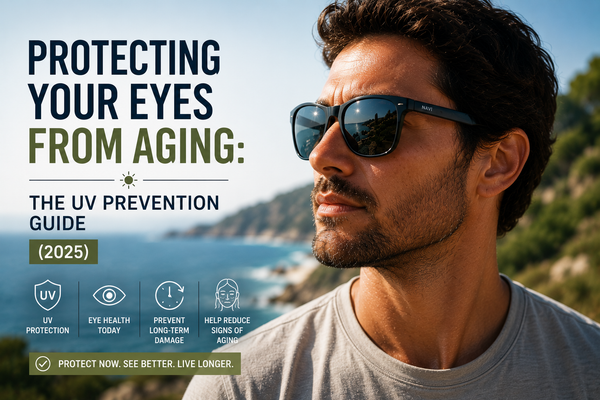

Protecting Your Eyes from Aging: The UV Prevention Guide
Most Americans take better care of their skin from UV than their eyes. Sunscreen is a daily habit for millions. UV400 eye protection is not — even though the eyes are at least as vulnerable to cumulative UV damage as the skin, and the consequences of that damage are far less reversible. You can treat UV-damaged skin with topical retinoids, laser resurfacing, and peels. You cannot treat UV-damaged crystalline lens proteins or retinal pigment epithelium cells.
This guide is about the practical prevention side of the UV-eye aging relationship: what UV does to the eyes over a lifetime, what you can start doing at any life stage to reduce your lifetime UV ocular burden, and what specific habits and specifications make the biggest difference. It is not about perfect protection from every photon. It is about consistently reducing a lifetime cumulative dose that determines your visual future.
This is a C22 Anti-Aging & Longevity supporting post. It links back to the cluster pillar atsunglasses, anti-aging and longevity: the complete eye health guide.
Quick Answer
Establish UV400 outdoor use as a consistent daily habit — not a sunny-day habit. Start as early as possible; the 25-year-old starting today is making a better investment than the 50-year-old who will start next year. Wear UV400 from March through October in most US states, year-round in the Sun Belt and Southwest. Choose UV400 polycarbonate (not just dark lenses). Polarize for glare comfort and visual fatigue reduction. Replace scratched lenses. The specific pair costs $30. The return compounds over 40 years of protected outdoor life.

Table of Contents
Part 1: Why the Eye Is Different From the Skin
Skin is a regenerating organ. Its outer layers (epidermis) replace themselves approximately every 2–4 weeks. UV damage to the epidermis is repaired through this regeneration cycle and through active DNA repair mechanisms that correct UV-induced thymine dimers and other photochemical lesions. Chronic UV damage that exceeds the repair capacity leads to photoaging and carcinogenesis, but the repair machinery is active.
The crystalline lens has no blood supply and its cells cannot regenerate. The lens fiber cells that form the nucleus and cortex of the lens are formed early in life and persist without replacement. UV-induced protein oxidation, cross-linking, and aggregation in these cells accumulates without any repair mechanism to reverse it. There is no lens equivalent of skin cell turnover.
The retinal pigment epithelium is similarly irreplaceable in its functional form. RPE cells are post-mitotic in adults; they do not divide to replace lost or damaged cells to any meaningful extent. UV and light-induced damage to RPE cells over decades is cumulative without reversal. The geographic atrophy of advanced dry AMD represents the literal loss of RPE cells that cannot be replaced.
This biological difference — regenerating skin vs non-regenerating lens and RPE — is the reason that UV eye protection is, if anything, more urgent than UV skin protection. The skin has error correction mechanisms; the lens and RPE do not.
Part 2: The Life Stages of UV Eye Exposure
|
Life Stage |
Primary UV Exposure Context |
Eye Vulnerability |
Priority Action |
|
Infancy and toddlerhood (0–3) |
Outdoor play; stroller exposure |
Highest lens UV transmission; maximum vulnerability |
UV400 sunglasses from first outdoor use |
|
Childhood (4–12) |
School outdoor time; sports; summer recreation |
Still high lens UV transmission; accumulating lifetime dose |
Daily UV400 habit; UV400 for all outdoor activity |
|
Adolescence (13–17) |
Sports; outdoor socializing; driving learner |
Lens UV transmission declining but still elevated |
UV400 as daily standard; consistent year-round |
|
Young adulthood (18–29) |
Outdoor recreation; commuting; beach/sport |
Adult lens developing protective yellowing |
Establish UV400 daily habit now; highest leverage decade |
|
Adult (30–49) |
Work commute; outdoor recreation; parenting outdoors |
Lens yellowing increasing; some UV protection from lens itself |
Maintain consistent UV400 habit; model for children |
|
Midlife (50–64) |
Commuting; outdoor leisure; travel |
Lens yellowing provides more UV protection; but AMD risk rising |
UV400 for all outdoor use; begin regular AMD monitoring |
|
Senior (65+) |
Leisure; gardening; outdoor social |
High lens yellowing; reduced but still meaningful UV risk |
UV400 for outdoor use; annual dilated fundus exam standard |
Part 3: What Is Accumulating in Your Eyes Right Now
Every outdoor day without UV400 protection, the following processes are occurring at a low but non-zero rate in the eyes of unprotected adults:
None of these processes is currently causing noticeable visual impairment in most people in their 20s, 30s, and 40s. They are building toward conditions that will become symptomatic in the 60s and 70s. The time to intervene is before the symptoms, not after.
Part 4: The Behaviors That Drive Lifetime UV Dose
Understanding which daily behaviors contribute most to lifetime ocular UV dose allows prioritization of where UV400 protection makes the biggest difference:

Part 5: The UV Protection Habit — What It Requires
The UV protection habit for long-term eye health has three components that determine its effectiveness:
Consistency
The habit must operate on all outdoor days that have meaningful UV, not only on visually bright days. In most US states, this means UV400 use from March through October on all outdoor days regardless of cloud cover. In the Sun Belt and Southwest, year-round. The overcast-day gap — removing sunglasses when the sky turns gray — is the most common failure mode of the UV protection habit.
Correct Specification
The lens must be UV400 certified polycarbonate. A dark non-UV400 lens provides no UV protection and is actively harmful because it dilates the pupil (allowing more UV in) without blocking UV. A clear UV400 polycarbonate lens provides complete UV protection. Category, tint, and darkness are irrelevant to UV protection; UV400 certification is the only relevant criterion.
Adequate Frame Coverage
Standard frames with small lenses allow UV to reach the eye and periocular skin from above, below, and the sides. Frames with adequate lens size and coverage — covering the brow, temple, and cheek zones — reduce both ocular and periocular UV exposure. Wraparound and semi-wraparound geometries are the most protective for outdoor UV exposure contexts.
Part 6: Choosing the Right Specification for Eye Protection
The UV protection specification for long-term eye health:
Part 7: UV Protection at Different Life Stages
The 20s and 30s — The Highest-Leverage Decade
People in their 20s and 30s are making the most consequential UV protection decisions of their lives — usually without knowing it. The UV accumulated in these decades adds to a cumulative total that will determine cataract and AMD risk at 60 and 70. Young adults have several factors that increase their UV dose: higher outdoor activity, higher sun intensity in peak outdoor recreation years, and no established UV protection habit.
The 25-year-old who establishes UV400 outdoor use as a daily habit today has the most to gain from the habit. The compounding effect of 40+ years of consistent protection versus unprotected outdoor time is the largest of any life stage. If this guide reaches one person in their 20s who establishes the UV400 habit as a result, the long-term health return is among the highest of any single health behavior change they can make.
The 40s and 50s — The Risk-Awareness Window
The 40s and 50s are when most Americans first become aware of their eye health as a longevity concern — after a physician mentions AMD risk, or a family member has cataract surgery, or the first presbyopia reading glasses trigger a conversation about eye aging. UV400 protection started in the 40s is still valuable; the UV dose for the subsequent decades is reduced. But the 20 years of unprotected outdoor time from age 20 to 40 cannot be recovered.
The 60s and Beyond — Maintenance and Monitoring
UV400 protection in the 60s and beyond has diminishing but still real marginal benefit. The natural yellowing of the aging crystalline lens provides some UV protection by the 60s. AMD and cataract risk monitoring through regular dilated fundus examination becomes the primary eye health intervention at this stage. UV400 use continues to reduce the UV dose to the retina in the years when AMD progression risk is highest.
✨ NAVI EYEWEAR — UV400 FOR LIFE.UV400 polycarbonate. Polarized. The daily habit that compounds over decades. The 25-year-old starting today protects vision at 70 in ways the 50-year-old cannot recover. Buy 1, Get Any 3 Pairs Free — $119 for four pairs (~$30 each). Free shipping. Free replacements. |
Part 8: The Overcast Day Gap
The overcast day gap is the most significant UV protection failure pattern in American behavior: the instinct to remove sunglasses when the sky turns gray, because sunglasses “don’t seem necessary” in non-sunny conditions.
The UV science is unambiguous: moderate overcast transmits 40–60% of clear-sky UV. On a July overcast day in any temperate US state, the UV Index may still reach 3–5. In the Sun Belt, it may reach 5–7. The WHO recommends UV eye protection from UV Index 3 upward. The overcast day is not a UV-free day.
For the UV protection habit to capture the full lifetime UV dose reduction, it needs to operate on overcast days as well as sunny ones. In frequently overcast climates (Pacific Northwest, Great Lakes, northeastern US), overcast days may represent the majority of outdoor days from October through April. Protecting only on sunny days in these climates misses most of the annual UV protection opportunity.
The complete overcast UV science is inshould you wear sunglasses on a cloudy day? the UV science.
Part 9: Occupational UV Exposure
For outdoor workers, UV exposure is an occupational health issue of the same magnitude as chemical exposure or noise exposure — it is a predictable, accumulated, preventable occupational hazard. The populations with the highest lifetime occupational UV exposure include:
For these workers, UV400 eye protection is not a personal wellness choice — it is an occupational health measure with the same legitimacy as hearing protection for noise or dust masks for particulate exposure. Employers with outdoor work populations providing UV400 eyewear as standard PPE are applying the evidence-based occupational health standard.
Part 10: Diet, Antioxidants, and UV Defense
UV damage to the lens and retina is oxidative in mechanism. Dietary antioxidants provide some systemic support for the eye’s endogenous antioxidant defense systems, though dietary intervention is not a substitute for UV400 eye protection.
The relationship:diet and supplementation can support the eye’s defensive capacity against oxidative damage; UV400 sunglasses reduce the UV-driven oxidative load that the defensive systems are working against. Both interventions are complementary, not substitutable.
Part 11: The Role of Regular Eye Examinations
UV400 sunglasses are a prevention tool; they are not a substitute for regular ophthalmologic monitoring. The standard of care for age-appropriate eye health includes:
UV400 sunglasses worn consistently reduce the UV contribution to the conditions these examinations monitor. They do not eliminate the need for monitoring.
Part 12: Comparison Table — UV Protection Approaches and Their Effectiveness
|
Approach |
Addresses UV? |
Addresses Aging Mechanisms? |
Practical Effectiveness |
Role |
|
UV400 polarized daily outdoor use |
Yes — blocks all UV to 400nm |
Yes — reduces primary damage driver |
High — if consistent |
Primary prevention; essential foundation |
|
Dark non-UV400 lenses |
No — no UV blocking |
No |
Negative (pupil dilation increases UV) |
Avoid entirely |
|
UV400 sunny-day-only use |
Partial — misses overcast UV |
Partial |
Moderate — captures peak UV days only |
Better than nothing; habit extension needed |
|
Dietary antioxidants / AREDS2 |
No UV blocking |
Yes — supports antioxidant defense |
Moderate for AMD progression risk |
Complementary; not a substitute |
|
Regular eye examinations |
No UV blocking |
Early detection of damage |
High for treatment timing |
Monitoring and detection; not prevention |
|
UV400 + Amsler grid + AREDS2 diet |
Yes |
Yes (multiple pathways) |
Best combination |
Complete evidence-based anti-aging approach |
Part 13: Best For
UV400 Polarized Category 2 — Best For:
Part 14: Common Mistakes
Bottom Line
UV-driven eye aging is a prevention problem with a simple, accessible solution: UV400 polarized sunglasses worn consistently outdoors, starting as early as possible, maintained as a daily habit across decades. The lens and RPE cannot repair UV damage; they can only accumulate it or be protected from it. Every year of consistent UV400 protection is a year of reduced accumulation. Every year without it adds to an irreversible total.
The habit is simple. The specification is simple. The cost is low. The return is measured in decades of clearer vision and reduced disease risk. There is no other single daily habit with a comparable return on investment in long-term eye health at a comparable cost.
Browse UV400 polarized options atnavieyewear.com/collections/polarized. Add 4 pairs — Buy 1, Get Any 3 Free auto-applies. Free shipping. Free replacements.

Frequently Asked Questions
What age should you start wearing UV400 sunglasses for eye health?
As early as possible. The WHO estimates up to 80% of lifetime ocular UV may be accumulated before age 18 because children’s lenses transmit more UV than adult lenses and children spend extensive outdoor time. From the first years of outdoor activity, UV400 sunglasses are the appropriate protection. Young adults in their 20s who have not yet established the habit have the highest remaining lifetime UV protection opportunity.
Do UV400 sunglasses prevent age-related eye conditions?
They reduce one modifiable risk factor for cataract and AMD — cumulative ocular UV exposure. They do not prevent these conditions with certainty (both have multiple risk factors including genetics, smoking, and aging). But the epidemiological research consistently shows that lifetime UV exposure is a significant risk factor for cortical cataract in particular, and the WHO estimates 20% of cataracts globally may be UV-attributable. UV400 protection is the most accessible and direct intervention against this modifiable risk factor.
Is it too late to start wearing UV400 sunglasses at 50?
No. Starting at 50 eliminates future UV accumulation for the subsequent decades — which are when AMD progression risk is highest and when the cumulative damage is most likely to reach clinical significance. The damage accumulated to 50 cannot be reversed, but the UV dose for the next 20–30 years can be substantially reduced. Starting at 50 is significantly better than not starting at all.
What is the difference between UV400 and regular sunglasses?
UV400 certification means the lens material blocks all UV wavelengths to 400nm. Regular sunglasses with no UV400 certification may or may not block UV — there is no guarantee from lens darkness alone. Dark non-UV400 lenses dilate the pupil (admitting more light, including UV) without blocking that UV, potentially increasing UV exposure compared to no sunglasses at all. UV400 certification is the only reliable UV protection criterion.
Should I take vitamin supplements for eye health alongside wearing sunglasses?
The AREDS2 formula (vitamins C and E, zinc, copper, lutein, zeaxanthin) has evidence for reducing AMD progression risk in patients with intermediate AMD. For primary prevention in healthy eyes, dietary lutein and zeaxanthin from dark leafy greens and eggs supports macular pigment density. UV400 sunglasses and dietary antioxidants address different parts of the UV-aging equation — reducing the UV load and supporting the antioxidant defense system respectively. Both are complementary.
How do I know if my sunglasses have real UV400 protection?
Look for UV400 certification labeling on the lens, frame, or accompanying documentation. Polycarbonate lens material inherently absorbs UV, but UV400 should be confirmed rather than assumed. If buying online, look for explicit UV400 or 100% UV protection claims from the manufacturer. Lens darkness does not indicate UV protection. A reputable manufacturer will state UV400 certification clearly; absence of this claim should be treated as absence of protection.
Does polarization add to UV protection?
No. Polarization and UV400 are independent lens properties. Polarization eliminates horizontal surface glare by blocking horizontally polarized light. UV400 blocks UV wavelengths through the polycarbonate material. A UV400 polarized lens has both properties; a UV400 non-polarized lens has UV400 only; a polarized non-UV400 lens has polarization only but no UV protection. For both visual performance and UV protection, UV400 polarized is the complete specification.
How often should I replace my sunglasses for eye protection purposes?
Replace when the lenses are significantly scratched or when the frame no longer fits securely. Deep scratches can compromise both optical clarity and UV coating integrity. The free replacement provision from Navi eliminates the cost barrier to replacing damaged lenses. There is no fixed replacement schedule for UV protection; the key is replacing visibly damaged lenses rather than continuing to wear them.
Supporting Articles
UV400 DAILY. THE HABIT THAT PROTECTS DECADES FROM NOW.UV400 polycarbonate. Polarized. Consistent daily use from as early as possible. The lens and RPE cannot repair UV damage. They can only accumulate it or be protected from it. Buy 1, Get Any 3 Pairs Free — $119 for four pairs. Free shipping. Free replacements. |
SOURCES & CITATIONS[1] Taylor HR, West SK, Rosenthal FS, et al..“Effect of ultraviolet radiation on cataract formation.”New England Journal of Medicine, 1988.View source [2] Age-Related Eye Disease Study 2 Research Group.“Lutein + zeaxanthin and omega-3 fatty acids for age-related macular degeneration: the Age-Related Eye Disease Study 2 (AREDS2) randomized clinical trial.”JAMA, 2013.View source [3] Sliney DH.“UV radiation ocular exposure dosimetry.”Documenta Ophthalmologica, 1994.View source [4] World Health Organization.“Global solar UV index: a practical guide.”WHO/SDE/OEH/02.2, 2002.View source [5] American Academy of Ophthalmology.“Sunglasses: choosing the right pair for UV protection.”AAO EyeSmart, 2023.View source |