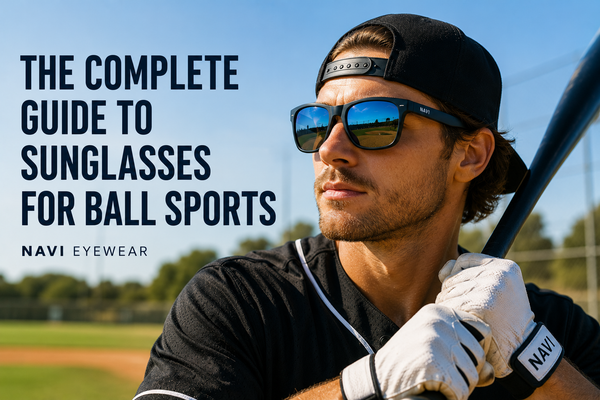

QUICK ANSWERBall sports demand more from sunglasses than almost any other outdoor activity. Sky tracking, fast object movement, glare from playing surfaces, and collision risk all place simultaneous demands on lens performance, impact resistance, frame security, and visual clarity. The consistent specification across every ball sport: UV400 certified polycarbonate lenses (impact resistant, structurally protective), polarized to eliminate surface glare, amber or brown tint for contrast enhancement and object tracking, and a sport frame with secure retention. The details vary by sport — this guide covers every major ball sport in depth. |

Contents
1. Why Ball Sports Are the Highest-Demand Environment for Sunglasses
2. The Core Lens Science Behind Sport Visual Performance
3. Frame and Fit Requirements for Active Sport
4. Baseball and Softball
5. Tennis
6. Pickleball
7. Soccer and Field Sports
8. Beach Volleyball and Sand Sports
9. Motorsports and Racing
10. At-a-Glance Sport Comparison Table
11. Scenario Table: UV Risk and Lens Recommendation by Sport
12. Frequently Asked Questions
13. Supporting Articles in This Cluster
1. Why Ball Sports Are the Highest-Demand Environment for Sunglasses
Sky Tracking: The Unique Visual Challenge
Most outdoor activities involve looking forward, downward, or laterally across a landscape. Ball sports regularly require looking directly upward into bright sky — tracking a fly ball, serving in tennis, heading a soccer ball, jumping for a volleyball spike. This upward-gaze axis is the most UV-intense direction of view because it looks directly at or near the solar path. UV from directly above the eye is less filtered by the brow and surrounding face structure than lateral or downward UV.
The sky-tracking demand also creates an acute glare problem. Looking up into sky during a high-contrast outdoor scene — bright sky above, dark playing surface below — creates extreme luminance range that challenges the human visual system. Lenses that manage this contrast range while maintaining object visibility against sky are a genuine visual performance tool, not just UV protection.
Fast Object Tracking: The Contrast Requirement
Tracking a fast-moving ball against complex visual backgrounds — sky, crowd, stadium, other players — requires the visual system to rapidly distinguish the object from its background. Contrast sensitivity is the relevant visual capacity: the ability to see differences between an object and its surroundings. Certain lens tints specifically enhance contrast sensitivity in outdoor sport conditions, making fast-moving objects more visible against typical backgrounds.
This is not a subtle effect. Athletes who switch from non-polarized fashion sunglasses or no eyewear to quality polarized amber or brown lenses in outdoor sport contexts consistently report improved ability to track the ball, especially in high-glare or high-contrast lighting conditions. The effect is most pronounced in sports with small, fast-moving objects against sky or bright backgrounds — baseball, tennis, pickleball.
Impact Risk: Why Lens Material Is Non-Negotiable
Ball sports carry inherent impact risk to the face and eyes — from the ball itself, from collisions with other players, from contact with equipment, or from falling. Standard fashion sunglass lenses — optical resin or glass — can shatter into sharp fragments on impact, converting a routine sports incident into a serious eye injury. Polycarbonate is the only lens material appropriate for ball sports: it is approximately 10 times more impact resistant than optical resin and does not shatter into sharp fragments on contact. In the US, ASTM F803 establishes impact resistance standards for protective eyewear in specific sports; polycarbonate lenses in properly designed sport frames provide impact protection that standard fashion frames cannot match.
→ ASTM F803 protective eyewear standards
Frame Security: Staying In Place During Athletic Movement
A sunglass frame that shifts, slides, or falls off during play is worse than no sunglasses — it introduces a distraction and a vision interruption at exactly the moments when visual focus is most critical. Ball sport frames need to be designed for secure retention during rapid directional changes, jumping, crouching, and the general physical intensity of competitive sport. This means sport-specific frame design: rubber grip on nose and temple contacts, close-fitting wraparound geometry, and for high-intensity or youth sport, optional elastic retention.
2. The Core Lens Science Behind Sport Visual Performance
Polarization: Eliminating Surface Glare
Polarization is the most impactful optical property for outdoor ball sports after UV400 certification. Natural light scatters in all directions; when it reflects off horizontal surfaces — grass, court, sand, water — it becomes predominantly horizontally polarized. This horizontally polarized reflected light is what creates glare: the intense brightness from playing surfaces that causes squinting, reduces contrast, and makes it harder to see objects clearly. Polarized lenses contain a chemical filter oriented to block horizontally polarized light while passing all other light. The result is elimination of surface glare, reduction of overall brightness, and a significant improvement in contrast and visual clarity on the playing surface. For the complete science, seehow polarized lenses work.
Amber and Brown Tints: The Sport Contrast Enhancers
Not all polarized lenses perform identically in sport contexts. Lens tint determines which wavelengths of light are transmitted, and for outdoor ball sports, amber and brown tints provide a specific advantage over gray tints. Amber and brown polarized lenses block more blue light, which scatters more than other wavelengths and reduces contrast in outdoor environments. By reducing blue scatter, amber and brown tints improve contrast sensitivity — the ability to distinguish objects from backgrounds — making fast-moving balls more visible against sky, crowd, and field backgrounds. Gray polarized provides color-accurate, brightness-reduced vision and is excellent for everyday and driving use; amber and brown polarized provides enhanced contrast that is specifically beneficial for tracking fast-moving objects in sport. For the complete tint guide, seethe science of lens color.
UV400 Certification: The Health Foundation
Every recommendation in this guide assumes UV400 certified lenses — 100% UVA and UVB blocking to 400 nanometers. UV exposure during outdoor sport is among the highest of any recreational activity: extended duration, peak daylight hours, and high-reflectance playing surfaces that amplify UV from below compound the direct overhead exposure. The cumulative UV dose from regular outdoor sport across a playing career is substantial, and the cataract, macular degeneration, and pterygium risk associated with unprotected UV accumulation is well documented. UV400 is the non-negotiable foundation; performance properties build on top of it. BrowseUV400 polarized options at navieyewear.com.
Lens Category by Intensity
Lens category (Cat 1–4) refers to the percentage of visible light the lens transmits:
Most outdoor ball sports in direct daylight are best served by Cat 2–3 amber or brown polarized. Cat 3 is appropriate for peak-sun beach, baseball, and tennis; Cat 2 for morning/evening sessions or overcast conditions.
3. Frame and Fit Requirements for Active Sport
Wraparound Design
Sport-specific frames use a slight-to-moderate wraparound design that provides peripheral coverage and keeps lenses in contact with the face during movement. Standard flat-front fashion frames create gaps at the periphery that allow glare and UV to enter from the sides — a meaningful performance and protection deficit during lateral movement in sport. The wraparound geometry of sport frames also provides better frame stability during movement, reducing the tendency to shift or bounce during running and jumping.
Rubber Grip Contact Points
Nose pads and temple contact points in sport frames are typically rubberized or made from silicone — materials that grip rather than slide on skin, even when wet with sweat. The difference between a rubberized nose pad and a smooth plastic one is significant during a two-hour outdoor sport session in warm conditions. Frames that slide down the nose during play are a consistent source of distraction and a safety risk; rubber grip nosepad materials largely eliminate this problem.
Lens Coverage and Brow Protection
Sport frames are designed with deeper lens coverage than fashion frames — covering more of the orbital area and extending closer to the brow. This matters for UV protection from overhead sun and for impact protection. In ball sports specifically, the depth of lens coverage determines how much of the eye orbital area is shielded from a direct-impact scenario. Sport frames with adequate brow coverage provide meaningfully better protection than fashion frames with minimal lens depth.
Weight and Comfort for Extended Wear
A frame worn for a two-hour sport session needs to be comfortable enough to forget about. Heavy frames create pressure fatigue on the nose and ears that becomes a distraction over time. TR90 nylon — the frame material in quality sport sunglasses — is significantly lighter than standard acetate or metal frames, maintains flexibility across temperature ranges, and does not conduct heat in the way metal frames do in direct sun. For any sport involving extended outdoor duration, frame weight is a practical performance factor.
4. Baseball and Softball
The Sky-Tracking Problem
No mainstream ball sport creates a more acute sky-tracking UV and glare challenge than baseball and softball. Outfielders tracking fly balls, infielders reading pop-ups, and batters picking up ball trajectory all require upward gaze directly into sky at varying sun angles across a multi-hour game. The transition from looking at ground-level play to sky-tracking a ball traverses the most extreme luminance range encountered in any ball sport.
The classic baseball player's response to this — flipping down a hat brim to shade the eyes — is a partial solution that reduces overhead glare but does nothing for UV protection. Quality polarized amber or brown lenses in a sport frame with good brow coverage solve both problems simultaneously: UV protection, glare reduction, and contrast enhancement that makes the ball more visible against sky.
→ See the dedicated guide: Sunglasses for Baseball and Softball
Lens Recommendation for Baseball and Softball
Position-Specific Notes
Outfielders benefit most from sky-tracking optimized lenses — amber Cat 3 for bright conditions. Catchers face a different challenge: close-range pitch tracking from a low position, often looking directly into light reflected off the pitcher's mound and infield. Amber or copper polarized suits catcher positioning well. Infielders deal with ground ball glare and short-range tracking — amber polarized handles both. Pitchers face the most variable gaze direction across all positions and benefit from a versatile amber or brown Cat 2–3 that handles both sky tracking and field-level vision.
5. Tennis
The Court Glare Environment
Tennis courts — particularly hard courts and clay courts in full sun — produce significant reflected glare from the court surface. The white and light-gray court colors used in most professional facilities are chosen for visibility at the expense of glare management; they reflect a high proportion of both visible and UV radiation upward toward players' faces. Combined with the side-to-side lateral movement that brings the sun into the visual field from multiple angles, tennis creates a sustained glare environment that persists across the full duration of a match.
Polarized lenses eliminate the court surface glare that standard tinted lenses only reduce. The combination of polarization and amber or brown tint provides both glare elimination and contrast enhancement for ball tracking against court and sky backgrounds. See the dedicated guide tosunglasses for tennis for the complete breakdown.
Lens and Frame for Tennis
6. Pickleball
The Fastest-Growing Outdoor Sport Has Unique Glare Demands
Pickleball courts are typically built on repurposed tennis courts or purpose-built outdoor surfaces, often in full sun with minimal overhead cover. The smaller court dimensions mean players are closer to each other and to the ball, with a faster reaction time requirement for visual tracking. The pickleball itself — typically yellow or green against court and sky backgrounds — benefits from contrast-enhancing amber or brown lenses that make the bright ball color more distinct against variable backgrounds. See the dedicated guide tosunglasses for pickleball for sport-specific depth.
Age Demographic and UV Priority
Pickleball has a significant demographic in the 50+ age group — players who have accumulated substantial lifetime UV dose and for whom additional UV accumulation from regular outdoor sport is a genuine eye health concern. For this demographic, UV400 protection is not an abstract future-health argument; the cumulative UV effects of cataracts, macular degeneration, and pterygium are risks with immediate relevance. Consistent UV400 polarized wearing during pickleball is a high-value health behavior for this demographic.
Lens Recommendation for Pickleball
7. Soccer and Field Sports
Duration and Exposure Accumulation
Soccer and other field sports — lacrosse, field hockey, rugby — share a characteristic that makes them particularly high UV accumulation activities: extended duration outdoors. A 90-minute soccer match, plus warm-up and cool-down, means 2+ hours of outdoor UV exposure during the primary playing season, typically in peak afternoon sun. Multiply this by practice sessions and a full season schedule, and outdoor field sport athletes accumulate among the highest UV doses of any recreational participant group.
The Movement Challenge
Soccer's multidirectional movement — sprinting, changing direction rapidly, heading the ball overhead — creates frame security demands similar to running but with the additional sky-tracking element of aerial ball challenges. A frame that shifts during a sprint or a header is a distraction that affects play. Sport-specific close-fitting frames with rubber grip contact points handle soccer's movement demands effectively.
Lens Recommendation for Soccer and Field Sports
8. Beach Volleyball and Sand Sports
The Highest UV Environment in Ball Sports
Beach volleyball combines every UV amplification factor simultaneously: direct overhead sun, sand surface reflecting UV upward (sand reflectance approximately 15–25% of UV), water proximity adding additional reflection, and coastal environments where UV index is further amplified by reduced atmospheric scattering. A beach volleyball session in peak summer produces UV exposure that rivals or exceeds a ski day — and without the cultural habit of wearing UV protection that ski slopes have established.
Sand glare is specifically addressed by polarized lenses — the horizontal surface reflection from sand is polarized and eliminated by polarization filters. For beach volleyball and other sand sports, polarized UV400 is not an upgrade; it's a practical necessity for comfortable visual function. BrowseUV400 polarized lenses at navieyewear.com.
Frame Considerations for Sand Environments
Sand is abrasive. Frames that trap sand in hinge mechanisms or lens grooves develop accelerated wear in beach environments. Simple hinge design, closed lens grooves, and materials that rinse clean — silicone and TR90 nylon — perform better in sand environments than complex frame architectures. Anti-saltwater coating on lenses is valuable for beach environments where salt spray is a consistent factor.
Lens Recommendation for Beach Volleyball
9. Motorsports and Racing
A Different Ball Sport: Speed, Wind, and UV
Motorsports — go-kart racing, motocross, track cycling, autocross — present a specific UV and visual challenge: high-speed movement in open environments where wind, vibration, and UV exposure combine. While not a 'ball sport' in the traditional sense, the visual performance demands (contrast tracking, glare management) and frame security requirements (frames must not shift or dislodge at speed) align closely with the ball sport category. The dedicated guide tosunglasses for motorsports and racing covers this context in full.
Lens Recommendation for Motorsports
NAVI EYEWEAR — UV400 POLARIZED SUNGLASSESBuy 1, Get Any 3 Pairs Free — $119.00 for 4 pairs. Discount auto-applies at cart. Free shipping. Free replacements. 30-day return on unworn pairs. Every lens: UV400 certified polycarbonate · FDA-cleared impact resistance · polarized PVA film · oleophobic coating · anti-saltwater coating · TR90 nylon frames · stainless 5-barrel hinges. |
10. At-a-Glance Sport Comparison Table
|
Sport |
Best Tint |
Category |
Key Challenge |
Frame Priority |
|
Baseball / Softball |
Cat 2–3 |
Sky tracking, ball vs sky contrast |
Brow coverage, wraparound, rubber grip |
|
|
Tennis |
Cat 2–3 |
Court glare, lateral movement |
Secure retention, close-fit wrap |
|
|
Pickleball |
Cat 2–3 |
Fast close-range tracking, UV accumulation |
Lightweight, rubber grip, UV400 |
|
|
Soccer / Field sports |
Cat 2–3 |
Duration UV exposure, movement security |
Lightweight wrap, rubber retention |
|
|
Beach volleyball |
Cat 3 |
Sand + water UV reflection, extreme glare |
Anti-salt coating, simple clean design |
|
|
Motorsports |
Cat 2–3 |
Wind, speed, vibration security |
Maximum retention, oleophobic coating |
11. Scenario Table: UV Risk and Lens Recommendation by Condition
|
Condition / Setting |
UV Risk |
Recommended Lens |
Notes |
|
Peak summer afternoon, outdoor field |
Very High |
Highest UV accumulation context — consistent wearing essential |
|
|
Morning or evening sport session |
Moderate |
Lower UV but still meaningful; Cat 2 provides comfortable brightness |
|
|
Overcast outdoor sport |
Low–Moderate |
Clouds transmit ~80% UV; contrast enhancement still valuable |
|
|
Beach or sand court, full sun |
Very High |
Sand and water amplify UV; polarization eliminates surface glare |
|
|
Indoor-to-outdoor transition sport |
Variable |
Variable conditions benefit from adaptive lens or medium Cat |
|
|
High altitude outdoor sport (ski, trail) |
Very High |
UV increases 10–12% per 1,000m; snow reflects 80% of UV |
12. Frequently Asked Questions
What's the best lens tint for outdoor ball sports?
Amber or brown polarized UV400 is the standard recommendation across most outdoor ball sports. These tints block blue scatter, enhance contrast, and improve ball visibility against sky, court, and field backgrounds — while polarization eliminates surface glare from playing surfaces. Gray polarized is better for driving and everyday use but provides less contrast enhancement in sport contexts. See the full tint breakdown atthe science of lens color.
Do I need polarized lenses for sport, or is UV400 enough?
Both matter, and together they perform better than either alone. UV400 provides the health protection — 100% UVA and UVB blocking — that prevents cumulative eye damage from outdoor sport UV exposure. Polarization adds the performance dimension: eliminating horizontal surface glare from playing surfaces that causes squinting, reduces contrast, and creates visual fatigue over the course of a game. For outdoor ball sports, polarized UV400 is the correct combined specification. Browsepolarized UV400 options at navieyewear.com.
Can I wear my regular sunglasses for sport?
Fashion sunglasses in standard optical resin or glass lenses are not appropriate for contact-risk ball sports. The impact risk in baseball, tennis, and field sports makes polycarbonate lenses a safety requirement, not a preference. Fashion frames also typically lack the secure retention, rubber grip, and close-fitting design that keeps eyewear in place during athletic movement. If your regular sunglasses are UV400 polarized polycarbonate in a close-fitting frame with rubber grip contact points, they may be adequate for lower-impact sports like pickleball or golf. For baseball, soccer, and tennis with significant impact risk, sport-specific frames are the appropriate choice.
What about prescription sunglasses for sport?
Prescription sport eyewear in UV400 polycarbonate is the correct solution for prescription-dependent athletes. Standard prescription sunglasses in fashion frames carry the same impact and retention risks as non-prescription fashion frames. Sport prescription goggles — wrap-design frames with polycarbonate lenses and prescription correction — are available from optical providers and are the appropriate solution for athletes who require vision correction. Athletes in contact-risk sports who wear contact lenses under non-prescription sport sunglasses should ensure their lens choice includes UV400 — some contact lens materials provide a degree of UV blocking but not as a substitute for eyewear UV protection.
Are photochromic lenses good for ball sports?
Photochromic lenses — which darken in UV and lighten indoors — can work in sport contexts where athletes move between indoor and outdoor environments. The limitation for outdoor sport is transition speed: most photochromic lenses take 20–60 seconds to reach full darkness in UV conditions, during which contrast is compromised. For sports played fully outdoors in consistent conditions, a fixed Cat 2–3 amber or brown polarized provides more reliable performance than a photochromic that is still transitioning. For sports with indoor-outdoor transitions (some tennis facilities, basketball that moves outside), photochromic UV400 is a reasonable choice.
Do sunglasses affect depth perception in sport?
Quality polycarbonate lenses in sport frames should have no effect on depth perception when the lenses are optically flat and correctly curved. Optical distortion — which can affect depth perception — is a quality issue, not an inherent property of sport sunglasses. Check lenses by looking through them at a straight horizontal line; if the line appears curved, the lens has distortion that should disqualify it for sport use. Polarization itself does not affect depth perception; the contrast enhancement it provides can actually improve the visibility of depth cues like ball position and court markings.
What's the difference between sport sunglasses and sport goggles?
Sport sunglasses are standard frame designs optimized for athletic use — close-fitting, rubber grip, wraparound, polycarbonate lenses. Sport goggles are sealed-frame designs with full peripheral coverage and often elastic strap retention, providing higher impact protection and more complete eye coverage. Sport goggles are appropriate for high-impact contact sports (racquetball, squash, basketball), snow sports, and water sports. For most outdoor ball sports — baseball, tennis, soccer, pickleball — quality sport sunglasses provide appropriate impact and UV protection without the full coverage of goggles.
How do I keep sport sunglasses from fogging?
Fog forms when warm humid air from the face contacts cool lens surfaces. Sport sunglasses are designed with ventilation channels — gaps between the lens and frame that allow airflow and reduce fogging compared to sealed goggles. Anti-fog coatings are available for lenses and help in moderate conditions. In very humid or rapidly temperature-changing conditions (moving from cold to warm environments), fogging can still occur; the practical solutions are ventilated sport frame design and anti-fog lens treatment. For most outdoor ball sports in non-extreme conditions, ventilated sport frames with standard lenses manage fog effectively.
How do I care for sport sunglasses after use?
Rinse with clean water after use in sandy, salty, or sweat-heavy conditions — particularly for beach sport. Use a microfiber cloth for lens cleaning; never wipe dry sand or grit across the lens surface as this scratches the coating. Oleophobic coatings on quality lenses repel sweat, oils, and environmental contaminants, making cleaning easier and protecting against staining. Store in a hard case when not in use — sport frames in bags with other equipment get the most abuse. TR90 nylon frames tolerate rough handling better than acetate or metal, but the lenses benefit from case protection.
Supporting Articles
→ Best Sunglasses for Baseball and Softball | Navi Eyewear
→ Best Sunglasses for Tennis | Navi Eyewear
→ Best Sunglasses for Pickleball | Navi Eyewear
→ Best Sunglasses for Motorsports and Racing | Navi Eyewear
→ Best Sunglasses for Beach Volleyball | Navi Eyewear
Perform Better. Protect Your Eyes. Do Both.Navi Eyewear UV400 polarized sunglasses: UV protection and sport visual performance in one. Buy 1, Get Any 3 Pairs Free for $119.00 — four pairs of UV400 certified polycarbonate polarized lenses. Free shipping. Free replacements. 30-day return. |
Sources & Citations[1] Dain SJ."Sunglasses and sunglass standards."Clinical and Experimental Optometry, 2003.View source → [2] Rosenthal FS, et al.."The effect of sunglasses on ocular exposure to ultraviolet radiation."American Journal of Public Health, 1988.View source → [3] Sliney DH."Ocular exposure to environmental light and ultraviolet."Journal of AAPOS, 2014.View source → [4] West SK, et al.."Exposure to sunlight and other risk factors for age-related macular degeneration."Archives of Ophthalmology, 1989.View source → [5] Taylor HR, et al.."Effect of ultraviolet radiation on cataract formation."New England Journal of Medicine, 1988.View source → [6] ASTM International."Standard performance specification for eye protectors for selected sports — F803."ASTM Standards, 2017.View source → [7] WHO."Global solar UV index: a practical guide."World Health Organization, 2002.View source → [8] American Academy of Ophthalmology."Protective eyewear for young athletes."AAO EyeSmart, 2022.View source → |