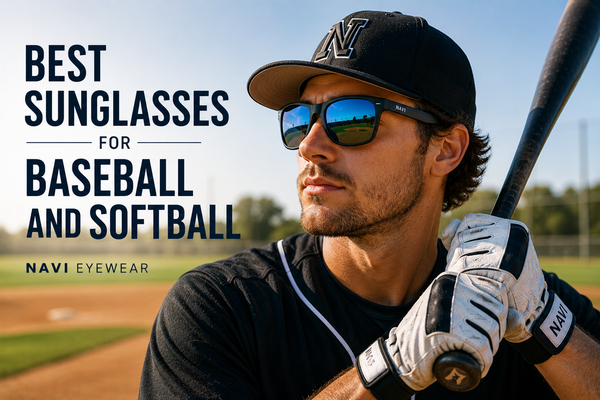

QUICK ANSWERFor baseball and softball: amber or brown polarized UV400 polycarbonate lenses in a close-fitting wraparound sport frame with rubber grip retention. Amber or brown tint enhances contrast for ball-vs-sky tracking and infield visibility. Polarization eliminates glare from infield dirt, outfield grass, and white-painted boundary lines. Polycarbonate is mandatory for impact safety. Position matters — outfielders and fly-ball situations demand the strongest sky-tracking lens, while catchers benefit from tints that handle low-angle reflected glare from the mound area. |

Baseball and softball sit near the top of any ranking of outdoor sports by visual demand. The combination of sky tracking, fast-moving small objects, extreme luminance contrast between sky and playing surface, hours of peak-UV exposure, and meaningful ball impact risk creates a specification list that eliminates most fashion sunglasses immediately. Getting the lens right for diamond sports makes a perceptible, immediate difference in playing performance — and the UV protection argument is a long-term health case that compounds with every season on the field.
For the complete framework covering all ball sports, see thecomplete guide to sunglasses for ball sports. This post focuses specifically on what works for baseball and softball players at every level.
1. The Visual Challenges Unique to Baseball and Softball
Sky Tracking: The Defining Visual Demand
No mainstream sport requires upward gaze into direct sky as routinely as baseball and softball. Every fly ball, pop-up, and high line drive demands that fielders shift gaze from ground-level play to directly overhead in a fraction of a second — and hold that gaze while tracking a fast-moving object against bright sky. This upward gaze into sky is the highest-UV-intensity visual direction available: it points directly toward the UV source, with minimal filtering from the brow or facial structure.
The contrast problem compounds the UV problem. Looking up at a white ball against bright blue sky is among the most extreme luminance contrast ratios encountered in any sport — the ball is a bright object against an already bright background, with no dark reference to help the visual system calibrate. Tints that enhance contrast in this specific situation (amber and brown, which reduce blue scatter) make the ball more visible against sky. Tints that simply reduce brightness overall (gray) help with glare but provide less contrast advantage against bright-sky backgrounds.
Infield and Outfield Glare
Ground-level glare from infield dirt, outfield grass, and foul-line chalk creates a sustained reflective environment for fielders tracking ground balls and line drives. This horizontal surface glare is exactly what polarized lenses are designed to eliminate — the Brewster's Law polarization filter blocks horizontal reflected light while transmitting direct and scattered light. A fielder with polarized lenses sees a ground ball against a glare-free surface; one without polarization is contending with surface reflections that reduce the contrast of the ball against the field.
UV Exposure Duration: A Multi-Hour High-UV Commitment
A baseball or softball game runs 2–3 hours. Season schedules mean regular participants accumulate 100+ hours of peak UV outdoor exposure per season. Career-level participants — high school athletes, adult league players, coaches — accumulate UV doses from baseball that represent a substantial proportion of lifetime UV exposure. The cataract and macular degeneration risk associated with this level of unprotected UV accumulation is documented and significant.
→ UV and cataract risk across the lifespan — PubMed
Ball Impact Risk
A baseball pitched at 90 mph or hit as a line drive carries enough kinetic energy to cause serious eye injury. Even in recreational softball and youth baseball, errant balls reaching the face are a real hazard. Polycarbonate lenses — approximately 10 times more impact resistant than standard optical resin, and non-shattering — are the only appropriate lens material for any fielding position in baseball or softball. This is not a performance preference; it is a safety requirement that should be non-negotiable at every level of play.
2. Lens Recommendations: Tint, Polarization, and Category
Amber Polarized: The Primary Baseball Lens
Amber polarized UV400 polycarbonate is the consensus best-in-class lens for baseball and softball across most playing conditions. The amber tint reduces blue light scatter — the atmospheric scattering that reduces contrast in bright sky conditions — while enhancing object definition against variable backgrounds. For outfielders tracking fly balls against sky, the contrast improvement over gray or non-polarized lenses is immediately perceptible. For infielders reading ground balls against sun-lit dirt and grass, polarization eliminates the surface glare that gray lenses only partially address. Browseamber and polarized UV400 options at navieyewear.com.
Brown Polarized: The Alternative
Brown polarized UV400 provides similar contrast enhancement to amber with a slightly warmer color rendering. Some players prefer brown over amber for its natural color tone — it provides contrast enhancement without the yellow-orange shift that amber lenses produce. For players who find amber tint changes colors in ways they find distracting, brown polarized is the natural alternative with very similar performance characteristics.
When to Consider Gray Polarized
Gray polarized UV400 is color-neutral — it reduces brightness without shifting color rendering. For baseball, gray polarized is a valid choice in very bright conditions (Cat 3 gray for intense afternoon sun) where overall brightness reduction is the priority and sky-tracking contrast is less critical — typically infielders and catchers who spend less time in sky-tracking gaze directions. Gray polarized is also the correct choice fordriving to and from the game — amber tints are not ideal for driving because they shift color rendering in ways that can affect traffic light discrimination in some conditions.
Lens Category by Playing Conditions
|
Condition |
Category |
Tint |
Notes |
|
Bright afternoon sun, direct overhead |
Cat 3 |
Peak UV and glare — standard mid-season afternoon game condition |
|
|
Morning or evening game, lower sun angle |
Cat 2 |
Lower UV but sun at low angle creates glare from equipment and surfaces |
|
|
Overcast or cloudy game day |
Cat 1–2 |
Clouds transmit ~80% UV; contrast enhancement still valuable |
|
|
Domed or shaded stadium with outdoor gaps |
Cat 1–2 |
Variable light; lighter category prevents over-darkening in shade |
|
|
Tournament all-day play, variable conditions |
Cat 2 |
Medium category versatility across morning through afternoon games |
3. Position-Specific Recommendations
Outfielders
Sky tracking is the outfielder's primary visual challenge. Fly balls, gap shots, and deep line drives all require upward gaze into sky at varying sun angles across a full game. The outfielder benefits most from amber or brown polarized Cat 3 in peak-sun conditions: maximum contrast for ball-vs-sky visibility, with polarization managing the grass glare of the outfield. Frame coverage matters here — a sunglass with good brow coverage provides better shading when the sun is directly overhead, supplementing the lens tint's brightness management.
Infielders
Infielders face a different primary visual challenge: short-range tracking of ground balls and line drives across highly reflective infield dirt. Polarization is particularly valuable here, eliminating the horizontal surface reflection from infield dirt that reduces ground ball contrast. Amber polarized Cat 2–3 handles the full range of infield visual conditions. Frame security is critical for infielders who dive, slide, and make rapid directional changes — rubber grip nose and temple contact points prevent shifting during explosive movements.
Catchers
The catcher's position involves looking directly out from a crouching position, tracking pitches coming toward the face from 60 feet away and reading infield play from behind the plate. The primary glare source for catchers is reflected light from the pitcher's mound area and the sun at low-to-mid angles. Amber or copper polarized UV400 handles catcher viewing angles well. Note: catchers wear a helmet and mask during play — sunglasses need to be compatible with catching gear, which means close-fitting frames without wide temples that conflict with the mask fit.
Pitchers
Pitchers face the most variable gaze direction of any position — tracking batters, fielders, base runners, and the plate from the mound involves looking in nearly every direction across the course of an inning. Versatile amber polarized Cat 2–3 is the standard recommendation. Pitchers in afternoon games with the sun behind the plate may face direct sun-glare when looking toward home plate — amber Cat 3 with good polarization handles this condition well. Frame stability is important: a frame that shifts during the pitching motion is a distraction on every pitch.
Batters
Batting creates a unique visual challenge: tracking a pitched ball from the pitcher's hand to the plate — approximately 60 feet of travel in under half a second for a 90 mph pitch — against a background that includes the center field scoreboard, crowd, and sky. The batter needs maximum contrast against complex backgrounds. Amber polarized is the consistent recommendation; Cat 2 is typically preferred over Cat 3 for batting because very dark lenses can make pitch-tracking harder in lower-light or shadow conditions. Many batters remove sunglasses for their at-bats and wear them in the field — a legitimate choice given the rapid light transitions involved.
NAVI EYEWEAR — UV400 POLARIZED SUNGLASSESBuy 1, Get Any 3 Pairs Free — $119.00 for 4 pairs. Discount auto-applies at cart. Free shipping. Free replacements. 30-day return on unworn pairs. Every lens: UV400 certified polycarbonate · FDA-cleared impact resistance · polarized PVA film · oleophobic coating · anti-saltwater coating · TR90 nylon frames · stainless 5-barrel hinges. |
4. Frame Specifications for Baseball and Softball
Impact Resistance: The Safety Non-Negotiable
Polycarbonate lenses are mandatory for baseball and softball. This is not a performance preference — it is a safety baseline. A standard fashion sunglass lens can shatter into sharp fragments on ball impact; a polycarbonate lens deforms and absorbs impact energy without shattering. The difference between a sports eye injury that causes temporary pain and one that causes permanent vision loss is often the lens material in the eyewear that was — or wasn't — being worn.
Wraparound Geometry
Close-fitting wraparound frames keep lenses in place during the directional changes, dives, and rapid movements of field play while providing peripheral coverage from lateral sky and surface UV. Standard flat-front fashion frames create gaps at the periphery that allow UV ingress from the sides and create lens-shift instability during movement. For any position involving running and diving — which is every position — wraparound design is the practical frame choice.
Rubber Grip and Sweat Management
Baseball and softball are warm-season sports played in conditions that produce substantial sweat. Rubber or silicone nose pad and temple contact surfaces grip wet skin rather than sliding — the difference between frames that stay in place through a full game and frames that require constant adjustment. Oleophobic lens coatings repel sweat and fingerprints, keeping the optical surface cleaner throughout a game.
Brow Coverage
Frame depth — how far the lens extends upward toward the brow — matters specifically for sky-tracking positions. Deep-lens frames provide a shading effect when tracking overhead fly balls that supplements the tint's brightness management. Shallow fashion frames leave the brow area open, allowing overhead glare to enter the eye around the top of the lens. Sport frames designed for baseball-specific use typically have deeper lens coverage than general sport frames.
Compatibility With Batting Helmets and Catching Gear
Frames must be compatible with batting helmets and catching equipment. Close-fitting sport frames without wide temple arms generally work well under batting helmets. For catchers, narrow temple arms that don't conflict with mask straps are the key fit consideration. Frames with flared or wide decorative temple arms are likely to conflict with both helmets and catching gear.
5. Softball-Specific Considerations
Pitching Angles and Trajectory
Softball pitching is underhand and produces different ball trajectories than baseball — balls approach from below the release point and rise before reaching the plate in some delivery styles. The visual tracking challenge is different in character from overhand baseball pitching, and batters in softball sometimes find that tracking the rise and movement of a softball pitch benefits from slightly different contrast conditions than baseball. Amber polarized remains the standard recommendation, with the same Cat 2–3 range.
Fielding in Women's Fastpitch
Women's fastpitch softball involves the same sky-tracking demands as baseball outfield play, with the added variable that fast-pitch delivery means fielders need to react to batted balls coming off the bat rapidly after pitch contact. The visual preparation between pitches involves reading the pitcher's delivery, position in the field, and potential defensive assignments — all under the same bright sun conditions. Amber polarized UV400 in a secure sport frame handles the full visual range of fastpitch fielding.
Recreational and Slow-Pitch Softball
Recreational slow-pitch softball involves more lofted ball trajectories with more air time — the outfield sky-tracking component is arguably more prominent than in fastpitch because the ball spends more time in the air. The same amber polarized Cat 2–3 recommendation applies. The UV exposure is identical regardless of competitive level — 2–3 hours of outdoor play in peak sun accumulates meaningful UV dose whether the context is recreational league or competitive tournament.
Frequently Asked Questions
What color lens is best for baseball?
Amber polarized UV400 is the standard recommendation for most playing positions and conditions. Amber tint reduces blue scatter and enhances contrast for ball-vs-sky tracking. Brown polarized is a close alternative with similar performance and slightly warmer color rendering. Gray polarized is color-neutral and suitable for very bright conditions where brightness reduction is the priority over contrast enhancement — better for infielders and catchers than outfielders. Browsepolarized UV400 options at navieyewear.com.
Do MLB players wear sunglasses?
Yes — sunglasses are standard equipment for MLB outfielders and are widely used by infielders and pitchers. Professional players consistently select amber or brown polarized sport lenses for their sky-tracking performance advantage. The flip-down sunglasses visible on outfielders tracking fly balls in television coverage are typically sport-specific polarized amber or brown lenses designed specifically for ball-vs-sky contrast.
Are polarized lenses good for baseball?
Yes — polarized lenses eliminate horizontal surface glare from infield dirt, outfield grass, and white boundary lines that standard tinted lenses only reduce. For ground ball tracking and general field-level vision, polarization is a meaningful performance upgrade over non-polarized lenses of equivalent tint. The combination of polarized and amber tint covers both the sky-tracking contrast case (amber) and the surface glare case (polarized) simultaneously.
Can I wear regular sunglasses to play baseball?
Not safely. Standard fashion sunglasses in optical resin or glass can shatter on ball impact, creating a serious eye injury risk. Polycarbonate lenses are the safety requirement for any position with ball impact exposure — which in baseball and softball means every fielding position and the batting box. Fashion frames also typically lack the secure retention and close-fitting geometry needed to stay in place during athletic movement.
What sunglasses do outfielders use?
Outfielders prioritize sky-tracking contrast and polarization for grass glare. The standard is amber or brown polarized UV400 polycarbonate in a close-fitting wraparound sport frame with good brow coverage. At the professional level, custom-tinted and prescription sport frames from optical sport specialists are common. At recreational through collegiate levels, quality sport frames with amber polarized polycarbonate lenses provide the same optical performance at significantly lower cost.
Do sunglasses help you hit a baseball?
Sunglasses don't make hitting mechanically easier, but they can improve the visual conditions for tracking pitches. For batters dealing with bright sun behind the mound or in the background, polarized amber UV400 reduces glare and improves contrast on the pitcher's delivery area. The more common performance benefit is fielding — most players report more immediate improvement in outfield and infield play than at the plate, where the visual challenge is pitch-tracking speed rather than glare.
What UV protection do baseball players need?
UV400 — 100% UVA and UVB blocking to 400 nanometers — is the standard for any outdoor sport UV protection. Regular baseball players accumulate substantial lifetime UV dose from season play, and the cataract and macular degeneration risk associated with unprotected UV accumulation is well documented. UV400 is the health protection baseline; polarization and amber tint are the performance layer on top. SeeUV and eye disease prevention for the full evidence.
How do I keep sunglasses from flying off during play?
Rubber grip nose pad and temple contact surfaces are the primary retention mechanism — they grip wet skin better than smooth plastic. Close-fitting wraparound design keeps the frame from catching wind or shifting during rapid movement. For youth players and very active adults, elastic sport retention straps provide an additional securing mechanism. The combination of rubber grip contact points and close-fitting frame geometry handles the retention demands of baseball and softball without needing additional retention hardware for most players.
The Bottom Line
For baseball and softball, amber or brown polarized UV400 polycarbonate in a close-fitting wraparound sport frame is the correct specification — at every position and every level of play. The contrast enhancement of amber tint, the glare elimination of polarization, the impact safety of polycarbonate, and the retention of a sport-fit frame work together to address every visual demand diamond sports create. This is the specification that professional players use; quality execution of it is available at a fraction of professional equipment pricing. For UV400 polarized polycarbonate sunglasses that deliver on this specification:navieyewear.com/collections/polarized — Buy 1, Get 3 Free for $119.
Sources & Citations[1] Taylor HR, et al.."Effect of ultraviolet radiation on cataract formation."New England Journal of Medicine, 1988.View source → [2] Dain SJ."Sunglasses and sunglass standards."Clinical and Experimental Optometry, 2003.View source → [3] Rosenthal FS, et al.."The effect of sunglasses on ocular exposure to ultraviolet radiation."American Journal of Public Health, 1988.View source → [4] ASTM International."Standard performance specification for eye protectors for selected sports — F803."ASTM Standards, 2017.View source → [5] American Academy of Ophthalmology."Protective eyewear for young athletes."AAO EyeSmart, 2022.View source → [6] Sliney DH."Ocular exposure to environmental light and ultraviolet."Journal of AAPOS, 2014.View source → |