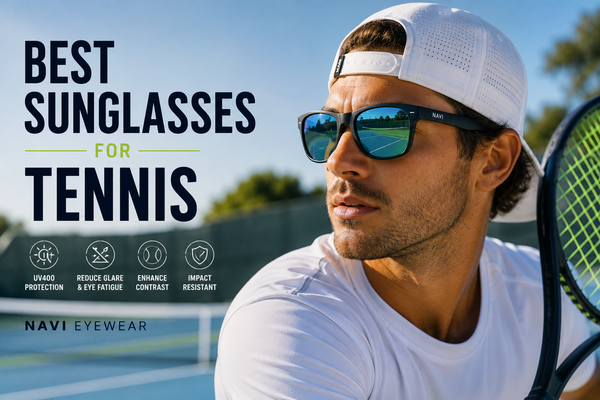

QUICK ANSWERFor tennis: amber or brown polarized UV400 polycarbonate in a close-fitting wraparound sport frame with rubber grip retention. Amber or brown tint enhances ball visibility against court and sky backgrounds. Polarization eliminates hard court surface glare. Polycarbonate provides impact protection from ball and racket face contact. Secure retention handles the lateral movement, overhead smashes, and net volleys that make frame stability critical. Court surface color matters — hard court, clay, and grass each create different glare profiles that influence optimal tint choice. |

Tennis is one of the few outdoor sports where players encounter sustained, high-intensity glare from multiple simultaneous directions — overhead sky during serves and lobs, court surface during ground strokes, and lateral sun angles during changeovers and baseline play. Add 2–3 hours of outdoor UV exposure per match, ball speeds reaching 130+ mph in professional play and 60–90 mph at recreational levels, and the physical demands of lateral sprinting, diving, and overhead extension — and the specification for tennis sunglasses becomes clear. For the full framework, see thecomplete guide to sunglasses for ball sports. This guide focuses specifically on the tennis court environment and what works best in it.
1. The Tennis Court Visual Environment
Hard Court Glare: The Primary Visual Challenge
Hard courts — the most common surface in American recreational tennis, and the surface of the US Open — use light gray, blue-gray, or green surfaces that reflect a high proportion of incoming light. These colors are chosen to maximize ball visibility for spectators and television, with little concern for player glare. The result is sustained, multidirectional glare that affects baseline players throughout a match.
Hard court glare is not purely horizontal— it comes from the court surface, from white sideline paint, from net tape, and from the low-angle sun hitting the fence behind the baseline. Polarized lenses address the horizontal component effectively; the full glare picture of a hard court in afternoon sun is best managed by the combination of polarization and a contrast-enhancing amber or brown tint.
The Serve and Overhead: Sky-Tracking Demands
The tennis serve requires a ball toss directly above head height, with the player tracking the ball against sky while executing a complex coordinated motion. This upward sky-tracking gaze under direct overhead sun is one of the highest-UV-intensity visual moments in any racquet sport. Players who serve into the sun — which affects one side of the court for most of the match in afternoon play — face repeated high-intensity UV and glare challenges at exactly the moment requiring precise visual-motor coordination.
Overhead smashes create the same sky-tracking challenge. A ball tracked against bright sky requires the highest contrast discrimination the visual system can provide — amber tints that reduce blue scatter and improve sky-background contrast make this tracking meaningfully easier.
Lateral Movement and Frame Stability
Tennis involves more sustained lateral movement than almost any other sport — baseline rallies require repeated split-step and push-off movements that create lateral G-forces on frame positioning. A frame that shifts even slightly during a lateral sprint creates a visual disruption at exactly the moment when visual focus is most critical. Sport-specific rubber grip nose pads and close-fitting frame geometry are not optional features for tennis — they are the practical foundation of wearing sunglasses effectively during match play.
Duration: UV Accumulation Per Match
A competitive tennis match at recreational through collegiate levels runs 1.5–3 hours. Tournament days may involve multiple matches. Regular competitive tennis players can accumulate 200+ hours of peak-UV outdoor exposure per year from tennis alone — a substantial lifetime UV dose contribution that makes UV400 protection not just beneficial but genuinely important from an eye health standpoint.
→ Cumulative UV and cataract risk — NEJM
2. Lens Recommendations by Court Surface
Hard Court
Hard courts produce the broadest spectrum of glare — court surface reflection, white line paint, net tape, and fence reflections combine with sky glare during serves and overheads. Amber polarized UV400 Cat 2–3 is the primary recommendation: amber enhances contrast for ball tracking against the blue-gray or green court background, and polarization eliminates the horizontal surface reflection component. Cat 3 for peak afternoon sun; Cat 2 for morning, evening, or overcast conditions. Browseamber polarized UV400 options at navieyewear.com.
Clay Court
Clay courts — red-orange or green clay — produce a different glare profile from hard courts. Red clay has lower reflectance than hard court surfaces, and the orange-brown color creates a visual environment where amber tint's contrast enhancement is somewhat different in character. Brown polarized UV400 performs particularly well on clay — the warm brown tint aligns with the clay court color spectrum in ways that provide good ball contrast without the slight color mismatch that amber can produce against red clay. Cat 2 for typical clay court conditions; Cat 3 for bright sun on dry, reflective clay.
Grass Court
Grass courts — Wimbledon-style, or private club grass courts — present a low-glare, high-contrast surface for ground strokes, with the main sky-tracking challenge at serve and overhead. The green grass surface reflects UV but with lower luminance than hard or clay courts. Amber polarized Cat 2 handles grass court conditions well — enough contrast enhancement for ball tracking against green background and sky, without over-darkening in the typically moderate-UV British or northeastern US grass court environments where this surface is most common.
Indoor or Covered Courts with Sun Windows
Some tennis facilities are partially covered or have translucent roof panels that create variable light conditions. Players moving between sun and shade patches mid-rally need lenses that handle both conditions without extreme transition. Cat 1–2 amber or brown polarized is the appropriate choice for mixed indoor-outdoor facilities — light enough to remain useful in shade, dark enough to handle sun patches without sudden vision impairment.
|
Court Surface |
Recommended Tint |
Category |
Key Advantage |
|
Hard court (blue/gray/green) |
Cat 2–3 |
Best ball contrast vs blue-gray surface and sky; eliminates court glare |
|
|
Clay court (red/orange) |
Cat 2 |
Warm tint complements clay color spectrum; strong glare elimination |
|
|
Grass court |
Cat 2 |
Ball contrast vs green background; moderate brightness reduction |
|
|
Mixed indoor/outdoor |
Cat 1–2 |
Lighter category handles shade-to-sun transitions without vision gap |
3. Frame Specifications for Tennis
Close-Fitting Wraparound: The Foundation
Tennis frame geometry needs to stay in place through split-steps, sprints, dives, and overhead extension. A frame that shifts during a lateral push-off is a distraction at the worst possible moment. Close-fitting wraparound design keeps the lens in contact with the face during movement and provides peripheral coverage from lateral sun angles that affect baseline players from both sides as the sun moves across the sky during a match.
Rubber Grip Contact Points
Sweat management is one of the most underappreciated frame specification factors for tennis. A two-set match in warm conditions produces substantial sweat that makes smooth plastic contact points slide continuously. Rubberized or silicone nose pads and temple tips grip wet skin effectively — the difference between frames that need constant adjustment and frames that stay in position through an entire match. Oleophobic lens coatings repel sweat that contacts the lens surface, maintaining optical clarity throughout play.
Peripheral Lens Coverage
The wraparound geometry provides peripheral coverage that matters during the extreme lateral movement of baseline play. When a player sprints laterally and the head angle changes relative to the sun, peripheral coverage prevents the sun from entering the visual field around the side of the lens. Standard flat-front fashion frames create large peripheral gaps that expose the eye to lateral UV and glare during exactly this kind of lateral movement.
Weight and Extended Wear
A tennis match of 2 hours or more demands frame comfort for extended continuous wear. Heavy frames create pressure fatigue on the nose bridge and ears that becomes a noticeable distraction by the second set. TR90 nylon — the material in quality sport frames — is significantly lighter than acetate or metal and maintains its shape and light weight across the temperature and humidity conditions of an outdoor match.
Compatibility With Tennis Hats and Visors
Most tennis players wear hats or visors for additional overhead shade. Sunglass frames need to be compatible with hat brims — close-fitting frames with no upward-flaring temple arms generally work well under standard tennis hat brims. Wraparound designs with temples that follow the skull profile rather than flaring outward create the least interference with hat wear.
NAVI EYEWEAR — UV400 POLARIZED SUNGLASSESBuy 1, Get Any 3 Pairs Free — $119.00 for 4 pairs. Discount auto-applies at cart. Free shipping. Free replacements. 30-day return on unworn pairs. Every lens: UV400 certified polycarbonate · FDA-cleared impact resistance · polarized PVA film · oleophobic coating · anti-saltwater coating · TR90 nylon frames · stainless 5-barrel hinges. |
4. The UV Case for Tennis Players
Lifetime UV Accumulation from Regular Tennis
A player who competes regularly from high school through recreational adult play — a common participation pattern in tennis — accumulates thousands of hours of outdoor UV exposure from tennis across their lifetime. UV damage to the eye is cumulative and irreversible; the cataracts that develop in the 50s and 60s have their roots in the UV doses accumulated over preceding decades. Regular tennis is one of the highest-UV-accumulation recreational activities because of the combination of duration per session, seasonal frequency, and peak-midday timing.
The Cataract Connection
UV-related cataract formation is one of the most extensively documented UV eye health associations in the literature. The lens proteins that cloud progressively with cataract formation are damaged by UV radiation, and the damage accumulates over decades. Tennis players who begin UV protection early in their playing career meaningfully reduce the UV dose contributing to this long-term risk. Even players who start UV400 protection later in their tennis career reduce ongoing accumulation.
→ UV and lens opacity — PubMed research
Pterygium in Tennis Players
Pterygium — a growth of conjunctival tissue across the cornea linked to UV and wind exposure — is particularly common in individuals with high outdoor UV exposure histories. Tennis players, particularly those who play year-round in Sun Belt states or outdoor facilities with limited shade, represent a risk group for pterygium consistent with other high-UV outdoor sports participants. UV400 protection is the primary preventive intervention.
5. Playing at Different Levels: Recreational to Competitive
Recreational Club and League Players
Recreational tennis typically involves 1–2 hour sessions at midday or afternoon times — the highest UV window. The UV protection case is identical to competitive play; the visual performance case is equally valid. Polarized amber lenses that reduce glare and improve ball tracking make recreational tennis more enjoyable and visually comfortable, regardless of competitive level. Frame retention requirements are somewhat lower than at the competitive level where physical intensity is higher.
High School and Collegiate Players
High school and collegiate tennis players accumulate high UV doses per season through frequent practice and match play. The sky-tracking challenge of serving and overheads, combined with practice sessions running through peak afternoon UV hours, makes consistent UV400 protection important at this level. Competitive play intensity also means frame security is important — matches at this level involve the full physical demand of the sport.
Competitive Adult and Tournament Players
Competitive adult players have typically accumulated substantial lifetime UV from their playing history and benefit most from consistent UV400 protection on an ongoing basis. Tournament play — multiple matches per day over multiple days — creates cumulative UV exposure per tournament that rivals a week of typical recreational exposure. Tournament-level physical intensity makes frame security specification most demanding.
Frequently Asked Questions
What color lens is best for tennis?
Amber polarized UV400 for hard court; brown polarized for clay court; amber polarized for grass court. Amber and brown tints enhance contrast for ball tracking against court surfaces and sky — the primary visual demand of tennis. Gray polarized provides color-neutral brightness reduction and is a valid alternative when overall brightness is the main issue (very bright hard court conditions), but provides less contrast enhancement than amber or brown for ball tracking.Browse polarized UV400 options at navieyewear.com.
Do professional tennis players wear sunglasses?
Some do, some don't. Sunglasses are permitted in professional tennis but not mandatory, and player preference varies. Players who wear sunglasses at the professional level typically use sport-specific polarized amber or brown lenses in close-fitting frames. The serve-into-sun situation — which affects one side of the court throughout a match — is the most common context where professional players reach for eyewear. Many players who don't wear sunglasses for baseline play will use them specifically for sun-side serving.
Are polarized lenses good for tennis?
Yes — polarized lenses eliminate the hard court surface glare that non-polarized lenses only partially reduce. Court surface reflection is horizontally polarized, meaning a polarization filter specifically addresses it. The combination of polarized and amber or brown tint handles both the surface glare (polarization) and the sky-tracking contrast challenge (amber/brown) simultaneously. Polarized-only or tinted-only lenses address one dimension each; the combination addresses both.
Will sunglasses interfere with my tennis game?
Quality sport sunglasses in the correct specification should be unnoticeable during play. The most common interference issues are: frame shifting during movement (solved by rubber grip and close-fitting design), lens distortion affecting ball tracking (solved by quality polycarbonate with no optical distortion), and tint too dark for the conditions (solved by Cat 2 for variable/moderate conditions). Many players who try quality sport sunglasses for the first time report improved visual comfort and ball visibility rather than interference.
Can I wear my everyday sunglasses for tennis?
If your everyday sunglasses are UV400 polarized polycarbonate in a close-fitting frame with rubber grip contact points, possibly yes for recreational tennis. For competitive play, ball impact risk makes polycarbonate lenses mandatory — standard optical resin lenses in fashion frames can shatter on ball impact. Frame security matters more at higher intensity levels. If your everyday pair meets the polycarbonate and close-fit requirements, they may be adequate for recreational play; sport-specific frames provide better retention for competitive-intensity movement.
What sunglasses are best for serving into the sun?
Amber or brown polarized UV400 Cat 3 is the optimal specification for serving directly into bright sun — the contrast enhancement of amber/brown maximizes ball visibility against bright sky during the toss, and Cat 3 darkness provides maximum brightness reduction during the direct-sun overhead motion. Players who find Cat 3 too dark for general baseline play sometimes keep a specific Cat 3 amber pair for sun-side serves and a Cat 2 for general match play.Browse the polarized collection at navieyewear.com.
How do I stop my sunglasses from fogging during tennis?
Fogging occurs when warm humid air from exertion contacts cooler lens surfaces. Sport frames are designed with ventilation gaps between the lens and frame that allow airflow and significantly reduce fogging compared to sealed goggles. Anti-fog lens treatments provide additional fog resistance in high-humidity conditions. For most outdoor tennis conditions, a ventilated sport frame handles fogging effectively. Fogging is more common in indoor facilities with air conditioning — if this is your primary court environment, anti-fog coating is worth prioritizing.
Do I need different sunglasses for doubles vs singles?
The visual demands are similar — same court, same ball, same sun angles. The main difference is movement intensity: singles involves more court coverage and higher sprint frequency, which makes frame security specification slightly more important. The lens recommendation (amber or brown polarized UV400 Cat 2–3 depending on court surface and conditions) is identical for singles and doubles.
The Bottom Line
Tennis creates sustained, high-intensity glare from multiple directions simultaneously — court surface, net tape, sidelines, and overhead sky during serves and smashes. The lens that handles all of these simultaneously is amber or brown polarized UV400 polycarbonate: contrast-enhancing tint for ball tracking and sky visibility, polarization for court surface glare elimination, UV400 for health protection across thousands of hours of career play, and polycarbonate for impact safety. In a close-fitting sport frame with rubber grip contact points that stays in position through 2+ hours of match play. Quality execution of this specification makes the visual experience of tennis noticeably better and protects the eyes that will be playing it for decades. For UV400 polarized options:navieyewear.com/collections/polarized — Buy 1, Get 3 Free for $119.
Sources & Citations[1] Taylor HR, et al.."Effect of ultraviolet radiation on cataract formation."New England Journal of Medicine, 1988.View source → [2] West SK, et al.."Exposure to sunlight and other risk factors for age-related macular degeneration."Archives of Ophthalmology, 1989.View source → [3] Dain SJ."Sunglasses and sunglass standards."Clinical and Experimental Optometry, 2003.View source → [4] Rosenthal FS, et al.."The effect of sunglasses on ocular exposure to ultraviolet radiation."American Journal of Public Health, 1988.View source → [5] Sliney DH."Ocular exposure to environmental light and ultraviolet."Journal of AAPOS, 2014.View source → [6] ASTM International."Standard performance specification for eye protectors for selected sports — F803."ASTM Standards, 2017.View source → |