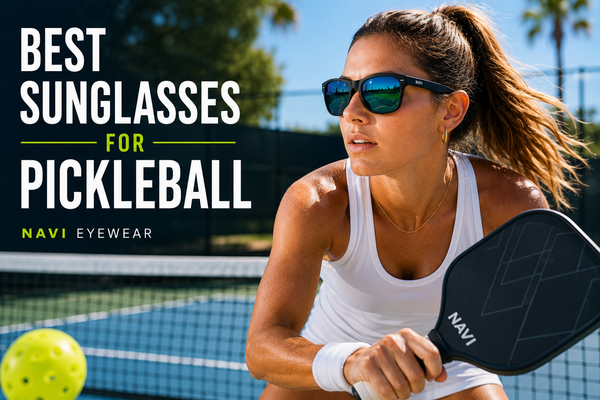

QUICK ANSWERFor pickleball: amber or brown polarized UV400 polycarbonate in a lightweight close-fitting sport frame with rubber grip retention. Amber or brown tint enhances the visibility of yellow-green pickleballs against court and sky backgrounds. Polarization eliminates hard surface glare. Polycarbonate provides impact protection. The 50+ demographic that dominates pickleball participation has the most accumulated lifetime UV of any recreational sport group — making UV400 protection not just performance-relevant but a genuine ongoing eye health priority. |

Pickleball has grown faster than any recreational sport in the United States over the past decade, with participation now exceeding 36 million players. Its combination of smaller court dimensions, fast ball speeds, and social play format has created a sport that is simultaneously easy to start and demanding enough to reward skill development. The outdoor pickleball environment — typically a repurposed tennis court or purpose-built outdoor surface in full sun — creates UV and visual performance demands that are similar to tennis but with the added specificity of the yellow-green pickleball and the demographic reality of a primarily 50+ player base.
For the complete ball sports framework, see thecomplete guide to sunglasses for ball sports. This post covers what's specific to pickleball — the ball color, court geometry, player demographics, and visual challenges that make it worth a dedicated treatment.
1. What Makes Pickleball Visually Different From Tennis
The Ball: Yellow-Green in Variable Light
The standard pickleball is yellow or yellow-green — a color chosen for visibility, but one that interacts with lens tints differently than a tennis ball. Against blue-gray court surfaces and bright sky, yellow-green ball visibility is enhanced by amber and brown tints that block blue scatter and improve contrast in the wavelength ranges where yellow and green are most distinct. Gray lenses reduce overall brightness without this specific enhancement. The practical difference: an amber-tinted polarized lens makes a yellow pickleball more distinctly visible against court and sky backgrounds than a gray polarized lens of the same transmission level.
Smaller Court, Faster Reactions
Pickleball's court is approximately one-quarter the area of a tennis court — 44 feet long by 20 feet wide versus tennis's 78 by 27 feet baseline area. The smaller court means the ball travels shorter distances, arriving faster and requiring quicker reaction times. Visual clarity at close range — the kitchen (non-volley zone) dink exchange — and mid-range — groundstrokes from the baseline — is more important than the long-distance sky tracking that defines baseball outfield play. The glare-free, high-contrast visual environment that polarized amber lenses provide is directly relevant to the close-range visual demands of pickleball.
The Kitchen: Low-Angle Ball Tracking
Much of pickleball's most tactically significant play happens at the kitchen line — the non-volley zone 7 feet from the net — where players exchange low, fast dinks just over the net. Tracking a ball moving at low height across a reflective court surface is exactly the visual challenge that polarized lenses address: horizontal surface reflection from the court is eliminated, revealing the ball moving at low height with better contrast against the court background.
Sun Exposure Duration: The 50+ UV Reality
Pickleball sessions typically run 1–2 hours, and many players participate multiple times per week year-round, particularly in Sun Belt states where outdoor courts are accessible year-round. A regular pickleball player logging 3 sessions per week accumulates 150+ hours of outdoor UV exposure per year from pickleball alone. For the 50+ demographic that represents the core of pickleball participation, this UV accumulation occurs after decades of prior UV exposure — in the window where cataract formation and macular degeneration risk are most active. UV400 protection during pickleball is not an abstract future health precaution for this demographic; it is an ongoing, current health decision.
→ UV and age-related macular degeneration risk — PubMed
2. The UV Health Case: Why It Matters More for Pickleball's Demographic
50+ Players and Cumulative UV
The crystalline lens of the eye accumulates UV damage across the lifespan. By age 50, most adults have accumulated substantial lifetime UV doses, and the lens proteins damaged by UV begin to manifest as cloudiness — early cataract formation. The macular pigment that protects the macula from UV-related degeneration is also subject to cumulative depletion over time. Regular outdoor sport at this life stage adds incrementally to existing UV accumulation at exactly the time when the cumulative effects become clinically relevant.
UV400 protection during pickleball reduces the ongoing UV accumulation rate at the highest-risk life stage. For players already managing early cataract development or early AMD diagnosis, UV protection during regular outdoor sport is an active protective measure, not merely a future risk reduction.
The Pterygium Connection
Pterygium — growth of conjunctival tissue over the cornea — is strongly associated with cumulative UV and wind exposure, and is more common in outdoor sport participants than the general population. The 50+ pickleball player who has spent decades with outdoor UV exposure faces the highest pterygium risk of any pickleball demographic. UV400 protection does not reverse existing pterygium but significantly reduces the UV driver of its progression and reduces the risk of new growth.
Dry Eye and Pickleball
Dry eye disease prevalence increases with age and is particularly common in the 50+ demographic. Outdoor sport in wind and sun conditions exacerbates dry eye symptoms — wind accelerates tear evaporation, and UV exposure contributes to ocular surface inflammation. Close-fitting wraparound sport frames create a partial wind barrier around the eye that reduces tear evaporation during outdoor play — a meaningful functional benefit for pickleball players managing dry eye conditions.
3. Lens Specification for Pickleball
Amber Polarized UV400: The Primary Recommendation
Amber polarized UV400 polycarbonate is the first-choice lens for most pickleball conditions. The amber tint enhances yellow-green ball visibility against court surfaces and sky backgrounds by reducing blue scatter and improving contrast in the relevant wavelength range. Polarization eliminates the horizontal court surface glare that reduces visibility during low-height kitchen exchanges. UV400 provides the health protection that matters most for the 50+ demographic. Browseamber polarized UV400 options at navieyewear.com.
Brown Polarized: The Close Alternative
Brown polarized UV400 provides similar contrast enhancement to amber with a warmer color rendering and slightly different spectral response. Some players find brown more natural-looking than amber's yellow-orange shift. For pickleball specifically, brown's warm tone aligns well with yellow-green ball visibility. Players who find amber tint visually distracting should try brown as the natural alternative — the performance characteristics for pickleball are nearly identical.
Gray Polarized: When to Consider It
Gray polarized UV400 is color-neutral — it reduces brightness uniformly without shifting color rendering. For pickleball players who are very sensitive to color shifts and find that amber or brown distorts the visual environment in ways they find distracting, gray polarized is a valid alternative. It provides full polarization benefit for court surface glare and full UV400 protection, without the contrast-enhancement of amber or brown. For the complete tint comparison, seethe science of lens color.
Lens Category by Playing Conditions
|
Playing Condition |
Category |
Tint Recommendation |
Notes |
|
Peak afternoon sun, outdoor court |
Cat 3 |
Maximum brightness reduction; most common midday session condition |
|
|
Morning or late afternoon play |
Cat 2 |
Lower UV but sun angle creates glare from court and net area |
|
|
Overcast or partly cloudy |
Cat 1–2 |
Clouds pass ~80% UV; contrast enhancement still valuable |
|
|
Sun Belt year-round outdoor |
Cat 2–3 |
Year-round UV is meaningful in FL, AZ, CA, TX — consistent wearing |
|
|
Mixed shade/sun court |
Cat 1–2 |
Lighter category prevents over-darkening in shaded zones |
4. Frame Specifications for Pickleball
Lightweight: The Comfort Priority
Pickleball attracts players across a wide age range, but the 50+ demographic that dominates participation has specific comfort considerations that younger sport demographics often don't prioritize. Frames worn for 1–2 hours multiple times per week need to be comfortable enough to forget about — nose bridge pressure and temple arm pressure that is tolerable for 30 minutes becomes genuinely uncomfortable over a full session. TR90 nylon frames are the lightest quality sport frame material available and maintain their lightness in warm weather, unlike metal frames that can conduct heat uncomfortably in summer outdoor conditions.
Close-Fitting but Not Constricting
The wraparound geometry appropriate for tennis and baseball benefits pickleball as well — it keeps lenses in place during the lateral movements and net approaches of pickleball play. However, pickleball's movement intensity is generally lower than tennis at equivalent skill levels, so the extreme close-fit required for high-intensity tennis sprinting is somewhat less critical. The key requirements remain: rubber grip contact points for sweat management, stable positioning during lateral movement, and peripheral coverage from lateral sun angles.
Rubber Grip and Sweat Management
Outdoor pickleball in summer conditions produces meaningful sweat, particularly in Sun Belt locations where year-round play occurs. Rubber or silicone nose pad and temple contacts grip wet skin and prevent sliding. This is particularly relevant for 50+ players whose skin surface may be drier than younger players — rubberized contacts provide grip on both wet and dry skin surfaces where smooth plastic contacts slide on either.
Bridge Fit for Varied Anatomy
The 50+ demographic that plays pickleball has more anatomical variation in nose bridge shape, height, and width than younger sport demographics — partly from natural anatomical diversity, partly from prior nasal surgeries or injuries that change bridge geometry. Adjustable nose pad configurations provide better fit customization than fixed-bridge designs. For players with low nose bridges, specific low-bridge sport frame designs accommodate the anatomy rather than forcing a poor fit.
NAVI EYEWEAR — UV400 POLARIZED SUNGLASSESBuy 1, Get Any 3 Pairs Free — $119.00 for 4 pairs. Discount auto-applies at cart. Free shipping. Free replacements. 30-day return on unworn pairs. Every lens: UV400 certified polycarbonate · FDA-cleared impact resistance · polarized PVA film · oleophobic coating · anti-saltwater coating · TR90 nylon frames · stainless 5-barrel hinges. |
5. Pickleball-Specific Visual Scenarios
The Dink Exchange at the Kitchen
The most tactically complex part of pickleball — the dink exchange at the kitchen line — involves tracking a ball moving at low height, just over the net, at close range, against the court surface background. Polarized lenses eliminate the horizontal court reflection that creates a glare layer over this low-height visual zone. The result is a cleaner, higher-contrast view of the ball trajectory during kitchen exchanges that many players report as immediately noticeable when switching from non-polarized to polarized eyewear.
Overhead Smashes and Lobs
Like tennis, pickleball involves overhead smash opportunities when opponents lob the ball above the player's reach. Sky tracking at overhead angles is the highest-UV visual direction and the situation where amber tint's sky-contrast enhancement is most valuable. Players in kitchen-dominant rallies who encounter overhead opportunities benefit from having the amber contrast advantage already in place when the lob opportunity arrives.
Serving Into the Sun
Pickleball serves are underhand, requiring less overhead sky-tracking than tennis serves, but players on the sun-facing side of the court still deal with low-to-mid-angle sun in their field of view during service and return. Amber or brown Cat 2–3 handles the full range of sun angles encountered during pickleball service situations.
Transitioning Between Indoor and Outdoor Courts
Many pickleball facilities include both indoor and outdoor courts, and players may move between them during open play sessions or tournaments. Players who move between indoor and outdoor need lenses that are light enough to be useful indoors or in shade, yet provide adequate UV protection outdoors. Cat 1–2 amber is the most versatile choice for this transition pattern; Cat 3 is too dark for most indoor conditions.
Frequently Asked Questions
What are the best sunglasses for pickleball?
Amber or brown polarized UV400 polycarbonate in a lightweight close-fitting sport frame with rubber grip. The amber or brown tint enhances yellow-green pickleball visibility against court and sky backgrounds. Polarization eliminates court surface glare during kitchen exchanges. Polycarbonate provides impact safety. Lightweight TR90 frames provide comfort for multi-hour sessions. Browsepolarized UV400 options at navieyewear.com.
Do you need special sunglasses for pickleball?
You need sunglasses that meet the sport's functional requirements: UV400 certified polycarbonate lenses for safety and health, polarized for court glare elimination, amber or brown tint for ball contrast, and a close-fitting frame with rubber grip that stays in place during lateral movement. 'Special' pickleball sunglasses are those that meet these specifications — they aren't a proprietary category, but standard fashion sunglasses typically don't meet the impact safety or optical performance requirements.
Are polarized sunglasses good for pickleball?
Yes — polarized lenses are particularly effective for pickleball because the kitchen exchange at low ball height is precisely the visual scenario where court surface glare is most disruptive. Horizontal surface reflection from the court creates a glare layer at exactly the height where kitchen-zone ball tracking occurs. Polarized lenses eliminate this specific type of glare while passing the direct and scattered light that provides ball visibility.
What color lens is best for pickleball?
Amber for most conditions — it enhances yellow-green ball visibility against court and sky, manages blue-sky contrast, and reduces squinting fatigue. Brown polarized is a close alternative with similar performance. Gray polarized is color-neutral and valid when brightness reduction is the priority, though it provides less ball-specific contrast enhancement than amber or brown. Seethe complete lens color guide for the full breakdown.
Should older pickleball players wear UV400 sunglasses?
Yes — and this is particularly important for the 50+ demographic that plays pickleball most frequently. Cumulative UV damage is the driver of cataract formation and macular degeneration, and regular outdoor sport at this life stage adds to UV accumulation at the time when these conditions are most active. UV400 polarized sunglasses during pickleball provide both the vision performance benefits of glare reduction and the health protection of UV400 blocking — both relevant to older players. See the full guide tosunglasses anti-aging and eye health for the complete evidence.
Can I use reading glasses prescription with pickleball sunglasses?
For players who use reading glasses for close work but have adequate distance vision for court play, standard non-prescription sport sunglasses are typically appropriate — pickleball ball tracking at court distances does not require reading-prescription correction. For players who use distance prescription glasses, prescription sport frames with UV400 polycarbonate lenses are the correct solution. Some players use contact lenses under non-prescription sport sunglasses — this is a valid approach provided the contact lenses do not substitute for the UV400 protection that eyewear provides. Contacts alone provide limited UV blocking.
How do pickleball sunglasses differ from tennis sunglasses?
The core specification is identical: amber or brown polarized UV400 polycarbonate in a close-fitting sport frame. The differences are nuanced: pickleball's yellow-green ball color makes amber tint's contrast enhancement slightly more specific to the ball color than in tennis; pickleball's lower movement intensity makes extreme wraparound frame security slightly less critical than in high-intensity tennis; and pickleball's 50+ demographic makes lightweight frame comfort and the UV health case more prominent considerations. The same quality sport frame with amber polarized polycarbonate lenses that works for tennis works for pickleball.
Do I need different sunglasses for outdoor vs indoor pickleball?
For outdoor-only play, Cat 2–3 amber polarized provides optimal conditions. For indoor-only play, standard non-tinted safety glasses with UV400 polycarbonate lenses are appropriate — there is no UV risk indoors and no surface glare from artificial lighting that polarization addresses. For mixed indoor/outdoor play, Cat 1–2 amber is the most versatile choice: light enough for indoor play, protective enough for outdoor conditions.
The Bottom Line
Pickleball's specific demands — yellow-green ball, low-height kitchen exchanges, court surface glare, Sun Belt year-round play, and a 50+ demographic with the highest cumulative UV burden of any recreational sport group — make UV400 polarized amber sport eyewear a straightforward recommendation. The visual performance case (glare elimination, ball contrast) is immediately perceptible, and the UV health case is most relevant precisely to the demographic that plays pickleball most frequently. Quality execution doesn't require premium pricing:navieyewear.com/collections/polarized — Buy 1, Get 3 Free for $119 — delivers UV400 certified polycarbonate polarized lenses at a price that makes equipping your pickleball bag practical.
Sources & Citations[1] West SK, et al.."Exposure to sunlight and other risk factors for age-related macular degeneration."Archives of Ophthalmology, 1989.View source → [2] Taylor HR, et al.."Effect of ultraviolet radiation on cataract formation."New England Journal of Medicine, 1988.View source → [3] Dain SJ."Sunglasses and sunglass standards."Clinical and Experimental Optometry, 2003.View source → [4] Sliney DH."Ocular exposure to environmental light and ultraviolet."Journal of AAPOS, 2014.View source → [5] Rosenthal FS, et al.."The effect of sunglasses on ocular exposure to ultraviolet radiation."American Journal of Public Health, 1988.View source → [6] Sports & Fitness Industry Association."Pickleball participation report."SFIA Annual Participation Topline Report, 2023.View source → |