
QUICK ANSWERFor motorsports: UV400 polycarbonate lenses with maximum-security retention — the non-negotiables. Tint by surface: gray polarized for road surfaces and tarmac (color-neutral, eliminates road glare, no color shift affecting traffic cues); amber polarized for off-road and motocross (terrain contrast, depth definition on uneven surfaces). Frame: close-fitting wrap with no wind gap, rubber grip or full goggle seal. Oleophobic coating for fuel, oil, and road film resistance. For high-speed open cockpit applications, goggle-style full-seal eyewear is appropriate over standard sunglasses. |

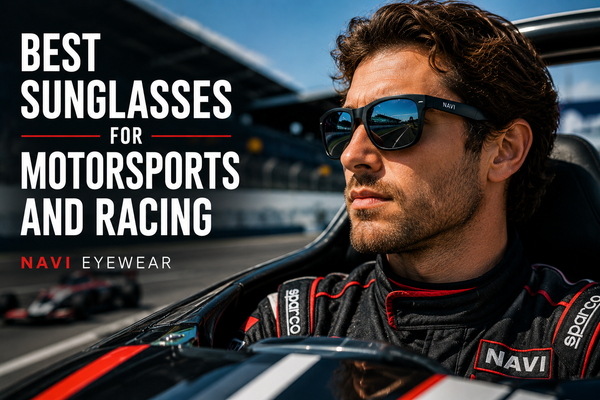
Motorsports create a set of eyewear demands that don't fully align with any other sport category. Speed generates wind pressure that can lift or shift frames; vibration from road surfaces and engines creates continuous frame instability; debris — grit, rubber particles, track material — travels at speed toward the face; UV exposure from open cockpit or helmet-free riding accumulates rapidly; and visual demands shift constantly between close instrument reference and far-field track reading at speeds where a momentary visual disruption has significant consequences.
This guide covers the full spectrum of motorsport contexts — from recreational go-kart sessions and weekend autocross events through motocross riding, track days in road cars, and open-cockpit racing. For the framework covering all ball and performance sports, see thecomplete guide to sunglasses for ball sports. For everyday driving UV protection, seebest sunglasses for driving.
1. The Motorsport Visual Environment
Speed: Wind Pressure and Frame Stability
At 60 mph, wind pressure on an exposed face generates approximately 7–8 lbs per square foot of force. At 100 mph, this increases to roughly 20 lbs per square foot. Any gap between a sunglass frame and the face becomes a wind-catch point that lifts or shifts the frame. Standard temple-arm frames that rest on ears and nose without sealing against the face will shift, vibrate, or dislodge at speed. This is not a comfort issue — a frame shifting in the visual field at track speed is a genuine safety hazard.
The solution is either extremely close-fitting wraparound frames with no air-gap geometry, or goggle-style eyewear that seals against the face with foam or rubber gasket. The appropriate choice depends on the specific motorsport context — many track day and autocross participants wear helmets that accommodate standard close-fitting frames; motocross and open-cockpit racing typically benefit from goggle-style full-seal solutions.
Vibration: Continuous Frame Instability
Road surface vibration, engine vibration, and the general mechanical environment of motorsports creates continuous micro-movements in frame position. Over a 20-minute track session, cumulative vibration creates more total frame displacement than the wind pressure from any single high-speed straight. Rubber grip contact points are the primary counter — they dampen vibration transmission to the frame and absorb the micro-movements that would otherwise accumulate into visible optical disturbance.
Debris: Impact Protection at Speed
Track debris — rubber particles from tire wear, grit from track surface, small stones from off-road sections — travels at the relative speed between the debris source and the vehicle. At 50 mph, a 3mm stone from a preceding vehicle strikes with significant kinetic energy. Standard fashion sunglass lenses in optical resin or glass are not appropriate for open-cockpit or helmet-free motorsport — they can shatter on debris impact. Polycarbonate lenses, with approximately 10x the impact resistance of optical resin, are the minimum standard for any motorsport context with debris exposure.
UV Exposure: Extended Duration at Altitude and Speed
Outdoor motorsports accumulate UV exposure across extended outdoor sessions — a full autocross day may involve 4–6 hours of outdoor time; a motocross ride can run all day. Track days at circuits typically involve multiple 20-minute sessions across a full day. The UV accumulation from motorsport is comparable to other outdoor sports, with the altitude factor adding additional UV intensity for mountain motocross and hill climb events.
→ UV exposure and outdoor sport duration — PubMed
Visual Demands: Near-Far Switching at Speed
Driving or riding at speed requires constant switching between near-field reference (instruments, mirrors, gauges) and far-field track reading (apex, exit points, other vehicles). Any optical distortion in the lens that affects depth perception or introduces visual artifacts is more consequential in motorsports than in most other sport contexts because the response time to visual information is compressed by speed. Optically flat, distortion-free polycarbonate lenses are the quality requirement.
2. Lens Tint by Motorsport Surface Type
Road and Tarmac: Gray Polarized
Gray polarized UV400 is the standard recommendation for road-surface motorsports — track days, autocross, karting on paved circuits, and road racing. The rationale:
Browsegray polarized UV400 options at navieyewear.com.
Off-Road and Motocross: Amber Polarized
Off-road motorsports — motocross, enduro, trail riding, off-road racing — operate over terrain where depth perception and surface texture reading are critical for safety. Amber polarized UV400 is the recommendation for off-road contexts:
Mixed Surface (Rallycross, Dual-Surface Tracks)
Events that combine paved and unpaved surfaces — rallycross, some autocross courses with gravel sections, dual-surface hill climbs — present a tint choice challenge. Gray polarized handles paved sections optimally; amber handles unpaved sections optimally. The practical solution for most mixed-surface participants is amber polarized Cat 2 — the contrast enhancement is helpful on unpaved sections, and Cat 2's moderate darkness handles paved section brightness without the color-shift concerns of Cat 3 amber in critical visual contexts.
Low Light and Dawn/Dusk Racing
Endurance racing events and early-morning track sessions create low-light conditions where standard Cat 2–3 lenses are too dark. Cat 1 amber or clear polycarbonate with UV400 certification is appropriate for dawn, dusk, and overcast low-light motorsport. Never use any tinted lens for night racing — clear UV400 polycarbonate or no sunglasses are appropriate for dark conditions. For the complete night driving guide, seenight driving and dawn/dusk sunglasses.
|
Motorsport Context |
Recommended Tint |
Category |
Key Requirement |
|
Paved track / autocross / karting |
Cat 2–3 |
Color neutrality, road glare elimination, no color shift on signals |
|
|
Motocross / off-road / enduro |
Cat 2–3 |
Terrain contrast, depth on uneven surfaces, debris impact resistance |
|
|
Rallycross / mixed surface |
Cat 2 |
Balance of contrast and brightness; versatile across both surfaces |
|
|
Open-cockpit / high-speed straight |
Cat 2–3 |
Maximum frame security — goggle seal preferred at high speed |
|
|
Dawn, dusk, overcast endurance |
Cat 1 amber or clear UV400 |
Cat 1 |
Too dark for low light — lighter lens or clear UV400 |
|
Night racing |
Clear UV400 polycarbonate |
- |
No tint — never any tinted lens in true darkness |
3. Frame Security: The Most Critical Specification
Why Standard Frames Fail at Speed
The fundamental geometry problem with standard sunglasses in high-speed motorsport is the air gap. Standard frames sit against the nose and ears with a gap between the frame body and the face. At speed, air entering this gap generates lift pressure under the lens that pushes the frame away from the face and eventually off entirely. The higher the speed, the stronger this effect. Frames that work perfectly at 30 mph on a bicycle may become unusable at 80 mph in an open vehicle.
Close-Fitting Wraparound: The Minimum for Paced Motorsport
For go-kart tracks, autocross events, and moderate-speed open-vehicle contexts, a close-fitting wraparound sunglass that hugs the face contour without a significant air gap provides adequate retention. Key features:
Goggle-Style Full-Seal: For High Speed and Off-Road
Motocross, enduro, and high-speed open-cockpit racing benefit from goggle-style eyewear that seals against the face with foam or rubber gasket. This full seal eliminates wind entry, debris penetration, and provides the maximum retention against frame displacement at speed. Motocross goggles are specifically engineered for the debris, mud, and physical impact environment of off-road riding. For open-cockpit track racing, motorcycle-inspired goggle designs that fit under or within helmet geometry provide the highest security.
The trade-off with goggle-style eyewear is fogging — the sealed environment around the eye reduces airflow that carries moisture away from the lens interior surface. Goggle-specific anti-fog coatings and vented goggle designs manage this effectively in most conditions; solid-sealed goggles are more prone to fogging in high-humidity or rain conditions.
Helmet Compatibility
Many motorsport participants wear helmets — full face, open face, or motorcycle helmets — that must be compatible with eyewear. Key compatibility considerations:
4. Lens Coatings for the Motorsport Environment
Oleophobic Coating: Fuel, Oil, and Road Film
The motorsport environment involves exposure to fuel vapors, oil mist, tire rubber, and road film that do not occur in other sport contexts. Oleophobic coatings — which resist oil and organic contaminants — are particularly valuable in motorsport because they prevent the bonding of these contaminants to the lens surface. A lens without oleophobic coating in a motorsport environment accumulates a film of oil and rubber that progressively degrades optical clarity across a day of use. Quality polycarbonate lenses with oleophobic coating stay cleaner and are significantly easier to wipe clean when contaminated.
Hydrophobic Coating: Rain and Spray
Wet-weather track sessions, rain-start races, and outdoor endurance events expose lenses to water — either rainfall or spray from preceding vehicles. Hydrophobic coatings cause water to bead and run off rather than sheeting across the lens surface. A non-coated lens in rain conditions develops a water film that significantly degrades optical clarity; a hydrophobic-coated lens maintains much better clarity as water beads and runs off in the airflow.
Scratch Resistance
Debris impacts that would shatter standard lenses are absorbed by polycarbonate — but small debris creates surface scratches that accumulate over time and degrade optical quality. Quality polycarbonate lenses include hard scratch-resistant coatings that extend lens life in the debris-rich motorsport environment. No coating makes polycarbonate scratch-proof, but quality coatings significantly extend the time before scratching becomes an optical problem.
Anti-Fog
Temperature transitions — entering a cold paddock from a hot track, or the humid morning start of an endurance day — create fogging conditions on uncoated lenses. Anti-fog coatings or treatments reduce the surface tension differential that allows moisture to condense as a film on the lens interior. For goggle-style eyewear, anti-fog is particularly important given the reduced airflow inside a sealed frame.
NAVI EYEWEAR — UV400 POLARIZED SUNGLASSESBuy 1, Get Any 3 Pairs Free — $119.00 for 4 pairs. Discount auto-applies at cart. Free shipping. Free replacements. 30-day return on unworn pairs. Every lens: UV400 certified polycarbonate · FDA-cleared impact resistance · polarized PVA film · oleophobic coating · anti-saltwater coating · TR90 nylon frames · stainless 5-barrel hinges. |
5. Context-Specific Guides
Go-Kart Racing (Indoor and Outdoor)
Go-karting at recreational and competitive levels offers two contexts: indoor electric kart tracks (typically fluorescent-lit, no UV) and outdoor gas kart circuits (full UV, higher speeds, debris exposure). Indoor karting requires no UV protection — clear polycarbonate safety glasses or standard lenses are appropriate. Outdoor karting involves meaningful UV exposure and debris at speeds of 40–80 mph in recreational through competitive categories. Gray or amber polarized UV400 polycarbonate in a close-fitting frame handles the outdoor karting environment effectively. Speed at most outdoor recreational kart tracks is moderate enough that standard close-fitting sport sunglasses — not goggles — are adequate for retention.
Autocross
Autocross events involve solo runs through cone-defined courses at relatively low speeds — typically 30–60 mph for competitive times. The environment is typically an open parking lot or airfield surface in full sun. UV exposure across a full competition day (4–6+ hours outdoors) is substantial. Gray polarized UV400 handles the paved surface and sun conditions effectively. Frame security at autocross speeds is less demanding than road racing; standard close-fitting sport sunglasses with rubber grip are adequate. Spectating at autocross events also accumulates meaningful UV — the social and outdoor duration of autocross events makes UV protection relevant beyond just drivers.
Track Days (Road Course)
Road course track days involve higher speeds — 80–140+ mph depending on the circuit and vehicle — and more significant wind pressure. Close-fitting wraparound frames with elastic retention backup are appropriate for open vehicles (roadsters, convertibles) at these speeds. For closed-cockpit cars with windows, standard close-fitting sport sunglasses are adequate. The UV exposure from a full track day (multiple 20-minute sessions across 6–8 hours) is comparable to a beach day. Gray polarized Cat 2–3 handles the tarmac and sun conditions.
Motocross and Off-Road Riding
Motocross involves the most demanding eyewear environment of any motorsport category: high speed, terrain vibration, debris from other riders, mud roost, jump landings, and potential fall scenarios. Purpose-built motocross goggles with foam seal, polycarbonate dual-layer lenses (outer clear or tinted over inner clear), roll-off or tear-off systems for mud clearing, and helmet-compatible geometry are the correct equipment for motocross. Amber tinted outer lens for off-road terrain contrast is the standard lens choice. Sunglasses, however close-fitting, are not a substitute for purpose-built motocross goggles in competitive or high-intensity motocross.
Road Cycling and Motorcycle Riding
Road cycling and motorcycle riding share many of the wind, debris, and UV demands of motorsport but at lower or moderate speeds. Close-fitting wraparound sport sunglasses with polycarbonate lenses and UV400 certification are appropriate for both. Gray polarized for road cycling (tarmac surface, color accuracy for traffic signals); amber for mountain biking or trail riding (terrain contrast, depth on unpaved surfaces). For the dedicated cycling guide, seesunglasses for cycling.
Frequently Asked Questions
What sunglasses are best for track days?
Gray polarized UV400 polycarbonate in a close-fitting wraparound frame with rubber grip and optional elastic retention. Gray for color neutrality on paved surfaces; polarized for road glare elimination; UV400 for the full day's outdoor UV exposure; polycarbonate for debris impact safety. For open vehicles at higher speeds, add elastic retention. Browsepolarized UV400 options at navieyewear.com.
Can I wear regular sunglasses for go-karting?
For indoor electric karting — yes, any eyewear is fine since there's no UV or significant debris. For outdoor gas karting, regular fashion sunglasses in optical resin lack the impact resistance for debris at speed. Polycarbonate UV400 in a close-fitting frame is the minimum appropriate specification. Most recreational outdoor kart tracks have low enough speeds that standard close-fitting sport sunglasses (not goggles) are adequate for retention.
Should motorsports sunglasses be polarized?
For road-surface motorsports, yes — polarized lenses eliminate road surface glare that creates luminance variation across the track. For motocross and off-road, polarized is beneficial for the same glare-reduction reason on uneven terrain. The only context where polarization requires caution is digital instrument reading — some LCD displays appear dark or blacked-out when viewed through polarized lenses at certain angles. For vehicles with LCD instrument panels, test the lens-to-display angle before use and adjust viewing angle as needed.
What's the difference between motorsport sunglasses and regular sport sunglasses?
The key differences are retention design (wind resistance matters in motorsports, not in most other sports), debris impact resistance (polycarbonate is mandatory for any open-vehicle context), lens coatings (oleophobic for fuel and oil exposure), and compatibility with helmet geometry. The optical performance specifications — UV400, polarized, appropriate tint — are the same as for other outdoor sports. A quality sport sunglass that meets the retention and impact requirements works well for many motorsport contexts; specialist motorsport eyewear adds sealing, goggle geometry, and helmet-compatibility engineering.
Are yellow or amber lenses good for night racing?
No — this is one of the most persistent myths in motorsport eyewear. Yellow and amber tinted lenses do not improve night visibility and should never be worn for night driving or racing. No tinted lens improves on natural night vision; some yellow lenses subjectively feel brighter due to contrast effects but measurably reduce the total light reaching the retina, which is the opposite of what night vision requires. Clear UV400 polycarbonate is appropriate for night racing; no sunglasses are needed in darkness.
What lenses are best for motocross?
Purpose-built motocross goggles with polycarbonate lenses are the correct equipment for motocross — not sunglasses, regardless of how close-fitting. Motocross goggles provide foam seal for debris exclusion, helmet geometry compatibility, roost protection from preceding riders, and roll-off or tear-off mud clearing systems that sunglasses cannot replicate. Amber tinted outer lens is the standard for off-road terrain contrast. Sunglasses are appropriate for trail walking, observer positions, and paddock use at motocross events, not for riding.
Will polarized lenses affect how I see LCD instruments?
Potentially — LCD screens use polarizing filters that can interact with polarized lens filters, causing the display to appear dark or black at certain relative orientations. This is more commonly an issue with motorcycle instrument panels and some car instrument clusters. Test before your event by sitting in the vehicle in daylight, putting on polarized lenses, and rotating your head to check whether the instrument panel remains clearly visible at normal viewing angles. If display visibility is compromised, non-polarized UV400 polycarbonate in the appropriate tint is the alternative.
How do I keep motorsport sunglasses from fogging?
Fogging in motorsports typically occurs at low speed (reduced airflow) or in high-humidity conditions. Anti-fog lens coating or spray treatment is the primary solution. Vented frame designs that allow airflow across the lens rear surface reduce fogging at speed. For goggle-style eyewear, dual-pane lenses with a gap between inner and outer lens provide thermal insulation that reduces condensation on the inner surface. In rain conditions at speed, hydrophobic coating helps water clear from the outer surface while anti-fog manages the inner surface.
The Bottom Line
Motorsports demand more from eyewear retention and lens protection than almost any other activity, while sharing the UV protection requirements of all outdoor sports. The specification varies by context: gray polarized UV400 polycarbonate for road surfaces, amber for off-road; close-fitting wraparound with rubber grip for moderate-speed contexts; goggle-style full-seal for motocross and high-speed open cockpit. Oleophobic and hydrophobic coatings add meaningful performance in the fuel, oil, and weather environment of motorsports. For quality UV400 polarized polycarbonate sunglasses appropriate for track days, autocross, and recreational motorsport contexts:navieyewear.com/collections/polarized — Buy 1, Get 3 Free for $119.
Sources & Citations[1] Sliney DH."Ocular exposure to environmental light and ultraviolet."Journal of AAPOS, 2014.View source → [2] Dain SJ."Sunglasses and sunglass standards."Clinical and Experimental Optometry, 2003.View source → [3] Rosenthal FS, et al.."The effect of sunglasses on ocular exposure to ultraviolet radiation."American Journal of Public Health, 1988.View source → [4] Taylor HR, et al.."Effect of ultraviolet radiation on cataract formation."New England Journal of Medicine, 1988.View source → [5] ASTM International."Standard performance specification for eye protectors for selected sports — F803."ASTM Standards, 2017.View source → [6] WHO."Global solar UV index: a practical guide."World Health Organization, 2002.View source → |