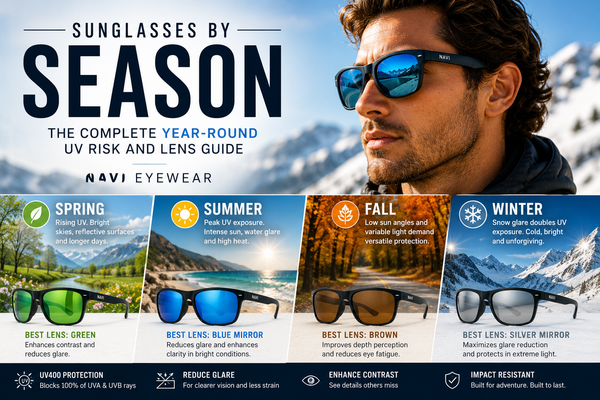

Sunglasses by Season: The Complete Year-Round UV Risk and Lens Guide
UV radiation is present and biologically significant in every season. The UV index varies across the year — peaking in summer, dropping in winter — but never reaches zero anywhere in the continental United States. Clouds transmit approximately 80% of UV. Snow reflects up to 80% of UV back toward the face. The result: winter outdoor exposure, overcast spring days, and fall afternoon sunlight all carry meaningful UV risk that sunglasses address. This guide covers UV risk, sun angle, light conditions, and lens recommendations for every season and every major US climate zone.
Contents
- 1. The Science of Seasonal UV: Why It Never Actually Stops
- 2. Spring (March–May): The Underestimated Season
- 3. Summer (June–August): Peak UV and How to Manage It
- 4. Fall (September–November): The Transition Window
- 5. Winter (December–February): The Most Underprotected Season
- 6. Regional Variation: UV by US Climate Zone Year-Round
- 7. Seasonal Lens Recommendations: Category and Tint by Conditions
- 8. The Year-Round Habit: Why Seasonal Thinking Fails
- 9. Scenario Table: UV Risk by Season and Condition
- 10. Frequently Asked Questions
- 11. Supporting Articles in This Cluster

1. The Science of Seasonal UV: Why It Never Actually Stops
What Drives Seasonal UV Variation
UV radiation intensity at ground level is primarily driven by the solar zenith angle — the angle between the sun and the point directly overhead. In summer, the sun reaches a higher maximum elevation angle in the sky, and solar radiation passes through less atmosphere before reaching the ground. The result is higher UV intensity per unit area. In winter, the sun's maximum elevation angle is lower, and radiation passes through more atmosphere — scattering and absorbing more UV before it reaches ground level.
In the contiguous United States, the summer-to-winter UV index ratio at the same location ranges from approximately 3:1 in the South to 6:1 in the northern states. This means a typical winter day in Minneapolis might have a UV index of 1–2, while a summer day might reach 7–9. Both are biologically relevant — UV index 1 still produces cumulative UV damage with sufficient exposure time, and UV index 2 produces erythema (sunburn) in fair-skinned individuals with prolonged unprotected exposure.
The Ozone Factor
The ozone layer absorbs UV-B radiation — the shorter-wavelength UV that causes most direct biological damage. Ozone concentration varies seasonally, with lower ozone typically occurring in late winter and early spring in the Northern Hemisphere. This means the UV index in early spring may be higher relative to temperature than later in the season when ozone recovers. The "bright, cold spring day" scenario that produces UV index 4–5 with temperatures still in the 40s is partly driven by seasonal ozone variation — UV risk is high before it feels warm enough to think about sun protection.
Surface Reflection: The Year-Round Amplifier
UV reflectance from surfaces amplifies ground-level UV exposure beyond what the solar elevation angle alone would produce. Key seasonal surface reflectance values:
- Snow: reflects up to 80% of UV radiation — in winter, a snow-covered landscape effectively doubles UV exposure compared to the same solar angle without snow cover.
- Sand: reflects 15–25% of UV — summer beach environments have meaningfully higher effective UV than the UV index alone suggests.
- Water: reflects 25%+ of UV at low sun angles — fall and spring water activities near dawn and dusk involve more reflected UV than midday summer.
- Concrete and pavement: reflects approximately 8–12% of UV — urban environments in all seasons have some surface UV amplification.
- Grass and vegetation: reflects approximately 2–5% of UV — the lowest common surface reflectance, relevant to outdoor sport on grass fields.
Cloud Cover: The Most Misunderstood UV Factor
The single most consequential misconception in seasonal UV awareness is the assumption that cloud cover eliminates UV risk. Clouds attenuate UV significantly less than they attenuate visible light. A heavily overcast sky that cuts visible light to 20% of clear-sky levels typically transmits 70–80% of UV. The result: people who would never consider sun protection on a "dull" overcast day are receiving 70–80% of the UV they would receive in bright sun. This applies in every season. For the dedicated guide to this topic, see sunglasses on cloudy days: does UV still matter.
2. Spring (March–May): The Underestimated Season
The Spring UV Gap
Spring is the most under-protected season for UV eye health, and the reasons are behavioral rather than physical. UV intensity rises rapidly through March–May as the sun's elevation angle increases toward summer maximum. By late April, UV index values across the southern half of the United States regularly reach 6–8 — well within the "high" UV category that causes erythema in under an hour for unprotected skin. Meanwhile, temperatures remain cool, people are not yet in "summer mode," and sun protection behaviors remain suppressed.
The behavioral gap is significant: sun protection rates — sunscreen application, hat wearing, sunglasses use — typically correlate with temperature perception rather than UV intensity. Spring's cool temperatures suppress the perceived need for UV protection precisely when UV intensity is rising to or exceeding summer comparable levels.
The Ozone Depletion Effect in Spring
Spring UV intensity is further elevated by seasonal atmospheric effects. The ozone layer that absorbs UV-B reaches its annual minimum in late winter and early spring in the Northern Hemisphere, before recovering through late spring and summer. This means March and April may have higher UV intensity per unit of solar elevation angle than equivalent conditions in June or July — the UV index is partly elevated relative to what the sun's position alone would produce.
Spring Outdoor Activities and UV Accumulation
Spring brings people outdoors after winter: gardening, outdoor dining, spring sports, hiking, cycling, and the general increase in outdoor time associated with improving weather. The combination of high UV intensity and resumed outdoor activity makes spring a high UV accumulation window — particularly for those who have been primarily indoors through winter and whose UV protection habits have lapsed.
Spring Lens Recommendation
Gray or amber polarized UV400 Cat 2 for most spring conditions — appropriate for the moderate-to-high UV index of spring without the full darkness of summer Cat 3. Cat 3 is appropriate for spring beach days, spring skiing, and peak-sun spring afternoons in southern US locations. For more detail, see the spring UV risk guide.
3. Summer (June–August): Peak UV and How to Manage It
Peak UV Index: The June–July Window
The summer solstice (approximately June 21) marks the maximum solar elevation angle in the Northern Hemisphere — the point at which UV index reaches its annual peak across all US locations. UV index values from June through August reach 8–10 across most of the contiguous US, with values of 10–12 in the Southwest, Hawaii, and at altitude. At UV index 10, unprotected fair skin reaches erythema threshold in as little as 12 minutes.
For the eyes, peak UV in summer produces the highest-intensity cataract, macular degeneration, and pterygium risk accumulation of any time of year. Consistent UV400 protection during summer outdoor time is the single highest-return investment in eye health available on a seasonal basis.
The Midday Peak: 10 AM to 4 PM
Within each summer day, UV intensity is not uniform. The solar zenith angle — and therefore UV intensity — peaks between approximately 10 AM and 4 PM local solar time, with the true peak around solar noon. Over 70% of a typical summer day's total UV dose is received between 10 AM and 4 PM. For anyone spending outdoor time during peak hours — which is most people during the summer workday — UV400 eye protection is most critical in this window.
Summer Lens Recommendation
Gray or amber polarized UV400 Cat 3 for peak summer conditions — beach, sport, prolonged midday outdoor time. Cat 2 amber for morning and evening activities, overcast summer days, and moderate outdoor time. For more detail, see the summer peak UV guide.
4. Fall (September–November): The Transition Window
UV Intensity Decline and Low-Angle Sun
Fall UV intensity declines from summer peak as the sun's elevation angle decreases toward the winter solstice. By October, UV index in the northern states drops to 2–4; in the South, it remains 4–6 through October and 2–4 through November. These levels are lower than summer but meaningfully above zero — and cumulative UV accumulation continues at rates that matter for long-term eye health.
The declining sun elevation angle in fall introduces a new visual and UV challenge: low-angle sun. As the sun arc drops lower in the sky through October and November, it spends more time near the horizon and at eye level, creating intense glare at angles that summer sun never occupies. The low autumn sun on a westbound afternoon commute, hitting directly in the driver's line of sight, is more visually disruptive than summer overhead sun in many ways.
The Commuter's Autumn Glare Problem
Fall commuting — morning eastbound and evening westbound — aligns with sunrise and sunset angles that put the sun directly in the commuter's visual field at the low elevation angles that maximize direct UV and glare to the eye. Polarized gray UV400 lenses are the standard recommendation for this scenario. See best sunglasses for driving for the complete driving UV guide.
Fall Lens Recommendation
Gray or amber polarized UV400 Cat 2 for most fall conditions. Cat 1–2 for overcast or late-fall conditions in northern states. Cat 3 for fall beach days, hiking at altitude, and peak-sun fall afternoons in southern US locations. For more detail, see fall UV changes.
5. Winter (December–February): The Most Underprotected Season
Why Winter UV Is Not Zero
Winter UV intensity at sea level in the continental US ranges from UV index 1–2 in the northern states to UV index 4–6 in the southern states and Southwest. These values are low compared to summer peaks, but they are not zero — and the cumulative UV dose from winter outdoor time, particularly for people who spend significant time outdoors, remains biologically meaningful. More importantly, winter UV is systematically underprotected because the behavioral association between warm weather and sun protection causes people to abandon UV habits in winter.
Snow: The Winter UV Amplifier
Snow reflectance transforms winter UV risk. Fresh snow reflects up to 80% of UV radiation — meaning a snow-covered landscape creates a UV environment that rivals or exceeds summer beach conditions. The UV from snow reflection reaches the lower face, under the chin, and the lower orbital area that overhead summer UV does not typically reach directly. Skiers and snowboarders standing on a bright snow day at altitude are receiving UV from overhead sky, from snow-reflected UV from below, and from the higher UV intensity of altitude — a combination that makes a ski day one of the highest UV exposure events in a year for most people.
Winter Lens Recommendation
Gray or amber polarized UV400 Cat 2 for general winter outdoor use at sea level. Cat 3 polarized for ski slopes, bright snow environments, and high-altitude winter activities. Cat 1 for low-light winter days, overcast winter conditions, and dawn/dusk outdoor activity in winter. Never Cat 4 for driving at any time of year.
6. Regional Variation: UV by US Climate Zone Year-Round
| US Region | Summer UV Index | Winter UV Index | Key Seasonal Notes |
|---|---|---|---|
| Pacific Northwest (WA, OR) | 6–8 | 1–2 | Heavy overcast winter; UV present but lower; spring UV underestimated |
| Northern Plains / Upper Midwest | 8–10 | 1–2 | Extreme seasonal range; winter snow amplifies low UV index meaningfully |
| Northeast (NY, NE, Mid-Atlantic) | 7–9 | 1–3 | Low-angle fall/winter sun creates commuter glare hazard October–February |
| Southeast (GA, FL, SC, NC) | 9–11 | 4–6 | Year-round meaningful UV; winter UV still significant in FL/GA |
| Sun Belt (TX, AZ, NM, NV) | 10–12 | 4–7 | Year-round high UV; winter index 4–7 requires consistent protection |
| Southern California | 10–11 | 4–6 | Consistent UV year-round; coastal UV amplified; mild winter outdoor exposure |
| Mountain West (CO, UT, ID) | 9–11 + altitude | 3–5 + altitude | Altitude amplifies all seasons; ski season is highest UV window of year |
| Hawaii | 10–12+ | 8–10 | Highest year-round UV in the US; minimal seasonal variation; always Cat 2–3 |
7. Seasonal Lens Recommendations: Category and Tint by Conditions
| Season / Condition | UV Index Range | Category | Tint | Notes |
|---|---|---|---|---|
| Peak summer, midday, clear sky | 8–12 | Cat 3 | Gray or amber polarized | Highest UV window of the year; Cat 3 for outdoor and beach |
| Summer, morning / evening | 4–6 | Cat 2 | Gray or amber polarized | Meaningful UV but lower intensity; Cat 2 comfortable |
| Spring, clear sky, moderate sun | 5–8 | Cat 2–3 | Gray or amber polarized | UV rises faster than temperature; often under-protected |
| Fall, clear sky, daytime | 3–6 | Cat 2 | Gray or amber polarized | Moderate UV plus low-angle sun; Cat 2 versatile |
| Fall / winter, low-angle commute sun | 2–5 | Cat 2 | Gray polarized | Direct glare at eye level; polarized essential for driving |
| Winter, general outdoor, sea level | 1–3 | Cat 1–2 | Gray or amber polarized | Low but present UV; Cat 1 suitable for very low light |
| Ski slope / snow cover, any season | UV + 80% snow reflection | Cat 3 | Amber or gray polarized | Snow doubles effective UV; Cat 3 mandatory for ski conditions |
| Overcast, any season | ~80% of clear sky UV | Cat 1–2 | Gray or amber polarized | Clouds ≠ no UV; protection still needed; lighter category comfortable |
| High altitude, any season | UV + 10–12% per 1,000m | Cat 3–4 | Gray or amber polarized | Altitude amplifies all seasons; Cat 4 for glacier/extreme altitude only |
| Hawaii / extreme Sun Belt, year-round | 8–12+ | Cat 2–3 | Gray or amber polarized | Year-round high UV; seasonal mindset inappropriate here |
8. The Year-Round Habit: Why Seasonal Thinking Fails
The Habit Gap in Winter
The behavioral problem with seasonal UV protection is that habits maintained only seasonally are inherently weaker than year-round habits. A person who wears sunglasses consistently from May through September and then stops for seven months has not built a consistent habit — they have built a summer-triggered conditional behavior. Each spring, this habit has to be re-established, meaning the first weeks of high UV spring exposure occur without protection while the habit re-forms.
The most effective UV protection habit is one triggered by outdoor exposure regardless of season — "going outside" is the trigger, not "going outside in summer." This habit structure means protection is continuous across seasons and the highest-risk seasonal moments (early spring UV peak, surprise high-UV days in autumn, ski season) are protected automatically.
The Economic Argument for Year-Round Lenses
A single pair of quality UV400 polarized sunglasses worn consistently year-round provides more total UV protection than multiple pairs worn only seasonally. Navi Eyewear's Buy 1, Get 3 Free offer — $119 for 4 pairs — provides the multi-location, multi-context redundancy (car, bag, home, sport) that makes year-round consistent wearing practically frictionless.
9. Scenario Table: UV Risk by Season and Condition
| Scenario | Season | UV Risk | Lens Recommendation | Notes |
|---|---|---|---|---|
| Summer beach day, midday | Summer | Very High | Amber Cat 3 polarized | Peak UV + sand/water reflection + coastal amplification |
| Spring hiking, 8,000 ft elevation | Spring | High | Gray Cat 3 polarized | Altitude amplifies spring UV; snow possible at elevation |
| Overcast fall day, outdoor errands | Fall | Moderate | Gray Cat 1–2 polarized | Clouds pass 80% UV; comfortable lighter category |
| Ski day, Colorado resort, 10,000 ft | Winter | Very High | Amber Cat 3 polarized | Snow + altitude = highest routine UV exposure scenario |
| Evening commute, fall, westbound | Fall | Moderate + glare | Gray Cat 2 polarized | Low-angle sun at eye level; polarized critical for driving |
| Early spring afternoon, cold but sunny | Spring | Moderate-High | Gray Cat 2 polarized | UV risk underestimated because temperature is cool |
| Winter walk, northern state, overcast | Winter | Low | Gray Cat 1 polarized | Low UV but consistent habit preferred over seasonal gap |
| Summer outdoor sport, afternoon | Summer | Very High | Amber Cat 3 polarized | Peak season, peak hours — maximum UV accumulation scenario |
| Hawaii outdoor activity, any month | Year-round | High–Very High | Gray or amber Cat 2–3 polarized | Minimal seasonal variation; year-round Cat 2–3 appropriate |
10. Frequently Asked Questions
Do I need sunglasses in winter?
Yes — particularly for outdoor workers, winter sport participants, and anyone spending significant time outdoors. UV index in winter at sea level in the US ranges from 1–6 depending on location, and snow reflectance can double effective UV exposure on bright days. For ski and snow environments, Cat 3 polarized is mandatory regardless of how cold it is.
When is UV strongest during the day?
Between approximately 10 AM and 4 PM local solar time, with peak intensity around solar noon. Over 70% of a typical day's UV dose is delivered in this 6-hour window. UV400 protection is most critical during peak hours but worthwhile at any time of day for prolonged outdoor exposure.
Does cloud cover protect against UV?
Partially — clouds reduce UV by approximately 20–30% on average, meaning 70–80% of UV passes through overcast conditions. This is not sufficient protection on its own. UV400 sunglasses are appropriate and protective on overcast days at any time of year. For the complete guide, see sunglasses on cloudy days.
What lens category should I use in winter?
Cat 1–2 for general winter outdoor use at sea level — appropriate for the lower UV index of most winter days while remaining comfortable in low-light winter conditions. Cat 3 for ski slopes, bright snow environments, and high-altitude winter activities. Never Cat 4 for driving. Browse polarized UV400 options at navieyewear.com.
Is spring UV really as high as summer?
By late April and May across much of the US, yes — UV index values reach 6–9 in many locations, comparable to early summer. The spring UV underestimation problem is behavioral: cool temperatures suppress sun protection habits even when UV intensity is high. See the dedicated spring UV risk guide for the full breakdown.
How does altitude affect seasonal UV?
Altitude increases UV intensity by approximately 10–12% per 1,000 meters throughout the year, in every season. At 3,000 meters (ski resort elevation), UV intensity is 30–40% higher than at sea level in the same location and season. This amplification applies equally to summer high-altitude hiking and winter skiing.
What's the difference between UV protection in northern vs southern US?
The primary difference is the magnitude of seasonal UV variation. In northern states, the summer-to-winter UV ratio is approximately 5–6:1. In the South and Southwest, the ratio is closer to 2–3:1. Southern states have higher winter UV than northern summer UV on many days. Year-round protection is most critical in southern and Sun Belt states.
Do I need different sunglasses for different seasons?
Not necessarily — a good Cat 2 amber or gray polarized UV400 serves most seasonal conditions well as a single versatile choice. The only context requiring Cat 3 is high-intensity UV environments (ski slopes, summer beach, high altitude). The lens material (UV400 polycarbonate polarized) is more important than exact category across most seasonal conditions.
Why do my eyes feel less strained with sunglasses in winter?
Winter sun at low elevation angles hits the eye at angles that the brow and facial structure do not shade naturally. The result is direct glare exposure from a low sun angle that is often more visually fatiguing than higher summer sun. Polarized lenses eliminate the horizontal surface glare component of this low-angle winter sun, which is often the most visually fatiguing element.
What's the best UV protection strategy for year-round outdoor workers?
UV400 polarized sunglasses worn consistently throughout the workday, year-round, regardless of season or cloud cover. Cat 2 amber for most conditions; Cat 3 for peak summer. See sunglasses for outdoor workers for the complete guide.
11. Supporting Articles in This Cluster
- Spring UV Risk: Why You Need Sunglasses Before Summer | Navi Eyewear
- Summer Peak UV: Maximizing Eye Protection at the Height of Exposure | Navi Eyewear
- Fall UV Changes: What Happens to UV Risk in Autumn | Navi Eyewear
- Holiday and Winter Gift Sunglasses | Navi Eyewear
- Overcast and Cloudy Day UV: Why Sunglasses Still Matter | Navi Eyewear
The Bottom Line
UV doesn't take a season off. UV index 1 in December still accumulates. Clouds still transmit 70–80% of UV. Snow reflects up to 80% back toward your face. The habit that provides the most total lifetime protection is year-round — triggered by going outdoors, not by seasonal temperature cues. Cat 2 gray or amber polarized UV400 handles most of the year; Cat 3 for peak summer and ski conditions. navieyewear.com/collections/polarized — Buy 1, Get 3 Free for $119.
Related Reading
- Sunglasses by Climate and Geography: The Complete Guide | Navi Eyewear
- Sunglasses for High-Altitude Mountain UV | Navi Eyewear
- Sunglasses for Hot and Sunny Climates | Navi Eyewear
- Best Sunglasses for Driving | Navi Eyewear
- UV and Eye Disease: Cataracts, Macular Degeneration and Prevention | Navi Eyewear
- How Polarized Sunglasses Work | Navi Eyewear
- The Science of Lens Color: What Tint Does Your Vision Need? | Navi Eyewear
- Shop Polarized UV400 Sunglasses | Navi Eyewear
Sources & Citations
[1] WHO. "Global solar UV index: a practical guide." World Health Organization, 2002. View source →
[2] Diffey BL. "Sources and measurement of ultraviolet radiation." Methods, 2002. View source →
[3] Dain SJ. "Sunglasses and sunglass standards." Clinical and Experimental Optometry, 2003. View source →
[4] Taylor HR, et al. "Effect of ultraviolet radiation on cataract formation." New England Journal of Medicine, 1988. View source →
[5] West SK, et al. "Exposure to sunlight and other risk factors for age-related macular degeneration." Archives of Ophthalmology, 1989. View source →
[6] Sliney DH. "Ocular exposure to environmental light and ultraviolet." Journal of AAPOS, 2014. View source →
[7] McKinlay AF and Diffey BL. "A reference action spectrum for ultraviolet induced erythema in human skin." CIE Journal, 1987. View source →
[8] Sola Y, et al. "Total ozone mapping and UV index variations in the Northern Hemisphere." Atmospheric Environment, 2008. View source →