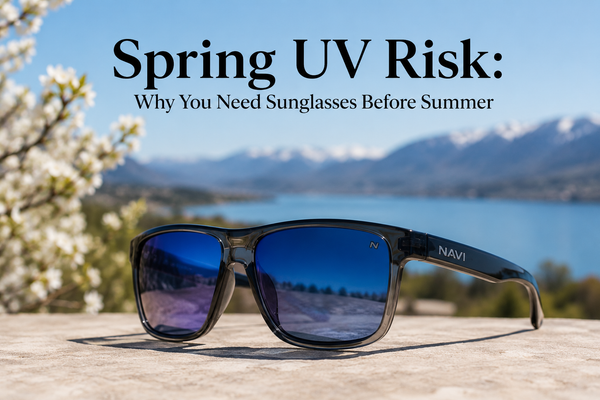

Spring UV Risk: Why You Need Sunglasses Before Summer
By late April across most of the US, UV index values reach 6–8 — well within the "high" category that causes measurable eye and skin UV damage. Spring UV rises faster than temperatures, creating a protection gap where UV risk is high but sun protection habits haven't kicked in yet. Add seasonal ozone depletion in early spring and the sharp increase in outdoor time after winter, and spring becomes one of the highest UV accumulation windows of the year — systematically under-protected.
There is a predictable pattern in how people approach UV protection through the year: it begins in earnest when temperatures rise, peaks in summer, and fades in autumn. The problem is that UV does not follow this pattern. UV intensity follows the sun's elevation angle — and in spring, that angle rises much faster than temperatures do. By May across much of the US, UV intensity is comparable to early summer values, but sun protection rates remain at winter levels because it still "doesn't feel like summer." For the full seasonal framework, see the complete year-round UV and seasonal sunglasses guide.

1. The Spring UV Gap: What's Actually Happening
UV Rises Faster Than Temperature
Temperature lags the solar calendar by approximately 4–6 weeks due to thermal inertia — the time it takes solar energy to heat land, water, and atmosphere. UV intensity, by contrast, tracks the solar elevation angle directly with almost no lag. The result: by late March and April, UV intensity is increasing rapidly toward summer peak, while temperatures are still 20–30°F below their summer highs.
In practical terms, a 58°F April afternoon in Chicago or Boston might carry a UV index of 5–6 — the same UV index as a typical summer afternoon in many northern European countries, and well above the threshold for measurable UV eye and skin damage with prolonged exposure. The UV is there; the behavioral cues that trigger sun protection are not.
The Ozone Depletion Window
Spring UV is further elevated by a seasonal atmospheric effect: stratospheric ozone concentration reaches its annual minimum in late winter and early spring before recovering through late spring and summer. The ozone layer absorbs UV-B — the shorter-wavelength, higher-energy UV that causes the most direct biological damage to skin and eyes. When ozone is thinner in March and April, more UV-B reaches ground level per unit of solar elevation angle than in equivalent conditions later in the season.
The practical consequence: March and April UV-B intensity is often higher relative to the sun's position than equivalent conditions in June or July. A spring day with UV index 5 may carry a higher UV-B dose per unit of exposure than a summer day with UV index 5 at a higher sun angle, because the spring UV is reaching the ground through thinner ozone.
Spring Outdoor Time Is Increasing Rapidly
March through May marks the return of outdoor activity for most of the US population — gardening, outdoor dining, spring sports, hiking, cycling, and general outdoor socializing resume after winter. This rapid increase in outdoor time coincides exactly with the rapid increase in UV intensity. The combination of more time outdoors and higher UV per hour makes spring a high UV-accumulation window that rivals or exceeds fall for total UV dose received by the average person.
2. Month by Month: What Spring UV Looks Like
March: The Early Spring Window
In the Sun Belt states (Florida, Texas, Arizona, California, New Mexico), UV index values in March regularly reach 5–7, with peak values on clear days approaching 8. For the northern tier (New England, Upper Midwest, Pacific Northwest), March UV index ranges from 2–4 on clear days — meaningfully lower than peak summer but still well above the UV index 1–2 of deep winter.
March is particularly hazardous for people who spend time near snow — snow reflectance of up to 80% amplifies the direct UV, and March is when ski season is still active across much of the Mountain West. A March ski day at altitude combines rising spring UV, altitude amplification, and snow reflectance into a UV environment that can exceed many summer beach days.
April: The Underestimation Peak
April is the month where the spring UV gap is most acute. Across most of the continental US, April UV index reaches 4–7 on clear days. In the South and Southwest, April UV index regularly hits 7–9 — high UV category values that produce erythema in fair-skinned individuals in 20–30 minutes. Temperatures in April range from the 50s in the North to the 70s in the South — still within the range that most people associate with "spring" rather than "sun season."
Spring gardening, school outdoor activities, spring sports practice, and outdoor events all cluster in April — precisely when UV is high and protection habits are absent. The average April outdoor afternoon is higher UV exposure than most people's mental model of "spring sun" acknowledges.
May: Approaching Summer UV
By May, UV index values across the US approach or match early summer values. Southern states and the Southwest see UV index 9–11 on clear May days. The northern tier reaches 6–8. Memorial Day weekend — the traditional start of "summer" in the American cultural calendar — arrives with UV conditions that have been at or near summer levels for several weeks already. The cultural holiday that marks the start of sun protection season is lagging the actual UV season by 4–6 weeks.
3. The Eye Health Case for Spring UV Protection
Cumulative Damage Has No Spring Break
UV damage to the eye is cumulative and irreversible. The crystalline lens proteins that progressively cloud with cataract formation, the macular photoreceptors that degenerate with age-related macular degeneration, and the corneal and conjunctival tissue that responds to UV with pterygium growth do not distinguish between summer UV and spring UV. Every hour of unprotected UV exposure adds to the cumulative dose that determines long-term eye health outcomes, regardless of the season in which it occurs.
The practical implication: UV accumulation that occurs in the spring months — when protection rates are lowest — contributes equally to lifetime UV dose as summer exposure with higher protection rates. The asymmetry between spring UV intensity and spring protection rates creates a systematic gap that meaningfully contributes to lifetime UV accumulation.
Photokeratitis: The Immediate Spring Risk
Beyond long-term cumulative damage, spring UV creates a specific acute risk: photokeratitis — UV sunburn of the cornea. This condition produces pain, tearing, and temporary vision disruption 6–12 hours after UV exposure. It occurs in spring contexts where UV is high and the eye is unprotected for extended periods — early spring hikes, outdoor festivals, spring beach days, and gardening sessions on bright spring days are all potential photokeratitis contexts. UV400 sunglasses completely prevent photokeratitis by blocking the UV-B wavelengths that cause it.
Spring Sports: High Exposure, Low Protection
Spring outdoor sport — baseball and softball season begins, tennis and pickleball resume, cycling season ramps up, track and field season runs — produces high UV exposure through extended outdoor athletic time during exactly the spring window where UV is high and protection habits are lowest. UV400 protection during spring sport is as important as during summer sport. See the complete guide to sunglasses for ball sports for sport-specific recommendations.
4. Regional Spring UV Guide
| Region | March UV Index | April UV Index | May UV Index | Notes |
|---|---|---|---|---|
| Sun Belt (FL, AZ, TX, NM) | 5–7 | 7–9 | 9–11 | Year-round UV; spring ramp is steep and reaches high values quickly |
| Southeast (GA, SC, NC, LA) | 4–6 | 6–8 | 8–10 | Spring UV underestimated; April outdoor events carry real UV risk |
| Mid-Atlantic / Northeast | 2–4 | 4–6 | 6–8 | April is the underestimation peak; May approaches summer UV |
| Midwest / Great Plains | 2–4 | 4–6 | 6–8 | Spring UV rises fast; snow still possible in March amplifying UV |
| Pacific Northwest | 2–3 | 3–5 | 5–7 | Lower absolute UV but same behavioral gap; spring rain ≠ no UV |
| Mountain West | 3–5 + altitude | 5–8 + altitude | 7–10 + altitude | Ski season still active in March/April; snow + altitude = high UV |
| Southern California | 5–7 | 7–9 | 9–11 | Minimal seasonal barrier; spring UV protection often overlooked |
| Hawaii | 8–10 | 9–11 | 10–12 | Minimal spring variation; year-round high UV — Cat 2–3 always |
5. What to Wear in Spring: Lens Recommendations
The Spring Lens Default: Cat 2 Amber or Gray Polarized
For most spring conditions — clear to partly cloudy days, moderate-to-high UV index — Cat 2 amber or gray polarized UV400 is the appropriate specification. Cat 2 lenses (transmitting 18–43% of visible light) provide meaningful brightness reduction for spring sun without the full darkness of Cat 3 summer lenses that can feel heavy on a 55°F spring morning. Amber tint enhances contrast in the variable light conditions of spring — partly cloudy days with shifting light benefit from contrast enhancement that amber provides. Gray polarized is the alternative for color-neutral brightness reduction.
When to Go Cat 3 in Spring
Cat 3 lenses (the summer standard) are appropriate in spring for:
- Spring ski days — snow + altitude + spring UV = Cat 3 mandatory
- Spring beach days in southern states where UV index reaches 8–9
- High-altitude spring hiking where altitude amplifies already-high spring UV
- Extended midday outdoor activity in the Sun Belt during April–May
- Spring outdoor sport in southern states during peak afternoon hours
Overcast Spring Days: Still Need Protection
The overcast spring day is the highest-risk underprotection scenario. A gray April morning that "doesn't feel sunny" carries 70–80% of the UV of a clear day. Spring gardening, outdoor errands, and casual outdoor activity on overcast days accumulate real UV in conditions where virtually no one reaches for sunglasses. Cat 1–2 polarized UV400 is appropriate for overcast spring conditions. See sunglasses on cloudy days for the full overcast UV guide.
6. Building the Spring UV Habit
The Re-Entry Problem
For people who reduce or stop wearing sunglasses in winter, spring requires a habit re-establishment that typically lags the actual UV risk by weeks. The transition from winter (low UV, low protection) to spring (rising UV, lagging protection) is where the gap is largest. The solution is not spring-specific — it is a year-round habit that avoids the re-entry problem entirely. A person who wears UV400 sunglasses consistently through winter reaches spring with the habit fully intact and no re-entry delay.
Spring as the Re-Start Point
For people who do not currently wear sunglasses year-round, spring is the best time to establish or re-establish the habit — precisely because the UV risk is real and rising, and because the habit established in spring carries forward naturally into summer. Starting the habit in March, when UV is rising and outdoor time is increasing, is more effective than starting in June when it already feels like "catching up."
Spring Sunglasses as a Gift
Mother's Day and Father's Day fall in May and June — directly within the spring-to-summer UV transition window. Quality UV400 polarized sunglasses given as spring gifts arrive at precisely the moment when they are most needed and when the UV habit is most valuably established. Navi Eyewear's Buy 1, Get 3 Free offer — $119 for 4 pairs — provides enough pairs for a family to cover multiple contexts: car, bag, home, and sport.
Frequently Asked Questions
Is UV harmful in spring?
Yes — by April across most of the US, UV index values reach 4–8, which is sufficient to cause cumulative eye and skin UV damage with prolonged unprotected exposure. Spring UV rises faster than temperatures, creating a systematic under-protection gap. The UV accumulation in spring months contributes equally to lifetime UV dose as summer exposure.
When should I start wearing sunglasses in spring?
Year-round wear is the correct answer — the habit that requires no seasonal re-start. For people who do take a winter break: resume in March in Sun Belt states and by April across the northern tier. By late April in most US locations, UV is firmly in the "high" category requiring consistent protection. Don't wait for Memorial Day — UV is there weeks earlier.
Do I need sunglasses on cloudy spring days?
Yes — clouds transmit approximately 70–80% of UV. A cloudy April day carries substantially more UV than most people assume. UV400 sunglasses appropriate for overcast conditions (Cat 1–2) are worthwhile on overcast spring days, particularly for extended outdoor activity. See sunglasses on cloudy days for the full evidence.
Is spring UV worse than summer UV?
Peak summer UV (July) is higher than peak spring UV (May) across most US locations. However, spring UV is meaningfully higher than most people's behavioral response to it — the protection gap is larger in spring than in summer. The early-spring ozone depletion effect also means March–April UV-B intensity per unit of solar angle is genuinely higher than equivalent summer conditions.
What sunglasses are best for spring?
Amber or gray polarized UV400 Cat 2 for most spring conditions. Amber tint handles the variable cloud-and-sun light conditions of spring well. Cat 2 darkness is appropriate for typical spring UV without over-darkening in lower-light spring mornings. Cat 3 for spring ski days, southern beach days, and peak-sun afternoon sport.
Can I get photokeratitis (UV corneal burn) in spring?
Yes — photokeratitis requires UV-B exposure above a threshold level for a sufficient duration, which spring conditions can provide. Spring ski days (snow + altitude + rising spring UV), extended spring beach days in southern states, and prolonged outdoor spring sporting events in bright conditions are all photokeratitis-risk contexts. UV400 sunglasses completely prevent photokeratitis by blocking the UV-B wavelengths responsible.
Why does UV rise in spring but temperatures stay cool?
UV intensity follows the solar elevation angle directly — as the sun rises higher in the sky through spring, UV increases rapidly. Temperature, by contrast, lags the solar calendar by 4–6 weeks due to thermal inertia — the time required for solar energy to heat land, ocean, and atmosphere. This lag creates the spring behavioral gap: UV is already high while it still feels cool, and sun protection habits triggered by temperature perception have not yet caught up.
The Bottom Line
Spring UV is real, rises faster than temperatures, and is systematically under-protected. By April across most of the US, UV index values are within the range that produces cumulative eye damage with regular unprotected exposure. The UV accumulation happening during spring gardening, outdoor sport, casual errands, and recreational activity contributes equally to lifetime UV dose as summer exposure — and occurs with a fraction of the protection awareness. The habit that solves this is year-round UV400 polarized wearing triggered by outdoor exposure, not by seasonal temperature cues. navieyewear.com/collections/polarized — Buy 1, Get 3 Free for $119.
Related Reading
- Sunglasses by Season: The Complete Year-Round UV Guide | Navi Eyewear
- Summer Peak UV: Maximizing Eye Protection | Navi Eyewear
- Overcast and Cloudy Day UV: Why Sunglasses Still Matter | Navi Eyewear
- Sunglasses for High-Altitude Mountain UV | Navi Eyewear
- The Complete Guide to Sunglasses for Ball Sports | Navi Eyewear
- UV and Eye Disease: Cataracts, Macular Degeneration and Prevention | Navi Eyewear
- Holiday and Winter Gift Sunglasses | Navi Eyewear
- Shop Polarized UV400 Sunglasses | Navi Eyewear
Sources & Citations
[1] WHO. "Global solar UV index: a practical guide." World Health Organization, 2002. View source →
[2] Sola Y, et al. "Total ozone mapping and UV-B variation in the Northern Hemisphere." Atmospheric Environment, 2008. View source →
[3] Taylor HR, et al. "Effect of ultraviolet radiation on cataract formation." New England Journal of Medicine, 1988. View source →
[4] West SK, et al. "Exposure to sunlight and other risk factors for age-related macular degeneration." Archives of Ophthalmology, 1989. View source →
[5] Dain SJ. "Sunglasses and sunglass standards." Clinical and Experimental Optometry, 2003. View source →
[6] Sliney DH. "Ocular exposure to environmental light and ultraviolet." Journal of AAPOS, 2014. View source →