
Best Sunglasses for Beach Volleyball
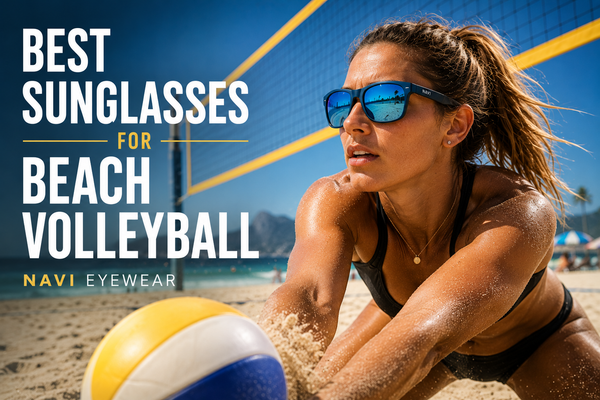
For beach volleyball: copper or amber polarized UV400 polycarbonate in a close-fitting sport frame with rubber grip and anti-saltwater coating. The beach environment stacks UV amplifiers — direct overhead sun, sand reflection (15–25% UV reflectance), water proximity adding further reflection, coastal UV amplification — making it one of the highest UV exposure environments in any sport. Copper polarized provides the strongest glare elimination from sand and water surfaces while enhancing ball contrast. Anti-saltwater coating protects lenses from salt spray degradation. Polycarbonate handles dive-and-impact scenarios. Frame security must handle diving, rolling, and sand contact.
Beach volleyball is played in the most extreme UV environment of any mainstream outdoor sport. Every UV amplifier that exists stacks simultaneously: direct overhead sun at peak hours, sand that reflects 15–25% of UV upward from below, proximity to water that adds further reflection from the side, coastal locations where reduced atmospheric scattering increases UV intensity, and the physical positioning of volleyball play that regularly orients the face directly toward the sun during spikes and serves. A two-hour competitive beach volleyball match under these conditions produces UV exposure comparable to a full day of casual outdoor activity.
For the complete ball sports framework, see the complete guide to sunglasses for ball sports. This guide covers what is specific to the beach volleyball environment — the UV amplification, sand-specific glare, salt exposure, physical contact demands, and the visual case for copper-tinted polarized lenses.

1. Why Beach Volleyball Is the Highest UV Exposure Ball Sport
The UV Amplification Stack
Most outdoor sports expose players to direct overhead UV and some degree of ground-surface UV reflection. Beach volleyball stacks multiple UV amplification factors that are not simultaneously present in any other mainstream ball sport:
- Direct overhead UV: peak summer midday UV index at coastal US locations ranges from 8–11+ (very high to extreme). Beach volleyball tournaments are typically scheduled across full weekend days in peak-UV hours.
- Sand UV reflectance: dry sand reflects approximately 15–25% of UV radiation upward — the beach surface effectively creates a second UV source from below, exposing underside of facial features and lower orbital area that overhead UV does not reach directly.
- Water proximity: coastal courts near water experience additional UV reflection from the water surface, particularly when the sun is at low-to-mid angles in morning and late afternoon sessions.
- Coastal UV amplification: coastal locations typically have reduced atmospheric particulate matter compared to inland urban areas, meaning less UV scatter and absorption in the atmosphere — coastal UV index is often higher than equivalent inland locations at the same latitude.
- Altitude of overhead gaze: volleyball's spike, block, and serve mechanics require frequent upward gaze — looking directly toward the UV source — at the highest UV intensity gaze direction available.
The combined effect: a beach volleyball player at a summer coastal tournament is accumulating UV at a rate that rivals or exceeds a ski day at altitude — but without the cultural norm of UV protection that snow sports have established.
Duration: Full-Day Tournament Exposure
Competitive beach volleyball tournaments run across full weekend days, with matches scheduled from morning through late afternoon. Players on teams that advance through elimination brackets can spend 6–8 hours in the beach UV environment across a tournament day. Even recreational beach volleyball — a 2–3 hour session with friends — occurs in the highest-UV outdoor environment accessible to most players. The UV accumulation from regular beach volleyball participation across a summer season is substantial.
Physical Positioning: Upward Gaze Frequency
Volleyball mechanics place players in upward-gaze positions more consistently than most sports. Setting, spiking, blocking, and serving all involve tracking or directing the ball at overhead height. The serve involves looking directly up to track the ball toss before contact. The overhead spike requires tracking the set as it rises and positioning for the attack angle. These repeated upward-gaze moments are the highest-UV-intensity visual directions available — looking up into sun is the most direct UV exposure angle for the eye.
2. The Glare Environment: Sand, Water, and Sky
Sand Glare: The Unique Challenge
Sand glare is distinct from hard court glare or road glare in its directionality and intensity. Dry beach sand is composed of small reflective particles that scatter light in multiple directions rather than producing the strongly directional horizontal reflection of a flat hard surface. The result is diffuse glare from the entire court surface — reflected light that comes from across the full sand area rather than a single horizontal reflective plane.
Polarized lenses eliminate the horizontally polarized component of sand glare — the portion that reflects at the Brewster's angle from the sand surface. This is the dominant component of sand glare for players at standing height looking across the court. For dive-and-roll situations where the player's eye level drops to near-sand height, the polarization benefit remains significant as the horizontal reflection component increases at lower viewing angles to flat surfaces.
Water Proximity Glare
Courts positioned near the water — a common configuration at beach volleyball venues, recreational beaches, and coastal tournaments — receive additional reflected UV and visible glare from the water surface. Water reflects approximately 25% of UV at low sun angles. Players on courts near the water experience this lateral glare in addition to the overhead and sand sources. Polarization specifically eliminates water surface glare — the horizontally polarized light from water reflection is the canonical case for polarization filter effectiveness.
Sky Glare During Play
The combination of direct sky brightness during overhead play and the diffuse sky luminance across the full visual field during court-level play creates a sustained high-luminance visual environment. Amber and copper tints reduce overall brightness while enhancing the contrast that allows the ball to be distinguished against sky and sand backgrounds. The ball in beach volleyball is white or light-colored — against bright sky and sand, color-contrast enhancement from amber and copper tints provides meaningful ball visibility improvement.
3. Lens Specification for Beach Volleyball
Copper Polarized: The Primary Beach Volleyball Lens
Copper polarized UV400 polycarbonate is the first-choice lens for beach volleyball and sand sports generally. The specific advantages of copper over amber in the beach environment:
- Maximum horizontal glare elimination: copper tint combined with polarization filter provides the strongest practical elimination of sand and water surface glare of any sport lens combination.
- Warm-spectrum contrast: copper's warm transmission spectrum enhances the contrast of white and yellow objects against sand and sky backgrounds — directly relevant to volleyball ball visibility.
- Blue-water depth perception: in coastal locations where water is visible in the visual field, copper tint enhances the color contrast of water and sky in ways that amber does not.
Browse copper and amber polarized UV400 options at navieyewear.com.
Amber Polarized: The Strong Alternative
Amber polarized UV400 is the close alternative to copper for beach volleyball and performs very similarly in the sand and outdoor context. Players who find copper's color rendering slightly too warm often prefer amber's slightly cooler orange-yellow shift. Both provide contrast enhancement for ball visibility and both combined with polarization effectively address sand and water glare. The choice between copper and amber for beach volleyball is largely personal preference on color rendering once both are tried.
Why Gray Polarized Is Less Optimal for Beach Volleyball
Gray polarized UV400 provides full polarization benefit for glare elimination and full UV400 protection, but without the contrast enhancement of copper or amber. In the beach volleyball environment specifically — white ball against bright sand and sky — the contrast-enhancing properties of copper and amber make the ball more distinctly visible than gray's color-neutral transmission. Gray is the better choice for driving and everyday use where color accuracy is the priority; copper and amber are better for the ball-tracking and glare-intensive beach environment.
Lens Category by Playing Conditions
| Condition | Category | Tint | Notes |
|---|---|---|---|
| Peak summer beach, full sun, midday | Cat 3 | Copper or amber polarized | Highest UV amplification environment — Cat 3 appropriate |
| Morning or late afternoon beach play | Cat 2 | Copper or amber polarized | Lower sun angle, meaningful UV still present from sand/water reflection |
| Overcast beach or coastal conditions | Cat 2 | Amber or copper polarized | Clouds transmit 80% UV; coastal diffuse glare still benefits from polarization |
| Indoor or shaded gymnasium volleyball | Cat 1 or clear | Amber or clear polycarbonate | No sand glare; UV protection less critical indoors |
4. Coatings: The Beach Environment Requires More Than Standard
Anti-Saltwater Coating: Non-Negotiable for Coastal Play
Standard lens coatings — including most oleophobic and hydrophobic coatings — are not designed to withstand repeated salt exposure. Salt spray from coastal wind, salt water from ocean splashes, and the salt content of sweat in beach conditions can progressively damage unprotected lens coatings, causing pitting, clouding, and delamination of coating layers. Anti-saltwater coating — a specific coating formulation that resists salt crystallization and penetration — is the appropriate protection for any lens used in coastal or beach sport environments.
All Navi Eyewear lenses include anti-saltwater coating as standard — a specification detail that matters specifically for beach volleyball and coastal activities where standard lenses degrade under repeated salt exposure.
Hydrophobic Coating for Ocean Spray and Sweat
Hydrophobic coatings cause water to bead and run off rather than sheeting across the lens. In beach conditions — ocean spray, perspiration, and the general moisture of a beach environment — hydrophobic coating keeps the lens surface cleaner and maintains optical clarity without constant wiping. Combined with anti-saltwater coating, hydrophobic coating provides the full protection suite for beach-environment lens maintenance.
Oleophobic Coating for Sunscreen
Sunscreen is applied regularly during beach play and inevitably contacts lenses — through hand contact, spray drift, or sweat carrying applied sunscreen into the eye area. Oleophobic coating repels oily substances including sunscreen and significantly reduces the bonding of sunscreen film to the lens surface, making lens cleaning much more effective with a simple wipe.
Navi Eyewear — UV400 Polarized Sunglasses
Buy 1, Get Any 3 Pairs Free — $119.00 for 4 pairs. Discount auto-applies at cart. Free shipping. Free replacements. 30-day return on unworn pairs.
Every lens: UV400 certified polycarbonate · FDA-cleared impact resistance · polarized PVA film · oleophobic coating · anti-saltwater coating · TR90 nylon frames · stainless 5-barrel hinges.
Shop now: navieyewear.com/collections/polarized
5. Frame Specifications for Beach Volleyball
Sand Contact Tolerance
Beach volleyball involves diving and rolling in sand — a reality that most sunglasses are not designed for. Frame design priorities for beach volleyball:
- Simple hinge construction: complex hinge mechanisms trap sand and develop accelerated wear in beach environments; simple barrel hinges like stainless 5-barrel designs are more sand-tolerant.
- Smooth frame surfaces: frame surfaces without recessed grooves or tight joints where sand can pack are easier to clean and resist sand-induced wear.
- Washable materials: TR90 nylon frames and silicone rubber contact surfaces rinse clean effectively.
- Closed lens grooves: lens-to-frame grooves that trap sand accelerate lens scratching when the frame is rubbed; closed or minimal-groove designs perform better in sand environments.
Retention for Dynamic Play
Beach volleyball's jump, dive, and explosive lateral movement demands mean frame retention is as critical as in any high-intensity sport. Rubber grip nose and temple contacts are the foundation. For competitive play with frequent dives and jumps, elastic sport retention straps provide additional security during the most dynamic movements. Many competitive beach volleyball players use elastic retention straps as standard practice.
Peripheral Coverage for Multi-Direction Sun
The beach sun environment involves UV and glare from overhead, from sand below, and from the water laterally. Close-fitting wraparound sport frames that sit close to the face across their full perimeter provide coverage against all three UV directions simultaneously — overhead through the lens, sand-reflected UV limited by lens depth and face-contact closeness, and lateral UV covered by the wrap geometry.
6. Recreational vs Competitive Beach Volleyball
Recreational Beach Play
Recreational beach volleyball — pickup games, resort play, beach parties — typically involves shorter durations and lower physical intensity than competitive play. The UV environment is identical, however — the same sun, same sand, same UV amplification stack applies regardless of competitive level. The lens specification (copper or amber polarized UV400 Cat 2–3) is equally appropriate for a casual two-hour beach session as for a competitive tournament.
Competitive Club and Tournament Play
Competitive beach volleyball involves full-intensity athletic movement — running dives, jump serves, attack approach sequences — across multiple matches per tournament day. Frame security at this intensity requires rubber grip contact points and, for players with particularly dynamic defensive play, elastic retention straps. The UV exposure across a full tournament day is substantially higher than a recreational session — Cat 3 copper or amber polarized is the appropriate specification for full-day tournament conditions.
Youth Beach Volleyball
Youth players in beach volleyball face the same UV amplification environment as adults, with the added vulnerability of developing eyes that transmit more UV to the retina. The lens specification — copper or amber polarized UV400 polycarbonate — applies equally to youth players; frame sizing needs to match the child's face proportions rather than adult sizing. For the complete youth UV protection guide, see UV protection for children.
Frequently Asked Questions
What are the best sunglasses for beach volleyball?
Copper or amber polarized UV400 polycarbonate in a close-fitting sport frame with rubber grip, anti-saltwater coating, and hydrophobic coating. Copper provides the strongest sand and water glare elimination with contrast enhancement for ball visibility. Browse polarized UV400 options at navieyewear.com — all Navi lenses include anti-saltwater coating as standard.
Do you need polarized sunglasses for beach volleyball?
Yes — and the beach is arguably the most compelling use case for polarization of any sport environment. Sand surface glare and water reflection are both horizontally polarized — exactly the light type that polarization filters specifically eliminate. Non-polarized UV400 lenses block UV and reduce brightness but leave the sand and water surface glare intact. The visual difference between polarized and non-polarized in a beach volleyball environment is immediately and dramatically perceptible.
What color lens is best for beach volleyball?
Copper polarized is the primary recommendation — it provides the strongest combination of polarized glare elimination and warm-spectrum contrast enhancement for white ball visibility against sand and sky. Amber polarized is a close alternative with very similar performance. Gray polarized provides full UV and polarization protection without the contrast enhancement — valid but less optimal for the ball-tracking and high-glare beach environment. See the complete lens color guide for the full tint science.
Will sunglasses stay on during beach volleyball dives?
With the correct frame design, yes. Rubber grip nose pad and temple contacts grip even when wet with sweat or water. Close-fitting wraparound geometry reduces the tendency to shift during dynamic movement. For players who dive frequently or play at competitive intensity, elastic sport retention straps provide an additional securing layer that essentially eliminates frame loss during dives.
How do I clean sand off beach volleyball sunglasses?
Rinse with clean water first — never wipe dry sand across a lens surface, as the abrasive particles will scratch the coating. After rinsing, wipe gently with a clean microfiber cloth. For salt spray, rinse with fresh water after each session to prevent salt crystal formation on the frame and coating surfaces. Store in a hard case — soft cases in a beach bag accumulate sand that then scratches lenses on retrieval.
Is the sand UV reflection really significant?
Yes — and it's underappreciated. Dry sand reflects approximately 15–25% of incident UV, creating a secondary UV source from below that reaches orbital areas and lower facial skin that overhead UV doesn't directly contact. Combined with direct overhead UV, this effectively increases total UV exposure for a person at the beach compared to the same UV index in a non-reflective surface environment.
Can I use my regular sport sunglasses for beach volleyball?
If your sport sunglasses are UV400 polarized polycarbonate in a close-fitting frame with rubber grip, yes — for the lens performance and frame retention requirements. The additional beach-specific requirements are coating-related: anti-saltwater and hydrophobic coatings protect against salt spray degradation that standard sport sunglasses may not be equipped for. Rinse thoroughly with fresh water after every beach session to extend coating life if using non-anti-saltwater-coated frames.
Do beach volleyball sunglasses need to be sports-specific brands?
They need to meet sports-specific specifications — UV400 polycarbonate, polarized, close-fitting, rubber grip, appropriate coatings. The brand is less relevant than whether the frame meets these requirements. The value differentiator in beach volleyball eyewear is whether the specific coatings (anti-saltwater, hydrophobic, oleophobic) are present — verify these rather than assuming they're included with any sport-branded frame.
The Bottom Line
Beach volleyball stacks UV amplifiers — direct sun, sand reflection, water proximity, coastal UV intensity — into the highest UV exposure environment of any mainstream ball sport, while simultaneously demanding eyewear that handles sand contact, salt spray, dynamic athletic movement, and extended full-day exposure. The specification that addresses all of these: copper or amber polarized UV400 polycarbonate with anti-saltwater and hydrophobic coatings, in a close-fitting sport frame with rubber grip retention. All Navi Eyewear polarized lenses include anti-saltwater coating as standard. navieyewear.com/collections/polarized — Buy 1, Get 3 Free for $119.
Related Reading
- The Complete Guide to Sunglasses for Ball Sports | Navi Eyewear
- Best Sunglasses for Baseball and Softball | Navi Eyewear
- Best Sunglasses for Tennis | Navi Eyewear
- Best Sunglasses for Pickleball | Navi Eyewear
- Sunglasses for Tropical Travel: Caribbean, Mexico and Hawaii | Navi Eyewear
- UV Protection for Children: The Complete Family Eye Health Guide | Navi Eyewear
- How Polarized Sunglasses Work | Navi Eyewear
- Shop Polarized UV400 Sunglasses | Navi Eyewear
Sources & Citations
[1] WHO. "Global solar UV index: a practical guide." World Health Organization, 2002. View source →
[2] Diffey BL. "Sources and measurement of ultraviolet radiation." Methods, 2002. View source →
[3] Taylor HR, et al. "Effect of ultraviolet radiation on cataract formation." New England Journal of Medicine, 1988. View source →
[4] Dain SJ. "Sunglasses and sunglass standards." Clinical and Experimental Optometry, 2003. View source →
[5] Rosenthal FS, et al. "The effect of sunglasses on ocular exposure to ultraviolet radiation." American Journal of Public Health, 1988. View source →
[6] Sliney DH. "Ocular exposure to environmental light and ultraviolet." Journal of AAPOS, 2014. View source →