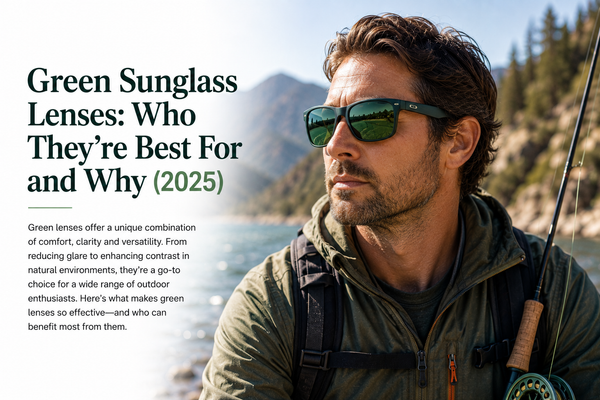

Green Sunglass Lenses: Who They’re Best For and Why
Green is the tint that no one talks about but a lot of people end up with. It sits between gray and amber on every optical dimension that matters — more contrast than gray, more color accuracy than amber, better in flat light than gray, less color-altering than amber. It is the compromise lens, which sounds like faint praise but is not. For a specific set of activities and users, the compromise is the optimal position.
This guide covers exactly what green lenses do to light, how the visual experience differs from gray and amber, which activities green specifically serves, and the honest case for when gray or amber is still the better choice. Green has earned a definitive guide, not because it is the most dramatic tint, but because it is more useful to more people than its niche reputation suggests.
This is a C18 Lens Color Deep Dives supporting post. It links back to the cluster pillar atthe complete sunglass lens color guide. For the gray and amber comparisons, seegray sunglass lenses: why neutral is the smartest everyday choice andbrown and amber sunglass lenses: contrast, depth and outdoor performance.
Quick Answer
Green lenses absorb some blue and some red wavelengths, providing moderate contrast enhancement with less color shift than amber. The visual result is crisp and natural — better outdoor definition than gray without the warm color cast of amber. Green excels for tennis, padel, golf (as a close second to amber), hiking, and any activity where both contrast enhancement and reasonably accurate color perception matter. It is the most versatile compromise tint when one pair must serve multiple activities.

Table of Contents
Part 1: How Green Lenses Filter Light
Green lenses absorb light in both the blue end (400–500nm) and the red end (620–700nm) of the visible spectrum, transmitting the green and yellow-green middle range (500–580nm) most readily. The absorption profile sits between gray (uniform across the full spectrum) and amber (strongly blue-preferential, transmitting warm wavelengths heavily).
The blue absorption component gives green its contrast enhancement property — the same mechanism as amber, reducing the scattered blue light that creates outdoor visual haze. The partial red absorption limits the color shift that amber’s strong warm-wavelength preference creates. The result is a lens that improves outdoor contrast without the dramatic color temperature shift of amber.
The degree of blue absorption in green lenses varies by formulation. Some green tints have a stronger blue-filtering component and perform closer to amber for contrast enhancement. Others have a lighter touch and perform closer to gray for color accuracy. The variation means that two green lenses from different manufacturers may differ meaningfully in their contrast performance. The optical quality of the specific lens material matters alongside the tint category choice.
Part 2: The Visual Experience Through Green
Through a quality green lens, the outdoor world appears crisp and natural. The scene has more definition than through gray — edges are slightly more distinct, surfaces have slightly more texture, the separation between objects and backgrounds is slightly improved. But the world still looks broadly like the world. The sky is blue, not yellow-orange. Grass is green, not warm-tinted. Traffic signals read approximately correctly.
Many wearers describe green lenses as providing a ‘clean’ visual quality — a term that captures the combination of improved clarity (from the contrast enhancement) and color naturalness (from the moderate color shift). It is a perceptually comfortable lens for extended wear. The color environment does not feel as dramatically altered as amber, which can create a sense of visual fatigue over long sessions for some wearers. Green’s more moderate color shift tends to be easier to wear for extended periods without the visual recalibration that amber requires when moving between outdoor and indoor environments.
Part 3: Green vs Gray — Where Green Has the Edge
Outdoor Contrast in Bright Conditions
Gray’s uniform absorption means it reduces the brightness of the outdoor scene without changing the contrast relationships between objects and backgrounds. The scene is darker but not more defined. Green’s partial blue absorption reduces the scatter component of outdoor light, improving the contrast between objects and their backgrounds. In bright outdoor conditions — on a tennis court, a hiking trail, a golf course — green produces a sharper, more defined visual scene than gray.
Ball Visibility in Outdoor Sport
For outdoor racquet sports, ball sports, and any activity where tracking a moving object against an outdoor background matters, green provides better object-background contrast than gray. Not as much as amber — but meaningfully more than gray. For tennis specifically, where the ball is yellow-green and the court surface is often green, the contrast dynamics of a green lens are particularly suited: the ball’s color is in the transmitted range of the lens, making it appear bright and visible against the court and sky backgrounds.
Flat Light Performance
In overcast or flat-light outdoor conditions, gray produces a visually flat scene that accurately represents the low-contrast character of diffuse light. Green’s partial blue filtering adds modest contrast improvement in these conditions — not as dramatically as amber, but enough to make outdoor activities in typical overcast conditions more visually engaging than gray provides.
Part 4: Green vs Amber — Where Color Accuracy Catches Up
Color Accuracy for Mixed-Use Contexts
Amber’s strong blue absorption creates a warm color shift that alters the perceived color of traffic signals, road signs, and other color-coded visual information. Green’s more moderate absorption maintains better color accuracy across these wavelength ranges. For users who want contrast enhancement without the strong color alteration of amber — particularly those who also use their sunglasses for casual driving or who move between outdoor sport and urban environments in the same session — green provides a workable compromise.
Extended Wear Comfort
Some wearers find amber’s color cast fatiguing over long outdoor sessions because the visual recalibration required on each transition between outdoor and indoor environments is more extreme than green requires. Green’s more moderate color shift makes extended outdoor wear and the transitions it involves perceptually smoother.
Versatility Across Contexts in One Pair
For users who want a single pair that serves both outdoor activity and general everyday use without constant switching — the person who walks to work, runs at lunch, and attends an outdoor afternoon meeting in the same pair — green provides more versatility than amber. It does not require the same mental color recalibration when shifting between contexts.
Part 5: The Activities Where Green Is the Best Choice
Tennis and Padel
Green is the closest to an ideal tennis lens. The yellow-green tennis ball is in the transmitted wavelength range of green lenses, making it appear bright and distinct against both court surfaces and outdoor sky backgrounds. The court’s own green or red surface provides color contrast with the ball that green lenses maintain more accurately than amber (which warms the court’s color) or gray (which does not enhance the ball’s color contrast). Green’s combination of ball-color enhancement and court-color accuracy makes it specifically suited to racquet sports in a way that gray and amber are not.
General Hiking and Trail Outdoor Use
Hiking involves continuous terrain and surface awareness across variable light conditions — open hillside, forest shade, streamside, rocky exposure. Green’s contrast enhancement improves terrain definition without the dramatic color alteration of amber that can look unnatural under forest canopy or in complex natural environments. For hikers who want one pair across all trail conditions, green handles the range from bright ridge exposure to shaded valley trail more comfortably than amber.
Golf — Close Second to Amber
For golf, amber is the optimal tint for the specific visual tasks of ball tracking and green reading. Green is a very close second. The contrast enhancement it provides for ball-against-sky and surface texture reading is meaningful, and its more accurate color rendering means the course environment looks more natural through green than amber. For golfers who find amber’s color cast distracting or who play on courses with complex color environments, green is the appropriate alternative.
All-Round Outdoor Everyday
For users who want a single outdoor pair that serves casual outdoor activities, walking, spectator sport, and occasional light outdoor exercise without dedicating to the sport-specific performance of amber, green is the correct choice. It provides the contrast improvement that outdoor environments benefit from while maintaining the color naturalness that gray provides in color-coded environments.
Part 6: When Gray or Amber Is Still Better
When Gray Is Better Than Green
When Amber Is Better Than Green
Part 7: Green and Driving
Green is acceptable for casual everyday driving. Its color shift is less extreme than amber, and traffic signals remain broadly readable at their correct colors through a quality green lens. However, for professional driving, high-density urban driving, or any context where rapid and unambiguous color code interpretation matters, gray remains the correct specification.
The practical position: green is appropriate for the driver who predominantly uses sunglasses for outdoor activities and sometimes drives while wearing the same pair. It is not the optimal driving lens — that is gray — but it is usable for driving without the color accuracy concerns that amber introduces. If driving is the primary use case, choose gray. If outdoor activity is the primary use case with driving secondary, green is a workable single-pair compromise.
Part 8: Green and Polarization
Green polarized UV400 is the complete specification for the activities green serves. Polarization adds the glare elimination that contrast enhancement alone does not provide. On a tennis court in bright sun, polarization removes the surface glare that reduces court texture visibility, while green’s contrast enhancement improves ball-background definition. The combination addresses both the specular glare problem (polarization) and the diffuse scatter problem (green tint) simultaneously.
For hiking, the combination eliminates the water surface reflection and reflective rock glare that can be disorienting on trail surfaces, while the green tint improves the contrast and definition of the trail surface itself. Green polarized UV400 is a genuinely useful all-round outdoor specification for users who want a single pair that handles varied outdoor activities without amber’s color compromises.
The complete polarization science is inpolarized vs non-polarized sunglasses: the definitive guide.
Part 9: Lens Category for Green
✨ NAVI EYEWEAR — UV400 POLARIZED. EVERY TINT.UV400 polycarbonate. Polarized. Oleophobic and anti-saltwater coating. TR90. Stainless hinges. Gray for driving and everyday. Amber for outdoor sport. Green for the versatile middle ground. Buy 1, Get Any 3 Pairs Free — $119 for four pairs (~$30 each). Free shipping. Free replacements. |
Part 10: Comparison Table — Green vs Gray and Amber
|
Property |
Green |
Gray |
Amber |
|
Color accuracy |
Good — moderate shift |
Excellent — neutral |
Altered — warm yellow |
|
Contrast enhancement |
Moderate — meaningful |
Minimal |
High — strong |
|
Flat-light performance |
Good |
Limited |
Excellent |
|
Ball tracking (sport) |
Very good |
Good |
Excellent |
|
Driving (mixed traffic) |
Acceptable — gray preferred |
Best |
Not recommended |
|
Tennis / racquet sport |
Excellent — best tint for tennis |
Good |
Very good |
|
Golf |
Very good |
Good |
Excellent |
|
Trail running / hiking |
Very good |
Good |
Excellent |
|
Extended wear comfort |
High — moderate color shift |
High — neutral |
Variable — yellow cast |
|
Single-pair versatility |
Excellent |
Excellent |
Good — driving limit |
Part 11: Best For
Green Polarized UV400 Category 2 — Best For:
Part 12: Common Mistakes
Bottom Line
Green sunglass lenses occupy a genuinely useful middle position in the tint spectrum. More contrast than gray — enough to matter for outdoor sport and activity. More color accuracy than amber — enough to maintain visual naturalness and reduce color fatigue over extended wear. Best specifically for tennis and padel, where the yellow-green ball color interacts particularly well with the green lens’ transmission range, and for hiking and general outdoor use where both contrast and color naturalness are needed.
Green is not the answer when maximum contrast enhancement is the priority — amber and brown are. It is not the answer when maximum color accuracy is the priority — gray is. It is the answer when the priority is a single pair that handles outdoor activity better than gray and everyday use better than amber. That is a specific and genuinely common use case, and green serves it well.
Browse UV400 polarized options atnavieyewear.com/collections/polarized. Add 4 pairs — Buy 1, Get Any 3 Free auto-applies. Free shipping. Free replacements.
Frequently Asked Questions
What do green sunglass lenses do?
Green lenses absorb some blue and some red wavelengths, providing moderate contrast enhancement with a relatively natural color rendering. The visual result is a crisp, clean outdoor image with more definition than gray and less color shift than amber. Green is the compromise tint — better contrast than gray, better color accuracy than amber.
Are green sunglass lenses better than gray?
For outdoor activity — tennis, hiking, golf, and outdoor sport — green provides better contrast enhancement than gray. For driving in mixed traffic and professional color-critical outdoor roles, gray’s color accuracy advantage makes it the better choice. The comparison depends entirely on the primary use context.
Are green or amber lenses better for sunglasses?
Amber provides stronger contrast enhancement and is the better choice for dedicated outdoor sport performance — golf, trail running, overcast outdoor activity. Green provides better color accuracy and more versatility across mixed use contexts. Choose amber for maximum outdoor sport performance; choose green when one pair must serve both outdoor activity and everyday mixed-context use.
Are green lenses good for driving?
Acceptable for casual everyday driving. Green’s color shift is less extreme than amber, and traffic signals remain broadly readable. For professional driving or high-density traffic, gray is the correct specification because of its complete color accuracy. Green is a workable compromise for the person whose sunglasses serve both outdoor activity and casual driving.
What sport are green lenses best for?
Tennis and padel. The yellow-green tennis ball is in the transmitted wavelength range of green lenses, making it appear particularly bright and visible against court and sky backgrounds. Green also maintains the court’s own color accuracy better than amber, which warms the court surface color. For racquet sports, green is specifically better suited than gray or amber.
Do green lenses enhance contrast?
Yes — moderately. Green’s partial blue absorption reduces the scattered blue light that creates outdoor visual haze, improving the contrast between objects and their backgrounds. The enhancement is meaningful compared to gray but less dramatic than amber. Green sits between gray (minimal contrast enhancement) and amber (high contrast enhancement) on the contrast spectrum.
Can I wear green lenses for hiking?
Yes — green is a good hiking lens. The contrast enhancement improves terrain and surface definition across variable trail conditions, while the more natural color rendering than amber makes the trail environment look less artificially filtered. Green handles the range from bright exposed ridge to shaded forest trail more naturally than amber while providing more contrast improvement than gray.
How do green lenses compare to gray for everyday use?
Gray is the most versatile everyday lens because of its complete color accuracy. Green provides modest contrast improvement for outdoor environments while maintaining reasonable color accuracy for everyday use. For a user whose everyday use is primarily urban and driving-focused, gray is better. For a user whose everyday use is primarily outdoor-active — walking, park visits, outdoor lunch, casual sport — green is a more visually engaging everyday lens.
Supporting Articles
UV400. POLARIZED. THE VERSATILE MIDDLE GROUND.UV400 polycarbonate. Polarized. Oleophobic and anti-saltwater coating. TR90. Stainless hinges. Green polarized UV400: outdoor contrast with color accuracy. The smart single-pair choice. Buy 1, Get Any 3 Pairs Free — $119 for four pairs. Free shipping. Free replacements. |
SOURCES & CITATIONS[1] Dain SJ.“Sunglasses and sunglass standards.”Clinical and Experimental Optometry, 2003.View source [2] De Faber JT, Naeser K, Kessing SV.“Polarized light and contrast sensitivity under glare conditions.”Ophthalmic Research, 2013.View source [3] Rosenthal FS, Bakalian AE, Lou CQ, Taylor HR.“The effect of sunglasses on ocular exposure to ultraviolet radiation.”American Journal of Public Health, 1988.View source [4] American Academy of Ophthalmology.“Sunglasses: choosing the right pair for UV protection.”AAO EyeSmart, 2023.View source |