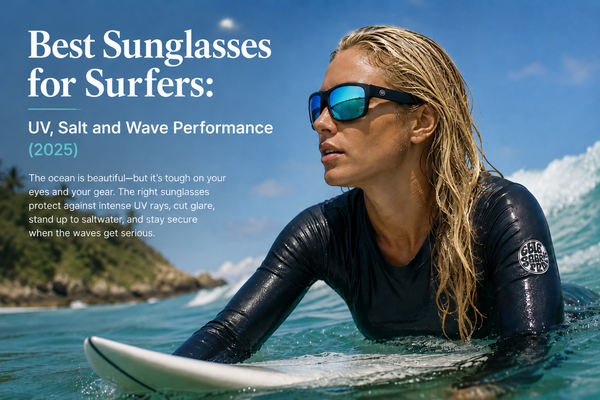

Best Sunglasses for Surfers: UV, Salt and Wave Performance
Surfers operate in the highest combined UV environment of any common outdoor activity. Direct overhead UV at the beach. Up to 20% UV reflection from the water surface reaching the eye from below and at eye level. UV reflected from white water and foam. And for surf instructors, lifeguards, and anyone who works in the surf zone professionally, this environment is not a weekend experience — it is a daily occupational reality across an entire season or year-round career.
The surf environment also creates specific demands beyond UV: salt spray that degrades unprotected lens surfaces, the physical demands of paddling and wipeout that require genuine frame security, and the visual performance needs of reading wave sets, tracking swimmers, and navigating the line-up that make lens tint a functional choice rather than an aesthetic one.
This is a C17 Professions & Occupations supporting post. It links back to the cluster pillar atthe complete guide to sunglasses for outdoor workers by profession. For the complete beach guide, seebest sunglasses for the beach.
Quick Answer
For surfers and surf professionals: UV400 polycarbonate (mandatory), gray or copper polarized at Category 3 for peak sun surf sessions, anti-saltwater coating (non-negotiable for any regular salt water exposure), TR90 nylon frame with rubberised grip and retention cord or strap, stainless hardware. Gray polarized eliminates water surface reflection while maintaining the visual clarity of the lineup. Copper polarized enhances sub-surface water features and wave structure for instructors and competitive surfers.

Table of Contents
Part 1: The Surf UV Environment — Why It Is the Highest Combined Exposure
The surf zone combines UV intensity factors that compound in ways that most outdoor environments do not. Understanding the full UV geometry of surfing explains why surfers have among the highest UV-associated eye condition prevalence of any recreational group.
Direct Overhead UV
Beach and coastal environments at sea level receive high ambient UV. Surfing sessions typically occur in morning and midday windows when the UV index is at or approaching its peak. Unlike urban outdoor environments where buildings create partial shade and reduce ambient UV, open ocean and beach environments have no overhead UV mitigation beyond the atmosphere.
Water Surface Reflection: 10–20%
The ocean surface reflects 10–20% of incoming UV, depending on sun angle and sea state. This reflected UV travels upward and laterally from the water surface, reaching the eye from directions that overhead UV protection — hat brims, brow ridges — does not protect against. A surfer lying on their board or sitting in the lineup is receiving reflected UV from the water surface that reaches the lower and anterior eye directly.
White Water and Foam Reflection
Breaking waves and white water have significantly higher UV reflectance than the open ocean surface. The foam and aerated water of breaking waves reflects up to 30–40% of UV, creating intense localised UV reflection events every time a wave breaks in the surfer’s vicinity. Surfers in active wave zones are receiving multiple high-intensity UV reflection events throughout a session.
Sand Reflection
The beach environment surrounding the surf zone adds sand reflection of 15–25% UV. Surfers spending time on the beach between sessions, walking to and from the water, or instructors on the beach observing students are receiving this additional sand-reflected UV component on top of the water reflection they receive in the lineup.
The full UV eye disease science is inUV and eye disease: the complete guide.
Part 2: Pterygium — The Surfer’s Eye Condition
Pterygium is a benign but significant eye condition characterised by a growth of vascularised tissue from the conjunctiva onto the corneal surface. It is strongly associated with chronic UV exposure and is particularly prevalent in populations with high outdoor UV exposure — surfers, fishermen, farmers, and outdoor workers in high-UV environments.
The condition is not trivial. Advanced pterygium can encroach on the visual axis, causing visual disturbance and potentially requiring surgical removal. Even moderate pterygium causes chronic eye irritation, redness, and foreign body sensation. Population studies have found pterygium prevalence in surfer populations at rates significantly higher than age-matched non-surfers, with UV exposure as the primary modifiable risk factor.
UV400 protection that blocks all UVA and UVB to 400nm is the evidence-based preventive measure for pterygium in high-risk individuals. Close-fitting frame geometry that reduces peripheral UV entry from the lateral and inferior directions — where water surface and sand reflection reach the eye — provides more complete pterygium prevention coverage than standard open-frame sunglasses.
Part 3: Why Anti-Saltwater Coating Is Non-Negotiable
Salt water contact with lens surfaces is not just a cleaning inconvenience. It is a progressive lens degradation mechanism that affects unprotected lenses in the marine environment.
The Salt Crystal Abrasion Mechanism
When salt water evaporates on a lens surface, it leaves sodium chloride crystals. When those crystals are then rubbed across the lens surface — which happens automatically when a surfer wipes their face or cleans their lenses with a cloth or shirt without first rinsing with fresh water — the crystals act as abrasives. Over repeated sessions, this salt crystal abrasion progressively degrades the lens surface and any coatings present.
What Anti-Saltwater Coating Does
Anti-saltwater coating modifies the surface chemistry of the lens so that salt water beads up and rolls off rather than spreading across the surface in an evaporating film. This prevents the salt crystal deposition that is the first step in the abrasion mechanism. It does not make the lens waterproof or eliminate the need for fresh water rinsing after surf sessions. It significantly reduces the rate of salt-induced surface degradation.
Fresh Water Rinsing After Every Session
Anti-saltwater coating reduces but does not eliminate salt crystal deposition. Rinsing sunglasses with fresh water after every surf session — when rinsing the rest of the gear — is the primary maintenance practice that extends lens and frame life in the marine environment. The combination of anti-saltwater coating and post-session fresh water rinse is the correct maintenance approach for surf sunglasses.
Part 4: Polarization in the Surf Zone
Polarization is the lens property most immediately transformative in the surf environment. The ocean surface is one of the most polarized natural environments — the water surface reflection that creates the blinding glare of a sunlit ocean is almost entirely horizontally polarized. A polarized lens blocks this reflection completely, revealing:
The complete polarization science is inpolarized vs non-polarized sunglasses: the definitive guide.
Part 5: Gray vs Copper — Choosing the Right Tint
Gray Polarized — The All-Conditions Surf Tint
Gray polarized UV400 is the most versatile surf tint. It eliminates horizontal water surface reflection while maintaining neutral colour rendering of the surf environment. The lineup, the horizon, the wave faces, and the shoreline all appear at natural colours but without the blinding surface glare. Gray is the correct choice for lifeguards and surf instructors whose job requires accurate colour perception of the water environment — identifying swimmers in difficulty, reading water colour for hazard assessment, and monitoring the full scope of the surf zone.
Copper Polarized — The Sub-Surface Visibility Tint
Copper polarized UV400 provides the sub-surface visibility enhancement that gray does not. Copper filters the blue and green wavelengths that dominate water scattering, emphasising the warmer wavelengths that penetrate water most clearly. The result: a polarized copper lens reveals reef structure, bottom depth, and underwater features more clearly than a polarized gray lens. For surfers at reef breaks where reef awareness is a safety issue, and for fishing instructors and guides who need to see sub-surface fish and features, copper is the performance choice.
The Practical Choice
For most recreational surfers and surf students: gray polarized Category 3 is the everyday surf choice. For competitive surfers and experienced reef break surfers who want maximum sub-surface awareness: copper polarized at Category 2–3. For lifeguards and safety professionals: gray polarized at Category 3 for colour accuracy in safety assessment.
Part 6: Lens Category for Surfing
Part 7: Frame Requirements for Surf Use
TR90 Nylon: Mandatory for Surf
TR90 nylon is the correct frame material for surf use. It is flexible, so it survives the physical impacts of paddling, duck-diving, and wipeout. It does not corrode in salt water environments where base metal alloys degrade. It is lightweight for extended session wear. Standard acetate frames are heavier and less flexible; metal frames corrode in salt environments regardless of their lens specification.
Rubberized Grip on Nose and Temples
A surf session involves the face being submerged, sprayed, and physically impacted by water. Standard smooth nose pads provide no grip on a wet, salt-water face. Rubberised or silicone nose pads and temple tips maintain grip in the water environment and are the difference between sunglasses that stay on the face during paddling and sunglasses that are immediately removed by the first wave.
Stainless Hardware
Salt water corrodes base metal alloys in the hinge and hardware within a season of regular use. Loose hinges are the primary mechanical failure mode for surf sunglasses in regular use. Stainless steel hardware resists this corrosion and maintains hinge function across multiple seasons of regular surf exposure.
Close-Fitting or Wraparound Geometry
Close-fitting or wraparound frame geometry provides two surf-specific benefits: it reduces lateral salt spray entry behind the lens (which would reach the lens inner surface and accelerate degradation), and it reduces peripheral UV entry from the water reflection angles that standard frames leave open.
Part 8: The Retention Strap — Essential, Not Optional
A retention strap — a cord or strap connecting the two temple ends behind the head — is mandatory for surf use. Without a strap, sunglasses lost to a wipeout or paddle-out go overboard immediately. At sea, recovering a lost pair of sunglasses from the water is unlikely. The retention strap converts a lost-in-wipeout event from an eyewear replacement to a brief retrieval.
Navi Eyewear frames do not include retention straps as standard, but straps are universally available at surf shops, outdoor retailers, and online for a few dollars. Any strap that attaches to standard temple arms works. The attachment takes seconds and the protection from loss is complete.
For lifeguards and surf instructors whose sunglasses are professional equipment rather than personal gear, the retention strap is part of the standard kit alongside the frames and lenses. Losing professional UV protection equipment to water during a working session is an occupational health event, not a shopping inconvenience.
Part 9: For Surf Instructors and Lifeguards
Surf instructors and lifeguards are in the marine UV environment for the duration of their working shift. An instructor teaching from dawn patrol to late afternoon across a summer season accumulates annual surf-zone UV that is genuinely occupational in scale. The specification is identical to the recreational specification but the compliance requirement is higher: professional surf zone workers should treat UV400 eyewear the same way they treat their wetsuit — as occupational equipment that is worn consistently and replaced when damaged.
Lifeguards have an additional functional requirement: the ability to detect swimmers in difficulty through polarized lenses. Gray polarized at Category 3 provides the best visual performance for this task: polarization eliminates the water surface reflection that obscures sub-surface objects, and gray maintains the colour accuracy needed for hazard assessment and communication with shore. Category 3 darkness manages the sustained high-UV conditions of a full beach shift.
Retention straps for lifeguards are operational equipment. During active surveillance and rescue operations, hands-free is the requirement: a lifeguard whose sunglasses are on a retention cord does not lose their UV protection during a water entry rescue. The cord keeps the glasses retrievable for post-rescue use and maintains the professional standard of complete UV coverage throughout the shift.
✨ NAVI EYEWEAR — UV400 AND ANTI-SALT. SURF READY.UV400 polycarbonate. Gray or copper polarized. Anti-saltwater coating standard on every pair. TR90 nylon. Stainless 5-barrel hinges. Add a retention strap for full surf deployment. Buy 1, Get Any 3 Pairs Free — $119 for four pairs (~$30 each). Free shipping. Free replacements. |
Part 10: Comparison Table — Surf Sunglass Specifications
|
Specification |
Surf Relevance |
Priority |
|
UV400 polycarbonate |
Overhead + water reflection UV; impact from physical session |
Mandatory |
|
Polarization |
Water surface reflection elimination; sub-surface visibility; glare fatigue |
Mandatory for surf |
|
Anti-saltwater coating |
Salt crystal abrasion prevention; lens life extension |
Mandatory for regular salt exposure |
|
Gray polarized |
Color-accurate; lineup reading; lifeguard hazard assessment |
Best all-conditions surf tint |
|
Copper polarized |
Sub-surface reef, sandbar, depth visibility; wave structure reading |
Best for reef breaks and experienced surfers |
|
Category 3 |
Peak sun surf sessions; high UV coastal environments |
Standard for full-sun surf |
|
TR90 nylon frame |
Flexible under physical impact; salt corrosion resistant |
Mandatory for surf frame |
|
Stainless hardware |
Multi-season corrosion resistance in salt environment |
Strongly recommended |
|
Rubberised grip |
Frame security on wet face during paddling and wipeout |
Strongly recommended |
|
Retention strap |
Loss prevention during wipeout; operational continuity |
Essential for surf use |
Part 11: Best For
Gray Polarized UV400 Category 3 + Anti-Saltwater — Best For:
Copper Polarized UV400 Category 2–3 + Anti-Saltwater — Best For:
Part 12: Common Mistakes
Bottom Line
The surf environment is the most demanding combined UV scenario of any common outdoor activity: direct overhead UV plus 10–20% water reflection plus white water reflection plus sand reflection. Surfers — recreational and professional — operate in this environment for hours at a time, regularly, across seasons or careers. The UV case for consistent eyewear use in the surf is as strong as it gets.
The specification is specific: UV400 polycarbonate (mandatory), polarized (mandatory — non-polarized misses the primary glare source), anti-saltwater coating (mandatory for regular salt exposure), gray or copper tint depending on the visual priority, TR90 with rubberised grip and stainless hardware, retention strap. At $119 for four Navi pairs with free replacements, the surf rotation is genuinely accessible.
Browse UV400 polarized options atnavieyewear.com/collections/polarized. Add 4 pairs — Buy 1, Get Any 3 Free auto-applies. Free shipping. Free replacements.
Frequently Asked Questions
What are the best sunglasses for surfers?
UV400 polycarbonate, gray or copper polarized at Category 3, anti-saltwater coating, TR90 nylon frame with rubberised grip and stainless hardware, with a retention strap. Gray for all-conditions versatility and colour accuracy; copper for sub-surface reef and wave structure visibility at reef breaks. Anti-saltwater coating is mandatory for any regular salt water exposure.
Do surfers need anti-saltwater coating on their sunglasses?
Yes — for anyone who surfs regularly. Salt water that evaporates on an unprotected lens leaves sodium chloride crystals that act as abrasives when the lens is cleaned or when anything contacts the surface. Over a surf season, this progressive abrasion degrades the lens surface and coatings significantly. Anti-saltwater coating prevents the crystal deposition that initiates this process.
Should surf sunglasses be polarized?
Yes. The ocean surface is one of the most intensely polarized environments in everyday life. Non-polarized lenses reduce overall brightness without addressing the horizontal surface reflection that is the specific glare source. Polarized lenses eliminate this reflection completely, revealing sub-surface features, improving lineup visibility, and eliminating the sustained glare fatigue of an unobstructed ocean surface in full sun.
What is the difference between gray and copper polarized for surfing?
Gray polarized maintains neutral colour accuracy while eliminating surface reflection — the best choice for lifeguards, instructors, and recreational surfers who want all-conditions versatility and colour-accurate visual assessment. Copper polarized additionally filters blue and green wavelengths to enhance sub-surface water visibility, revealing reef structure, depth, and underwater features more clearly — the better choice for experienced reef break surfers and competitive surfing where sub-surface wave reading matters.
How do I keep surf sunglasses from washing off?
Retention strap. A strap connecting the two temple ends behind the head converts a wipeout from a loss event to a brief retrieval. Straps are available at any surf or outdoor shop for a few dollars and attach to standard temple arms in seconds. There is no other effective solution to wipeout loss — rubberised nose pads help with paddling stability but do not prevent loss in a serious wipeout.
What UV condition do surfers face?
The highest combined UV of any common sport: direct overhead UV at beach UV index levels, up to 20% UV reflection from the open water surface, up to 30-40% from white water and foam, and 15-25% from surrounding sand. All of these UV vectors reach the eye from different angles simultaneously. Surfers who session regularly through a summer — or year-round in surf-rich climates — accumulate UV eye exposure that rivals outdoor occupational workers.
Can regular sunglasses be worn for surfing?
Only with a retention strap, and only if they are UV400 polycarbonate with polarization and anti-saltwater coating. Without the retention strap, they will be lost. Without anti-saltwater coating, the salt environment will degrade them within a season. Without polycarbonate, a physical impact becomes a serious safety risk. Without UV400 and polarization, they are failing at the primary protective function in the most demanding UV environment most people will encounter.
Do surf instructors need professional UV eyewear?
Yes. Surf instructors working full shifts in the marine UV environment accumulate occupational-scale UV exposure. UV400 eyewear is professional equipment for surf instructors in the same way wetsuits are — worn consistently as a health and performance tool, not as an optional accessory. The complete occupational outdoor worker guide covering this and other professions is inthe complete guide to sunglasses for outdoor workers by profession.
Supporting Articles
UV400. ANTI-SALT. POLARIZED. SURF READY.UV400 polycarbonate. Polarized. Anti-saltwater coating standard on every pair. TR90. Stainless. Add a retention strap. Rinse after every session. Rotate four pairs. Buy 1, Get Any 3 Pairs Free — $119 for four pairs. Free shipping. Free replacements. |
SOURCES & CITATIONS[1] Sherwin JC, Hewitt AW, Coroneo MT, et al..“The association between time spent outdoors and myopia using a novel biomarker of outdoor light exposure.”Investigative Ophthalmology & Visual Science, 2012.View source [2] Taylor HR, West SK, Rosenthal FS, et al..“Effect of ultraviolet radiation on cataract formation.”New England Journal of Medicine, 1988.View source [3] Gies HP, Roy CR, Toomey S, et al..“Solar UVR exposures of three groups of outdoor workers on the Sunshine Coast, Queensland.”Health Physics, 1995.View source [4] Rosenthal FS, Bakalian AE, Lou CQ, Taylor HR.“The effect of sunglasses on ocular exposure to ultraviolet radiation.”American Journal of Public Health, 1988.View source [5] Dain SJ.“Sunglasses and sunglass standards.”Clinical and Experimental Optometry, 2003.View source [6] American Academy of Ophthalmology.“Sunglasses: choosing the right pair for UV protection.”AAO EyeSmart, 2023.View source |