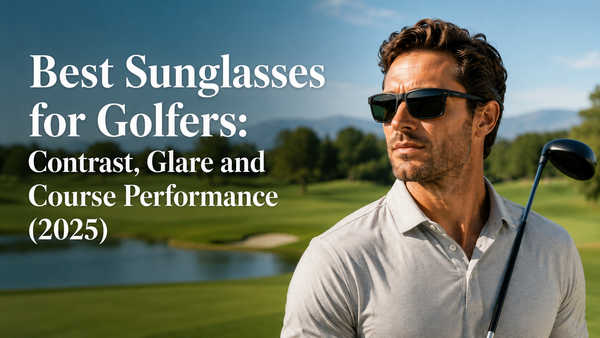

Best Sunglasses for Golfers: Contrast, Glare and Course Performance
A round of golf is one of the longest continuous outdoor UV exposures most people voluntarily subject themselves to. Three to five hours on an open course with minimal shade, typically during the highest UV index hours of the day, on surfaces that reflect UV at a meaningful rate. Golf professionals, caddies, and regular players accumulate annual ocular UV from golf alone that rivals many outdoor occupations.
But golf also creates specific visual demands that go beyond UV protection. Reading the break of a green, tracking a ball against a pale sky, distinguishing fairway from rough at distance, judging the lie of a ball in shadow — these are visual tasks where the right lens tint is not a comfort preference but a performance tool. The best golf sunglass is the one that simultaneously protects against the UV of a three to five hour outdoor session and enhances the specific visual contrasts that the game demands.
This is a C17 Professions & Occupations supporting post. It links back to the cluster pillar atthe complete guide to sunglasses for outdoor workers by profession. For the complete lens colour science, seethe complete sunglass lens colour guide.
Quick Answer
Amber or brown polarized UV400 at Category 2 is the standard golf recommendation. Amber filters blue scatter, which enhances the contrast between ball and sky, between fairway and rough, and between the flag and the course background. Polarization eliminates fairway shimmer and water hazard glare. Category 2 covers the full range from early tee-off light to peak midday sun without requiring a lens change mid-round. UV400 polycarbonate for the 3–5 hour UV dose that an average round delivers.

Table of Contents
Part 1: Golf’s UV Profile — Why a Round Is a Significant Exposure Event
Golf courses are UV-intense environments. Open fairways with minimal shade canopy, reflective short-grass surfaces, and water hazards that add a reflected UV component combine to create UV conditions that are significantly higher than urban outdoor environments in the same geography.
Turf surfaces reflect 2–5% of UV — a lower reflectance than concrete or water, but meaningful when the entire ground plane visible from the fairway is turf. Sand bunkers reflect 15–20% of UV. Water hazards reflect 10–20% of UV from the water surface. A golfer playing a course with water features and bunkers is moving through multiple reflected UV environments throughout a round.
The duration is the primary UV risk factor. A 4-hour round starting at 9am in summer covers the entire rising UV index period and the peak UV window from 11am to 1pm. A regular golfer playing twice a week throughout the season accumulates annual golf UV exposure that represents one of the most significant leisure UV totals of any sport. Golf professionals who play 150–250 rounds per year in addition to range practice sessions are in a genuinely occupational UV accumulation category.
The full UV eye disease science is inUV and eye disease: the complete guide.
Part 2: The Specific Visual Demands of Golf
Golf is a visually demanding sport in ways that are distinct from most outdoor activities. The specific visual tasks that sunglass lens choice affects:
Ball Tracking Against Sky
After the strike, a golf ball travels against a sky background for most of its flight. The sky is a high-luminance, often pale-blue background. A ball against a bright pale sky with glare and high luminance contrast is the most demanding ball-tracking scenario in any ball sport. Amber lenses filter the blue-scatter component of sky light, reducing the luminance of the sky relative to the ball and improving the ball’s visible contrast against the background.
Green Reading and Surface Texture
Reading the break, grain, and undulation of a putting green requires fine surface texture discrimination at close range in variable light. Polarization eliminates the surface glare that flattens green texture in bright conditions. Amber or brown lens tints enhance the subtle colour variations across grass surfaces that indicate grain direction and moisture variation. Gray lenses are colour-accurate but do not provide the contrast enhancement that helps differentiate subtle surface features.
Fairway vs Rough Discrimination
Identifying whether a ball has landed in fairway, rough, or hazard at distance requires colour and contrast discrimination across grass surfaces of different lengths and textures. The colour contrast between closely mown fairway and longer rough is subtle in many lighting conditions. Amber’s blue-scatter filtering enhances the perceived contrast between these surfaces in outdoor light, making lie identification more reliable at distance.
Flag and Hole Identification
Locating the flag at distance on a course with complex background scenery — treelines, bunker sand, surrounding rough — requires the flag to stand out from its background. A red or yellow flag against a complex green and sand background is a colour contrast task. Amber and brown tints can enhance this contrast by reducing background scatter while maintaining the warm colours of the flag.
Depth Perception in Variable Light
Judging distance and slope on a course requires good depth perception, which depends on contrast sensitivity. Outdoor glare reduces contrast sensitivity by reducing the luminance difference between objects and backgrounds. Polarization reduces the most contrast-destroying element of outdoor light — horizontal surface reflection — and amber tints enhance the colour contrast that supports depth judgement in outdoor environments.
Part 3: Why Amber Is the Golf Lens Tint
Amber is the recommended golf lens tint not because it is the most common choice — many golfers default to gray or use no sunglasses at all — but because its optical properties most closely match the specific visual demands of the game.
Amber lenses filter blue wavelengths preferentially through the absorption properties of the amber pigment in the lens material. Blue light, particularly in the 400–500nm range, is the component of sunlight most responsible for atmospheric scatter — the haze and luminance that reduces the apparent contrast of objects viewed at distance in outdoor conditions. By filtering this component, amber lenses effectively increase the apparent sharpness and contrast of outdoor scenes in a way that gray lenses, which reduce all wavelengths proportionally, do not.
The specific golf benefit: a ball in flight against a bright sky is easier to follow through an amber lens because the sky background is more suppressed relative to the ball. A green’s surface texture is more readable because the scatter from the surface is reduced. The fairway’s contrast with the rough is enhanced. The flag stands out more clearly against its background.
The trade-off: amber alters colour perception. The sky appears warmer. Grass appears more yellow-green. Traffic signals appear slightly different. For a dedicated round of golf these trade-offs are irrelevant. For driving to the course and back, they matter — which is the reason a separate gray polarized driving pair and an amber golf pair is the most practical two-pair golf rotation.
Part 4: Polarization on the Golf Course
Polarization on a golf course eliminates the glare from water hazards, dew-wet fairways in morning rounds, and the surface shimmer of closely mown turf in bright sun. For many golfers, particularly morning players when dew is present on greens and fairways, this is the most immediately noticeable benefit of polarized lenses.
Polarization also improves green reading specifically. A wet or slightly dewy putting surface reflects considerable horizontal glare that reduces the visible texture of the green. Polarized lenses eliminate this surface reflection, revealing the texture and grain of the green surface more clearly for reading purposes.
The one consideration with polarized lenses on the golf course: some golfers report that polarized lenses can make certain digital distance measuring devices (laser rangefinders, GPS displays) more difficult to read at specific angles — the same PVA filter interaction with polarized LCD displays described in the driving context. Tilting the head slightly or increasing display brightness usually resolves this.
The complete polarization science is inpolarized vs non-polarized sunglasses: the definitive guide.
Part 5: Lens Category for Golf
Category 2 (18–43% VLT) is the recommended golf lens category for most conditions. This may seem lighter than some golfers expect, but the reasoning is practical:
Category 3 is appropriate for golfers in very high UV climates — playing in full summer sun in southern US, Mediterranean, or tropical environments where sustained maximum UV is the primary concern and visual task demands are secondary to UV management.
Part 6: What to Wear at Different Stages of the Round
|
Stage |
Conditions |
Lens |
Notes |
|
Early tee (6–8am) |
Low sun; dew on course; cooler |
Amber polarized Cat 2 |
Low-angle glare from dew; polarization critical |
|
Front nine (9–11am) |
Rising UV; variable sun |
Amber polarized Cat 2 |
Core round conditions; amber contrast benefits active |
|
Midday (11am–2pm) |
Peak UV; full sun |
Amber polarized Cat 2 (or Cat 3 in high UV climate) |
Highest UV window; UV400 essential |
|
Back nine (2–4pm) |
Afternoon sun angle; still high UV |
Amber polarized Cat 2 |
Low westward sun can create fairway glare |
|
Late afternoon |
Dropping sun angle; variable light |
Amber polarized Cat 2 |
Variable conditions; Cat 2 versatility important |
|
Driving to/from course |
Road traffic; variable conditions |
Gray polarized Cat 2 |
Traffic colour accuracy; switch from amber for driving |
Part 7: Frame Requirements for Golf
Stability During the Swing
A golf swing involves significant head rotation and changes in orientation. Frames that sit loosely on the nose or have smooth nose pads can shift during the swing. This shift not only disrupts concentration but creates a UV exposure gap during the swing phases when the golfer is most focused on the ball. Frames with adjustable or rubberised nose pads provide better stability across the head movements of the swing.
Peripheral Vision
Golf requires awareness of the ball’s position and the course environment in the peripheral visual field. Very narrow frames that limit peripheral vision reduce course awareness. Standard-coverage frames that reach reasonably close to the brow line and cheekbone provide better peripheral coverage without the total-wrap aesthetic of sport-specific glasses.
Style for the Course
Golf has a dress code culture that varies by club but consistently values a clean, professional appearance. Sport wraparound frames, while functionally adequate, read as contextually mismatched on many courses. Classic aviators, clean rectangulars, and sport-clean ovals in neutral colours (gray, gunmetal, silver, dark brown) suit the golf aesthetic while providing the UV and optical performance the course demands.
Weight for Round Duration
A 4-hour round is a long time to wear sunglasses. Frames that create nose or temple pressure over extended wear become a distraction and are more likely to be removed, creating UV exposure gaps. Lightweight TR90 under 25g for round-duration comfort.
Part 8: For Golf Professionals and Coaches
Golf professionals, teaching pros, caddies, and golf coaches face an occupational UV accumulation that regular players do not. A teaching professional conducting lessons from 8am to 5pm accumulates 8–9 hours of outdoor UV daily across the playing season. Caddies on tour carry for a full tournament week — 4–5 days of multiple rounds. Course rangers and marshals spend full working days on the course.
The specification for golf professionals is the same as for high-outdoor-exposure workers generally: UV400 polycarbonate, amber polarized at Category 2–3, TR90 with stainless hardware, multiple pairs at accessible locations (pro shop, teaching bay, cart, bag) to eliminate exposure gaps. The rotation model is not optional for professionals — the occupational UV dose makes consistent daily UV400 protection a genuine health investment across a long career.
The complete professional and occupational outdoor worker guide is inthe complete guide to sunglasses for outdoor workers by profession.
✨ NAVI EYEWEAR — AMBER POLARIZED UV400. COURSE READY.UV400 polycarbonate. Amber polarized — ball-tracking contrast; green-reading texture. Polarization eliminates fairway shimmer and water hazard glare. Buy 1, Get Any 3 Pairs Free — $119 for four pairs (~$30 each). Free shipping. Free replacements. |
Part 9: Comparison Table — Golf Lens Options
|
Lens Option |
Ball Tracking |
Green Reading |
UV Protection |
Overall Golf Verdict |
|
Amber polarized UV400 Cat 2 |
Excellent — blue scatter filtered |
Excellent — surface texture enhanced |
Complete |
Best choice |
|
Brown polarized UV400 Cat 2 |
Very good — similar to amber, slightly warmer |
Very good |
Complete |
Excellent alternative |
|
Green polarized UV400 Cat 2 |
Good — maintains colour accuracy |
Good |
Complete |
Good all-rounder |
|
Gray polarized UV400 Cat 2 |
Good — neutral; no contrast enhancement |
Good — no enhancement |
Complete |
Versatile but no performance edge |
|
Amber non-polarized UV400 |
Good contrast; fairway shimmer remains |
Good; green glare remains |
Complete |
Contrast benefit without glare elimination |
|
Non-UV400 dark lens |
N/A — UV protection absent |
N/A |
None |
Never — unsafe |
Part 10: Best For
Amber Polarized UV400 Category 2 — Best For:
Brown Polarized UV400 Category 2 — Best For:
Gray Polarized UV400 Category 2 — Best For:
Part 11: Common Mistakes
Bottom Line
Golf delivers a 3–5 hour UV dose in conditions — open sky, reflective turf, water and sand — that make UV400 protection as important as any leisure activity. The amber polarized lens does something beyond protection: it enhances the contrast of ball against sky, green surface texture, and fairway against rough in ways that genuinely support the visual demands of the game. This is the rare instance where the UV protection specification and the performance specification are the same product.
Amber polarized UV400 at Category 2 in a classic or sport-clean frame. A dedicated golf pair alongside the driving pair. Gray for the road; amber for the round.
Browse UV400 polarized options atnavieyewear.com/collections/polarized. Add 4 pairs — Buy 1, Get Any 3 Free auto-applies. Free shipping. Free replacements.
Frequently Asked Questions
What are the best sunglasses for golfers?
Amber or brown polarized UV400 at Category 2 for most golfers. Amber enhances the contrast of ball against sky, green surface texture, and fairway vs rough discrimination that are the specific visual demands of the game. Polarization eliminates fairway shimmer and water hazard glare. Category 2 covers the full variable light range of a 4-hour round.
Should golfers wear polarized sunglasses?
Yes. Polarization eliminates the horizontal surface reflection from dew-wet fairways and greens in morning rounds, water hazard surface glare, and the fairway shimmer that reduces surface clarity in bright conditions. It also specifically improves green reading by revealing surface texture obscured by glare. The only minor consideration: some rangefinder screens can be harder to read through polarized lenses at specific angles — tilt the head slightly or increase screen brightness.
What lens color is best for golf sunglasses?
Amber or brown. Both filter blue scatter from the lens, which enhances contrast of ball against sky, definition of green surface texture, and discrimination of fairway from rough. Amber has a slightly stronger contrast enhancement effect; brown is similar with a marginally warmer color. Either is significantly better than gray for the specific visual tasks of golf.
Can I wear the same sunglasses for golf and driving?
Gray polarized UV400 at Category 2 works for both — it is not the optimal golf lens but it is appropriate and provides full UV protection and polarization on the course. If you want to optimize, keep a dedicated amber golf pair and a gray driving pair. The amber enhances golf-specific contrasts; the gray maintains colour accuracy for traffic.
Do sunglasses affect depth perception in golf?
Yes, positively when the correct specification is used. Outdoor glare reduces contrast sensitivity, which impairs depth perception. Polarized lenses eliminate the most contrast-damaging element of outdoor light (horizontal surface reflection), and amber tints enhance colour contrast that supports depth judgement. Golfers wearing amber polarized UV400 typically perceive better surface depth and slope definition than those wearing non-polarized or gray lenses.
What category lens is best for golf?
Category 2 (18–43% VLT) for most golf conditions. It covers the variable light range of a typical round from early morning to midday without over-darkening shadows needed for approach shot and green reading. Category 3 for golfers in high-UV climates (southern US, Mediterranean, tropical) where sustained maximum UV is the primary concern across peak midday rounds.
What sunglasses do professional golfers use?
Professional golfers commonly use amber or brown polarized lenses in sport or sport-clean frames from performance eyewear brands. The functional specification is consistent across brands: amber or brown polarized UV400 in lightweight close-fitting frames. The brand varies; the specification converges. Navi’s amber polarized UV400 at $30 per pair with free replacements provides the same functional specification at a fraction of tour-player endorsed brand pricing.
Are expensive golf sunglasses worth it?
Above the UV400 polycarbonate quality threshold, additional cost primarily buys brand heritage and tour association rather than meaningfully better UV protection or optical performance. The amber polarized UV400 specification that improves ball tracking and green reading is achievable at $30 per pair. The complete spec-by-spec analysis is incheap vs expensive sunglasses: a spec-by-spec comparison.
Supporting Articles
AMBER POLARIZED UV400. ONE ROUND, ALL DAY.UV400 polycarbonate. Amber polarized — enhanced ball tracking, green reading, fairway contrast. Eliminate fairway shimmer. Read the break. See the lie. UV400 every hole. Buy 1, Get Any 3 Pairs Free — $119 for four pairs. Free shipping. Free replacements. |
SOURCES & CITATIONS[1] Gies HP, Roy CR, Toomey S, et al..“Solar UVR exposures of three groups of outdoor workers on the Sunshine Coast, Queensland.”Health Physics, 1995.View source [2] Sliney DH.“UV radiation ocular exposure dosimetry.”Documenta Ophthalmologica, 1994.View source [3] De Faber JT, Naeser K, Kessing SV.“Polarized light and contrast sensitivity under glare conditions.”Ophthalmic Research, 2013.View source [4] Taylor HR, West SK, Rosenthal FS, et al..“Effect of ultraviolet radiation on cataract formation.”New England Journal of Medicine, 1988.View source [5] Dain SJ.“Sunglasses and sunglass standards.”Clinical and Experimental Optometry, 2003.View source [6] American Academy of Ophthalmology.“Sunglasses: choosing the right pair for UV protection.”AAO EyeSmart, 2023.View source |