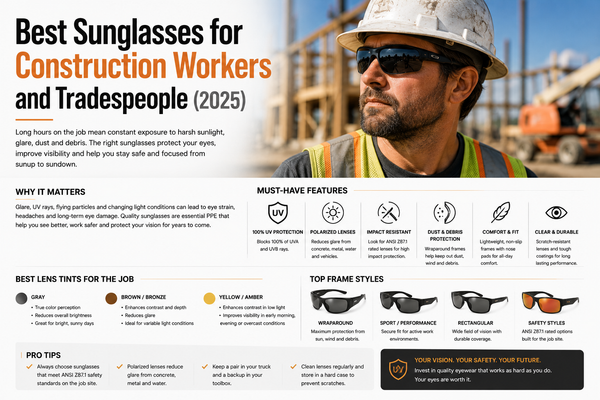

Best Sunglasses for Construction Workers and Tradespeople
The average construction worker in the UK receives approximately five to seven times more annual ocular UV than an office worker in the same city. In the US sunbelt, the ratio is closer to eight to ten. This is not an edge case. It is the daily reality of a profession that puts people outdoors for the majority of the working day, in environments that combine direct overhead UV with significant reflected UV from concrete, pale aggregate, rendered surfaces, and glass.
Most construction workers do not wear sunglasses on site. When they do, many wear cheap unverified products that provide no meaningful UV protection and no impact resistance. This guide sets out what construction workers, roofers, scaffolders, electricians, plumbers, carpenters, and all outdoor tradespeople actually need from their eyewear — and why the occupational UV and impact case is as strong as any leisure or sport application.
This is a C17 Professions & Occupations supporting post. It links back to the cluster pillar atthe complete guide to sunglasses for outdoor workers by profession.
Quick Answer
For all construction workers and tradespeople: UV400 polycarbonate (mandatory for both UV protection and impact resistance from site debris), amber polarized at Category 2–3, TR90 nylon frame with rubberised nose grip, stainless hardware for sweat and weather corrosion resistance. Gray polarized for workers operating vehicles or machinery on site. Keep a rotation of multiple pairs — construction sites destroy sunglasses at a rate that makes the single-pair model a UV exposure guarantee.

Table of Contents
Part 1: The Construction Site UV Environment
Construction sites are outdoor UV environments with specific characteristics that differ from open countryside or leisure outdoor settings. The combination of direct overhead UV, substantial reflected UV from construction materials, and the physical work demands that place the face in unusually UV-exposed orientations creates an occupational UV environment that is more demanding than most people — including most construction workers — appreciate.
UK Health and Safety Executive data classifies outdoor construction work as a high UV exposure occupation. NIOSH in the US makes the same classification. Multiple studies in occupational medicine have found that construction workers have higher rates of UV-associated eye conditions — pterygium, climatic droplet keratopathy, and accelerated cataract formation — than matched populations with lower outdoor occupational exposure. These are not anecdotal associations. They are documented outcomes in peer-reviewed occupational health literature.
A bricklayer, roofer, or scaffolder working a standard 8-hour day in summer is receiving a UV dose that a recreational runner would accumulate over 3–4 weeks of typical training. Over a 30-year construction career, this compounds into a lifetime ocular UV accumulation that is genuinely in a different category from any leisure exposure profile.
Part 2: The Reflected UV Problem on Construction Sites
Construction sites generate reflected UV from multiple surfaces simultaneously:
|
Surface |
UV Reflection Rate |
Significance for Workers |
|
Fresh concrete |
20–30% |
High — workers on concrete pours, slabs, floors receive intense reflected UV from below |
|
Light-coloured aggregate / gravel |
15–25% |
High — site ground cover in many projects |
|
White-rendered / painted surfaces |
25–35% |
High — plasterers, painters, bricklayers near pale surfaces |
|
Glass façades under installation |
35–45% |
Very high — glaziers and curtain wall workers |
|
Pale timber / plywood formwork |
8–15% |
Moderate — carpenters on formwork and timber construction |
|
Dark tarmac / asphalt |
4–10% |
Lower — but present on road and civil construction |
The reflected UV from these surfaces reaches the eye at angles that overhead UV does not. Direct sun comes from above and is partially blocked by the brow ridge and hat brim. Reflected UV comes from below and at eye level — bypassing the brow entirely and hitting the lower and anterior eye surface directly. For workers spending hours on concrete pours, rendering, or glazing installations, this reflected UV vector is a significant and often unrecognised exposure component.
Part 3: Upward Work Postures — The Overhead UV Risk
Several construction trades involve sustained upward-facing work postures that create a specific overhead UV exposure risk:
For these trades specifically, the upward posture eliminates the primary natural protection against overhead UV that normal head orientation provides. The brow ridge is no longer between the eye and the overhead UV source. UV reaches the retina directly for extended periods. UV400 with wraparound or close-fitting geometry that provides overhead coverage is particularly important for these trades.
Part 4: Why Polycarbonate Is a Safety Requirement, Not Just a Preference
Construction sites generate debris. Grit, dust, mortar particles, nail fragments, cable clippings, glass chips, wood shavings, metal swarf from grinding — all of these are present in the air of active construction environments and can contact the eye at velocities sufficient to cause corneal injury.
Glass lenses and some lower-grade plastic lenses fracture on impact, producing sharp fragments in close proximity to the eye. Polycarbonate does not fracture in this way — it deforms under impact, absorbing energy without producing fragments. This is why polycarbonate is the standard lens material for safety eyewear in industrial and construction environments. FDA-cleared polycarbonate impact resistance is not a marketing specification for construction workers. It is the specification that determines whether a piece of site debris produces a corneal abrasion or a penetrating eye injury.
This is a separate safety argument from the UV protection case, and it applies independently of UV conditions. A construction worker who only wears sunglasses on sunny days is leaving themselves unprotected from debris impact on overcast days. Polycarbonate UV400 sunglasses with Category 2 lenses provide both UV protection in all outdoor daylight conditions and impact resistance in all site conditions regardless of sunlight.
Note: some construction environments require ANSI Z87.1 (US) or EN166 (EU/UK) rated safety eyewear for specific high-hazard tasks. Consult site-specific health and safety requirements. UV400 polycarbonate sunglasses are appropriate for general outdoor site UV and debris protection; specialist rated eyewear may be required for grinding, chemical handling, or high-velocity particle environments.
Part 5: The Correct Lens Specification by Trade
|
Trade |
Primary UV Hazard |
Tint |
Category |
Frame Priority |
|
Bricklayer |
Direct + concrete reflection |
Amber polarized |
Cat 2–3 |
Secure fit; impact resistant |
|
Roofer |
Direct overhead (upward posture); high direct UV |
Amber polarized |
Cat 3 |
Wraparound; maximum coverage |
|
Scaffolder |
Elevated; overhead posture; height UV |
Amber polarized |
Cat 2–3 |
Secure grip; close-fitting |
|
Electrician (outdoor/overhead) |
Overhead posture; site debris |
Amber polarized |
Cat 2 |
Impact resistant; secure |
|
Carpenter (outdoor) |
Direct + wood surface reflection |
Amber polarized |
Cat 2 |
Comfortable for all-day wear |
|
Plasterer (exterior) |
Direct + rendered surface reflection |
Amber polarized |
Cat 2–3 |
Anti-scratch; debris resistant |
|
Site manager / supervisor |
Sustained outdoor exposure; site movement |
Gray or amber polarized |
Cat 2 |
Professional register; versatile |
|
Plant / vehicle operator |
Vehicle UV + site ambient; traffic |
Gray polarized |
Cat 2 |
Colour accuracy; Cat 2 versatile |
|
Groundworker |
Direct + earth/gravel reflection; sustained |
Amber polarized |
Cat 2–3 |
Durable; rubberised grip |
Part 6: Amber vs Gray — Which Tint for Construction Work
Why Amber for Most Construction Trades
Amber polarized UV400 is the primary recommendation for construction workers for the same reason it serves other outdoor work environments: the blue-scatter filtering of amber enhances contrast of edges, surfaces, and three-dimensional features in outdoor environments. On a construction site, this translates to better definition of surface textures, edge alignment for precision trades, and general spatial awareness in cluttered three-dimensional work environments.
When Gray Is the Correct Choice
Plant operators, site vehicle drivers, and anyone whose site work involves operating machinery or vehicles needs gray polarized UV400 rather than amber. The traffic colour accuracy requirement — maintaining the correct colour rendering of signals, indicator lights on machinery, and hazard warning colours — applies to construction vehicle operation in the same way it applies to road transport. Site supervisors who spend time on the road travelling between sites also benefit from gray as the all-contexts versatile choice.
Lens Darkness: Category 2 vs Category 3
Category 2 (18–43% VLT) is the correct all-conditions construction site lens. It handles everything from bright summer outdoor to overcast conditions without the adaptation time of Category 3 and without requiring removal when entering site offices, vehicles, or covered areas. Category 3 is appropriate for workers in sustained high-UV environments — roofers in midsummer, groundworkers in open exposed sites in high-UV climates — but adds the limitation of slow adaptation in rapidly changing light.
Part 7: Frame Requirements for Site Use
TR90 Nylon: The Site Frame Material
TR90 nylon is the correct frame material for construction site use. It is flexible under physical stress without snapping — important when frames are inevitably sat on, dropped on hard surfaces, and compressed in tool bags. It is resistant to the temperature extremes of outdoor work — from cold winter mornings to hot summer afternoons in direct sun. It is lightweight for all-day wear and does not corrode in the sweat and weather environments of physical outdoor work.
Stainless Hardware: The Corrosion Requirement
Sweat, rain, cement dust, and general site contamination accelerate corrosion in base metal alloys. Stainless steel hinges and hardware maintain function over the multi-year lifespan of work sunglasses in these environments. Frames with stainless hardware are the correct specification for any work environment involving sustained sweat exposure and weather.
Rubberised Nose and Temple Grip
Construction workers perform physical work that creates bending, tilting, and movement that dislodges loose-fitting frames. Rubberised nose pads and temple tips maintain grip on a face that is sweating, dirty, and in constant physical movement. The rubberised grip is equally important for preventing frame loss in overhead work where a dropped frame is both a cost and a safety event for workers below.
Wraparound or Close-Fitting Geometry for High-UV Trades
For roofers, scaffolders, and other workers in high overhead UV postures, wraparound or close-fitting frame geometry that reduces peripheral UV entry from above and at the sides provides more complete protection than standard open-frame geometry. The upward-facing work posture changes the UV exposure geometry relative to standard forward-facing outdoor positions, and the frame needs to address this.
Part 8: The Multi-Pair Site Rotation
Construction sites destroy eyewear at a rate that makes the single-pair model untenable for UV protection consistency. Sunglasses are dropped from height, sat on during lunch breaks, left in the wrong jacket, broken in tool bags, and lost on cluttered sites at a rate that means a single pair will typically be absent, damaged, or lost at multiple points per month.
The practical solution is the same rotation model that applies to all high-attrition use contexts: multiple pairs at accessible locations. One pair in the hi-vis jacket pocket. One pair in the tool bag or van. One pair at home as backup. One pair as a genuine spare for when the first is broken or lost.
At $119 for four Navi pairs with free replacements, this rotation costs the same as a single pair from a mid-tier heritage brand. The free replacement provision means that when site conditions destroy a pair, it can be replaced without the cost barrier that leads many workers to go without rather than replace damaged eyewear immediately.
✨ NAVI EYEWEAR — IMPACT-RESISTANT UV400 FOR THE SITE.UV400 polycarbonate. FDA-cleared impact resistance. Amber polarized for site contrast. TR90 nylon. Stainless 5-barrel hinges. Rubberised grip. Built for construction environments. Buy 1, Get Any 3 Pairs Free — $119 for four pairs (~$30 each). Free shipping. Free replacements. |
Part 9: Comparison Table — Construction Sunglass Options
|
Specification |
Construction Relevance |
Priority |
|
UV400 polycarbonate |
UV protection from direct and reflected site UV |
Mandatory |
|
FDA impact resistance |
Debris protection from site particles |
Mandatory |
|
Amber polarized |
Contrast on site surfaces; debris definition |
Strongly recommended |
|
Gray polarized |
Colour accuracy for vehicle/plant operation |
Required for site vehicle operators |
|
Category 2 |
All-conditions versatility across site and cab |
Recommended for most trades |
|
Category 3 |
Maximum UV for sustained high-UV outdoor work |
For roofers, groundworkers in high-UV climates |
|
TR90 nylon frame |
Flexible; lightweight; all-day comfort |
Strongly recommended |
|
Stainless hardware |
Corrosion resistance in sweat/weather |
Strongly recommended |
|
Rubberised grip elements |
Secure fit during physical movement |
Important for active site work |
|
Wraparound geometry |
Overhead UV protection for upward-posture trades |
For roofers, scaffolders, electricians |
Part 10: Best For
Amber Polarized UV400 Category 2 TR90 — Best For:
Amber Polarized UV400 Category 3 + Wraparound Geometry — Best For:
Gray Polarized UV400 Category 2 — Best For:
Part 11: Common Mistakes
Bottom Line
Construction workers face one of the highest occupational UV exposures of any profession — direct overhead UV compounded by significant reflected UV from concrete, pale aggregate, and rendered surfaces, across upward-facing work postures that eliminate normal brow protection. The UV protection case is unambiguous. The impact protection case is equally compelling: polycarbonate UV400 on a construction site is not a leisure choice, it is a safety specification for both UV accumulation and debris impact.
Amber polarized UV400 at Category 2 in TR90 with stainless hardware is the specification that covers all these requirements simultaneously. Gray for plant operators. Category 3 for roofers and high-UV sustained outdoor work. Multiple pairs in the rotation so the right lens is always on site when it is needed.
Browse UV400 polarized options atnavieyewear.com/collections/polarized. Add 4 pairs — Buy 1, Get Any 3 Free auto-applies. Free shipping. Free replacements.
Frequently Asked Questions
What sunglasses should construction workers wear?
UV400 polycarbonate (mandatory — both UV protection and impact resistance from site debris), amber polarized at Category 2–3, TR90 nylon frame with rubberised grip, stainless hardware. Gray polarized for plant and vehicle operators. Multiple pairs kept at fixed site locations so the right lens is always accessible.
Do construction workers need UV protection sunglasses?
Yes — more than almost any other population. Construction workers receive 5–10x the annual ocular UV of office workers in the same geography. Multiple occupational health studies have documented higher rates of UV-associated eye conditions in construction workers. UV400 polycarbonate worn consistently throughout the working day is the straightforward preventive intervention.
Are regular sunglasses adequate for construction sites?
Only if they are UV400 polycarbonate — which most fashion sunglasses are not. The construction site requires polycarbonate specifically for debris impact resistance in addition to UV protection. Dark lenses without UV400 certification and without polycarbonate impact resistance are worse than no glasses: they provide pupil dilation into unprotected UV and no debris protection. UV400 polycarbonate is the minimum for site use.
What lens tint is best for construction workers?
Amber polarized UV400 for most construction trades — the blue-scatter filtering enhances surface contrast and edge definition in outdoor work environments. Gray polarized for plant operators and site vehicle drivers where traffic colour accuracy is required. Both at Category 2 for most applications; Category 3 for roofers and high-UV sustained outdoor work.
Why is polycarbonate important for construction site eyewear?
Construction sites generate debris — grit, particles, nail fragments, swarf. Polycarbonate absorbs impact without fracturing, unlike glass or some lower-grade plastics that shatter into sharp fragments near the eye. FDA-cleared polycarbonate impact resistance is the specification that prevents site debris from producing penetrating eye injuries. It is a safety requirement as well as a UV protection specification.
How many pairs of sunglasses should construction workers keep?
Multiple — at minimum one in the work jacket, one in the tool bag or van, and one at home as backup. Construction sites consistently create separation between workers and their single pair. Multiple pairs at fixed locations eliminate the exposure gaps. At $119 for four Navi pairs with free replacements, this is a completely practical approach.
Do roofers need special sunglasses?
Roofers benefit from wraparound geometry and Category 3 lens darkness in addition to the standard UV400 polycarbonate amber polarized specification. The upward work posture of roofing eliminates the brow ridge protection against overhead UV, making close-fitting or wraparound frames that provide overhead coverage more important for roofers than for ground-level trades. Category 3 is appropriate for sustained high-UV roofing work in summer.
Should construction site managers wear different sunglasses to workers?
Site managers and supervisors who split time between outdoor site work and road travel between sites benefit from gray polarized UV400 at Category 2 — the colour accuracy of gray serves both traffic and the site environment, and Category 2 is versatile across all conditions. Workers in specific trades can use amber polarized for the contrast benefits that their specific tasks require. Gray is the all-contexts choice for the supervisory role that spans multiple environments.
Supporting Articles
IMPACT-RESISTANT. UV400. BUILT FOR THE SITE.UV400 polycarbonate. FDA-cleared impact resistance. Amber polarized. TR90. Stainless hinges. Four pairs in the rotation so the right lens is always accessible on site. Buy 1, Get Any 3 Pairs Free — $119 for four pairs. Free shipping. Free replacements. |
SOURCES & CITATIONS[1] Gies HP, Roy CR, Toomey S, et al..“Solar UVR exposures of three groups of outdoor workers on the Sunshine Coast, Queensland.”Health Physics, 1995.View source [2] Sliney DH.“UV radiation ocular exposure dosimetry.”Documenta Ophthalmologica, 1994.View source [3] Taylor HR, West SK, Rosenthal FS, et al..“Effect of ultraviolet radiation on cataract formation.”New England Journal of Medicine, 1988.View source [4] U.S. Food and Drug Administration.“Impact resistance requirements for sunglass lenses (21 CFR Part 801).”FDA Regulations, 2023.View source [5] Dain SJ.“Sunglasses and sunglass standards.”Clinical and Experimental Optometry, 2003.View source [6] National Institute for Occupational Safety and Health (NIOSH).“Occupational exposure to solar radiation.”NIOSH Publication, 2014.View source |