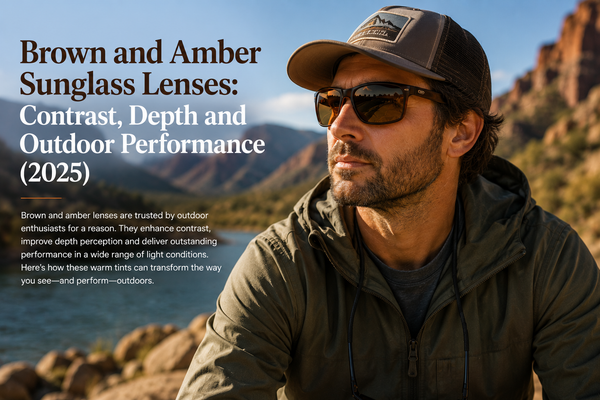

Brown and Amber Sunglass Lenses: Contrast, Depth and Outdoor Performance
Amber and brown are the lenses that make the outdoor world look sharper. Not because they add artificial sharpness — but because they reduce the specific component of outdoor light that causes visual haze and low contrast. Blue scatter, the atmospheric light scattering that washes out the distinction between objects and backgrounds in outdoor conditions, is the primary target of both amber and brown lenses. Filter it, and terrain definition improves, ball tracking becomes easier, surface textures become more readable, and the outdoor scene gains a visual depth that gray and green lenses do not produce.
This guide covers the complete science: why amber and brown filter blue light, what the visual consequences are for different activities, how amber and brown differ from each other, when each outperforms gray, and when gray remains the better choice. With specific activity guidance and a direct comparison between the two tints.
This is a C18 Lens Color Deep Dives supporting post. It links back to the cluster pillar atthe complete sunglass lens color guide. For the gray lens comparison, seegray sunglass lenses: why neutral is the smartest everyday choice.
Quick Answer
Amber and brown lenses filter blue wavelengths preferentially, reducing atmospheric scatter and enhancing the contrast and depth of outdoor scenes. Amber produces a slightly yellower, crisper visual result; brown produces a warmer, more muted result. Both are excellent for outdoor sport, golf, trail running, cycling, fishing, and beach use where contrast enhancement serves performance. Neither is appropriate as a primary driving tint for mixed traffic. Gray is better for driving and city use; amber and brown are better for outdoor sport and active use.

Table of Contents
Part 1: The Blue Light Filtering Mechanism
Visible light includes a blue component in the 400–500nm wavelength range. In outdoor daylight, this blue light is scattered by atmospheric particles more than other wavelengths — a phenomenon called Rayleigh scattering, which is the same mechanism that makes the sky appear blue. This scattered blue light creates a diffuse luminance across the visual field that reduces the apparent contrast between objects and their backgrounds in outdoor environments. It is the haze that makes the horizon look less sharp, the surface that looks flat rather than textured, the background that bleeds into the foreground.
Amber and brown lenses absorb a significant portion of blue wavelengths. By reducing this blue scatter component, they effectively reduce the visual haze and improve the apparent contrast across the visual scene. The effect is most noticeable in two conditions: overcast or flat-light outdoor environments where blue scatter is the dominant quality problem, and in outdoor sport environments where the contrast between a ball or terrain feature and its background determines performance.
The physics is straightforward:when the component of light that reduces contrast (scattered blue) is selectively absorbed, contrast improves. This is not a perceptual trick or a distortion. It is a genuine optical improvement for specific visual tasks in specific outdoor conditions.
Part 2: What Amber Does to Your Vision
Through an amber lens, the outdoor world appears with a warm, slightly yellowish cast and enhanced visual depth. The sky appears less pale and more saturated. Terrain surfaces have more defined texture. Objects against outdoor backgrounds appear more distinct and sharply separated from their surroundings. The overall impression is often described as “crisp” or “vivid” compared to the same scene through a gray lens.
The Ball-Against-Sky Effect
The most frequently cited performance benefit of amber lenses is ball tracking in outdoor sport. A ball in flight travels against a sky background that, in natural light, has a pale blue luminance that reduces the contrast between the ball and background. Amber’s blue absorption reduces the sky’s apparent luminance without reducing the ball’s reflected light proportionally, increasing the contrast ratio between ball and sky. The ball is more visible, earlier in its flight, with an amber lens than with a gray one.
Terrain and Surface Definition
Trail surfaces, fairways, rough, and outdoor terrain all have three-dimensional texture that is partially obscured by blue scatter in outdoor light. Amber’s blue filtering reveals this texture more clearly by removing the scattered light that fills in the shadows and reduces surface definition. A trail runner can see root and rock features more clearly; a golfer can read green texture more accurately; a cyclist can read trail surface conditions at greater distance.
Flat Light Performance
Overcast conditions produce diffuse, low-contrast light where the blue scatter component is proportionally higher and there are no strong shadows to provide natural depth cues. Amber lenses are particularly effective in overcast conditions because the blue filtering addresses the primary visual quality problem of flat light. The overcast sky appears slightly warmer and the scene gains a perceived depth that it lacks through gray lenses in the same conditions.
Part 3: What Brown Does to Your Vision
Brown lenses produce a similar but subtly different visual experience to amber. Where amber creates a yellower, crisper cast, brown creates a warmer, earthier tone — a richer visual quality that many wearers find more natural and comfortable for extended outdoor wear. Brown absorbs blue wavelengths in a similar range to amber but typically also absorbs some green and blue-green wavelengths, producing the characteristic warm-brown color shift of the transmitted light.
The contrast enhancement effect of brown is comparable to amber. The specific quality of the enhancement is slightly different: amber’s result tends toward visual crispness and clarity; brown’s result tends toward visual warmth and depth. Both are improvements over gray for outdoor contrast tasks. The difference between them is most noticeable over extended wear — some wearers find brown more comfortable and less fatiguing over long outdoor sessions because its color shift is perceived as more natural and less intense than amber’s yellower cast.
Brown as a Heritage Tint
Brown has a long association with outdoor and sport eyewear as a heritage tint. Classic sport sunglasses from the mid-20th century used brown as the standard performance tint. The color is associated with the natural world — wood, earth, warm light — and reads aesthetically as an outdoor-oriented, considered choice. This heritage association is part of brown’s enduring appeal alongside its functional optical properties.
Part 4: Amber vs Brown — The Differences That Matter
|
Property |
Amber |
Brown |
|
Primary wavelength absorbed |
Blue (400–500nm) — strong |
Blue + blue-green — moderate |
|
Color of transmitted light |
Warm yellow-orange cast |
Warm red-brown cast |
|
Contrast enhancement |
High — crisp and vivid |
High — warm and deep |
|
Color accuracy vs gray |
Altered — warmer |
Altered — warmer, earthier |
|
Flat light performance |
Excellent |
Excellent |
|
Ball tracking (sport) |
Excellent — strong sky contrast |
Excellent — strong sky contrast |
|
Extended wear comfort |
Variable — yellow cast can fatigue some |
Often more comfortable — earthier tone |
|
Aesthetic character |
Crisp, modern, vivid |
Warm, traditional, natural |
|
Best for |
Golf, trail running, overcast sport |
Fishing, casual outdoor, long-duration wear |
In practice, for most outdoor sport applications amber and brown are functionally interchangeable. The choice between them is primarily personal preference for the color quality of the visual experience. Some people prefer amber’s crispness; others prefer brown’s warmth. Both deliver the contrast enhancement that makes them the outdoor sport lens over gray.
Part 5: Where Amber and Brown Outperform Gray
Golf
Amber and brown are the golf lens standard. Ball tracking against sky, green surface texture reading, fairway vs rough discrimination, and flag identification against complex backgrounds all benefit from the blue-scatter filtering of amber and brown. The detailed golf lens guide is inbest sunglasses for golfers: contrast, glare and course performance.
Trail Running
Trail surfaces present a continuous contrast challenge: root vs soil, rock vs trail, water vs dry ground, light vs shadow. Amber’s terrain contrast enhancement reduces the risk of misjudging these features at running pace. This is both a performance benefit (faster, more confident trail navigation) and a safety benefit (reduced stumble risk on technical terrain).
Fishing
Amber and particularly copper (a variant of amber) enhance sub-surface water visibility by filtering the blue-green wavelengths that dominate water scattering. For freshwater fishing where spotting fish and reading underwater structure is the skill, amber or copper polarized lenses transform the experience compared to gray. The surface reflection elimination of polarization combined with amber’s wavelength filtering provides the maximum sub-surface visibility achievable with a sunglass lens.
Beach and Coastal Outdoor Use
Beach environments combine the high UV of open sky with the reflected UV and glare of sand and water. Amber’s blue filtering in this environment produces a richer, warmer visual quality that many find more comfortable for extended beach time than gray’s neutral rendering. The amber visual experience in a beach environment is often described as “making it look like a perfect summer day.”
Overcast and Variable Conditions
In flat overcast light, gray produces a flat, neutral visual experience that preserves the low-contrast character of the light. Amber creates perceived depth and definition by removing the scatter that is the source of the flatness. For outdoor activities in typically overcast climates — UK outdoor sport, Pacific Northwest hiking, northern European coastal activities — amber’s flat-light performance advantage over gray is particularly significant.
Part 6: Where Gray Outperforms Amber and Brown
Driving in Mixed Traffic
Traffic signal colors must read accurately for safe driving. Amber and brown alter the perceived color of amber/yellow traffic signals. Gray is the correct driving tint. This is not a close call — for professional drivers and regular commuters in mixed traffic, gray is the lens. Amber and brown are acceptable for rural driving where traffic signals are rare, but gray is the universal recommendation.
Urban and City Environments
Cities are full of color-coded information: traffic signals, road markings, hazard signs, emergency vehicles. Gray preserves this information accurately. Amber and brown alter it.
Professional Color-Critical Roles
Any professional outdoor role requiring accurate color assessment — plant operation, emergency response, quality control in color-sensitive outdoor work — requires gray. Amber is not appropriate.
When You Want One Pair for Everything
Gray’s versatility across all contexts makes it the correct choice when a single pair must serve driving, city use, professional contexts, and outdoor activities. If versatility across context is the primary requirement, gray wins. If performance in specific outdoor activities is the primary requirement, amber or brown wins.
Part 7: Activity-by-Activity — Amber and Brown in Use
|
Activity |
Amber |
Brown |
Category |
|
Golf |
Excellent — ball tracking + green reading |
Excellent — similar; warmer aesthetic |
Cat 2 |
|
Trail running |
Excellent — terrain contrast + safety |
Very good |
Cat 2 |
|
Road running (traffic) |
Acceptable — gray is safer |
Acceptable — gray is safer |
Cat 2 |
|
Cycling (trail/mountain) |
Excellent — terrain contrast |
Excellent |
Cat 2 |
|
Cycling (road/traffic) |
Acceptable — gray preferred |
Acceptable — gray preferred |
Cat 2–3 |
|
Fishing |
Excellent — copper is even better |
Very good |
Cat 2–3 |
|
Beach/coastal |
Excellent — warm visual quality |
Excellent — warm visual quality |
Cat 3 |
|
Skiing (bright) |
Good |
Good |
Cat 3 |
|
Overcast outdoor |
Excellent — best flat-light performer |
Excellent |
Cat 1–2 |
|
Driving (city/mixed traffic) |
Not recommended |
Not recommended |
N/A — use gray |
Part 8: Lens Category for Amber and Brown
✨ NAVI EYEWEAR — AMBER POLARIZED UV400. CONTRAST FOR THE OUTDOORS.UV400 polycarbonate. Amber polarized — blue-scatter filtering for contrast, depth, and terrain definition. Oleophobic and anti-saltwater coating. TR90 frames. Stainless 5-barrel hinges. Buy 1, Get Any 3 Pairs Free — $119 for four pairs (~$30 each). Free shipping. Free replacements. |
Part 9: Comparison Table — Amber and Brown Against Other Tints
|
Tint |
Contrast Enhancement |
Color Accuracy |
Driving |
Sport & Outdoor |
Verdict |
|
Amber |
High — vivid and crisp |
Altered (warm yellow) |
Not recommended for traffic |
Excellent |
Best for sport and outdoor activity |
|
Brown |
High — warm and deep |
Altered (warm brown) |
Not recommended for traffic |
Excellent |
Best for sport; warmer aesthetic than amber |
|
Gray |
Minimal |
Excellent |
Best tint for driving |
Good |
Best for driving and city; not contrast-optimized |
|
Green |
Moderate |
Good |
Acceptable |
Very good |
Compromise; less contrast than amber |
|
Yellow |
Maximum (low light) |
Strongly altered |
Not appropriate |
Specialist low-light only |
Specialist; not everyday |
Part 10: Best For
Amber Polarized UV400 Category 2 — Best For:
Brown Polarized UV400 Category 2 — Best For:
Part 11: Common Mistakes
Bottom Line
Amber and brown lenses filter blue light to enhance the contrast, depth, and definition of outdoor scenes. They make balls more visible against sky, terrain features more defined, green surfaces more readable, and overcast outdoor conditions more visually engaging. For outdoor sport — golf, trail running, fishing, cycling, beach — they outperform gray for the specific visual demands of those activities.
The distinction from gray is real and specific: amber and brown enhance contrast by filtering the blue scatter that reduces it. Gray preserves color accuracy by not filtering selectively. Both are UV400 when correctly specified; both can be polarized. The choice between them is determined by the primary activity: outdoor sport and active use — amber or brown. Driving, city, and professional color-critical use — gray.
Browse UV400 polarized options atnavieyewear.com/collections/polarized. Add 4 pairs — Buy 1, Get Any 3 Free auto-applies. Free shipping. Free replacements.
Frequently Asked Questions
What do amber sunglass lenses do?
Amber lenses absorb blue wavelengths (400–500nm) preferentially, reducing the atmospheric scatter that creates visual haze in outdoor conditions. The visual result: enhanced contrast between objects and backgrounds, improved terrain and surface definition, and a warm yellowish-orange color cast. The world appears sharper and more defined, but with altered color rendering compared to reality.
Are amber or brown lenses better for sunglasses?
Both provide similar contrast enhancement through blue light filtering. Amber produces a yellower, crisper visual result; brown produces a warmer, earthier result. For outdoor sport performance, they are functionally comparable. The choice is personal preference for visual experience: choose amber for vivid crispness, brown for warm depth. Either is excellent for golf, trail running, fishing, and outdoor active use.
When should I use amber lenses instead of gray?
When the primary activity is outdoor sport or active use where contrast enhancement matters more than color accuracy. Golf, trail running, mountain biking, fishing, beach use, and overcast outdoor sport all benefit from amber’s contrast enhancement. Use gray when driving in mixed traffic or operating in urban environments where traffic signal color accuracy is a safety requirement.
Are amber lenses good for driving?
Not recommended as a primary driving lens for mixed traffic. Amber’s blue filtering alters the perceived color of amber/yellow traffic signals. Gray is the correct driving tint for color accuracy. Amber is acceptable for rural driving with minimal traffic signal density, but gray is the universal driving recommendation.
What is the difference between amber and copper lenses?
Both filter blue light to enhance contrast. Copper additionally filters green and blue-green wavelengths, specifically optimizing for sub-surface water visibility by emphasizing the warm wavelengths that penetrate water most clearly. For fishing and water activities where seeing through the water surface matters, copper outperforms amber. For general outdoor sport and golf, amber and copper perform similarly.
Do amber lenses improve depth perception?
Yes, in outdoor conditions. By reducing blue scatter — the diffuse light that reduces the luminance difference between foreground objects and backgrounds — amber increases the apparent contrast that the visual system uses to judge depth. The effect is most significant in overcast or flat-light outdoor conditions where natural shadows are absent and blue scatter is the dominant quality problem.
Why do golf sunglasses use amber lenses?
Because amber’s blue-scatter filtering enhances the specific visual contrasts that golf demands: ball against sky, green surface texture, fairway vs rough, and flag against complex backgrounds. Amber is not the most comfortable or color-accurate tint for general use, but for the specific visual tasks of golf, its contrast enhancement is a genuine performance tool. The complete golf lens guide is inbest sunglasses for golfers: contrast, glare and course performance.
Can amber lenses be UV400?
Yes. UV400 protection is determined by the lens material and UV-absorbing additives, completely independently of the tint color. An amber polarized UV400 polycarbonate lens provides complete UV400 protection and complete glare elimination through polarization, with the contrast enhancement of the amber tint. Tint color and UV protection are independent properties — always verify UV400 certification regardless of the tint.
Supporting Articles
AMBER POLARIZED UV400. CONTRAST FOR EVERY OUTDOOR SESSION.UV400 polycarbonate. Amber polarized — blue-scatter filtering for contrast and depth. The outdoor sport lens. Golf, trail, fishing, beach, and everything in between. Buy 1, Get Any 3 Pairs Free — $119 for four pairs. Free shipping. Free replacements. |
SOURCES & CITATIONS[1] Dain SJ.“Sunglasses and sunglass standards.”Clinical and Experimental Optometry, 2003.View source [2] De Faber JT, Naeser K, Kessing SV.“Polarized light and contrast sensitivity under glare conditions.”Ophthalmic Research, 2013.View source [3] Rosenthal FS, Bakalian AE, Lou CQ, Taylor HR.“The effect of sunglasses on ocular exposure to ultraviolet radiation.”American Journal of Public Health, 1988.View source [4] American Academy of Ophthalmology.“Sunglasses: choosing the right pair for UV protection.”AAO EyeSmart, 2023.View source |