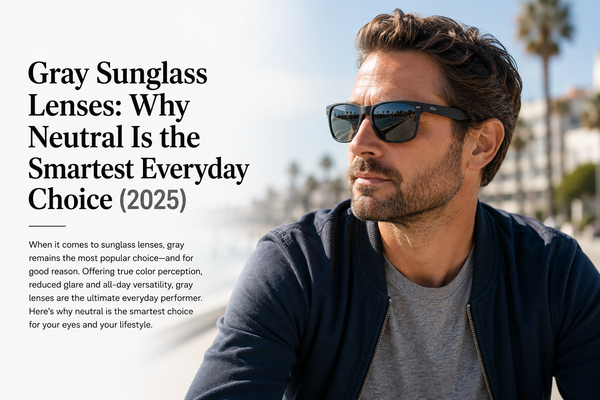

Gray Sunglass Lenses: Why Neutral Is the Smartest Everyday Choice
Gray is the most popular sunglass lens color in the world. It is also the most misunderstood. Most people who choose gray choose it because it “looks right” — neutral, clean, professional. They are making the correct choice without knowing why.
The reason gray is the right default lens color is not aesthetic. It is optical. Gray is a neutral absorber — it reduces visible light intensity across the full spectrum without preferentially filtering any wavelength range. The consequence: the world through a gray lens looks exactly like the real world, just darker and with the glare removed. Colors remain accurate. Traffic signals read as their correct colors. Road markings retain their contrast. A red light is red. A green signal is green.
This guide explains the full science of why gray works the way it does, what it cannot do (and why that matters when choosing for specific activities), and when gray is the clear right answer versus when a different tint serves better.
This is a C18 Lens Color Deep Dives supporting post. It links back to the cluster pillar atthe complete sunglass lens color guide. For the amber and brown comparison, seebrown and amber sunglass lenses: contrast, depth and outdoor performance.
Quick Answer
Gray polarized UV400 at Category 2 is the correct everyday sunglass lens. Gray preserves color accuracy across the full visible spectrum — traffic signals, road markings, and color-coded visual information all read correctly. Polarization eliminates horizontal surface glare. Category 2 handles the full range of everyday conditions from bright sun to variable overcast. Gray is not the most exciting choice. It is the most reliably correct one for the widest range of daily scenarios.

Table of Contents
Part 1: The Optics of Gray — How Neutral Absorption Works
Visible light spans from approximately 380 nanometers (violet) to 700 nanometers (red), with blue (400–500nm), green (500–570nm), and red/orange/yellow (570–700nm) occupying the major portions. A tinted lens selectively absorbs some portion of this spectrum, transmitting the rest to the eye.
Gray lenses absorb all wavelengths across the visible spectrum in approximately equal proportions. The absorption is not perfectly flat — no real lens material achieves exact neutrality across the full range — but gray comes closer than any other tint to equal absorption across the visible spectrum. The result: the ratio of wavelengths reaching the eye is the same as in natural light, just at a lower overall intensity.
The visual experience: the world through a gray lens looks like the real world with the brightness turned down. Colors appear as they actually are. Contrast between objects is preserved at its natural level. The eye’s color processing — which depends on the relative ratio of wavelengths received, not absolute intensity — continues to function as it normally would. Gray is optically transparent in the most literal sense: it transmits the visual information of the world without filtering, it just reduces the amount of that information reaching the eye uniformly.
Part 2: What Gray Preserves That Other Tints Do Not
Color Relationships
Color vision works by comparing the relative activation of three types of cone photoreceptors in the retina (sensitive to long, medium, and short wavelengths respectively). The perceived color of an object is determined by which combination of cones is activated. When a tinted lens preferentially reduces one wavelength range — as amber reduces blue, or copper reduces blue and green — it alters the relative activation of the cone types, shifting color perception throughout the visual scene.
Gray’s proportional absorption preserves the relative activation ratios of all three cone types. The brain receives the same color signal as in unfiltered daylight, just at reduced intensity. Color relationships between objects — which is red, which is green, which is brighter or more saturated — are all preserved accurately.
Traffic Signal Legibility
Traffic signals use specific wavelengths for their red, amber/yellow, and green displays. The signal colors are engineered to be unambiguous in normal daylight vision. Amber and brown tints shift perceived color temperature toward warmer values, subtly altering the perceived color of amber/yellow traffic signals and potentially reducing the distinctiveness of different signal states. Gray preserves the exact color code that traffic signals are designed to communicate.
Road Marking Contrast
White road markings on gray or black road surfaces provide contrast that assists lane tracking and hazard identification. Gray lenses preserve the natural luminance contrast between white markings and darker road surfaces. Tints that alter color temperature can shift the perceived contrast of markings relative to their background.
Part 3: Color Accuracy and Traffic Safety
The traffic safety argument for gray is the most concrete and specific case for neutral color rendering. Modern road environments use color as a primary information channel: signal states, hazard indicators, road signs, emergency vehicle lighting, painted road markings. The driver or pedestrian who perceives these colors accurately has more reliable access to the safety-critical information they encode.
This is not a theoretical concern. Road safety researchers and optometrists consistently recommend gray (or “neutral”) lens tints for driving precisely because of the traffic color accuracy requirement. The Society of Automotive Engineers, the American Academy of Ophthalmology, and equivalent bodies in the EU and UK all identify neutral color rendering as the primary lens tint property for driving use.
For professional drivers — truck drivers, delivery drivers, taxi drivers, bus and coach operators — this becomes an occupational requirement. Gray polarized UV400 is the universal professional driving lens recommendation for this reason. The full professional driver guide is in
best sunglasses for truck drivers and long-haul drivers.
Part 4: Gray vs Amber — The Core Trade-Off
The gray vs amber comparison is the most commonly asked lens color question, and the answer is genuinely context-dependent. Both are excellent lens tints. Neither is universally superior. The choice depends entirely on the primary activity.
Where Gray Wins
Where Amber Wins
The Two-Pair Answer
For most active people, the correct answer is both: gray polarized for driving and everyday use, amber polarized for outdoor sport and beach. At $119 for four Navi pairs, getting gray and amber in the same purchase is the practical solution to the gray vs amber question.
The complete amber and brown lens guide is inbrown and amber sunglass lenses: contrast, depth and outdoor performance.
Part 5: Gray vs Brown
Brown lenses provide a similar contrast enhancement to amber but with a slightly warmer, earthier color shift. The blue wavelength filtering of brown is comparable to amber; the aesthetic result is somewhat different — amber appears yellower and crisper, brown appears warmer and more muted.
Against gray, brown occupies the same performance trade-off as amber: better outdoor sport contrast, reduced color accuracy for traffic and professional color-critical use. For everyday urban driving use, gray outperforms brown for the same reasons it outperforms amber. For outdoor activity and general lifestyle use, brown and amber are functionally interchangeable — the choice between them is primarily aesthetic preference.
Part 6: Gray vs Green
Green lenses are the closest tint to gray in terms of color accuracy, providing moderate contrast enhancement with less color shift than amber or brown. Green’s partial blue filtering gives it slightly better contrast performance than gray in outdoor environments while maintaining better color accuracy than amber.
Green is often described as the “best of both worlds” — more contrast than gray, more color accuracy than amber. This framing is reasonable but slightly overstated: green is genuinely a versatile compromise, but it is neither as color-accurate as gray nor as contrast-enhancing as amber. For activities where one or the other property is the primary requirement, gray or amber is still the more appropriate choice.
Green is the better choice when both color accuracy and contrast enhancement matter in approximately equal proportion — tennis on a green court, hiking in terrain environments, general outdoor everyday use where the gray-amber trade-off cannot be resolved in favor of either.
Part 7: When Gray Outperforms Every Other Tint
Driving in All Conditions
There is no driving scenario in which any other tint outperforms gray for the complete driving task. Other tints may provide marginally better contrast for specific road surface features in specific conditions, but no other tint preserves the full traffic color language that driving safety depends on. Gray is the universal driving lens.
City and Urban Environments
Urban environments are color-coded throughout: traffic signals, pedestrian crossing signals, no-entry signs, bus lane markings, cycle lane markings, warning signs. Gray preserves all of this information. Amber and brown alter the perceived color of the orange/amber range that warning signs frequently use.
Variable Conditions Across the Day
A gray lens at Category 2 handles the full range of daily outdoor light conditions without requiring a lens change or adjustment. Morning commute in variable light. Midday in full sun. Afternoon in overcast. Each transition is handled correctly because gray’s neutral absorption provides consistent color rendering across all ambient light levels.
Professional Contexts
Any professional outdoor role where the worker must assess color information accurately — emergency response (colored emergency lighting), construction site management (machinery signal colors), sports refereeing (signal flags), outdoor retail — gray is the correct lens for maintaining the color accuracy that professional assessment requires.
Part 8: When Gray Is Not the Best Choice
Gray’s neutrality is its strength in color-critical situations and its limitation in contrast-critical situations. When the visual challenge is not “what color is that” but “how clearly defined is that object or surface against its background,” amber and brown outperform gray.
Part 9: Gray and Polarization — The Complete Everyday Package
Gray polarized UV400 is the complete everyday outdoor lens specification. The three components work together:
Together:visually accurate, glare-free, UV-protected. This is the outdoor daily-driver lens package. For the vast majority of everyday outdoor scenarios — driving, commuting, walking the dog, casual outdoor time, shopping, sport spectatorship, travel — gray polarized UV400 at Category 2 is the correct and complete answer.
The complete polarization science is inpolarized vs non-polarized sunglasses: the definitive guide.
Part 10: Lens Category for Gray
Most buyers need one gray pair at Category 2 for everyday use. Some active outdoor users benefit from a second gray pair at Category 3 for high-UV summer and coastal conditions. The Navi four-pair model at $119 allows a gray Cat 2 everyday pair and a gray or amber Cat 3 activity pair in the same purchase.
✨ NAVI EYEWEAR — GRAY POLARIZED UV400. THE EVERYDAY STANDARD.UV400 polycarbonate. Quality-controlled gray polarized lenses. Preserves color accuracy in all conditions. Oleophobic coating. Anti-saltwater coating. TR90 frames. Stainless 5-barrel hinges. Buy 1, Get Any 3 Pairs Free — $119 for four pairs (~$30 each). Free shipping. Free replacements. |
Part 11: Comparison Table — Gray vs Other Tints
|
Tint |
Color Accuracy |
Contrast Enhancement |
Driving |
Outdoor Sport |
Verdict vs Gray |
|
Gray |
Excellent |
Minimal |
Best |
Good |
The baseline standard |
|
Amber |
Altered (warm) |
High |
Not recommended for traffic |
Excellent |
Better for sport; worse for driving |
|
Brown |
Altered (warm) |
High |
Not recommended for traffic |
Excellent |
Similar to amber; aesthetic variant |
|
Green |
Good |
Moderate |
Acceptable |
Very good |
Compromise; neither gray’s accuracy nor amber’s contrast |
|
Yellow |
Strongly altered |
Maximum (low light) |
Not appropriate daytime |
Good (low light only) |
Specialist low-light; not everyday |
|
Blue |
Cool shift |
Reduced |
Not recommended |
Not recommended |
Primarily aesthetic |
Part 12: Best For
Gray Polarized UV400 Category 2 — Best For:
Gray Polarized UV400 Category 3 — Best For:
Part 13: Common Mistakes
Bottom Line
Gray polarized UV400 at Category 2 is the most reliably correct sunglass lens for the widest range of everyday outdoor situations. Not because it is the most exciting choice — it is not. Because it preserves color accuracy, eliminates glare through polarization, and provides complete UV400 protection across the full range of daily outdoor scenarios without requiring a lens change or compromising any safety-critical visual function.
For outdoor sport and activity where contrast matters more than color accuracy, amber or brown is the better choice. For everything else — driving, daily commute, city use, professional outdoor roles, travel — gray is correct. The practical solution for active people: gray Cat 2 for everyday and driving, amber Cat 2 for sport and beach, as part of the same four-pair rotation.
Browse gray polarized UV400 options atnavieyewear.com/collections/polarized. Add 4 pairs — Buy 1, Get Any 3 Free auto-applies. Free shipping. Free replacements.
Frequently Asked Questions
What do gray sunglass lenses actually do?
Gray lenses absorb all wavelengths of visible light in approximately equal proportions, reducing overall brightness without altering color ratios. The visual result: the world appears darker and with glare removed, but colors remain accurate — red is red, green is green, amber is amber. Gray is the neutral tint that transmits the visual information of the world without filtering it selectively.
Are gray or brown lenses better for sunglasses?
Depends on the primary use. Gray is better for driving, city use, and any situation requiring accurate color perception — traffic signals, color-coded signs, professional outdoor roles. Brown (and amber) are better for outdoor sport, golf, trail running, and activities where terrain and surface contrast enhancement is more valuable than color accuracy. For a driving-primary user: gray. For an outdoor sport-primary user: brown or amber. For both: one pair of each.
Why is gray the recommended tint for driving?
Traffic signals and road signage use color as a primary safety information channel. Red means stop; amber means prepare; green means go; blue signals emergency vehicles. Gray preserves these color codes accurately because it reduces all wavelengths equally without shifting the perceived color of any signal. Amber, brown, and other tints alter the perceived color temperature of the scene, subtly changing how traffic signal colors read to the eye.
Are gray lenses good for outdoor sport?
Good but not optimal. Gray provides full UV protection and glare elimination through polarization, which are valuable in sport. But gray does not provide the contrast enhancement that amber and brown deliver for terrain visibility, ball tracking, and surface definition. For outdoor sport where visual performance matters alongside UV protection, amber or brown polarized is the better choice.
What is the difference between gray and green sunglass lenses?
Gray absorbs all wavelengths equally for maximum color accuracy. Green absorbs some blue and red wavelengths, providing moderate contrast enhancement while maintaining better color accuracy than amber. Green is a compromise between gray’s color accuracy and amber’s contrast enhancement. For pure color accuracy, gray wins. For pure contrast enhancement, amber wins. Green sits in between, which makes it useful for activities where both properties matter in roughly equal measure.
Should I get gray polarized or gray non-polarized?
Polarized, for virtually all outdoor use. Gray without polarization reduces overall brightness without eliminating horizontal surface glare from roads, water, and reflective surfaces. Gray polarized provides color accuracy AND glare elimination. The combination is significantly better for driving, outdoor activities, and everyday use than non-polarized gray. The full polarization science is inpolarized vs non-polarized sunglasses: the definitive guide.
Can I wear gray lenses for the beach?
Yes — gray polarized UV400 at Category 3 is appropriate for beach use. It provides full UV protection, eliminates water and sand surface glare through polarization, and maintains color accuracy. Amber Cat 3 also works well at the beach with the additional benefit of contrast enhancement for the sand and water environment. Both are correct beach choices; the decision between them is whether color accuracy or contrast enhancement is the priority for beach use.
Are gray lenses darker or lighter than amber?
Gray and amber can be made in the same category (same VLT level), so they can be equally dark. The comparison is about color filtering, not darkness. A Category 2 gray lens and a Category 2 amber lens transmit the same total amount of visible light — but the amber lens transmits less blue light and more yellow-orange light, while the gray lens transmits all wavelengths proportionally.
Supporting Articles
GRAY POLARIZED UV400. ALWAYS CORRECT. NEVER WRONG.UV400 polycarbonate. Gray polarized — color-accurate in every condition. The lens that handles driving, city, travel, and everyday outdoor without compromise. Buy 1, Get Any 3 Pairs Free — $119 for four pairs. Free shipping. Free replacements. |
SOURCES & CITATIONS[1] Dain SJ.“Sunglasses and sunglass standards.”Clinical and Experimental Optometry, 2003.View source [2] De Faber JT, Naeser K, Kessing SV.“Polarized light and contrast sensitivity under glare conditions.”Ophthalmic Research, 2013.View source [3] Rosenthal FS, Bakalian AE, Lou CQ, Taylor HR.“The effect of sunglasses on ocular exposure to ultraviolet radiation.”American Journal of Public Health, 1988.View source [4] American Academy of Ophthalmology.“Sunglasses: choosing the right pair for UV protection.”AAO EyeSmart, 2023.View source |