
The Complete Sunglass Lens Color Guide: What Every Tint Does to Your Vision
The color of a sunglass lens is not a style decision that happens to affect vision. It is a functional optical choice that determines how light reaches your eye, which visual information is enhanced or suppressed, and which activities the lens is optimised for. Every tint is a selective filter with specific properties that make it better for some activities and worse for others.
Most buyers choose lens color by instinct — gray because it looks neutral and professional, brown because it looks warm, whatever came with the frame. Most brands offer lens color as a style option without explaining the optical consequences. This guide changes that. Every major tint is explained in terms of what it physically does to light, what visual experience it creates, which activities it serves, and who should choose it.
This is the C18 Lens Color Deep Dives pillar post. The supporting posts in this cluster go one level deeper on each tint: gray sunglass lenses: benefits and uses,brown and amber sunglass lenses: contrast, depth and outdoor performance,green sunglass lenses: who they’re best for and why,yellow and rose sunglass lenses: low-light performance explained, andblue and mirror sunglass lenses: aesthetics, function and when to use them.
Quick Answer
Gray for color-accurate driving, everyday use, and any situation where you need the world to look normal. Amber and brown for outdoor sport, beach, fishing, and any activity where contrast of terrain, ball, or surface features matters. Green for all-round outdoor use with good color accuracy. Yellow and rose for low light, overcast, and variable conditions. Blue and mirror as aesthetic coatings that add surface style on top of any base tint. The tint choice is made against the primary activity — then the UV specification (UV400 polycarbonate, polarized) is confirmed inside that tint.

Table of Contents
Part 1: How Lens Tint Works — The Optics of Color Filtering
Visible light is electromagnetic radiation in the wavelength range of approximately 380–700 nanometers. Different wavelengths produce different color experiences: violet and blue at the short end (380–500nm), green in the middle (500–570nm), yellow and orange transitioning (570–620nm), and red at the long end (620–700nm).
A tinted sunglass lens is a selective absorber. The lens material absorbs certain wavelengths more than others, reducing the proportion of those wavelengths that reach the eye. The tint color you see through the lens is the complement of what is being absorbed — a gray lens absorbs all wavelengths roughly equally (producing a neutral, darkened image), while an amber lens absorbs blue wavelengths preferentially (producing a warmer, yellower, higher-contrast image).
The visual consequence of selective absorption: when a specific wavelength range is reduced, the eye’s perception of contrast and color shifts. Objects that reflect the absorbed wavelengths appear relatively dimmer. Objects that reflect the transmitted wavelengths appear relatively brighter. This is why amber lenses increase the apparent contrast between a ball and a blue sky — the sky’s dominant wavelengths are reduced; the ball’s reflected wavelengths are relatively preserved.
Part 2: The Lens Category System — Darkness vs Tint
Tint and darkness are independent properties of a sunglass lens. A lens can be any tint at any category darkness. The lens category (visible light transmission, or VLT) describes how dark the lens is — how much total visible light it transmits. The tint describes which wavelengths are absorbed preferentially within that overall darkness.
|
Category |
VLT Range |
Description |
Best Conditions |
|
Cat 0 |
80–100% |
Clear or very lightly tinted |
Indoor; night; negligible UV |
|
Cat 1 |
43–80% |
Light tint |
Overcast; low UV; indoor-outdoor |
|
Cat 2 |
18–43% |
Medium tint |
Variable; everyday outdoor |
|
Cat 3 |
8–18% |
Dark |
Bright sun; beach; driving in full sun |
|
Cat 4 |
3–8% |
Very dark |
Extreme UV: alpine, glacier — NOT for driving |
Category and tint are chosen together. Category 2 amber means a medium-dark amber lens. Category 3 gray means a dark gray lens. The same tint can be used across multiple categories. Understanding both dimensions is necessary to make the full lens choice.
Part 3: Gray Lenses — The Neutral Standard
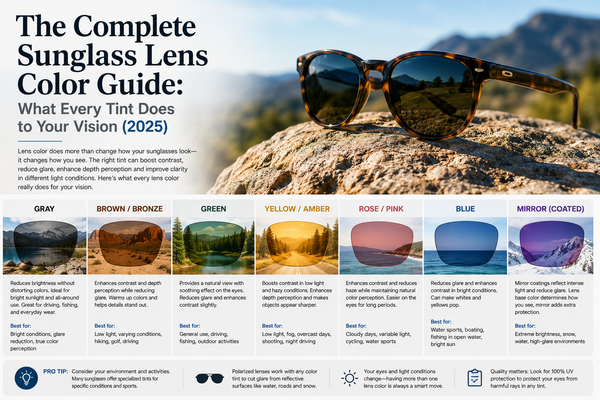
Gray is the neutral tint. It reduces visible light intensity approximately equally across the full visible spectrum, which produces a darkened image that maintains the natural colour balance of the scene. Objects through a gray lens look like they do in real life, just darker and with the glare removed.
What Gray Does to Vision
Because gray absorbs all wavelengths proportionally, it does not alter the perceived color of objects. The sky is blue. Grass is green. Traffic signals read their correct colours. A red traffic light does not appear orange or amber. A green signal does not shift toward yellow. This color accuracy is the defining property of gray lenses and the reason they are the universal recommendation for any situation where color interpretation is a safety or accuracy requirement.
Best Applications for Gray
Gray’s Limitation
Gray does not enhance contrast. It reduces glare and brightness uniformly, which is what you want in colour-critical situations, but it does not provide the terrain and surface contrast enhancement that amber and brown deliver in outdoor sport and activity contexts. For activities where contrast matters more than colour accuracy — golf, trail running, fishing — amber and brown outperform gray.
The complete gray lens guide is ingray sunglass lenses: why neutral is the smartest everyday choice.
Part 4: Amber Lenses — The Contrast Enhancer
Amber is the contrast tint. It absorbs blue wavelengths preferentially — the 400–500nm range that includes the blue light responsible for atmospheric scatter. By reducing this blue scatter component, amber lenses increase the apparent depth of contrast between objects and backgrounds in outdoor environments. The sky appears deeper and less hazy. Terrain features appear more defined. Balls stand out more clearly against sky or grass backgrounds.
What Amber Does to Vision
Through an amber lens, the world appears warmer — more yellow-orange in tone. This is the visual signature of the blue absorption. It is also the mechanism of contrast enhancement: because the background scatter (which is predominantly blue) is reduced, the foreground objects appear more distinct and sharply defined against it. Visual contrast across the mid-range wavelengths — which is where most outdoor terrain features and sports objects fall — is enhanced.
Best Applications for Amber
Amber’s Limitation
Amber alters color perception. Traffic signals appear warmer. The colour code of the road environment is subtly altered. For driving in mixed traffic, amber is acceptable but gray is safer. For any color-critical professional task, amber is not the correct tint.
The complete amber lens guide is inbrown and amber sunglass lenses: contrast, depth and outdoor performance.
Part 5: Brown Lenses — The Warm Alternative to Amber
Brown lenses provide similar contrast enhancement to amber but with a slightly warmer, more muted color shift. Brown absorbs blue wavelengths but also filters some green and blue-green wavelengths, producing a warmer, earthier tone compared to amber’s yellower cast. The contrast enhancement effect is similar; the aesthetic result is slightly different.
Brown is the classic heritage sunglass tint — associated with traditional outdoor and sport eyewear. It suits warm skin tones and warm metal frame colors particularly well. For activities where amber serves but the warmer aesthetic of brown is preferred, brown is the appropriate choice. For most outdoor sport applications, amber and brown are functionally interchangeable; the choice between them is primarily aesthetic.
The complete brown and amber guide is inbrown and amber sunglass lenses: contrast, depth and outdoor performance.
Part 6: Green Lenses — The All-Rounder
Green lenses occupy a middle position in the colour filtering spectrum. They absorb some blue and some red wavelengths, providing moderate contrast enhancement without the strong colour shift of amber. The result is an image that has better contrast than gray but more accurate colour rendering than amber. Green is the all-rounder tint — not the best at any single attribute but performing well across the widest range of applications.
What Green Does to Vision
Through a green lens, the world appears with a subtly cooler and more natural color balance than amber but with more depth and contrast than gray. Green reduces the blue scatter that amber also addresses, but less aggressively. The visual result is often described as crisp and clear — a perceptually comfortable combination of contrast improvement and color naturalness.
Best Applications for Green
The complete green lens guide is ingreen sunglass lenses: who they’re best for and why.
Part 7: Copper Lenses — The Sub-Surface Visibility Specialist
Copper lenses filter blue and green wavelengths, transmitting the warm red-orange range that penetrates water most effectively. In outdoor sport terms, copper is a variant of amber optimized specifically for water environments: it enhances the apparent depth and clarity of water surfaces and sub-surface features by emphasizing the wavelengths that travel through water with the least scatter.
For fishing, surfing at reef breaks, kayaking, and any activity where sub-surface visibility through water matters, copper outperforms amber and dramatically outperforms gray. For inland fishing specifically, copper polarized is the lens combination that allows anglers to see fish, underwater structure, and bottom features through the water surface in a way that no other tint achieves comparably.
Copper is less common than amber and brown but is the optimal tint for a specific high-value use case. Anglers, surf instructors at reef breaks, and watersports participants who regularly need to see through the water surface will find copper transformative compared to their previous lens experience.
Part 8: Yellow Lenses — The Low-Light Performer
Yellow lenses absorb blue wavelengths aggressively, which produces the highest apparent contrast enhancement of any tint in flat, diffuse, or low-contrast light conditions. In dim or overcast outdoor conditions where the visual scene is flat and lacks natural contrast, yellow lenses can significantly improve the perceived definition of objects and surfaces.
What Yellow Actually Does
Yellow’s contrast enhancement in low light is real and documented. The blue filtering that reduces atmospheric scatter is most significant in low-light conditions where scatter is the primary visual quality problem. In bright conditions, however, yellow provides insufficient brightness reduction (typically Category 1 or less) and alters colour perception significantly. Yellow is explicitly a low-light, overcast, and indoor-outdoor transition tint, not a bright outdoor tint.
The Night Driving Yellow Lens Myth
Yellow-tinted ‘night driving glasses’ are marketed extensively with the claim that they improve night vision. Multiple independent studies have found that yellow lenses do not improve night driving performance and may worsen it by reducing the total light transmission through the lens while altering color perception. The myth-busting guide is in are yellow glasses for night driving actually safe? the truth.
Appropriate Yellow Applications
The complete yellow and rose lens guide is inyellow and rose sunglass lenses: low-light performance explained.
Part 9: Rose and Pink Lenses — The Depth Enhancer
Rose and pink lenses occupy a similar functional space to yellow but with a different wavelength balance. Rose lenses absorb green and blue-green wavelengths while transmitting red and warm wavelengths. The visual effect: improved perceived depth and definition in the visual scene, with a warm, pleasant colour cast that many wearers find perceptually comfortable for extended wear.
Rose is used in several specific performance contexts. Skiers use rose goggles for moderate overcast conditions where yellow would be too extreme but gray insufficient. Rose tints are used in some gaming and screen-use applications for their blue-filtering properties. The FL-41 tint used for migraine and photophobia management is a specific medical rose-derived tint designed around migraine photoreceptor research.
For everyday sunglass use, rose tints are primarily a fashion choice with the secondary benefit of some blue filtering and depth enhancement. Category 1 rose lenses are the most common everyday application: a light, warm tint that is more flattering than clear while providing some visual enhancement in variable light.
The complete yellow and rose guide including the FL-41 clinical tint is inyellow and rose sunglass lenses: low-light performance explained.
Part 10: Blue Lenses — Aesthetics Over Function
Blue-tinted lenses transmit blue wavelengths preferentially while absorbing red and green. The visual effect: the world appears cooler and more blue-tinged, with somewhat reduced contrast and potentially altered color perception. Blue lenses do not provide the contrast enhancement of amber, the color accuracy of gray, or the low-light performance of yellow.
Blue is primarily an aesthetic tint. It creates a distinct, striking visual look that many buyers find appealing for its fashion quality. The cool blue cast through the lens has an aesthetic appeal separate from any functional optical benefit. In many fashion sunglass products, blue is a tint choice that communicates a specific style identity.
The functional concern with blue lenses: they can slightly increase the proportion of high-energy visible (HEV) blue light reaching the eye relative to gray lenses that would proportionally reduce this component. For lenses that are UV400 polycarbonate, this HEV consideration is secondary — the UV400 certification covers UV protection, and HEV wavelengths (400–500nm) are in the visible spectrum. But for buyers concerned about HEV as a separate category, blue lenses are not the functional choice.
The complete blue and mirror lens guide is inblue and mirror sunglass lenses: aesthetics, function and when to use them.
Part 11: Mirror Coatings — Surface Style, Not Tint
Mirror coatings are not a tint. They are a reflective surface coating applied on top of the lens outer surface that reduces the amount of visible light transmitted through the lens by reflecting a portion of it away. A mirror coating is functionally equivalent to adding darkness to whatever base tint is beneath it.
Mirror coatings come in a range of colors — silver, gold, blue, red, green, flash colors — that are the color of the reflected light. The color you see when looking at mirror lenses from the outside is the color of the mirror coating. The tint you see through the lenses from inside is the base tint beneath the mirror coating — typically gray, brown, or amber.
The functional result of a mirror coating: additional darkness reduction on a Cat 2 or Cat 3 base, plus an aesthetic surface quality that reads as bold and fashion-forward. Silver mirror on a gray base is the most versatile combination. Gold or bronze mirror on an amber or brown base creates a warm, performance-oriented aesthetic. Flash mirror coatings in bright colors (red, blue, orange) are aesthetic statements with no functional optical basis.
The complete mirror coating guide is inblue and mirror sunglass lenses: aesthetics, function and when to use them.
Part 12: Photochromic Lenses — Variable Tint
Photochromic lenses automatically darken in UV light and return to a lighter state indoors. The mechanism: photochromic molecules in the lens material undergo a reversible chemical change when exposed to UV, absorbing more visible light in the darkened state. The lens adapts its category automatically to ambient light conditions.
The appeal:one pair that handles variable light conditions without manual lens changes. The limitations: photochromic lenses darken more slowly than they clear — the transition from bright outdoor to indoor can take 2–5 minutes of residual darkness. Photochromic lenses typically do not darken inside vehicles because windshield glass blocks the UV that triggers the reaction. For driving in variable conditions, a dedicated driving lens remains more effective than photochromic.
The complete photochromic vs polarized comparison is inphotochromic vs polarized: which is better for variable light?.
Part 13: Tint and UV Protection — The Critical Distinction
This is the most important single point in the entire lens color discussion: tint color and UV protection are completely independent properties. A dark amber lens without UV400 certification is not providing UV protection. A light rose lens with UV400 certification is providing complete UV protection. The darkness or color of the lens tells you nothing about its UV protection properties.
UV400 protection comes from the lens material (polycarbonate absorbs UV throughout the material) or from specific UV-absorbing additives, not from the tint. A clear polycarbonate lens provides UV400 protection. A very dark non-polycarbonate lens without UV additives provides zero UV protection and worsens retinal UV exposure by causing pupil dilation into an unprotected UV field.
The rule: always verify UV400 certification explicitly. Never assume that a dark lens is UV-protected or that a light tint is not. The tint color choice — gray, amber, green, or any other — is made after UV400 is confirmed, not instead of it.
The UV400 verification guide is inhow to verify UV400 certification on any pair of sunglasses.
Part 14: The Activity-to-Tint Decision Guide
|
Activity / Context |
Best Tint |
Why |
Category |
|
Driving (everyday) |
Gray polarized |
Traffic colour accuracy; road glare elimination |
Cat 2 |
|
Driving (summer motorway) |
Gray polarized |
As above; slightly darker for sustained bright |
Cat 3 |
|
Golf |
Amber or brown polarized |
Ball tracking; green texture; fairway contrast |
Cat 2 |
|
Trail running |
Amber polarized |
Terrain and surface contrast; variable shade |
Cat 2 |
|
Road running |
Gray polarized |
Traffic colour accuracy; road glare |
Cat 2 |
|
Cycling (road) |
Gray polarized |
Traffic; road surface glare |
Cat 2–3 |
|
Cycling (mountain) |
Amber polarized |
Terrain contrast on trails |
Cat 2 |
|
Fishing |
Copper polarized |
Sub-surface water visibility |
Cat 2–3 |
|
Surfing |
Gray or copper polarized |
Water surface glare elimination; sub-surface visibility |
Cat 3 |
|
Beach (general) |
Gray or amber polarized |
Sand and water glare; high UV |
Cat 3 |
|
Skiing (bright) |
Gray polarized |
Snow glare; colour accuracy |
Cat 3–4 |
|
Skiing (flat light) |
Yellow or rose |
Low-light contrast on flat snow |
Cat 1–2 |
|
Clay shooting |
Yellow |
Maximum contrast against overcast sky |
Cat 1–2 |
|
Tennis / padel |
Green or amber |
Ball visibility; court contrast |
Cat 2 |
|
Everyday casual |
Gray or green |
Versatile; colour accurate; comfortable |
Cat 2 |
|
Fashion / social |
Any UV400 |
Style-led choice within UV400 framework |
Cat 2 |
Part 15: The Complete Tint Comparison Table
|
Tint |
Colour Accuracy |
Contrast Enhancement |
Best Light |
Key Use Cases |
|
Gray |
Excellent — neutral |
Minimal |
All conditions |
Driving; everyday; professional |
|
Amber |
Altered — warmer |
High |
Bright and overcast |
Sport; trail; golf; beach |
|
Brown |
Altered — warm, earthy |
High |
Bright and overcast |
Sport; everyday; versatile |
|
Green |
Good — slight shift |
Moderate |
Variable |
Tennis; golf; hiking; all-round |
|
Copper |
Altered — very warm |
High + sub-surface |
Bright water |
Fishing; surfing; water sports |
|
Yellow |
Strongly altered |
Maximum |
Low light; overcast |
Clay shooting; skiing flat; variable |
|
Rose |
Altered — warm |
Moderate |
Low to moderate |
Overcast; migraine (FL-41); fashion |
|
Blue |
Cool shift |
Reduced |
Moderate |
Primarily aesthetic |
|
Mirror (silver) |
Depends on base |
Depends on base |
Bright |
Additional darkness + aesthetic |
✨ NAVI EYEWEAR — UV400 POLARIZED IN EVERY TINT.Gray polarized for driving, everyday, and professional use. Amber polarized for outdoor sport, beach, fishing, and terrain contrast. UV400 polycarbonate. Polarized. Oleophobic and anti-saltwater coating. TR90. Stainless hinges. Buy 1, Get Any 3 Pairs Free — $119 for four pairs (~$30 each). Free shipping. Free replacements. Shop the collection:navieyewear.com/collections/polarized |
Part 16: Best For
Gray Polarized UV400 — Best For:
Amber or Brown Polarized UV400 — Best For:
Green Polarized UV400 — Best For:
Yellow or Rose — Best For:
Part 17: Who Should Choose What
Choose Gray If:
You drive regularly, work in a professional outdoor role that requires colour accuracy, or want one pair that is always contextually appropriate and colour-accurate. Gray is the default correct choice for any situation where you are unsure.
Choose Amber or Brown If:
You prioritise outdoor sport and active use over driving colour accuracy, spend significant time at the beach or in outdoor sport environments, or want to enhance contrast for specific activities like golf, trail running, or cycling. Amber or brown is the correct choice when performance matters more than neutrality.
Choose Green If:
You want a moderate compromise — better contrast than gray without the strong colour shift of amber. Tennis players, hikers, and general outdoor users who want one pair for multiple activities often find green the most practically versatile.
Choose Yellow or Rose If:
You have a specific low-light application (clay shooting, ski flat-light conditions), or are managing migraine photophobia with clinical guidance (FL-41). These are specialist applications, not general-use tints.
Part 18: Common Mistakes When Choosing Lens Colour
Bottom Line
Lens color is the most under explained dimension of sunglass choice. Most buyers choose by instinct or brand default; most brands explain lens color as a style feature rather than a functional optical decision. The reality: each tint is a specific visual tool that changes how light reaches the eye in ways that are directly relevant to specific activities.
Gray for color accuracy and driving. Amber and brown for outdoor sport contrast. Green for all-round versatility. Yellow for low-light specialized applications. Mirror as surface style. The tint choice is made against the primary activity; the UV specification (UV400 polycarbonate, polarized) is confirmed inside that tint regardless of the color chosen.
For most people, the practical answer is two pairs: gray polarized UV400 for driving, everyday, and professional use; amber polarized UV400 for outdoor sport, beach, and active use. At $119 for four Navi pairs, this two-function rotation plus two spares is the complete lens color solution.
Browse UV400 polarized options atnavieyewear.com/collections/polarized. Add 4 pairs — Buy 1, Get Any 3 Free auto-applies. Free shipping. Free replacements.
Frequently Asked Questions
What is the best sunglass lens color?
There is no single best lens color — the best tint is the one matched to the primary activity. Gray for driving and everyday use requiring colour accuracy. Amber for outdoor sport and beach where contrast enhancement matters. Green for a versatile compromise. The correct question is: what is this pair primarily for?
What is the difference between gray and amber sunglass lenses?
Gray absorbs all wavelengths proportionally, producing a darkened but color-accurate image. Amber absorbs blue wavelengths preferentially, producing a warmer, higher-contrast image. Gray preserves color accuracy; amber enhances contrast. Use gray for driving and color-critical contexts; amber for outdoor sport and activities where contrast matters.
Are amber lenses better than gray?
Better for specific activities — not universally better. Amber outperforms gray for outdoor sport, golf, trail running, fishing, and beach use where contrast enhancement improves visual performance. Gray outperforms amber for driving in mixed traffic, professional color-critical work, and any situation requiring accurate color rendering.
Does lens color affect UV protection?
No. Tint color and UV protection are completely independent. UV400 protection comes from the lens material or UV-absorbing additives, not from the tint. A clear polycarbonate lens provides UV400 protection. A very dark non-polycarbonate lens without UV certification provides none. Always verify UV400 explicitly — never assume that darkness or color implies UV protection.
What lens color is best for driving?
Gray polarized UV400. Gray maintains color accuracy for traffic signals, road signs, and emergency vehicle indicators. Polarization eliminates road surface glare. Category 2 for all-conditions versatility. Amber is acceptable for rural driving with minimal traffic signals but gray is the universal driving safety recommendation.
What lens color is best for golf?
Amber or brown polarized UV400 at Category 2. Amber enhances ball-tracking contrast against sky, green reading surface texture, and fairway vs rough discrimination. Brown provides similar contrast with a slightly warmer aesthetic. Gray is functional but does not provide the contrast enhancement that makes amber and brown specifically valuable for golf visual performance.
What are mirror lenses for?
Mirror coatings reduce brightness by reflecting additional light away from the lens surface, adding effective darkness on top of the base tint. They also create a distinctive aesthetic — silver, gold, or colored reflective surfaces that read as bold and fashion-forward. Mirror is primarily an aesthetic choice with a secondary brightness-reduction function. The functional optical properties come from the base tint beneath the mirror coating, not from the mirror itself.
Do yellow lenses improve night driving?
No. Multiple independent studies have found that yellow night driving glasses do not improve night driving performance and may reduce it by reducing total light transmission while altering colour perception. Never wear sunglasses of any tint for night driving. The complete myth-busting guide is inare yellow glasses for night driving actually safe? the truth.
What lens color is best for tennis?
Green or amber polarized UV400 at Category 2. Green maintains reasonable colour accuracy while enhancing ball and court surface contrast. Amber provides stronger contrast enhancement with slightly more color alteration. Both serve tennis well; the choice between them is primarily how much color shift is acceptable to the individual player.
Should I choose polarized or non-polarized lenses?
Polarized for virtually all outdoor use involving reflective surfaces — driving, sport, beach, water. Non-polarized is appropriate for indoor use or very specific situations where LCD screen visibility is the priority and glare is not a factor. For all the contexts covered in this guide, polarized UV400 is the correct specification. The complete polarization science is inpolarized vs non-polarized sunglasses: the definitive guide.
Supporting Articles
EVERY TINT. ONE SPECIFICATION. UV400 POLARIZED.Gray for driving. Amber for sport. Both in UV400 polycarbonate with quality polarization. Oleophobic coating. Anti-saltwater coating. TR90. Stainless hinges. Buy 1, Get Any 3 Pairs Free — $119 for four pairs. Free shipping. Free replacements. |
SOURCES & CITATIONS[1] Dain SJ.“Sunglasses and sunglass standards.”Clinical and Experimental Optometry, 2003.View source [2] Rosenthal FS, Bakalian AE, Lou CQ, Taylor HR.“The effect of sunglasses on ocular exposure to ultraviolet radiation.”American Journal of Public Health, 1988.View source [3] De Faber JT, Naeser K, Kessing SV.“Polarized light and contrast sensitivity under glare conditions.”Ophthalmic Research, 2013.View source [4] Taylor HR, West SK, Rosenthal FS, et al..“Effect of ultraviolet radiation on cataract formation.”New England Journal of Medicine, 1988.View source [5] Wood JM, Tyrrell RA, Carberry TP.“Limitations in drivers’ ability to recognize pedestrians at night.”Human Factors, 2005.View source [6] American Academy of Ophthalmology.“Sunglasses: choosing the right pair for UV protection.”AAO EyeSmart, 2023.View source [7] Sliney DH.“UV radiation ocular exposure dosimetry.”Documenta Ophthalmologica, 1994.View source |