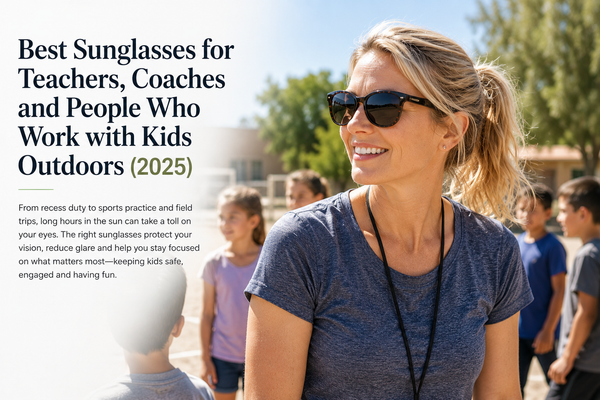

Best Sunglasses for Teachers, Coaches and People Who Work with Kids Outdoors
A PE teacher supervising a double period on a July afternoon is outside from 12:30 to 2:30 — the precise peak UV window of the day. They do this repeatedly, throughout every school term that coincides with meaningful UV conditions. A primary school teacher covering playground lunch duty does the same. A sports coach running sessions from 3:30 to 7pm in late summer is working through the highest ambient UV hours of the afternoon on a sports pitch with no shade.
This is a population of outdoor workers that almost nobody writes about in the context of UV eye protection. Construction workers and truck drivers have their own guides. Teachers and coaches are implicitly assumed to be ‘indoors most of the time’ — an assumption that is comprehensively wrong for the outdoor-facing component of their roles. This guide addresses the specific UV profile of education and coaching professionals who work outside, the professional appearance requirement that makes their sunglass choice different from most outdoor workers, and the correct specification that meets both needs.
This is the final C17 Professions & Occupations supporting post. It links back to the cluster pillar atthe complete guide to sunglasses for outdoor workers by profession. For the children’s UV protection guide, seethe complete guide to sunglasses for kids and teenagers.
Quick Answer
For teachers, coaches, and outdoor education professionals: gray or amber polarized UV400 at Category 2 in classic aviators or clean rectangular frames. Gray for the most professional register and colour accuracy; amber for outdoor sport contexts where contrast enhancement serves the coaching role. Category 2 for all-conditions versatility across the school day. The appearance requirement is real — classic frames in neutral colours are the correct choice for professionals in daily public view with students, parents, and colleagues.

Table of Contents
Part 1: The Midday UV Problem in Schools
The school timetable delivers outdoor workers to the highest-UV window of the day with remarkable consistency. Lunch duty, afternoon PE, mid-morning playground supervision, sports day — all of these fall within or adjacent to the 11am–2pm peak UV index window. This is not a coincidence of scheduling. It is the structure of the school day mapped against the UV index curve, and it means that outdoor-facing school staff are regularly in peak UV conditions during their working hours.
Unlike a construction worker who might avoid peak UV hours by starting early, or a farmer who works at dawn, school staff cannot shift their outdoor duties away from midday. The schedule is fixed by the school timetable. The PE lesson that falls at 1pm is at 1pm. The lunch duty that runs from 12:30 to 1:15 is at that time. The UV index at 1pm in July in the UK is significantly higher than at 8am, and there is no flexibility in when that duty occurs.
Over a career, the cumulative UV from midday outdoor school duties is meaningful. A teacher doing playground duty 3 times per week, 35 school weeks per year, for 30 years, accumulates approximately 3,000 midday UV exposures. Each of those exposures is concentrated in the highest-UV portion of the day. The aggregate ocular UV from this pattern is substantially higher than the casual outdoor UV of a comparable office worker.
The UV disease science behind this accumulation is inUV and eye disease: the complete guide.
Part 2: The Specific Roles and Their UV Exposure Profiles
|
Role |
Typical Outdoor Hours/Week |
Primary UV Context |
UV Risk Level |
|
PE teacher (secondary) |
6–10 hrs |
Sports pitches; afternoons and midday |
High — sustained pitch UV in peak hours |
|
PE teacher (primary) |
4–8 hrs |
Playground; pitches; outdoor PE |
High — playground midday duty compounds |
|
Sports coach (club/school) |
8–15 hrs |
Pitches, courts, tracks; afternoons/evenings |
High — afternoon UV + evening summer UV |
|
Playground / lunchtime supervisor |
5–8 hrs |
Open playground; peak lunch hours |
Very High — sustained midday outdoor |
|
Outdoor education instructor |
15–30 hrs |
Forest, water, hill environments; variable |
High to Very High — extended outdoor sessions |
|
Holiday camp / activity coach |
30–40 hrs (seasonal) |
Open outdoor; variable environments |
Very High — sustained full-day outdoor |
|
Swimming/athletics coach (outdoor) |
6–12 hrs |
Poolside / track; high UV reflection |
High — pool reflection adds UV component |
|
Primary teacher (general outdoor) |
3–6 hrs |
Outdoor learning; nature areas |
Moderate to High — depends on school programme |
Part 3: The Professional Appearance Requirement
This is what makes teacher and coach sunglass guidance different from construction worker or agricultural guidance. A PE teacher is in daily professional contact with students, parents, and school leadership. A sports coach works with athletes who are forming their impressions of professional conduct. An outdoor education instructor is a responsible adult in charge of young people in a professional capacity.
The sunglass choice for these professionals is not purely a specification decision. It is also an appearance decision that communicates professionalism, trustworthiness, and role-appropriate presentation. A PE teacher in wraparound sport frames is appropriate in context. A primary school teacher covering playground duty in wraparound sport frames at a school with a formal dress code is less appropriate.
The correct balance: classic frame shapes in neutral colours that carry professional register while delivering full UV400 polarized specification. Classic aviators in gray or gunmetal. Clean rectangular thin metal frames. Subtle oval or clean sport frames in neutral grey or black. These frames are appropriate in any professional education or coaching context, look deliberately chosen rather than accidentally worn, and carry the complete UV400 polarized specification inside them.
Sport wraparound frames are entirely appropriate for outdoor education instructors, activity coaches, and sports coaches working in contexts where functional sport equipment is the expected register. They are less appropriate for classroom teachers covering outdoor duties where the overall professional presentation matters.
Part 4: Gray vs Amber — The Coaching Role Drives the Choice
Gray Polarized — For the General Educator Role
Gray polarized UV400 is the primary recommendation for teachers and lunchtime supervisors whose outdoor role is supervision, duty, and general school outdoor activity. Gray maintains colour accuracy for all visual assessment tasks, does not alter the appearance of the school environment, and provides the most professional, neutral visual impression. A teacher in gray polarized frames looks like a professional who has made a considered sunglass choice. Gray is appropriate for all formal school contexts.
Amber Polarized — For the Coaching Performance Role
Amber polarized UV400 is the better choice for sports coaches, PE teachers during active coaching sessions, and outdoor education instructors. Amber’s blue-scatter filtering enhances the contrast of balls, players, and terrain features in outdoor sport and outdoor education environments. The visual performance argument for amber in a coaching context is the same as for golfers: it helps with ball tracking, player identification at distance, and terrain reading in outdoor environments. For a coach whose eyes are constantly tracking multiple players across a pitch, amber’s contrast enhancement is a functional benefit.
The Practical Two-Pair Model
For PE teachers and coaches who occupy both formal school professional contexts (staff meetings, parent evenings, school office) and active outdoor coaching contexts in the same working day: a gray pair for the professional/supervision context and an amber pair for the active coaching context covers both optimally. At $119 for four Navi pairs, this two-function rotation is the correct approach.
Part 5: Why Category 2 Is Right for the School Environment
Category 2 (18–43% VLT) is the correct school outdoor lens category for the same reasons it is correct for driving: the school outdoor environment involves rapid transitions between different light conditions that Category 3 handles poorly.
Part 6: The Children’s UV Protection Responsibility
Teachers and coaches who work with children outdoors are not only managing their own UV exposure. They are also modelling UV protection behaviour for the children in their care and, in many cases, influencing the UV protection habits of an entire generation of young people.
Children’s crystalline lenses are more UV-transparent than adults’ — they transmit a higher proportion of UV to the retina for the same ambient UV level. The WHO estimates that up to 80% of lifetime ocular UV may be accumulated before age 18. The outdoor school hours that children spend supervised by teachers and coaches represent some of the most UV-concentrated time of their developing years — the midday break, the afternoon games lesson, the sports day.
A PE teacher or sports coach who consistently wears UV400 sunglasses outdoors is modelling the behaviour that reduces the lifetime UV accumulation of the children watching them. Anecdotally and in educational research, children are highly observant of teacher behaviour and more likely to adopt protective habits when they observe them modelled consistently by trusted adults. The children’s UV case is separate from the teacher’s personal UV protection case but compound it with an additional responsibility.
The complete children’s UV protection guide is inthe complete guide to sunglasses for kids and teenagers.
Part 7: Frame Specification for Education Professionals
Classic Aviators — The Universally Appropriate Choice
Classic thin metal aviators in gray or gunmetal are appropriate across the full range of education professional contexts — from primary school playground duty to secondary school sports coaching to university sports science instruction. The frame reads as considered and professional. The thin construction keeps visual weight proportional. The tint options cover gray for supervision and amber for coaching. This is the starting recommendation for any teacher or coach who wants one pair that works everywhere.
Clean Rectangular Metal — The Professional Standard
Clean rectangular frames in thin metal with neutral colour provide a polished, professional impression that suits formal school contexts particularly well. These frames complement smart-casual professional dress codes and signal that the wearer has made a deliberate, quality choice rather than wearing whatever was available. For teachers who cover outdoor duties in formal school dress, clean rectangular frames in gray polarized UV400 are the specification that looks right and works correctly.
Sport-Clean Frames for Active Coaching
For coaches in dedicated sport contexts — PE lessons, after-school sports coaching, outdoor education sessions — sport-clean frames in TR90 nylon with rubberised grip are appropriate. These are not wraparound sport frames; they are frames with clean lines that have the physical durability, grip elements, and active-context aesthetic of sport eyewear without the full sporting equipment look of wraparound lenses. They perform well in active coaching contexts and still look professional.
Frame Weight for the School Day
A teacher wearing sunglasses for multiple outdoor duties across a school day needs frames that are comfortable over extended wear without creating nose or temple pressure. Lightweight TR90 under 25g is the target. Classic metal aviators typically weigh 18–22g. Clean rectangular TR90 frames are similarly light. Heavy acetate frames that create pressure become a reason to remove sunglasses mid-duty — creating the UV exposure gaps that the whole exercise is meant to prevent.
✨ NAVI EYEWEAR — UV400 FOR THE PROFESSIONAL OUTDOOR EDUCATOR.UV400 polycarbonate. Gray or amber polarized. Oleophobic coating. TR90. Stainless hinges. Classic and sport-clean styles appropriate for every education and coaching context. Buy 1, Get Any 3 Pairs Free — $119 for four pairs (~$30 each). Free shipping. Free replacements. |
Part 8: Comparison Table — Sunglass Options for Education Professionals
|
Role |
Tint |
Category |
Frame Style |
Key Spec |
|
Classroom teacher (outdoor duties) |
Gray polarized |
Cat 2 |
Classic aviator or clean rectangular |
Professional register; colour accurate |
|
Lunchtime supervisor |
Gray polarized |
Cat 2 |
Classic aviator or clean rectangular |
Peak midday UV; professional |
|
PE teacher (supervision) |
Gray polarized |
Cat 2 |
Classic or clean sport |
Versatile across supervision and coaching |
|
PE teacher (active coaching) |
Amber polarized |
Cat 2 |
Clean sport or aviator |
Ball tracking; player visibility; contrast |
|
Sports coach (club/school) |
Amber or gray polarized |
Cat 2 |
Classic or clean sport |
Active coaching context; versatile |
|
Outdoor education instructor |
Amber polarized |
Cat 2–3 |
Clean sport or wraparound |
Extended outdoor; elevation UV possible |
|
Swimming coach (poolside) |
Gray or amber polarized |
Cat 2–3 |
Close-fitting |
Water reflection UV; colour accuracy |
|
Holiday camp coach |
Amber polarized |
Cat 2–3 |
Clean sport |
Full-day sustained outdoor; versatile |
Part 9: Best For
Gray Polarized UV400 Category 2 in Classic Aviator — Best For:
Amber Polarized UV400 Category 2 in Clean Sport Frame — Best For:
Part 10: Common Mistakes
Bottom Line
Teachers, coaches, and outdoor education professionals are an overlooked outdoor UV worker group whose midday UV exposure is concentrated in the highest-UV periods of the school day. The specification is clear: UV400 polycarbonate, polarized, Category 2, in a frame that carries professional register. Gray for supervision and formal contexts; amber for active coaching where contrast enhancement serves the role. Classic aviators and clean rectangular frames are the correct shape choices for the dual requirement of UV protection and professional appearance.
The bonus that makes this population uniquely influential: consistently wearing UV400 sunglasses outdoors in front of children is the UV protection behaviour modelling that costs nothing beyond the pair itself and may shape the lifetime UV habits of every student who observes it.
Browse UV400 polarized options atnavieyewear.com/collections/polarized. Add 4 pairs — Buy 1, Get Any 3 Free auto-applies. Free shipping. Free replacements.
Frequently Asked Questions
Do teachers and coaches need UV400 sunglasses for outdoor work?
Yes. PE teachers, playground supervisors, and sports coaches regularly work in peak UV conditions during the school day — the 11am to 2pm window when UV index is at its highest. A teacher doing playground duty three times a week across a school career accumulates thousands of midday outdoor UV exposures. UV400 polarized sunglasses worn consistently during outdoor duties prevent this occupational UV from adding disproportionately to lifetime ocular UV accumulation.
What frame style is appropriate for teachers to wear outdoors?
Classic thin metal aviators in gray or gunmetal are the most universally appropriate choice — suitable across formal school professional contexts and active outdoor coaching. Clean rectangular thin metal frames provide an equally professional option. Sport wraparound frames are appropriate for dedicated sports coaching contexts but less suitable for formal school environments. Neutral frame colours — gunmetal, silver, dark grey, black — suit the professional register.
Gray or amber for a PE teacher?
Gray for supervision, formal duty, and any context requiring colour accuracy and professional neutrality. Amber for active coaching sessions where ball tracking, player identification at distance, and outdoor terrain contrast enhance coaching performance. Many PE teachers benefit from both: a gray pair for formal contexts and an amber pair for active coaching. At $119 for four pairs, this is a practical two-pair rotation.
Should PE teachers model UV protection to students?
Yes — and the effect is meaningful. Children observe and adopt the protective behaviours of trusted adults. A PE teacher who consistently wears UV400 sunglasses during outdoor school time models the specific UV protection behaviour that, adopted early, has the most impact on lifetime ocular UV accumulation. Children’s lenses are more UV-transparent than adults’ — making the outdoor school years among the most UV-consequential of their lives.
What lens category for teachers and coaches?
Category 2 (18–43% VLT) for all school outdoor professional contexts. The multiple indoor-outdoor transitions of the school day, the variable shade of school grounds, and the need for accurate visual assessment of students all make Category 3 impractical. Category 2 handles peak midday UV adequately while remaining comfortable across the full range of school outdoor conditions.
Are expensive sunglasses necessary for coaching?
No. The UV400 polycarbonate, polarized specification that serves a sports coaching context is achievable at approximately $30 per pair. The complete value analysis is incheap vs expensive sunglasses: a spec-by-spec comparison. At $119 for four Navi pairs, a gray pair for formal duties and an amber pair for coaching with two spare pairs costs less than a single premium branded pair.
How much UV do outdoor school professionals receive?
Significantly more than most indoor-office professionals realise. Regular midday outdoor duties — playground supervision, afternoon PE, outdoor education sessions — concentrated in the peak UV window of the day accumulate into a meaningful annual and career UV total. NIOSH and the UK HSE classify school outdoor workers in the moderate-to-high UV exposure category. The full occupational UV context is inthe complete guide to sunglasses for outdoor workers by profession.
What about swimming coaches at outdoor pools?
Poolside coaching at outdoor pools combines direct UV with 10–20% UV reflection from the water surface. Gray or amber polarized UV400 at Category 2–3 depending on sun intensity. Close-fitting frame geometry that reduces lateral glare from the pool surface reflection. Anti-saltwater coating if the pool is saltwater (increasingly common). The poolside coaching UV environment is comparable to recreational beach UV for the duration of the coaching shift.
Supporting Articles
PROFESSIONAL. UV400. EVERY OUTDOOR DUTY.UV400 polycarbonate. Gray or amber polarized. Oleophobic coating. TR90. Stainless hinges. Classic styles for formal school contexts. Clean sport styles for active coaching. Buy 1, Get Any 3 Pairs Free — $119 for four pairs. Free shipping. Free replacements. |
SOURCES & CITATIONS[1] Gies HP, Roy CR, Toomey S, et al..“Solar UVR exposures of three groups of outdoor workers on the Sunshine Coast, Queensland.”Health Physics, 1995.View source [2] Sliney DH.“UV radiation ocular exposure dosimetry.”Documenta Ophthalmologica, 1994.View source [3] World Health Organization.“Solar ultraviolet radiation: global burden of disease from solar ultraviolet radiation.”WHO Environmental Burden of Disease Series, 2006.View source [4] Rosenthal FS, Bakalian AE, Lou CQ, Taylor HR.“The effect of sunglasses on ocular exposure to ultraviolet radiation.”American Journal of Public Health, 1988.View source [5] Dain SJ.“Sunglasses and sunglass standards.”Clinical and Experimental Optometry, 2003.View source [6] American Academy of Ophthalmology.“Sunglasses: choosing the right pair for UV protection.”AAO EyeSmart, 2023.View source |