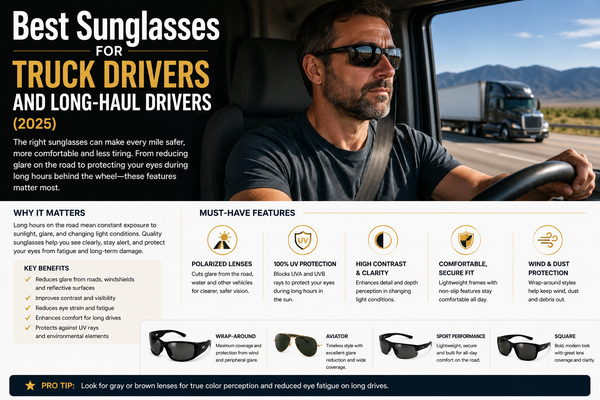

Best Sunglasses for Truck Drivers and Long-Haul Drivers
A long-haul truck driver working 5 days a week accumulates somewhere between 2,000 and 2,500 hours of driving UV exposure per year. That is a conservative estimate for someone whose working day is spent primarily behind a windshield. Over a 30-year career, it is a lifetime ocular UV total that most people — including most ophthalmologists — would not associate with driving as an occupation.
The driving sunglass question for professional drivers is not the same as for casual weekend drivers. It is not about comfort on a sunny Saturday morning. It is about a daily occupational UV and glare exposure that accumulates continuously over a career, and about a specific driving safety factor — glare-induced visibility reduction — that affects reaction time and decision quality in ways that have measurable safety consequences.
This guide covers the specific driving UV reality, the correct lens specification for professional drivers, why gray is the only appropriate tint for traffic-facing work, the specific glare events that cause the most serious visibility problems on long-haul routes, and how to build a driving rotation that keeps the right lens always accessible.
This is a C17 Professions & Occupations supporting post. It links back to the cluster pillar atthe complete guide to sunglasses for outdoor workers by profession. For the general driving sunglass guide, seebest sunglasses for driving: polarized lenses and glare reduction.
Quick Answer
Gray polarized UV400 at Category 2. Always. Gray for traffic signal colour accuracy — a safety requirement for anyone whose job involves traffic. Polarized for road surface glare elimination — the specific visibility hazard of long-haul driving. Category 2 for the full range from motorway sun to overcast urban delivery. Keep a spare pair in the cab. Free replacements from Navi mean the specification is always accessible.

Table of Contents
Part 1: The Professional Driver UV Exposure Reality
The UV exposure calculation for professional drivers is built from two components: direct UV through vehicle glass, and UV accumulated during the non-driving portions of the working day — loading, unloading, fuel stops, delivery runs, pre- and post-trip vehicle checks.
Laminated windshield glass blocks most UVB (the shorter, more energetic UV wavelength that causes corneal burns and is most associated with cortical cataract) but transmits a meaningful proportion of UVA (the longer UV wavelength that penetrates more deeply and is associated with nuclear cataract and retinal damage). Side windows in most commercial vehicles are not laminated and transmit UV at rates closer to open-air exposure. A driver who spends significant time with their face near a side window during manoeuvring, checking mirrors, or navigating urban environments is receiving significant lateral UV exposure that the windshield provides no protection against.
Add the non-driving components: a delivery driver making multiple drops per day enters and exits a vehicle repeatedly, walks to and from premises, waits outdoors for access. This intermittent outdoor UV exposure during peak UV hours adds a significant component to the in-cab exposure. NIOSH occupational health data classifies professional driving as a significant UV exposure occupation, not simply because of in-cab exposure but because of the total daily UV accumulation across the full working day.
Part 2: How Vehicle Glass Affects UV Transmission
|
Glass Type |
UVB Transmission |
UVA Transmission |
Notes |
|
Laminated windshield |
< 2% — effectively blocked |
20–60% depending on glass |
Standard in most vehicles post-2000 |
|
Tempered side window |
~60–80% transmitted |
~60–80% transmitted |
Most commercial and passenger vehicles |
|
Tinted side window |
Reduced but variable |
Reduced but variable |
Tint level and UV specification vary widely |
|
Sunroof / panoramic roof |
High — overhead UV transmitted |
High |
Direct overhead UV exposure during bright conditions |
The practical implication:professional drivers sitting near unlaminated side windows for extended periods — particularly on the sun-facing side of the vehicle — receive UV exposure that approaches outdoor levels through the side glass. On east-west routes in morning and evening, the low-angle sun directly through the side window is among the most intense driver UV exposure events of the working day.
Part 3: Why Gray Is Non-Negotiable for Professional Drivers
Traffic safety depends on color. Red lights, amber signals, green signals, blue emergency vehicle lighting, amber hazard lights, and the color-coded road signage of motorway and highway systems all use color as a primary information channel. A driver who cannot read these colors accurately and quickly is operating with a degraded information set in environments where rapid color-code interpretation is a safety-critical function.
Gray is the neutral tint. It reduces the intensity of visible light proportionally across the entire spectrum without emphasizing or emphasizing any color band. Traffic signals read as their correct colors through a gray lens. Red is red. Amber is amber. Green is green. The color-code is preserved at reduced intensity.
Amber and brown tints filter blue wavelengths selectively, warming the perceived colour temperature of the scene. They can subtly alter the apparent colour of amber and red signals. For leisure driving in low-traffic rural environments, this is a minor concern. For professional drivers in high-density traffic, navigating motorway junction signs, urban signal sequences, and emergency vehicle approach at the end of an 8-hour shift, this is not a minor concern. Gray is the specification that maintains the traffic colour language without alteration.
Yellow tints alter color perception significantly and are not appropriate for daytime professional driving. Amber is acceptable for rural professional driving where traffic signal density is low — a farm vehicle driver, an agricultural machinery operator on country roads. For HGV drivers, delivery drivers, coaches, and any professional driver in mixed traffic, gray is the only appropriate tint.
Part 4: Why Polarization Is a Safety Specification, Not a Preference
The distinction between a polarized and non-polarized driving lens is not one of comfort. It is a visibility distinction with measurable safety implications. Multiple studies in occupational and transport safety have found that glare from road surfaces, oncoming vehicle reflections, and wet road shimmer reduces driver reaction time and increases the probability of missed hazard detection.
Non-polarized lenses reduce all light proportionally. The glare from a wet motorway in early morning sun is dimmer, but it is still there as a high-contrast surface reflection that reduces the legibility of road markings, lane lines, and the silhouette of hazards ahead. The lane markings are difficult to read not because they are dark but because they are drowned in horizontal reflection.
Polarized lenses block horizontally oscillating light specifically — the type produced by road surface reflection. The wet motorway shimmer is eliminated. Road markings become legible. The lane line contrast is restored. The hazard silhouette is readable. This is not a perceptual preference. It is a measurable improvement in the visual information available to the driver at exactly the moments when that information is most safety-critical.
For a driver on a 7-hour motorway shift, this visual quality improvement is also a fatigue factor. Sustained squinting against unmanaged glare accumulates as visual fatigue that compounds general driving fatigue toward the end of long shifts. Polarized lenses reduce the visual fatigue load continuously throughout the shift, not just at the moments of acute glare.
The complete polarization science is inpolarized vs non-polarized sunglasses: the definitive guide.

Part 5: Lens Category for Professional Drivers
The professional driver default: Category 2 gray polarized UV400. Remove for tunnel entry if adaptation becomes slow. Replace with Category 3 when operating sustained routes in high-UV summer conditions where the specific brightness justifies the reduced versatility.
Part 6: The Specific Glare Events on Long-Haul Routes
Early Morning Eastbound — The Peak Glare Event
Eastbound driving in the morning hours places the rising sun directly in the driver’s forward line of sight at a low angle that generates the most intense combination of direct glare and road surface reflection of the entire driving day. The road surface ahead acts as a near-mirror for the low-angle sun. Lane markings, vehicle silhouettes, and road obstacles ahead are all obscured by this horizontal reflection. Polarized lenses eliminate the road surface reflection specifically, restoring the contrast of everything in the driver’s forward field.
Post-Rain Motorway — Maximum Reflection Conditions
After rain, road surfaces are highly reflective. The water film on the road acts as a mirror for any light source in the environment, producing intense horizontal reflection that extends across the full visible surface ahead. Professional drivers who drive through rain and continue in clearing conditions face some of the most intense road surface glare of any driving scenario. Polarized lenses eliminate this reflection completely. Non-polarized lenses make the road surface darker but no less reflective.
Oncoming Vehicle Low-Beam at Dawn and Dusk
At dawn and dusk, when ambient light levels are low but sky conditions are bright, oncoming vehicles with headlights activated reflect their bodywork and windshields into the driver’s line of sight. These reflection bursts from oncoming traffic are horizontally polarized and are significantly attenuated by polarized driving lenses. The reduction in glare burst intensity from oncoming traffic is one of the most consistently reported benefits of polarized driving sunglasses among professional drivers who have made the switch.
Urban Navigation — Wet Street and Building Glass
Urban delivery and navigation involves multiple glare sources beyond the road surface: building glass facades, parked vehicle bodywork, wet pavements. These horizontal reflective surfaces compound the general urban brightness into a sustained glare environment that creates visual fatigue over a long delivery shift. Polarized lenses reduce this accumulated glare burden throughout the urban portion of a mixed-route working day.
Part 7: Visual Fatigue — The Cumulative Shift Effect
Professional drivers who drive without polarized lenses in glare conditions are not simply uncomfortable. They are managing a continuous visual processing load that contributes to fatigue in ways that compound the general physical fatigue of long-distance driving. This mechanism is documented in the occupational health literature on professional drivers and visual performance.
The mechanism: sustained squinting activates the orbicularis oculi muscle around the eye continuously. This muscle fatigue, combined with the cognitive load of continuous glare compensation in traffic-dense environments, adds to the total fatigue burden of the driving day. Drivers who use polarized lenses report lower levels of end-of-shift eye tiredness and, in some studies, measurably better performance on visual attention tasks at the end of long driving sessions.
For safety regulators and fleet operators, this is a relevant occupational health consideration. The driver who arrives at the end of an 8-hour motorway shift with less accumulated visual fatigue is not just more comfortable — they are a safer driver for the final hours of the shift and for the subsequent rest and recovery that determines next-shift performance.
Part 8: Frame Requirements for Professional Drivers
Stability for Long Wear
Frames worn for 8–10 hours require stable nose fit and temple fit that does not create pressure points over extended wear. TR90 nylon under 25g with adjustable metal nose pads is the correct specification for long-duration wear. Heavy acetate frames that create nose and temple pressure become uncomfortable over a full shift in ways that lighter frames do not.
Cabin Environment Considerations
Modern truck cabs are climate-controlled environments where temperature and humidity are managed. This reduces the sweat-based fit challenges that affect outdoor manual workers. The primary fit requirement for professional drivers is stability and comfort over long durations rather than the grip-during-vigorous-activity requirement of construction or running use.
LCD Screen Compatibility
Some professional drivers report that polarized lenses make certain LCD navigation screens or dashboard displays difficult to read at specific viewing angles. This is a real phenomenon caused by the same PVA filter interaction with polarized LCD backlights. Modern vehicle displays are generally designed for polarized lens compatibility, but some older navigation screens and certain dashboard instruments can appear dark or invisible through polarized lenses at specific angles. If this is an issue, adjusting the screen brightness, tilting the head slightly, or using an anti-glare screen protector usually resolves it.
Keeping a Spare in the Cab
Professional drivers should keep a spare pair of gray polarized UV400 sunglasses in the cab at all times. The single pair model creates exposure gaps on every working day that the spare pair is absent, lost, or in the delivery bag rather than the cab. At $119 for four Navi pairs with free replacements, the spare cab pair is a $30 decision.
✨ NAVI EYEWEAR — GRAY POLARIZED UV400. THE PROFESSIONAL DRIVER SPECIFICATION.UV400 certified polycarbonate. Quality-controlled gray polarized lenses. Colour-accurate through traffic. TR90 frames. Stainless 5-barrel hinges. Lightweight for shift-length comfort. Buy 1, Get Any 3 Pairs Free — $119 for four pairs. One for the cab. One spare. Free shipping. |
Part 9: The In-Cab Pair and the Delivery Pair
Long-haul and HGV drivers primarily need a cab pair that is always accessible, always the right specification, and never accidentally left at home. Delivery drivers who make multiple stops per working day need a pair that is appropriate both for the in-vehicle leg and the outdoor legs between vehicle and premises.
The solution is the same in both cases: gray polarized UV400 at Category 2, always in the vehicle. Not the weekend pair that sometimes makes it into the work bag. A dedicated work pair that lives in the cab and never comes home. At $30 per Navi pair, this is a completely accessible approach.
The four-pair rotation model for professional drivers: one pair permanently in the cab, one pair in the delivery bag or jacket, one personal everyday pair, one spare at home. None of these four positions should ever be empty. When one pair is lost or broken, the rotation absorbs the loss without creating an exposure gap.
Part 10: Comparison Table — Driving Sunglass Options for Professional Drivers
|
Option |
Traffic Colour Accuracy |
Glare Management |
Category Versatility |
Professional Driver Verdict |
|
Gray polarized UV400 Cat 2 |
Neutral — full accuracy |
Maximum — horizontal glare eliminated |
Excellent — all conditions |
Best choice — professional standard |
|
Gray polarized UV400 Cat 3 |
Neutral — full accuracy |
Maximum |
Limited — too dark for variable/urban |
Good for sustained bright routes only |
|
Gray non-polarized UV400 |
Neutral — full accuracy |
Reduced brightness only; glare remains |
Good |
Acceptable; polarized is better |
|
Amber polarized UV400 Cat 2 |
Altered — warms signals |
Maximum |
Good |
Not recommended for traffic-dense driving |
|
Non-UV400 dark lens |
N/A — UV protection absent |
Reduced brightness only |
N/A |
Never — unsafe and unhealthy |
|
Category 4 (any tint) |
Variable |
Maximum darkness |
Not legal for driving |
Never — illegal for driving |
Part 11: Best For
Gray Polarized UV400 Category 2 — Best For:
Gray Polarized UV400 Category 3 — Best For:
Part 12: Common Mistakes
Bottom Line
Professional drivers face a specific UV accumulation and glare safety challenge that no other sunglass content addresses adequately. The combination of daily windshield UV transmission, side-window UV exposure, and the specific horizontal glare events of motorway and urban driving creates an occupational requirement for gray polarized UV400 at Category 2 that is both a health specification and a safety specification.
Gray for colour accuracy. Polarized for road visibility. Category 2 for all-conditions versatility. A dedicated cab pair so the right lens is always there. At $119 for four Navi pairs with free replacements, the professional driver rotation is an accessible decision.
Browse UV400 polarized options atnavieyewear.com/collections/polarized. Add 4 pairs — Buy 1, Get Any 3 Free auto-applies. Free shipping. Free replacements.
Frequently Asked Questions
What are the best sunglasses for truck drivers?
Gray polarized UV400 at Category 2. Gray maintains colour accuracy for traffic signals — essential for professional drivers in mixed traffic. Polarized eliminates road surface glare — the primary driving visibility hazard. Category 2 handles all driving conditions from motorway sun to overcast urban delivery without requiring removal. Keep a dedicated pair in the cab at all times.
Do truck drivers need polarized sunglasses?
Yes — polarized is the safety specification for professional drivers. Road surface reflection in wet conditions and at low sun angles creates the most serious visibility reduction events in professional driving. Polarized lenses eliminate horizontal road surface glare specifically, restoring the contrast of road markings and hazard silhouettes that non-polarized lenses reduce but cannot clarify. This is a safety improvement, not a comfort preference.
Can truck drivers use amber or brown sunglasses?
Not recommended for primary professional driving use. Amber and brown tints filter blue wavelengths, warming the perceived colour temperature and subtly altering traffic signal colours. For professional drivers in high-traffic environments who need reliable colour-code interpretation for signals and signs, gray is the correct tint. Amber is reasonable for rural professional driving with minimal traffic signal density.
What lens category is legal and safe for driving?
Category 2 (18–43% VLT) for all-conditions driving. Category 3 (8–18%) for sustained bright conditions — check jurisdiction-specific requirements. Category 4 is not legal for driving in the EU, UK, or most US states. Never use Category 4 while driving.
Do sunglasses reduce fatigue for professional drivers?
Yes, specifically polarized lenses. Sustained squinting against unmanaged road surface glare activates the orbicularis oculi muscle continuously, contributing to visual fatigue that compounds general driving fatigue. Studies in occupational health and driver performance have found that polarized lenses reduce end-of-shift visual fatigue and improve performance on visual attention tasks in professional drivers.
Should truck drivers keep sunglasses in the cab?
Yes — a dedicated pair that permanently lives in the cab. The single pair model that moves between work and personal use creates UV exposure gaps on every day the glasses are absent from the cab. A dedicated cab pair at $30 through Navi’s four-pair model is the correct approach. When that pair is lost or damaged, the free replacement provision replaces it.
Do polarized sunglasses affect GPS screens in truck cabs?
They can at specific viewing angles. Polarized lenses can make some LCD displays appear dark or invisible when the PVA filter aligns with the LCD’s polarized backlight. Most modern vehicle displays are designed for polarized lens compatibility, but some navigation screens can be affected. If this is an issue, increase screen brightness, tilt your head slightly, or use an anti-glare screen protector. The road safety benefit of polarized lenses for driving significantly outweighs this minor display adjustment consideration.
How often should professional drivers replace their driving sunglasses?
When optical clarity is compromised by lens scratching or coating degradation. For polycarbonate lenses, UV protection is inherent in the material and is not reduced by surface scratching — but optical clarity is reduced, and clear optics matter for contrast and hazard detection. A heavily scratched lens that creates visual scatter at the end of a long shift is a lens that should be replaced. With Navi’s free replacement provision, this is not a cost barrier.
Supporting Articles
GRAY POLARIZED UV400. IN THE CAB. EVERY SHIFT.UV400 polycarbonate. Gray polarized — traffic color accurate. Oleophobic coating. TR90. Stainless hinges. The professional driver standard. Keep one in the cab. Always. Buy 1, Get Any 3 Pairs Free — $119 for four pairs. Free shipping. Free replacements. |
SOURCES & CITATIONS[1] Sliney DH.“UV radiation ocular exposure dosimetry.”Documenta Ophthalmologica, 1994.View source [2] Rosenthal FS, Bakalian AE, Lou CQ, Taylor HR.“The effect of sunglasses on ocular exposure to ultraviolet radiation.”American Journal of Public Health, 1988.View source [3] De Faber JT, Naeser K, Kessing SV.“Polarized light and contrast sensitivity under glare conditions.”Ophthalmic Research, 2013.View source [4] Taylor HR, West SK, Rosenthal FS, et al..“Effect of ultraviolet radiation on cataract formation.”New England Journal of Medicine, 1988.View source [5] Dain SJ.“Sunglasses and sunglass standards.”Clinical and Experimental Optometry, 2003.View source [6] American Academy of Ophthalmology.“Sunglasses: choosing the right pair for UV protection.”AAO EyeSmart, 2023.View source |