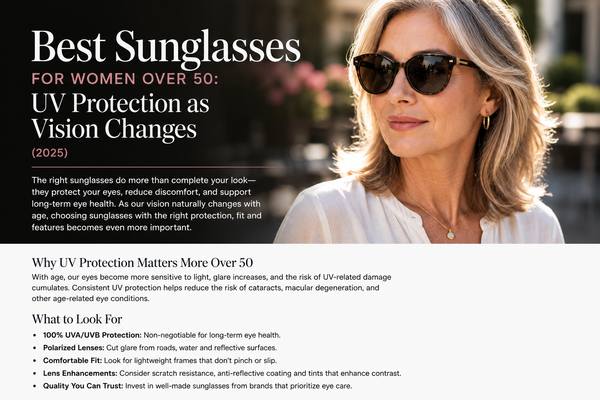

Best Sunglasses for Women Over 50: UV Protection as Vision Changes
The 50s are when UV eye damage becomes visible. Not because the damage starts then — it began accumulating in childhood and has continued every year since — but because the threshold for clinical manifestation of cataract and macular changes is typically reached in the 50s, 60s, and 70s. The decades of outdoor UV exposure without consistent protection are expressing themselves precisely when women are most aware of visual quality and most invested in maintaining it.
This guide covers what actually changes with eyes and vision after 50, why UV protection becomes more rather than less consequential with age, the specific eye conditions that become more relevant — dry eye, early cataract changes, AMD risk — and what the right sunglass specification looks like at this life stage. It also covers the style and fit considerations that change after 50: what works, what has changed from the frames of earlier decades, and how to build a practical rotation that covers every context.
This is the final C16 Women’s Sunglasses supporting post. It links back to the cluster pillar atthe complete guide to women’s sunglasses. For the hormonal connection to light sensitivity including menopause, seesunglasses and light sensitivity in women: the hormonal connection. For the longevity case for UV protection, seesunglasses as longevity: how UV protection is one of the best anti-aging eye investments.
Quick Answer
For women over 50: UV400 polarized polycarbonate at Category 2 as the everyday lens — the same core specification as always, now more consequential. Gray polarized for driving and daily use; amber for outdoor activity and beach. Oversized frames for maximum periocular skin coverage. Close-fitting geometry for women with dry-eye-driven light sensitivity. The UV protection investment made now is the one that shapes visual quality in the 60s, 70s, and 80s.

Table of Contents
Part 1: What Changes with Eyes After 50
Several ocular changes become relevant after 50, each with implications for sunglass choice:
Part 2: Why UV Protection Becomes More Important, Not Less
A common misconception is that UV protection matters most for young eyes and becomes less relevant as women age past their reproductive years. The opposite is true. UV protection in the 50s and 60s is preventing the acceleration of cataract and AMD processes that are already in motion from decades of prior accumulation. The protective investment made in the 50s and 60s directly shapes visual quality in the 70s and 80s.
The dose-response relationship between cumulative UV exposure and cataract risk is not linear — later-life UV exposure compounds on an already-high accumulated base. Each additional decade of unprotected outdoor UV exposure adds to a running total that determines whether clinical opacification develops at 65 or 75, whether AMD changes appear at 70 or remain subclinical until 80. The trajectory is modifiable at every age.
The complete longevity and anti-aging case for UV protection is insunglasses as longevity: how UV protection is one of the best anti-aging eye investments.
Part 3: Cataract — The Cumulative UV Disease
Cataract is the opacification of the crystalline lens — the clear lens inside the eye responsible for focusing. It is the leading cause of correctable visual impairment worldwide. UV exposure, particularly UVB, is one of the best-documented modifiable risk factors for cortical and nuclear cataract. The lens accumulates UV damage throughout life, and this oxidative damage is the proximate cause of the protein cross-linking that produces opacification.
Women have slightly higher lifetime cataract prevalence than men, partly because women live longer and accumulate more lifetime UV, and partly because of potential hormonal contributions. The Beaver Dam Eye Study, the Nurses’ Health Study, and multiple population cohorts have confirmed the UV-cataract relationship across different populations and geographies.
The clinical implication: cataract surgery is effective, safe, and widely available in developed healthcare systems. But cataract surgery is a significant medical intervention with recovery time, associated risks, and the permanent alteration of the natural lens. Delaying the onset of clinically significant cataract by consistent UV400 use throughout the 50s and 60s is a practical preventive strategy with a meaningful impact on the timing of this intervention.
The detailed cataract and UV science is incataracts are mostly preventable: what the science says about UV and lens health.
Part 4: Age-Related Macular Degeneration — The Long Game
Age-related macular degeneration (AMD) is the leading cause of central vision loss in adults over 65 in developed countries. The macula — the central retinal area responsible for fine detail vision — accumulates damage from UV and blue light exposure over decades. The drusen deposits and retinal pigment epithelium changes that characterise early AMD have typically been developing for 20–30 years before clinical vision loss appears.
Women are at higher AMD prevalence than men in older age groups, partly because of longer lifespans and partly because post-menopausal loss of oestrogen’s antioxidant effects on the retina may accelerate the cumulative oxidative damage that drives AMD progression. The Beaver Dam Eye Study found that sunlight exposure was associated with increased risk of early AMD and retinal pigment epithelium abnormalities.
UV400 polycarbonate with polarization addresses AMD risk through two mechanisms: UV400 removes the UV component directly implicated in retinal oxidative damage, and polarization reduces the reflected UV from outdoor surfaces that reaches the eye at angles that standard lens coverage geometry may not fully block.
The detailed AMD risk reduction science is inmacular degeneration risk reduction: what you can do starting today.

Part 5: Dry Eye After Menopause — The Vision Comfort Dimension
Post-menopausal dry eye is one of the most prevalent and under-discussed vision quality issues affecting women over 50. As oestrogen levels decline, meibomian gland function deteriorates and tear film stability decreases. The result: eyes that are comfortable in air-conditioned offices and indoor environments become uncomfortable in any outdoor environment involving wind, sun, or low humidity.
Dry eye’s effects on outdoor vision quality are significant. An unstable tear film produces fluctuating blur, increased sensitivity to bright light, and a persistent low-grade discomfort that makes outdoor activities less enjoyable. Many women in their 50s and 60s who report finding outdoor environments ‘too bright’ or experiencing more eye tiredness than previously are experiencing the combined effects of dry eye and the contrast sensitivity changes described in Part 1.
UV400 polarized lenses address dry-eye outdoor discomfort in two ways: polarization eliminates the horizontal surface glare that is disproportionately uncomfortable for dry-eye eyes, and close-fitting frame geometry reduces the wind exposure that accelerates tear film evaporation. These are comfort measures, not dry eye treatments, but they provide meaningful daily quality-of-life improvement for women with post-menopausal dry eye.
The complete dry eye and hormonal connection guide is insunglasses and light sensitivity in women: the hormonal connection.
Part 6: Presbyopia and Sunglass Choice
Presbyopia — the progressive loss of near focusing ability that typically becomes noticeable in the mid-40s — is well-established by the mid-50s. Most women over 50 use reading glasses, progressive lenses, or varifocals for near and intermediate vision. This creates specific considerations for sunglass choice.
Non-Prescription Sunglasses Over 50
Non-prescription UV400 polarized sunglasses remain fully appropriate for women over 50 for distance vision outdoor use. Driving, walking, sport, and any activity primarily involving distance vision is correctly served by quality non-prescription sunglasses. The UV protection and glare reduction benefits are identical regardless of any reading correction requirement.
Prescription Sunglasses and Readers
For women who want reading capability in sunglasses, prescription sunglass lenses or over-the-counter bifocal sunglass readers (with UV400 certification) are the practical solutions. Prescription sunglasses require an optician for the lens specification. Over-the-counter bifocal sunglasses in UV400 polycarbonate are available and serve the dual distance-reading need in casual outdoor contexts.
The Sunglasses Over Contact Lenses Option
Women who wear contact lenses for near correction can wear non-prescription UV400 polarized sunglasses over their contacts for complete vision correction plus UV protection. This is one of the simplest solutions for women who want the full Navi specification without requiring prescription sunglasses.
Part 7: The Periocular Skin Case for Larger Frames
The skin around the eyes — the periocular zone — is among the most UV-sensitive skin on the body. By the 50s, the cumulative UV damage to periocular skin from decades of outdoor exposure is already visible as fine lines, crow’s feet, skin thinning, and sun spot development. This is not purely a cosmetic concern: UV-driven skin changes in the periocular zone also contribute to the loss of skin elasticity that affects eyelid function and ocular surface protection over time.
Larger frames with generous coverage geometry extend UV protection beyond the eye itself to the periocular skin zone. Oversized frames that reach from above the brow line to the upper cheekbone provide meaningful protection to this skin area. For women over 50 who are both managing existing periocular sun damage and preventing further accumulation, frame coverage geometry is simultaneously an eye health and a skin health decision.
This is the most practical argument for larger frames over 50: they are not just aesthetically bold, they are functionally providing more comprehensive UV protection to the face’s most UV-sensitive skin zone.
Part 8: The Correct Specification After 50
The core specification is the same as at any age, now applied with greater urgency:
|
Specification |
After 50 Relevance |
Why More Important |
|
UV400 polycarbonate |
Essential — as always |
Cataract and AMD processes in motion; each year of protection matters more |
|
Polarization |
Essential — more so than before |
Contrast sensitivity reduction makes glare more impactful; dry eye increases glare discomfort |
|
Category 2 (18–43% VLT) |
Everyday recommendation |
Reduced pupil size means eyes need less darkness; Cat 3 can over-darken for comfort |
|
Oleophobic coating |
Strongly recommended |
Daily lens cleaning remains a priority; equally practical at every age |
|
Anti-saltwater coating |
Recommended for active use |
No change in recommendation — beach and coastal use still relevant |
|
Larger frame coverage |
More important after 50 |
Periocular skin protection increasingly valuable; coverage geometry matters |
|
Close-fitting frame |
More important after 50 |
Dry-eye wind protection; peripheral light reduction for increased light sensitivity |
|
Lightweight TR90 |
Always relevant |
Comfort over extended daily wear |
Part 9: Frame Style After 50 — What Works and What Has Changed
One of the most consistent cultural messages about sunglasses over 50 is that women should ‘age down’ their frame choices — avoid oversized frames, avoid bold shapes, choose smaller and more neutral. This is largely wrong, and it conflicts with the functional case made above for larger coverage frames.
What Has Changed Aesthetically
Facial proportions change gradually with age. The soft tissue redistributes slightly, and the contrast between face and frame is different than it was at 30. Frames that worked well at 30 may need slight adjustment at 55 — a slightly lighter construction, a slightly warmer metal, a slightly more generous lens height. These are refinements, not reinventions.
What Works Extremely Well After 50
Classic thin metal aviators — timeless, universally flattering, appropriate across all contexts. Oval or round thin metal frames — the soft geometry suits the changed facial proportions of the 50s and 60s beautifully. Oversized frames with quality construction — the bold scale works on faces with the presence that comes with age, and the coverage geometry serves both health and aesthetics. Quality acetate in warm neutrals — tortoiseshell, warm brown, subtle havana — complement the warm skin tones of mature women particularly well.
What to Approach with Care
Very dark heavy frames that add downward visual weight. Very small micro frames that reduce UV coverage geometry and look proportionally inadequate. Very trendy season-specific shapes that communicate youth-chasing rather than confident personal style. The same principles of proportion and context-appropriateness that apply at any age — without the additional constraint of feeling obligated to ‘look younger.’
Part 10: Fit Considerations After 50
Nose Bridge and Weight Distribution
Changes in facial soft tissue with age can alter how frames sit on the nose and cheeks. Frames that fitted perfectly at 40 may sit differently at 55. Adjustable metal nose pads in metal frames allow the fit to be customised as facial geometry changes. For women with progressive reading lenses in their everyday glasses, the nose pad position of sunglasses should ideally match the nose position of the everyday glasses to maintain consistent upper-face alignment.
Frame Weight for Daily Comfort
Any tendency toward headaches or temple pressure from frame wear is more likely to be noticed in the 50s and beyond. TR90 nylon frames under 25g provide the most comfortable all-day wear. If existing frames cause pressure headaches by midday, weight is often the cause rather than fit, and a lighter frame resolves it.
Temple Fit with Hearing Aids
For women who wear hearing aids — increasingly relevant from the late 50s onward — the temple arm of sunglasses shares the space behind the ear with hearing aid components. Slim temple arms that do not interfere with hearing aid placement are important. Most thin metal frames and many TR90 sport frames have adequately slim temples. Very thick acetate temple arms can conflict with behind-the-ear hearing aids.
The complete fitting guide is inhow to tell if sunglasses actually fit.
✨ NAVI EYEWEAR — UV400 PROTECTION FOR EVERY DECADE.UV400 polycarbonate. Polarized. Oleophobic and anti-saltwater coating. TR90. Stainless hinges. The specification that matters at 50, 60, 70, and every year beyond. Buy 1, Get Any 3 Pairs Free — $119 for four pairs (~$30 each). Free shipping. Free replacements. |
Part 11: Comparison Table — Sunglass Priorities Before and After 50
|
Priority |
Under 50 |
Over 50 |
Change? |
|
UV400 |
Essential |
Essential |
No change — equally critical |
|
Polarization |
Strongly recommended |
Essential — elevated priority |
More important: contrast sensitivity, dry eye |
|
Lens category |
Cat 2–3 |
Cat 2 everyday preferred |
Reduced pupil size; Cat 3 can over-darken |
|
Frame coverage |
Standard |
Larger frames preferred |
Periocular skin protection more valuable |
|
Frame fit |
Comfortable |
Also hearing-aid compatible |
New consideration from late 50s |
|
Frame weight |
Under 25g preferred |
Under 25g more important |
Comfort becomes more significant |
|
Anti-saltwater coating |
Recommended |
Recommended |
No change |
|
Oleophobic coating |
Essential for makeup wearers |
Essential for makeup wearers |
No change |
|
Style freedom |
Wide |
Equally wide — ignore ‘age down’ advice |
Confident personal style is the guide |
Part 12: Best For
Gray Polarized UV400 Category 2 in a Classic Aviator or Oval Frame — Best For:
Amber Polarized UV400 Category 2 in an Oversized Frame with Good Coverage — Best For:
Part 13: Common Mistakes
Bottom Line
After 50, every year of consistent UV400 polarized lens wear is making a meaningful difference to the trajectory of cataract and AMD progression. The UV protection investment made now is the one that shapes visual quality in the 70s and 80s. The specification is the same as always — UV400 polycarbonate, polarized, Category 2 everyday — but it is more consequential, and several additional considerations come into focus: larger frames for periocular skin coverage, close-fitting geometry for dry-eye wind protection, lighter frames for comfort, hearing-aid-compatible temple geometry.
The style case is equally important: frames over 50 should express confident personal style, not default to size-reduction out of misplaced caution. Oversized aviators, bold ovals, warm tortoiseshell — all work. The woman who has worn sunglasses with intention for decades arrives at 55 knowing exactly what suits her. The UV specification ensures she is also protecting the eyes that have to last another 30 or 40 years.
Browse UV400 polarized options atnavieyewear.com/collections/polarized. Add 4 pairs — Buy 1, Get Any 3 Free auto-applies. Free shipping. Free replacements.

Frequently Asked Questions
Do women over 50 still need UV protection sunglasses?
More than ever. UV protection after 50 is not redundant — it is actively modifying the trajectory of cataract and AMD processes that are already in motion from decades of prior UV accumulation. Each additional decade of unprotected outdoor exposure compounds on an already-high accumulated base. UV400 sunglasses worn consistently in the 50s and 60s directly affect whether clinical vision loss from cataract or AMD appears at 65 or 75.
What sunglasses are best for women over 50?
UV400 polarized polycarbonate at Category 2 in a well-fitted frame with adequate coverage. Gray polarized for everyday driving and professional use. Amber polarized for outdoor activities and beach. Larger frames with generous coverage geometry for periocular skin protection. Close-fitting frames for women with dry-eye-driven light sensitivity. Classic aviators, ovals, and quality oversized frames all work very well on mature faces.
Are bigger sunglasses better for women over 50?
From a UV protection standpoint, yes. Larger frames with generous coverage geometry protect the periocular skin zone — where UV-driven photoageing is most visible — in addition to the eye itself. The advice to ‘size down’ frames after 50 has no UV health rationale. Bold, well-proportioned frames suit the face presence that comes with age and provide better protection. The practical guide is proportion (not scale for its own sake) and good construction.
What lens category is right for women over 50?
Category 2 (18–43% VLT) for everyday use. Reduced pupil size after 50 means Category 3 can over-darken the visual field and reduce the useful contrast that mature eyes need for comfortable outdoor navigation. Category 3 remains appropriate for specific high-sun use — beach, sustained summer driving — but Category 2 is the more functional everyday category for most post-50 outdoor conditions.
Do sunglasses help with dry eye after menopause?
Yes, as comfort management rather than treatment. Polarized lenses reduce the horizontal surface glare that is disproportionately uncomfortable for dry-eye eyes. Close-fitting frame geometry reduces wind exposure that accelerates tear film evaporation outdoors. These measures improve daily outdoor comfort for women with post-menopausal dry eye. They do not treat the underlying dry eye condition, which requires specific ophthalmic management.
Can women over 50 wear fashionable sunglasses?
Absolutely — and the best ones are UV400 polarized. Oversized aviators, bold oval frames, quality tortoiseshell acetate, warm gold metal — all work well on mature faces with the presence and proportion that age brings. The UV specification and the style choice are made simultaneously, not as competing priorities. A beautiful frame on a woman over 50 with UV400 polycarbonate and polarized lenses is serving both purposes at once.
What about prescription sunglasses for women over 50 with presbyopia?
Non-prescription UV400 polarized sunglasses remain fully appropriate for distance vision outdoor use at any age. For combined near and distance correction in sunglasses, prescription progressive sunglass lenses from an optician are the highest-quality solution. UV400 polarized bifocal sunglasses (over-the-counter) provide a practical and accessible alternative for casual outdoor use. Women who wear contact lenses for near correction can wear non-prescription UV400 sunglasses over their contacts without any prescription constraint.
Why is macular degeneration more common in women?
Women have higher AMD prevalence in older age groups primarily because women live longer and therefore accumulate more lifetime UV exposure and age-related retinal change. Post-menopausal loss of oestrogen’s antioxidant effects on the retina may also contribute to faster AMD progression after menopause. The UV contribution to AMD risk is cumulative and modifiable at every age. The detailed AMD risk reduction guide is inmacular degeneration risk reduction: what you can do starting today.
Supporting Articles
UV400 PROTECTION FOR EVERY DECADE. STILL GOING.UV400 polycarbonate. Polarized. Oleophobic and anti-saltwater coating. TR90. Stainless hinges. The eyes you protect in your 50s are the eyes you see with in your 80s. Buy 1, Get Any 3 Pairs Free — $119 for four pairs. Free shipping. Free replacements. |
SOURCES & CITATIONS[1] Taylor HR, West SK, Rosenthal FS, et al..“Effect of ultraviolet radiation on cataract formation.”New England Journal of Medicine, 1988.View source [2] Cruickshanks KJ, Klein R, Klein BE.“Sunlight and age-related macular degeneration: the Beaver Dam Eye Study.”Archives of Ophthalmology, 1993.View source [3] Congdon N, Vingerling JR, Klein BE, et al..“Prevalence of cataract and pseudophakia/aphakia among adults in the United States.”Archives of Ophthalmology, 2004.View source [4] Sullivan DA, Rocha EM, Aragona P, et al..“TFOS DEWS II sex, gender, and hormones report.”The Ocular Surface, 2017.View source [5] Rosenthal FS, Bakalian AE, Lou CQ, Taylor HR.“The effect of sunglasses on ocular exposure to ultraviolet radiation.”American Journal of Public Health, 1988.View source [6] World Health Organization.“Solar ultraviolet radiation: global burden of disease from solar ultraviolet radiation.”WHO Environmental Burden of Disease Series, 2006.View source [7] American Academy of Ophthalmology.“Sunglasses: choosing the right pair for UV protection.”AAO EyeSmart, 2023.View source |