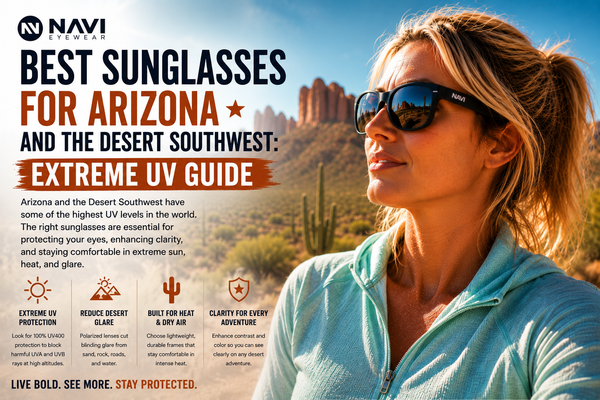

Best Sunglasses for Arizona and the Desert Southwest: Extreme UV Guide
Arizona is the most UV-intense state in the continental US by most measures. Phoenix averages 299 sunny days per year — more than any other major US city. The combination of low latitude (Phoenix at 33 degrees north, Tucson at 32 degrees north, Yuma at 32 degrees north), minimal cloud cover, low atmospheric humidity that reduces UV scattering, high desert elevation, and highly reflective desert terrain creates UV conditions that are genuinely extreme by continental US standards. Arizona residents who are regularly outdoors without UV400 protection are accumulating one of the highest UV doses of any US population. This guide covers Arizona's UV environments from Phoenix to the Grand Canyon and the lens specification for each.

1. Why Arizona UV Is Different
The Four Amplifiers
Arizona's extreme UV results from four factors operating simultaneously — not any one alone:
- Low latitude: Arizona's southern border at 31 degrees north places it closer to the equator than most of the continental US. Lower latitude means higher solar angles at midday and less atmospheric UV filtering at peak hours.
- Low humidity: the Sonoran Desert's arid air contains less water vapor than humid states — water vapor absorbs and scatters UV. Arizona's dry air allows more UV to reach the surface than equivalent latitude locations with more humidity, like South Florida.
- Minimal cloud cover: Phoenix averages fewer cloudy days than virtually any other major US city. Cloud cover reduces UV by 30–80% depending on density; with 299 sunny days annually, Arizona residents have minimal natural UV moderation from cloud cover.
- Desert reflectance: bare desert terrain — light-colored caliche, limestone, sandstone, and sand — reflects 15–25% of UV diffusely. Unlike water reflection (which is highly polarized and directional), desert surface UV reflection is diffuse — it reaches the eye from all lower-hemisphere angles rather than from a specific reflective surface. Polarized lenses reduce the directional component; UV400 addresses the total UV from all angles.
Arizona UV Index Numbers
Phoenix summer UV index: 11–13 at peak hours. Tucson summer UV index: 11–13. Yuma — one of the sunniest cities on Earth — summer UV index: 12–14. Flagstaff at 7,000 feet elevation: UV index 13–15 in summer with altitude amplification. Grand Canyon South Rim at 6,860 feet: UV index 13–15. The Mogollon Rim and Arizona's high country regularly exceed UV index 15 on clear summer days — among the highest UV environments accessible to the general public in the US.
2. Arizona Environments and UV Context
Phoenix and the Valley of the Sun
Metro Phoenix — the nation's fifth-largest city — is an outdoor lifestyle city despite its extreme summer heat. Morning hiking on Camelback Mountain, South Mountain, and the McDowell Sonoran Preserve; outdoor dining and rooftop venues; golf year-round; cycling on the extensive Phoenix metro trail network; and the car culture that means daily side-window UV through long commutes in a sprawling metro area. Phoenix's urban heat island effect keeps residents active outdoors year-round in the morning and evening when temperatures are manageable, but UV at 7am in Phoenix in July is already UV index 4–5 — meaningful for a 90-minute morning hike.
Phoenix morning hiking deserves specific attention: Camelback Mountain and South Mountain hikes starting at 6am involve UV index 2–4 during the hike and UV index 6–8 by the typical summit or turnaround time. The bare red sandstone and granite of Phoenix's desert mountains reflects diffuse UV from below and laterally — experienced hikers who understand the Phoenix heat threat often overlook the UV threat that co-occurs with every hike. Amber Cat 2 polarized UV400 for Phoenix morning hiking; amber Cat 3 for any hiking that extends past 9am in summer.
Tucson and the Sonoran Desert
Tucson sits at 2,389 feet elevation — higher than Phoenix, which adds altitude amplification on top of Phoenix's baseline. Saguaro National Park East and West, Mount Lemmon (9,157 feet), Sabino Canyon, and the Santa Catalina Mountains all provide the hiking terrain that makes Tucson an outdoor recreation hub. Mount Lemmon at 9,157 feet has UV indexes in summer that exceed UV index 16 — the highest category on the UV index scale — on clear days. The drive from Tucson to Summerhaven at 9,000 feet on the Catalina Highway is a UV amplification journey from moderately intense to extreme in under two hours.
Sedona: Red Rock UV
Sedona at 4,350 feet elevation combines the altitude UV amplification of northern Arizona with the spectacular red sandstone terrain that draws millions of outdoor recreation visitors annually. The red and orange iron oxide surfaces of Sedona's red rocks reflect UV diffusely at the characteristic warm wavelengths of the iron oxide spectrum — a different spectral reflection character than white sand or snow. Sedona's intense scenic beauty and outdoor hiking culture make UV protection a practical necessity for the sustained outdoor time that visitors dedicate to Sedona's trails. Amber Cat 3 polarized UV400 for Sedona hiking — amber for the warm-toned terrain contrast of red rock landscapes, Cat 3 for the altitude UV.
Grand Canyon: Altitude UV at One of America's Greatest Outdoor Destinations
The Grand Canyon South Rim sits at 6,860 feet; the North Rim at 8,241 feet. The Bright Angel Trail descends to the Colorado River at 2,480 feet — a 4,380-foot elevation descent that moves through dramatically different UV environments within a single hike. At the South Rim, UV index in summer reaches 13–15. At the river, the elevation reduction lowers UV somewhat but the canyon walls reflect diffuse UV from the exposed Vishnu Schist, Tonto Platform, and Kaibab Limestone at various sun angles. Grand Canyon hikers face sustained extreme UV on descent and ascent, with the additional challenge that the South Rim is crowded with casual visitors who have no concept of canyon UV intensity. Amber Cat 3 polarized UV400 with wide-brim hat for Grand Canyon hiking — the most UV-protective combination for extreme altitude desert canyon conditions.
Flagstaff and Northern Arizona
Flagstaff at 7,000 feet is both the gateway to the Grand Canyon and a destination in its own right — with the San Francisco Peaks, Mount Humphreys (the highest point in Arizona at 12,633 feet), Arizona Snowbowl ski area, and extensive ponderosa pine forest hiking. At 7,000 feet baseline, UV in Flagstaff exceeds Phoenix UV despite being at higher latitude (35 degrees north) simply because the altitude amplification more than compensates for the latitude effect. The ski season at Snowbowl adds snow UV reflection to altitude UV — the highest UV conditions in Arizona occur at Snowbowl on clear March days when the sun angle is rising but snow is still on the ground and altitude is above 9,500 feet.
Yuma: The Sunniest City
Yuma, Arizona averages 4,015 sunshine hours per year — the highest of any city in the world by some measurements, and certainly the highest in the continental US. With 91% of daylight hours being sunny, Yuma residents accumulate more annual UV than virtually any other US population. The outdoor agricultural workforce of the Yuma Valley accumulates occupational UV that is among the highest in the US. For Yuma residents and agricultural workers, UV400 protection is an occupational and public health priority of the highest order.
3. Desert Southwest Beyond Arizona
New Mexico: High Desert and Mountain UV
New Mexico's high desert (Albuquerque at 5,312 feet, Santa Fe at 7,199 feet) combines low latitude with significant elevation for UV comparable to northern Arizona. The Sandia Mountains above Albuquerque reach 10,678 feet; the Sangre de Cristo Mountains above Santa Fe exceed 13,000 feet. Amber Cat 3 polarized UV400 for New Mexico outdoor recreation at altitude.
Nevada: Las Vegas Desert and Lake Mead
Las Vegas at 2,001 feet sits in the Mojave Desert at 36 degrees north — lower UV than Arizona due to higher latitude, but still UV index 10–12 in summer with minimal cloud cover. Lake Mead's open water reflection adds the water UV component to the desert baseline. The outdoor recreation around Las Vegas — Red Rock Canyon, Valley of Fire, Lake Mead — involves sustained desert UV that the city's indoor entertainment culture can cause visitors to underestimate.
4. Arizona Lens Recommendations by Context
| Arizona / Desert SW Context | Recommended Tint | Category | Key Requirement |
|---|---|---|---|
| Phoenix morning hiking (Camelback, South Mtn) | Amber polarized | Cat 2–3 | Early UV ramp; desert terrain contrast |
| Sedona red rock hiking | Amber polarized | Cat 3 | Altitude UV; warm terrain contrast |
| Grand Canyon hiking | Amber polarized | Cat 3 | Extreme altitude UV; canyon wall reflection |
| Flagstaff and San Francisco Peaks | Amber polarized | Cat 3 | 7,000+ ft UV; pine forest variable light |
| Arizona Snowbowl skiing | Amber polarized | Cat 3 | Snow + altitude; 9,500 ft UV |
| Phoenix/Tucson everyday driving | Gray polarized | Cat 2 | Color accuracy; road glare; year-round UV |
| Lake Powell and Arizona water | Copper or amber polarized | Cat 3 | Water reflection + altitude UV |
| Yuma outdoor and agricultural work | Amber polarized | Cat 3 | World's sunniest city; occupational UV |
| Arizona golf (Scottsdale, Phoenix) | Gray polarized | Cat 2 | Green reading color accuracy; year-round |
| Tucson Mount Lemmon hiking | Amber polarized | Cat 3 | 9,000+ ft; extreme UV at summit |
5. Arizona-Specific Practical Considerations
Heat and Frame Durability
Arizona summer temperatures routinely exceed 110°F in Phoenix and 105°F in Tucson. Car interiors in direct sun reach 150–170°F. Standard plastic frames left in cars in Arizona summer heat can warp, soften, or permanently deform. TR90 nylon frames have superior thermal stability compared to standard polycarbonate or acetate frames — maintaining dimensional stability at temperatures that cause standard plastic frames to distort. For Arizona residents, TR90 frames are a practical frame material recommendation beyond the sport performance argument.
Lens Coating Durability in Extreme Heat and UV
The combination of extreme UV intensity and high heat accelerates coating degradation in substandard lenses. Arizona's UV intensity is 30–50% higher than the national average — lens coatings that last several years in moderate UV climates may show accelerated degradation in Arizona's extreme UV environment. The hard coat, oleophobic, and anti-saltwater coating suite that Navi Eyewear provides as standard directly addresses the coating durability demands of the Arizona UV environment. Browse UV400 polarized options at navieyewear.com.
The Car-Parked-in-Sun Problem
In Arizona's summer heat, leaving sunglasses in the car on the dashboard exposes them to extreme radiant heat from direct sun — 150–170°F temperatures that are beyond the recommended storage temperature for many lens coatings. Store car sunglasses in the center console or glove compartment rather than on the dashboard to avoid heat-related coating and frame damage. A small hard case in the console keeps the car pair protected during the hours the car is parked in Arizona summer sun.
Frequently Asked Questions
What UV index is Arizona year-round?
Phoenix: UV index 3–6 in winter (December–February), 11–13 in summer. Tucson: similar to Phoenix with slightly higher altitude contribution. Flagstaff: UV index 4–7 in winter, 13–15 in summer at 7,000 feet. Grand Canyon South Rim: UV index 13–15 in summer. Yuma: among the highest year-round UV in the continental US, 5–7 in winter, 12–14 in summer. Arizona has no true low-UV season for outdoor-active residents — winter mornings in Phoenix are comfortable and actively used for hiking and cycling at UV index 3–5.
What are the best sunglasses for hiking in Arizona?
Amber Cat 3 polarized UV400 polycarbonate in a TR90 sport frame with rubber grip contacts. Amber for desert terrain contrast that makes trail features, loose rock, and terrain changes more visually distinct. Cat 3 for the extreme UV of Arizona's altitude and latitude combination. Polycarbonate for impact resistance on rocky desert terrain. TR90 for the thermal stability that Arizona's extreme heat demands from frame materials.
Do I need Cat 4 sunglasses for Arizona hiking?
Cat 4 (3–8% light transmission) is designed for glacier and extreme alpine conditions — it is extremely dark and is not suitable for driving. For Arizona hiking, even at the Grand Canyon and Flagstaff altitudes, Cat 3 with quality UV400 polycarbonate provides appropriate protection. Cat 4 is unnecessarily dark for trail hiking and creates safety issues for descents and shaded canyon sections where visibility matters. Cat 3 is the appropriate maximum for Arizona hiking.
How does Arizona UV compare to Hawaii or Florida?
Hawaii has higher baseline UV at sea level due to its tropical latitude (20–22 degrees north) — UV index 12–14 in summer, 8–10 in winter. Arizona sea-level UV (Yuma, Phoenix) is comparable to South Florida and slightly below Hawaii sea-level UV. However, Arizona's high-altitude locations (Grand Canyon, Flagstaff, Mount Humphreys) exceed any Hawaii or Florida UV measurement at equivalent altitude — Arizona has the highest altitude extreme UV in the continental US. Overall, Arizona and Hawaii compete for the highest UV state designation depending on the specific location and season.
What about UV in the car in Arizona?
Car side windows in Arizona transmit UV-A at 50–70% — and Arizona's extreme UV index means the absolute UV-A coming through a side window in Phoenix in July is significantly higher than in most other states. A car commute in Phoenix without a gray polarized car pair is a substantial daily UV-A accumulation event. Gray polarized UV400 in the center console, year-round — the baseline protection for Arizona's car-dependent urban UV accumulation.
The Bottom Line
Arizona is the most UV-intense state in the continental US — low latitude, minimal cloud cover, low humidity UV scattering, high elevation, and reflective desert terrain combine to produce UV conditions that are genuinely extreme. Amber Cat 3 polarized UV400 in a TR90 frame for outdoor hiking, recreation, and all high-UV activity; gray Cat 2 polarized for driving and everyday urban life; copper for any Arizona water activity. TR90 frames for the thermal stability Arizona's car-parked-in-sun conditions demand. Year-round UV protection is not optional for Arizona's outdoor lifestyle — it is a health imperative in the continental US's highest UV state. navieyewear.com/collections/polarized — Buy 1, Get 2 Free for $85.
Related Reading
- Best Sunglasses for California | Navi Eyewear
- Best Sunglasses for Texas | Navi Eyewear
- Sunglasses for Desert and Arid Environments | Navi Eyewear
- Sunglasses for High-Altitude Mountain UV | Navi Eyewear
- Summer UV: Peak Season Eye Protection | Navi Eyewear
- TR90 Nylon Frames: Why the Material Matters | Navi Eyewear
- UV and Eye Disease: The Complete Guide | Navi Eyewear
- Shop Polarized UV400 Sunglasses | Navi Eyewear
Sources & Citations
[1] WHO. "Global solar UV index: a practical guide." World Health Organization, 2002. View source →
[2] Diffey BL. "Sources and measurement of ultraviolet radiation." Methods, 2002. View source →
[3] Sliney DH. "Ocular exposure to environmental light and ultraviolet." Journal of AAPOS, 2014. View source →
[4] Taylor HR, et al. "Effect of ultraviolet radiation on cataract formation." New England Journal of Medicine, 1988. View source →
[5] Dain SJ. "Sunglasses and sunglass standards." Clinical and Experimental Optometry, 2003. View source →
[6] NOAA. "Sunshine duration — average annual hours." National Oceanic and Atmospheric Administration Climate Data. View source →