
Best Sunglasses for Texas: UV, Heat, and the Lone Star Outdoors
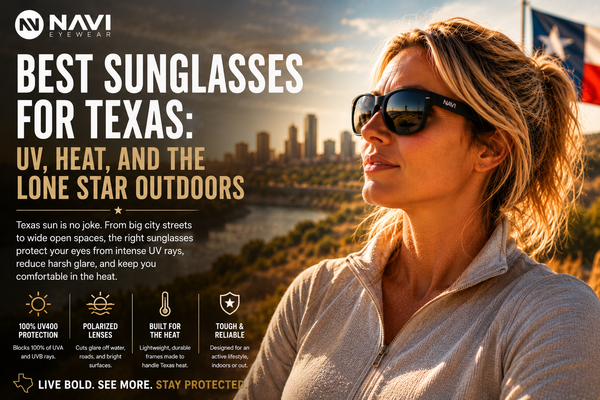
Texas is the second-largest state in the continental US, spanning from the Gulf Coast at 26 degrees north latitude to the Texas Panhandle at 36 degrees north — a 10-degree latitude range that encompasses meaningfully different UV environments. South Texas approaches Florida Keys UV intensity; West Texas and the Trans-Pecos region has some of the highest UV in the continental US due to the combination of low latitude and high altitude; the Gulf Coast concentrates water reflection UV; and the Hill Country, plains, and East Texas Piney Woods each have their own outdoor activity profiles. What unites all of Texas: intense summer UV, a driving and outdoor culture that keeps Texans outside year-round, and warm winters that prevent the UV reprieve northern states experience. This guide covers Texas's UV environments and the right lens setup for each.

1. Texas UV by Region
South Texas and the Rio Grande Valley: Near-Tropical UV
McAllen, Laredo, Brownsville, and the Rio Grande Valley sit at 26–28 degrees north — the same latitude range as South Florida. UV index here averages 10–13 in summer and 6–8 in winter, with the dry air of South Texas reducing atmospheric UV scattering compared to humid South Florida — potentially delivering slightly higher effective UV at the surface than equivalent Florida latitudes. The winter UV of South Texas is among the highest of any continental US location in December and January, making year-round UV protection non-negotiable for outdoor-active residents and agricultural workers in this region.
West Texas and the Trans-Pecos: Altitude Plus Low Latitude
Big Bend National Park, Alpine, Marfa, El Paso, and the Trans-Pecos region combine low latitude (29–32 degrees north) with significant elevation (El Paso: 3,762 feet; Marfa: 4,688 feet; Big Bend's Chisos Mountains: up to 7,825 feet). The altitude UV amplification (10–12% per 1,000 feet) stacks on top of an already high baseline UV to produce some of the most intense sustained UV in the continental US. Big Bend hikers in summer face UV index 13–15 at altitude — among the highest UV environments accessible by road in the US. Desert terrain with minimal vegetation also means high UV reflectance from bare rock and soil. This is genuinely extreme UV territory.
Houston and the Gulf Coast
Houston, Galveston, Corpus Christi, and the Texas Gulf Coast sit at 27–29 degrees north with the UV amplification of Gulf water reflection. Galveston Island and the Gulf coast beaches combine near-tropical UV with Gulf reflection — a high-UV outdoor environment for the state's largest metropolitan population. Houston's flat terrain, extensive highway network, and car-dependent culture mean daily commuting UV through side windows is a consistent and often overlooked UV accumulation source for Houston residents. The Gulf Coast's fishing and boating culture adds water sport UV on top of commuting and everyday outdoor exposure.
Dallas-Fort Worth and North Texas
Dallas, Fort Worth, and the Metroplex sit at 32–33 degrees north — meaningfully lower latitude than Chicago or New York, with correspondingly higher UV. Summer UV index in Dallas averages 10–12; winter UV index averages 3–5. North Texas's flat, open terrain provides no natural shade or terrain UV moderation during the extended summer. The outdoor culture of North Texas — golf, cycling, outdoor dining, Lake Texoma boating — occurs against a high summer UV backdrop that demands consistent Cat 2–3 protection during peak hours.
Austin and the Hill Country
Austin sits at 30 degrees north with UV index averaging 9–11 in summer and 4–6 in winter. The Hill Country — Fredericksburg, Wimberley, New Braunfels, the Guadalupe River — is Austin's outdoor recreation backyard, combining limestone canyon scenery with tubing, hiking, cycling, and outdoor dining. The Guadalupe and Comal rivers, with their crystal-clear spring-fed water, produce excellent polarized-lens sub-surface visibility and meaningful water reflection UV for tubers and swimmers. Austin's cycling culture (Barton Springs Road, the Veloway, Hill Country road rides) and outdoor running scene accumulate significant UV at exercise pace under the city's year-round warm conditions.
San Antonio and South-Central Texas
San Antonio at 29 degrees north has UV approaching South Texas intensity — UV index 10–12 in summer, 5–7 in winter. The River Walk and outdoor culture of San Antonio is active year-round. The Hill Country proximity means San Antonians access the same outdoor recreation UV environment as Austin residents. Military installations around San Antonio mean a significant outdoor worker and active-duty population with occupational outdoor UV exposure.
2. Texas-Specific UV Contexts
Texas Driving: The Highway State
Texas has more lane miles of highway than any other state. Texans drive more miles annually than residents of almost any other state. The south and west Texas sun at highway driving angles — particularly westbound afternoon driving on I-10, I-20, and Highway 90 — produces the most sustained direct-sun driving UV of any state. Gray Cat 2 polarized UV400 in the center console is the Texas driver's non-negotiable baseline. The side window UV-A issue is particularly relevant for long-haul Texas drives where a single I-10 trip from San Antonio to El Paso is 552 miles — nearly 8 hours of continuous side window UV exposure. Browse gray polarized UV400 options at navieyewear.com.
Texas Fishing: Bass, Saltwater, and Everything Between
Texas fishing spans freshwater bass fishing on Highland Lakes, Texoma, and hundreds of reservoirs; bay fishing in Corpus Christi Bay, Galveston Bay, and Matagorda Bay; Gulf offshore fishing; and the legendary shallow-water flats fishing for redfish and trout in the Laguna Madre. For saltwater bay and Gulf fishing: copper Cat 3 polarized UV400 with anti-saltwater coating — maximum sub-surface visibility in Texas's coastal waters. For freshwater reservoir bass fishing: amber Cat 2–3 polarized UV400 — contrast enhancement for reading water structure and casting accuracy in the green-tinted water of Texas reservoirs.
Texas Hill Country Outdoor Recreation
The Hill Country's tubing, hiking, cycling, and outdoor recreation involves sustained UV in a beautiful but UV-intense environment. The Guadalupe and Frio rivers' clear spring-fed water shows the sub-surface visibility benefit of copper polarized lenses dramatically — tubers with copper polarized glasses see the riverbed clearly while others see only glare. Amber Cat 2–3 polarized UV400 for Hill Country hiking and cycling; copper Cat 2 for river tubing and swimming.
Big Bend and West Texas Hiking
Big Bend National Park, Guadalupe Mountains National Park, Palo Duro Canyon, and the Trans-Pecos region offer some of Texas's most dramatic landscapes and most intense UV. Big Bend summer hiking involves UV index 12–15 at altitude with bare rock reflection and minimal shade in the Chisos Basin and Rio Grande canyons. Amber Cat 3 polarized UV400 for Big Bend and West Texas hiking — amber for terrain contrast on Texas's varied desert rock landscapes, Cat 3 for the extreme UV that altitude and latitude combine to produce. The desert environment's mixed UV reflection (rock, sand, caliche, gypsum in Guadalupe Mountains) adds to the direct UV from the intense Texas sun.
Texas Golf
Texas has more golf courses than any other state, and the golf season is genuinely year-round in South and Central Texas. A round of Texas golf in July involves 4–5 hours of sustained UV index 10–12 exposure with minimal shade between tee boxes and greens. Gray Cat 2 polarized UV400 for Texas golf — color accuracy for green reading, polarization for the water hazard and wet fairway glare that Texas's irrigated courses produce, Cat 2 for the variable light of a morning tee time that spans the UV ramp from 7am to 12pm.
3. Texas Lens Recommendations by Context
| Texas Context | Recommended Tint | Category | Key Requirement |
|---|---|---|---|
| Gulf coast beach and coastal | Copper polarized | Cat 3 | Anti-saltwater coating; Gulf reflection |
| Saltwater bay and Gulf fishing | Copper polarized | Cat 3 | Sub-surface fish visibility; anti-saltwater |
| Freshwater reservoir fishing | Amber polarized | Cat 2–3 | Freshwater contrast; structure reading |
| Big Bend and West Texas hiking | Amber polarized | Cat 3 | Altitude UV; desert terrain contrast |
| Hill Country outdoor recreation | Amber polarized | Cat 2 | Variable Hill Country light; river activities |
| Texas highway driving | Gray polarized | Cat 2 | Road glare; side window UV-A; color accuracy |
| Dallas/Houston/Austin urban everyday | Gray polarized | Cat 2 | Versatile daily UV; driving accuracy |
| Texas golf | Gray polarized | Cat 2 | Green reading color accuracy; water glare |
| South Texas and Rio Grande Valley | Gray or copper polarized | Cat 3 | Near-tropical year-round UV |
| Texas cycling and running | Amber polarized | Cat 2 | Road contrast; sport frame retention |
4. The Texas Multi-Pair Strategy
Texas's geographic and lifestyle diversity — Gulf coast fishing, West Texas hiking, Dallas urban commuting, Austin cycling, South Texas agriculture — means that a single pair of sunglasses is genuinely inadequate coverage for most Texas residents who engage multiple outdoor contexts. Three pairs cover the primary Texas UV contexts:
- Car pair: gray Cat 2 polarized UV400 — center console, covers Texas's extensive highway driving and daily commuting UV across all urban and rural road contexts
- Everyday bag pair: gray Cat 2 polarized UV400 — covers walking, lunch breaks, outdoor dining, errands, and the incidental outdoor UV of Texas urban life year-round
- Activity pair: copper Cat 3 for Gulf coast and water use, or amber Cat 3 for West Texas hiking and sport — the high-UV specialist pair for the outdoor activity that Texas life regularly includes
Navi Eyewear's Buy 1, Get 2 Free — $85 for three pairs — covers all three placements at the complete UV400 polycarbonate polarized specification for approximately $28 per pair.
Frequently Asked Questions
What is the UV index in Texas year-round?
South Texas (McAllen, Brownsville): UV index 6–8 in winter, 10–13 in summer. Houston and Gulf coast: 4–6 in winter, 10–12 in summer. Dallas-Fort Worth: 3–5 in winter, 10–12 in summer. Austin/San Antonio: 4–6 in winter, 10–12 in summer. West Texas at altitude (Big Bend area): UV index 5–8 in winter, 12–15 in summer with altitude amplification. No Texas city has a truly low-UV winter season by continental standards.
Do I need sunglasses year-round in Texas?
Yes — Texas winters are mild enough that outdoor activity continues year-round across the state, and winter UV in Texas (particularly South and Central Texas) is sufficient for daily accumulation. The South Texas winter at UV index 6–7 is comparable to a Los Angeles summer afternoon — year-round car pair and bag pair placement is appropriate for any Texas resident who spends regular time outdoors.
What are the best sunglasses for Texas fishing?
Copper Cat 3 polarized UV400 with anti-saltwater coating for saltwater bay and Gulf fishing — the gold standard for Texas redfish and trout flats fishing where sub-surface visibility is the decisive advantage. Amber Cat 2–3 polarized UV400 for freshwater bass fishing on Texas reservoirs where the darker, tannic water benefits from amber's contrast enhancement over copper's blue-absorption profile.
What sunglasses are best for Big Bend?
Amber Cat 3 polarized UV400 polycarbonate for Big Bend hiking — amber for the desert rock and canyon terrain contrast that makes trail features more distinct, Cat 3 for the extreme UV of Big Bend's altitude and latitude combination, polycarbonate for impact resistance on the rocky terrain. Wide-brimmed hat plus amber Cat 3 polarized UV400 is the recommended eye and face UV protection setup for sustained Big Bend hiking in summer.
Are polarized sunglasses worth it in Texas?
For Gulf coast fishing, beach, and boating: essential — the polarization benefit for water surface glare elimination and sub-surface visibility is the most impactful optical improvement for Texas water activities. For highway driving: highly valuable — Texas road surface glare on the long flat highway drives is among the most sustained road glare in the US, and polarization eliminates it completely. For everyday urban use: yes — the glass building facades of Houston, Dallas, and Austin produce significant urban reflected glare that polarization addresses.
The Bottom Line
Texas is a year-round UV state with significant geographic UV variation — from near-tropical South Texas to altitude-amplified West Texas to Gulf coast water reflection to North Texas's flat open summer UV. Gray Cat 2 polarized UV400 for the car and everyday bag covers Texas's driving and urban daily UV; copper Cat 3 for Gulf coast and saltwater fishing; amber Cat 3 for West Texas and Big Bend hiking; amber Cat 2 for Hill Country, cycling, and freshwater recreation. Three pairs, three placements, year-round availability. navieyewear.com/collections/polarized — Buy 1, Get 2 Free for $85.
Related Reading
- Best Sunglasses for California | Navi Eyewear
- Best Sunglasses for Florida | Navi Eyewear
- Best Sunglasses for Arizona and the Desert Southwest | Navi Eyewear
- The Complete Fishing Sunglasses Guide | Navi Eyewear
- Sunglasses for Desert and Arid Environments | Navi Eyewear
- The Complete Water Sports Sunglasses Guide | Navi Eyewear
- Best Sunglasses for Driving | Navi Eyewear
- Shop Polarized UV400 Sunglasses | Navi Eyewear
Sources & Citations
[1] WHO. "Global solar UV index: a practical guide." World Health Organization, 2002. View source →
[2] Sliney DH. "Ocular exposure to environmental light and ultraviolet." Journal of AAPOS, 2014. View source →
[3] Diffey BL. "Sources and measurement of ultraviolet radiation." Methods, 2002. View source →
[4] Taylor HR, et al. "Effect of ultraviolet radiation on cataract formation." New England Journal of Medicine, 1988. View source →
[5] Dain SJ. "Sunglasses and sunglass standards." Clinical and Experimental Optometry, 2003. View source →
[6] Rosenthal FS, et al. "The effect of sunglasses on ocular exposure to ultraviolet radiation." American Journal of Public Health, 1988. View source →