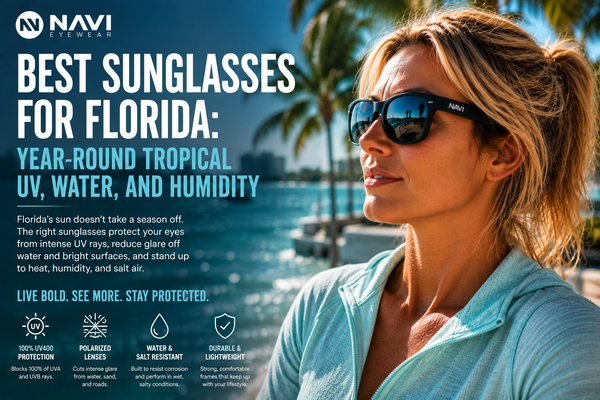

Best Sunglasses for Florida: Year-Round Tropical UV, Water, and Humidity
Florida sits between 24 and 31 degrees north latitude — closer to the tropics than any other continental US state. Miami, at 25.8 degrees north, receives UV comparable to Caribbean destinations. Even in December, Florida's UV index regularly hits 5–7 statewide — enough for meaningful daily UV accumulation for residents who spend any time outdoors. Add the state's water culture (Atlantic coast, Gulf coast, thousands of inland lakes and waterways), its flat terrain that provides no shade or terrain UV moderation, and its outdoor-dominant lifestyle, and Florida is one of the most demanding UV states in the country for eye protection. This guide covers Florida's UV profile, the specific lens and frame spec for each Florida environment, and the year-round multi-pair strategy that Florida's outdoor lifestyle requires.

1. Florida's UV Profile
Latitude and Baseline UV
Florida's low latitude is the primary driver of its UV intensity. UV index correlates with latitude — closer to the equator means less atmosphere for UV to pass through at high sun angles, producing higher UV at the surface. Miami's peak summer UV index regularly reaches 11–13; Tampa and Orlando average 10–12 at peak summer; even Pensacola in the Panhandle, Florida's northernmost major city, averages 9–11 in summer. In winter, Miami averages UV index 6–8 — higher than Los Angeles in winter and dramatically higher than most northern US cities in winter.
The Water Amplification Factor
Florida is surrounded by water on three sides and has more lakes than any other US state except Alaska. The Atlantic coast, Gulf coast, Florida Keys, Lake Okeechobee, and thousands of smaller lakes and waterways all reflect UV — adding a reflected UV component to the already high baseline. Miami Beach, Fort Lauderdale, Tampa Bay, and the Gulf beaches of Naples and Sarasota all face ocean and gulf UV reflection that amplifies effective UV above the already elevated UV index. The Florida Keys, at 24 degrees north latitude in clear tropical water, represent the highest sustained UV environment in the continental US.
Year-Round Outdoor Culture
Florida's outdoor culture is genuinely year-round — the 70-degree winter that makes snowbirds move south also means Florida residents are outdoors in winter when northern states are predominantly indoor. Golf, fishing, boating, beach walking, outdoor dining, and Florida's extensive park system are all active in December through February. This year-round outdoor pattern means Florida residents accumulate meaningful UV in every month of the year — there is no winter UV reprieve equivalent to what northern state residents experience.
Humidity and Lens Coating Requirements
Florida's humidity — 70–90% relative humidity for much of the year — creates specific lens coating demands. High humidity accelerates certain coating degradation mechanisms, and the combination of humidity, salt air (on the coasts), and sunscreen creates the most demanding lens surface environment of any US state. Anti-saltwater coating, oleophobic coating, and hydrophobic coating are not optional upgrades for Florida use — they are practical necessities for lenses that will maintain optical clarity through a Florida summer.
2. Florida Environments and UV Context
South Florida and Miami: Tropical UV Year-Round
Miami-Dade, Broward, and Palm Beach counties sit at 25–26 degrees north — essentially Caribbean latitude. UV index 11–13 in summer, 6–8 in winter. The combination of tropical latitude, Atlantic ocean reflection from the east, and Biscayne Bay and inland waterways to the west creates a multi-directional UV environment that the area's outdoor dining, beach, and water culture exposes residents to year-round. Copper Cat 3 polarized UV400 for South Florida beach and water use; gray Cat 2 polarized for driving and everyday urban use in Miami's dense automotive culture.
Tampa Bay and Gulf Coast: Water Activity Hub
Tampa, St. Petersburg, Sarasota, Naples, and Fort Myers face the Gulf of Mexico — typically calmer and shallower than the Atlantic, with high reflectance from the Gulf's lighter-colored sandy bottom visible through clear shallow water. Gulf coast UV combines the tropical latitude baseline with Gulf water reflection and the highly reflective white sand beaches of the Emerald Coast. Copper Cat 3 polarized for Gulf beach and water activities; the Gulf's calm conditions make it a prime fishing, kayaking, and boating environment where copper polarization's sub-surface water visibility benefit is fully realized.
The Florida Keys: The Continental US's Highest UV
The Florida Keys extend from Key Largo to Key West at 24–25 degrees north — the southernmost US latitude in the continental 48 states and the highest sustained UV environment in the continental US. Key West's UV index averages 7–9 in winter and 12–14 in summer. The clear tropical water of the Keys reflects UV with exceptional efficiency from the white sandy bottom visible in shallow waters. For Keys visitors and residents, copper Cat 3 polarized UV400 with anti-saltwater coating is the minimum specification — in this environment, it is an eye health imperative rather than a performance preference. Browse copper polarized UV400 options at navieyewear.com.
Orlando and Central Florida: Theme Park and Outdoor Heat UV
Orlando and Central Florida sit at 28 degrees north — high UV year-round, amplified by the theme park culture that has millions of visitors spending full outdoor days at Disney, Universal, and SeaWorld during peak summer hours. The irony: theme park visitors who plan carefully for sunscreen often overlook UV eye protection. A full day at a Florida theme park in July involves 8–10 hours of sustained peak UV exposure (UV index 10–12) with minimal shade between attractions. Gray Cat 2 polarized UV400 for theme park and urban Orlando use; copper or amber Cat 3 for the outdoor recreation and water parks that round out the Central Florida experience.
Northeast Florida and Jacksonville: Atlantic Coast
Jacksonville, St. Augustine, and the First Coast sit at 30 degrees north — lower UV than South Florida but still above the US national average. Atlantic coast beaches, the St. Johns River, and the outdoor culture of Northeast Florida create year-round UV exposure that demands consistent protection. Gray or amber Cat 2 polarized UV400 for everyday Northeast Florida use; copper Cat 3 for beach and Atlantic coast water activities.
The Florida Panhandle: Emerald Coast and Gulf Beaches
Pensacola, Destin, Panama City Beach, and the Emerald Coast are famous for their brilliant white quartz sand and turquoise-green Gulf water — a combination that produces some of the most visually spectacular and UV-intense beach environments in the US. The white quartz sand of Panhandle beaches reflects significantly more UV than typical sand beaches — quartz sand reflection approaches 25–30% UV reflectance. Copper Cat 3 polarized for Panhandle beach use; the Gulf's emerald-green rather than blue reflection character makes copper's slightly warmer spectrum appropriate for the specific reflection tones of this environment.
3. Florida Activity-Specific Recommendations
Fishing: Florida's Premier Water Activity
Florida is one of the world's premier fishing destinations — saltwater fishing in the Keys, backcountry flats fishing in Everglades National Park, offshore fishing in the Gulf, and freshwater bass fishing throughout Central and North Florida. For fishing, copper Cat 3 polarized UV400 is the definitive specification: maximum sub-surface water visibility through copper's blue absorption and polarization combination, Cat 3 for the sustained midday UV of a full fishing day, and anti-saltwater coating for the saltwater environments that cover most of Florida's fishing. See the complete fishing sunglasses guide.
Boating and Sailing
Florida has more registered boats per capita than any other US state. Open water boating — from bass boats on Central Florida lakes to offshore sportfishing in the Gulf Stream — exposes operators and passengers to sustained UV from above and water reflection from below. Copper Cat 3 polarized UV400 for saltwater boating; amber or copper Cat 2–3 polarized for freshwater lake boating depending on water color (darker freshwater: amber; clear turquoise freshwater: copper).
Golf
Florida has more golf courses per capita than any other US state, and the golf season is genuinely year-round. A round of golf involves 4–5 hours of sustained outdoor UV exposure with minimal shade between the tee boxes and greens. Gray Cat 2 polarized UV400 for golf — color-neutral for accurate green reading and flag discrimination (color accuracy matters for reading subtle slope and color variations on greens), polarized for the water hazard and wet fairway glare that Florida's irrigation-heavy courses produce.
Outdoor Running and Cycling
Florida's flat terrain makes it ideal for running and cycling year-round — and the outdoor exercise culture is year-round precisely because winters are mild. Morning runs and rides in South Florida occur at UV index 3–6 even in winter months. Amber Cat 2 polarized UV400 in a sport frame for Florida running and cycling — amber for road surface contrast in the flat, shadow-light conditions of Florida's early morning and late afternoon exercise windows.
4. Florida Lens Recommendations by Location and Activity
| Florida Context | Recommended Tint | Category | Key Requirement |
|---|---|---|---|
| South Florida beach (Miami, Fort Lauderdale) | Copper polarized | Cat 3 | Anti-saltwater coating; year-round Cat 3 |
| Florida Keys | Copper polarized | Cat 3 | Highest UV in continental US; premium coating |
| Gulf coast beach (Naples, Sarasota, Destin) | Copper polarized | Cat 3 | White sand + Gulf reflection |
| Saltwater fishing | Copper polarized | Cat 3 | Sub-surface fish visibility; anti-saltwater |
| Freshwater fishing (bass, inland lakes) | Amber polarized | Cat 2–3 | Freshwater color; sub-surface visibility |
| Boating — saltwater offshore | Copper polarized | Cat 3 | Open water UV; retention strap |
| Golf | Gray polarized | Cat 2 | Color accuracy for green reading |
| Miami/Orlando driving and urban | Gray polarized | Cat 2 | Road glare; color accuracy |
| Theme parks (Orlando) | Gray or amber polarized | Cat 2 | Sustained full-day outdoor UV |
| Running and cycling | Amber polarized | Cat 2 | Flat terrain contrast; sport frame |
5. Florida's Humidity: Coating Durability Matters
What Florida's Humidity Does to Substandard Lenses
Florida's combination of heat, humidity, salt air, and sunscreen creates the most demanding lens surface environment in the US. Lenses without proper coating suites show accelerated degradation in Florida conditions:
- Hydrophobic coating failure produces persistent water film on lenses in Florida's rain and spray environment — rain is frequent in the summer afternoon thunderstorm season, and without hydrophobic coating every rain shower requires lens wiping that increases scratch risk
- Anti-saltwater coating absence produces lens clouding and coating delamination within one to two seasons of regular coastal use
- Oleophobic coating failure allows sunscreen adhesion that smears into permanent optical distortion under Florida's sunscreen-mandatory conditions
Navi Eyewear's complete coating suite (anti-saltwater, hydrophobic, oleophobic, hard coat) addresses all four Florida-specific coating degradation mechanisms — essential for lenses that maintain optical quality through a Florida summer and saltwater season.
Frequently Asked Questions
What UV index is Florida year-round?
South Florida (Miami): UV index 6–8 in winter, 11–13 in summer. Central Florida (Orlando, Tampa): UV index 4–6 in winter, 10–12 in summer. North Florida (Jacksonville, Pensacola): UV index 3–5 in winter, 9–11 in summer. The Florida Keys are the highest — UV index 7–9 in winter, 12–14 in summer. There is no truly low-UV season in Florida for residents who spend regular time outdoors.
What are the best sunglasses for South Florida?
Copper Cat 3 polarized UV400 polycarbonate with anti-saltwater, hydrophobic, and oleophobic coatings for beach and water use. Gray Cat 2 polarized UV400 for driving and everyday Miami urban use. The two-pair South Florida minimum: gray in the car, copper in the beach bag — covering the two primary UV contexts of South Florida daily life.
Do I need sunglasses in Florida in winter?
Yes — Florida winter UV (December through February) is 6–8 in South Florida and 3–5 in North Florida. These are not trivial UV levels for residents who golf, fish, boat, walk, or exercise outdoors daily during Florida's mild winter. The resident who moves to Florida from Ohio for the winter and immediately stops wearing sunglasses because "it's winter" has misunderstood Florida's UV profile — Florida's "winter" is UV-equivalent to a mid-summer day in many northern states.
What sunglasses are best for Florida fishing?
Copper Cat 3 polarized UV400 polycarbonate with anti-saltwater coating for saltwater fishing; amber Cat 2–3 polarized UV400 for freshwater fishing. Copper polarization is the gold standard for sub-surface fish visibility in Florida's clear coastal and flats waters — the combination of copper's blue absorption and polarization removes the surface reflection that hides fish in Florida's shallow saltwater environments.
Are polarized sunglasses necessary in Florida?
For any outdoor activity involving water — absolutely. Florida's water culture (beach, fishing, boating, kayaking) and its extensive water reflection make polarization more functionally important than in any landlocked state. For driving and everyday urban use, polarization eliminates the significant road surface and building glass glare of Florida's flat, exposed urban environments. Non-polarized UV400 provides health protection; polarized UV400 provides health protection plus meaningfully better visual performance across Florida's reflective outdoor environments.
The Bottom Line
Florida is a year-round UV state with the highest baseline UV in the continental US, amplified by water reflection from three coasts and thousands of inland waterways, with no altitude, terrain, or seasonal reprieve from UV accumulation. Copper Cat 3 polarized UV400 for beach, water, and fishing use; gray Cat 2 polarized for driving and everyday urban life; amber Cat 2–3 for sport and inland freshwater use. Anti-saltwater, hydrophobic, and oleophobic coatings are functional requirements for lenses that maintain performance through Florida's demanding humidity and saltwater environment. navieyewear.com/collections/polarized — Buy 1, Get 2 Free for $85.
Related Reading
- Best Sunglasses for California | Navi Eyewear
- Best Sunglasses for Hawaii | Navi Eyewear
- The Complete Fishing Sunglasses Guide | Navi Eyewear
- The Complete Water Sports Sunglasses Guide | Navi Eyewear
- Sunglasses for Sailing and Offshore Racing | Navi Eyewear
- Sunglasses for Cruise and Open Water | Navi Eyewear
- Summer UV: Peak Season Eye Protection | Navi Eyewear
- Shop Polarized UV400 Sunglasses | Navi Eyewear
Sources & Citations
[1] WHO. "Global solar UV index: a practical guide." World Health Organization, 2002. View source →
[2] Sliney DH. "Ocular exposure to environmental light and ultraviolet." Journal of AAPOS, 2014. View source →
[3] Taylor HR, et al. "Effect of ultraviolet radiation on cataract formation." New England Journal of Medicine, 1988. View source →
[4] Dain SJ. "Sunglasses and sunglass standards." Clinical and Experimental Optometry, 2003. View source →
[5] Diffey BL. "Sources and measurement of ultraviolet radiation." Methods, 2002. View source →
[6] Rosenthal FS, et al. "The effect of sunglasses on ocular exposure to ultraviolet radiation." American Journal of Public Health, 1988. View source →